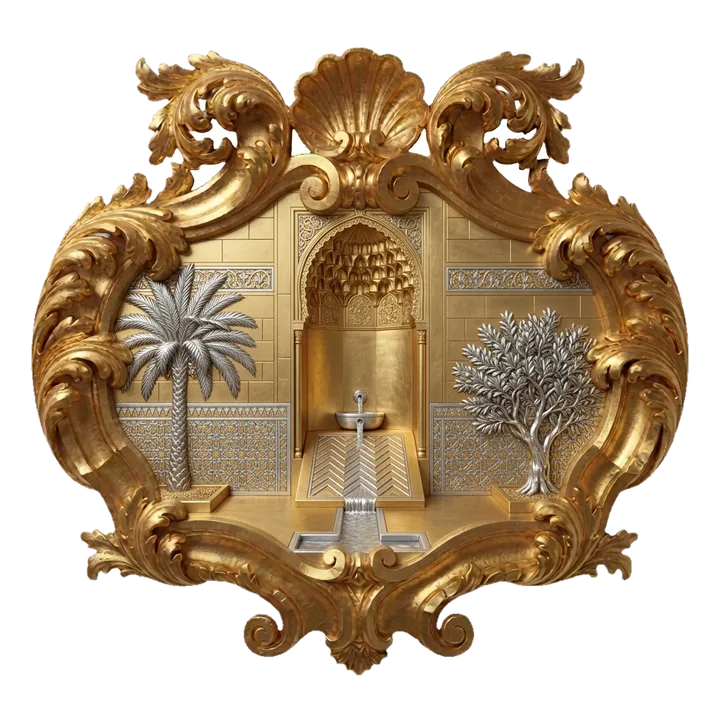
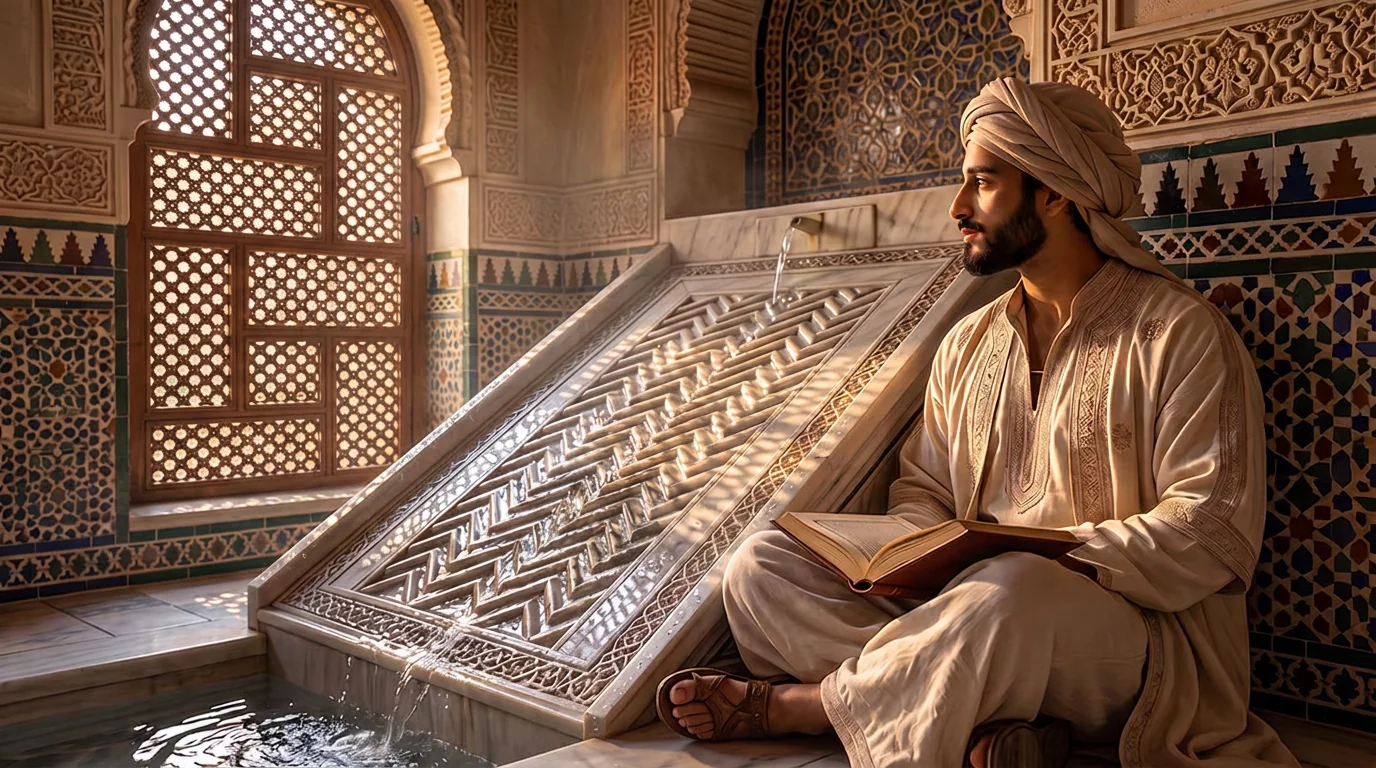
The hall of the fountain: water runs down the chevron slab of the salsabil, and a young man reads beside it
The crest of Al-Mithaq: the fountain hall of the Zisa between a palm and an olive tree

الميثاق

Al-Mithaq

The common charter of two craft houses

The Riad Al-Uns in Fez and Al-Funduq as-Siqilli, in the province of Ragusa, are two residential houses of the crafts founded on the same rules, the niẓām ad-dār, which members sign on entering and which govern the work, the common life, the apprenticeship and the internal arbitration. They use the same series of signs, and whoever has lived in one recognises the other. What changes is the scale: a courtyard house within the medina, a masseria of twenty-three hectares within a landscape.

The crest of the Riad Al-Uns

The house in Fez

Riad Al-Uns

رياض الأنس

What it is
A courtyard house in the medina, with resident masters in calligraphy, zellij, plaster, weaving and wood, and their apprentices under a single set of rules.
Where
Fez, in the medina, where the crafts of the hand have never been interrupted.
Progress
The rules are written and the legal texts are in draft. The building in the medina has not yet been found: the search is under way with architects in Fez.
The crest of Al-Funduq as-Siqilli

The house in Sicily

Al-Funduq as-Siqilli

الفندق الصقلي

What it is
A masseria of twenty-three hectares, restored as a house of the crafts: twelve apprentices, two masters, one workshop of fine saddlery in leather, wood and metal.
Where
The province of Ragusa, on the Iblei plateau. The masters come from Fez; the apprentices from the North African population of the province and from Europe.
Progress
Phase 0 under way: an option on the building and the restoration costed. The association Il Fondaco Siciliano has been constituted.

The house beside the house

Al-Munya

المُنية

Al-Munya is the guesthouse: beside each house, in a separate body, with its own entrance. Inside, two declensions. Dar al-Bidaya (“house of the beginning”) keeps the unpaid hospitality of the Riad; Dar al-Diyafa (دار الضيوف, “house of the guests”) keeps the paying hospitality of the Nudama. The company of the Munya pays the Riad an annual fee, regardless of profits. An-Nudama is the majlis of the ninety-nine founders, with its own treasury funding the Riad; it has no voice in the deliberations. This structure is the same in Fez (Riad Al-Uns) and in Sicily (Al-Funduq as-Siqilli).

AL-MUNYA guesthouse Dar al-Bidaya hospitality of the Riad Dar al-Diyafa hospitality of the Nudama

Two houses, one rule

Where they answer to one another

The space

At the Riad the patio: lime walls, no window on the street, the basins with water in movement and the masonry mass that holds the cool. At the Funduq the courtyard of the masseria in pale stone, the entrance passage and the twenty-three hectares of olive, almond and arable land. The same rule of water and mass, at two different scales.

The work

At the Riad the crafts of the hand of Fez, with masters who work in the house where they live. At the Funduq a single workshop at the opening, fine saddlery, whose work leaves on commission; calligraphy and the book come second. In both, the disciplines of the body with qualified instructors, without weapons and without grades, and the same undyed linen for everyone, masters included.

The order

The same rules, with the council, the majlis al-umanāʾ, and the arbitral panel, the hayʾat at-taḥkīm. At the Funduq they hold four bodies apart, the House, the farming, the guesthouse and the supporters, so that none may dispose of the others and the walls remain bound to their purpose.