An-Nudama
The house is Al-Munya. The company of the founders is An-Nudama. The two names do not merge: one is the built body, the other the closed company of the founders.
The ninety-nine founders
An-nudamāʾ (الندماء) are the companions of the table; in the singular, nadīm. In this project, An-Nudama names the ninety-nine founders: a distinct body, with a treasury of its own, which funds the house of formation. It is not a house, and it has no voice in the deliberations.
The name has a Sicilian history too. At the court of the Kalbid emirs, and then at that of Roger II, the nadīm was the prince’s companion of the table, versed in poetry, in music, sometimes in medicine, and above all in conversation; and the evening majlis was the place where that friendship kept the verses. Ibn Ḥamdīs of Syracuse is its best-known voice.
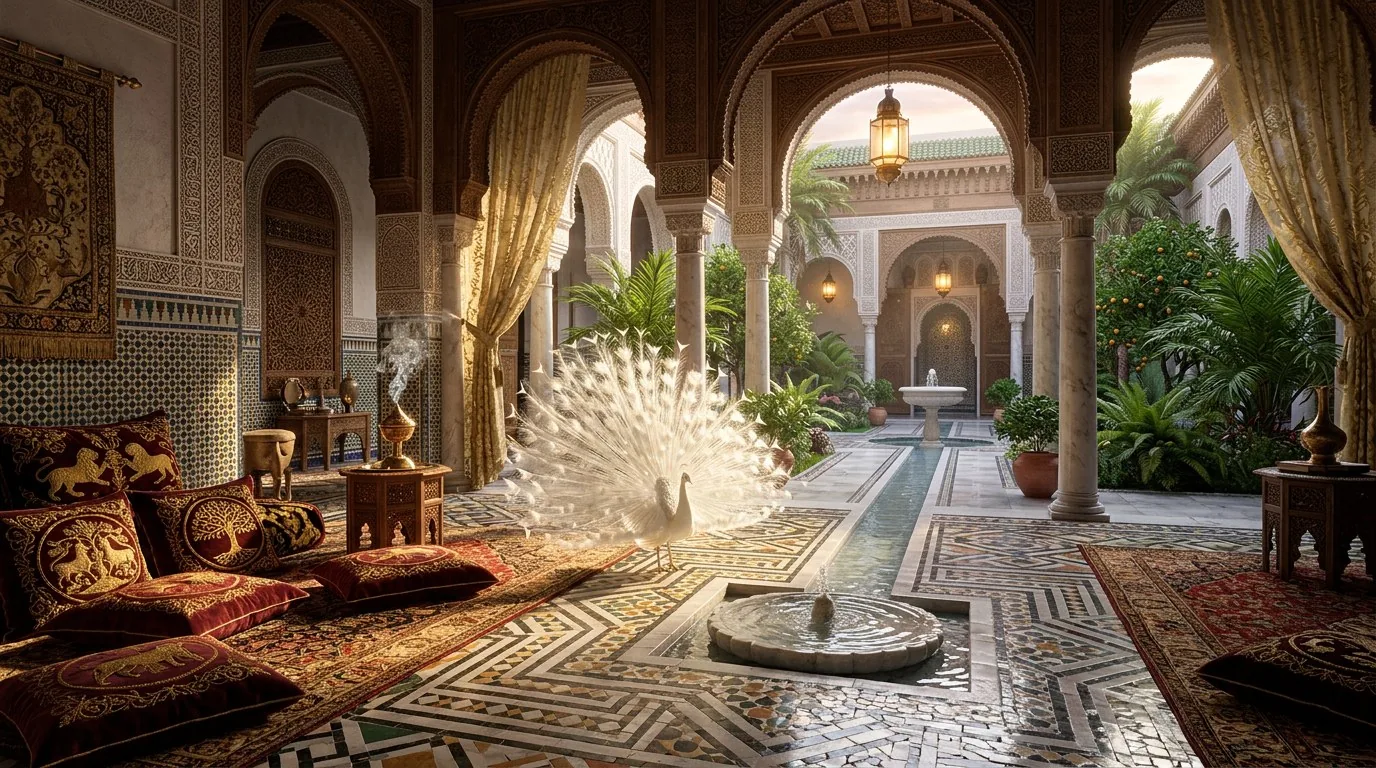
The salon of the Munya.
The crest
The association carries its own, the only night scene in a series otherwise made of gates, courtyards and gardens: a room in the evening, a lit brazier under the arch, silver stars on the vault and in the window grilles, a dado of zellij.
What it does, and what it does not
It carries the beginning
It gathers those who support the house at the moment when an entry share matters more than a regular subscription.
Where its members lodge
When they come, they are received in Al-Munya, at Dar al-Diyafa, the house of hospitality, and they pay the charge like the other guests.
It does not govern the Riad
The rules of the house of formation give its decisions to the majlis al-umanāʾ and its disputes to the hayʾat at-taḥkīm. An-Nudama sits on neither, and the separation is written into the statutes rather than left to custom.
Why the separation holds
A house that forms young men and depends on those who fund it ends by teaching what pleases those who fund it.
The distance between the two bodies is what allows the founders to be generous without becoming a power, and the house to receive without deforming.
What a founder obtains, in sum: a house that exists, a place at its table when he comes, and the right to say he was there at the beginning — with no vote on the common life.
The words of this page are in the common glossary; the works cited in the sources; the houses of the charter are Riyāḍ al-Uns and Al-Funduq aṣ-Ṣiqillī.