Al-Funduq as-Siqilli
The Fondaco Siciliano: a house of the crafts of art governed by its members, in the stone and the landscape of the province of Ragusa.
“We lodged in a funduq, in which we stayed nine days.”
Ibn Jubayr, Travels, Messina, December 1184 (translated from the Italian of M. Amari, Biblioteca arabo-sicula)
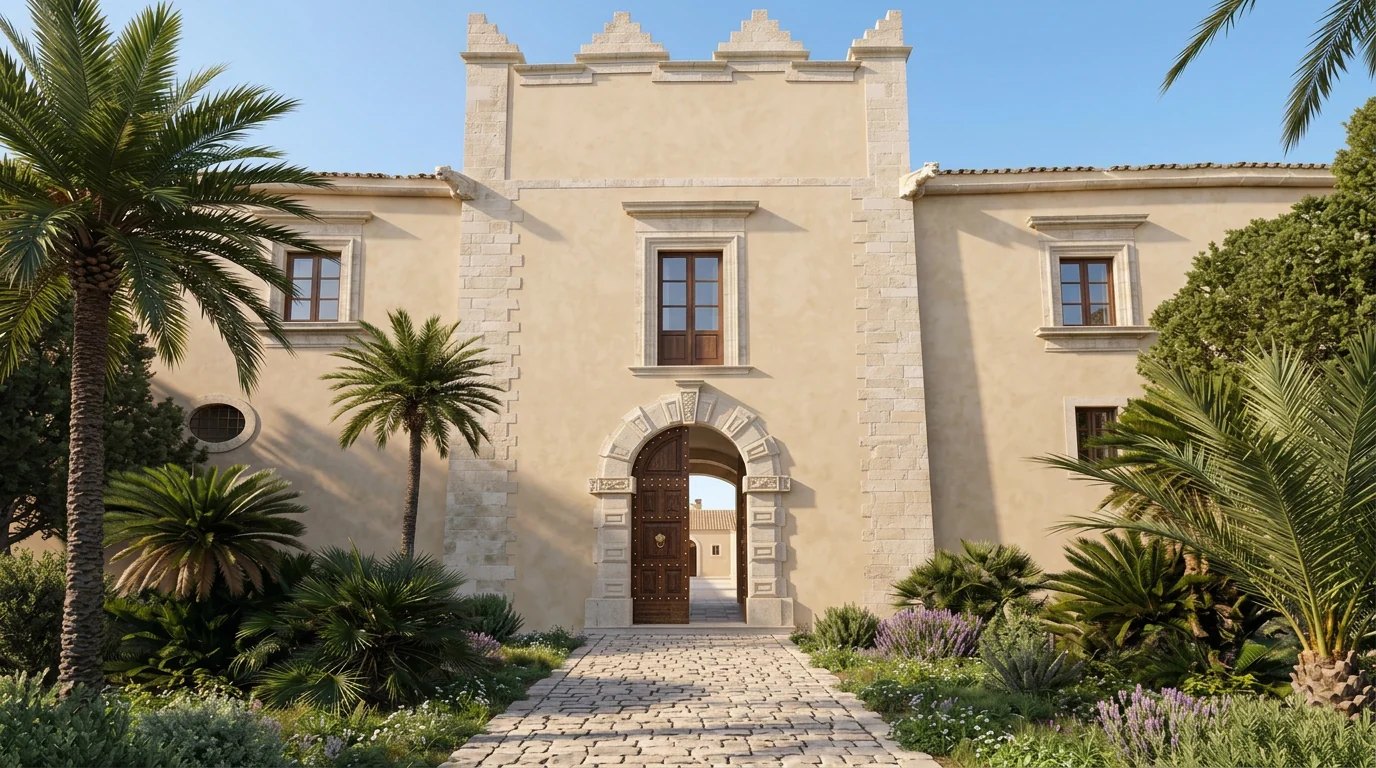
The masseria of the Iblei.
The threshold is secular. The rule is the same as in Fez for the craft, the table and the common life, and it stops there.
Here the craft is also learned by study: the house is a residential school, and the apprenticeship lives alongside the work to commission that arrives from outside.
The land: Ar-Rahl
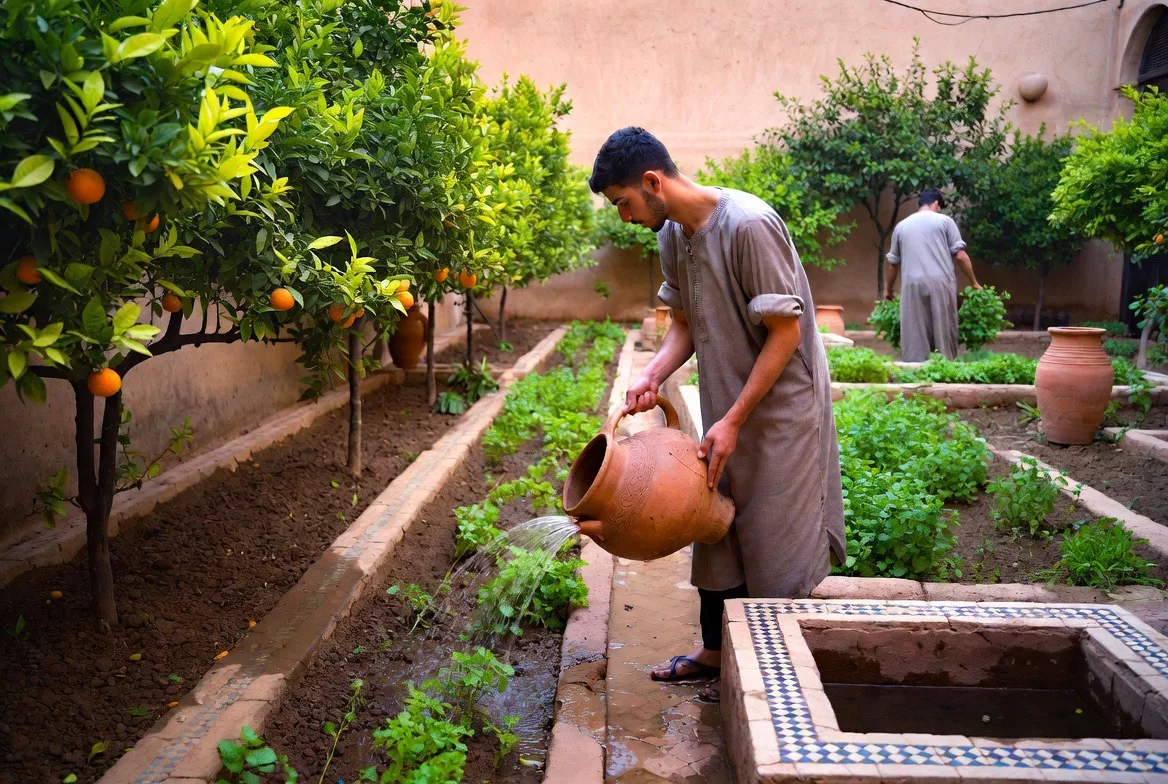
In the province of Ragusa the house inhabits a stone masseria. Around it lies Ar-Raḥl: twenty-three hectares, olives, carobs, and a garden with a vegetable plot and an orchard for the common table. Ibn Jubayr, sailing along the island, called it a daughter of Spain for its cultivated land and its abundance. The phrase measures a twelfth-century island, not this estate. Yet it names what Ar-Raḥl means to be: the land as part of the rule, not as a setting.
The workshops
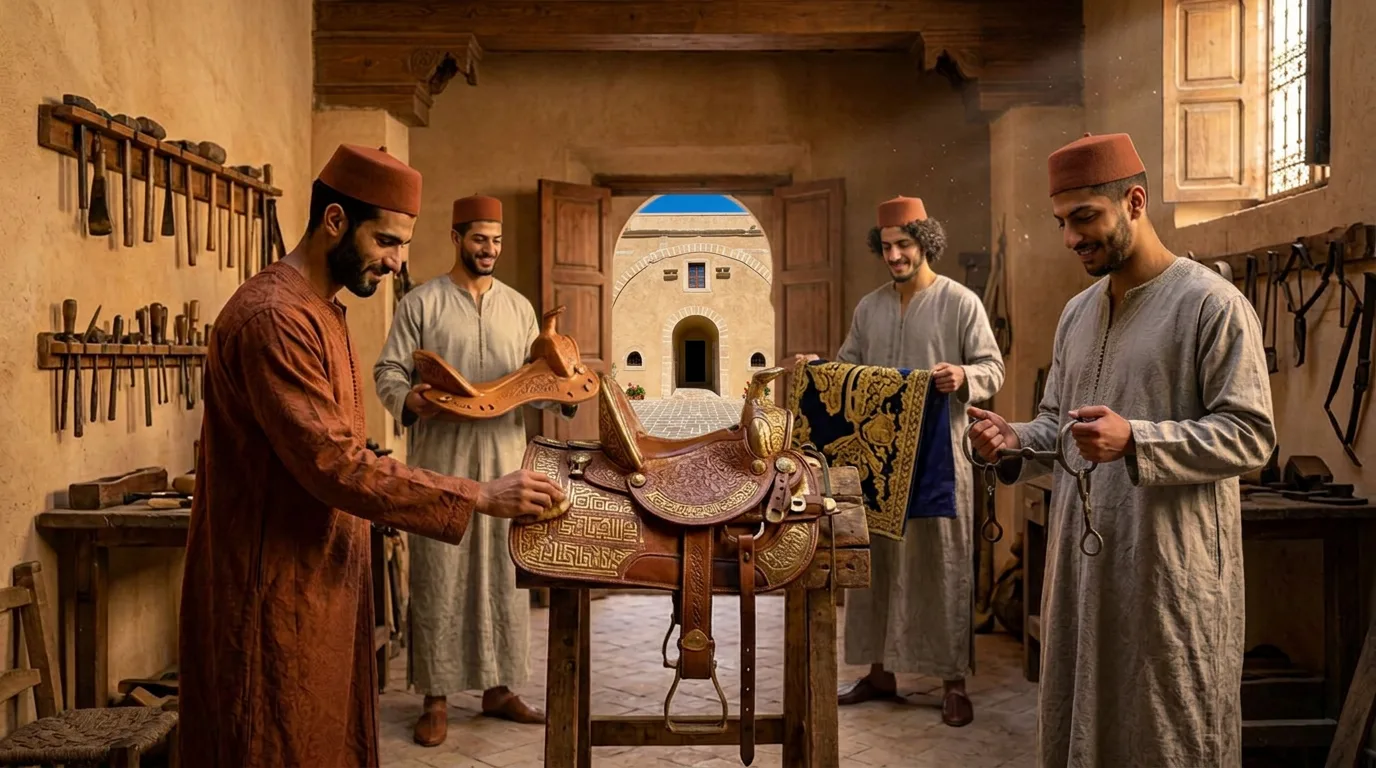
At the opening one workshop is at work: fine saddlery. In sixteenth-century Fez that craft filled a street: the saddletrees, the stirrups, three covers of cordovan. Here the same hands keep a single workshop, until the other signs have a master. Zellīj, plaster, textile, bookbinding and perfume come later. The light is that of the island; the order of work is that of the medina.
Al-Funduq as-Siqilli
الفندق الصقليFunduq comes from the Greek pandokeion, the inn that receives whoever arrives. The Venetian fontego comes from the Arabic, and Sicilian keeps funnacu for the inn with a stable. The word travelled because the thing travelled: in the medieval Mediterranean a fondaco was a house, in a foreign city, where a community lodged, kept its goods and settled its disputes by a rule of its own.
Aṣ-Ṣiqillī means “Sicilian”. The association is called Il Fondaco Siciliano. Ibn Jubayr, returning from Mecca, slept in a funduq at Messina and in a funduq at Palermo. On the same island the park of the Favara — the spring that wells up, the lake, the nine streams — was already, in the verses of ‘Abd al-Raḥmān of Trapani, a lodging of water and palms. The house at Ragusa takes up a principle: a community that accepts a discipline by contract, and among whose members that discipline holds as law.
مَا أَكَلَ أَحَدٌ طَعَامًا قَطُّ خَيْرًا مِنْ أَنْ يَأْكُلَ مِنْ عَمَلِ يَدِهِ
“No one has ever eaten better food than that which comes from the work of his own hand.”Al-Bukhārī, Ṣaḥīḥ, Kitāb al-buyūʿ, no. 2072
ἔργον δ᾽ οὐδὲν ὄνειδος, ἀεργίη δέ τ᾽ ὄνειδος“Work is no disgrace; the disgrace is idleness.”Hesiod, Works and Days, l. 311
Two shores of the same sea, and the same regard for the work of the hand.
A project, not yet a house
What these pages describe does not yet exist. The building has been identified and its owner is willing to sell, the legal texts are drafted, the masters have been identified but not yet engaged in writing. Nobody has yet lived under these rules, and nobody has yet tried to leave them.
The current phase serves to obtain contractual control of the property for eighteen months and to produce, within that term, the certified cost of the restoration, the legal entities duly constituted, the building application filed and the commitment of the first masters.
The conditions that would count as a negative verdict are fixed now, before anyone has an interest in the answer, and they are published.
The masseria, the dry-stone walls and the wells make a single built landscape, and they are preserved together or not at all.
“[Cultural heritage] includes all aspects of the environment resulting from the interaction between people and places through time”Faro Convention · art. 2, aCouncil of Europe Framework Convention on the Value of Cultural Heritage for Society, Faro, 27 October 2005 (CETS No. 199), art. 2, a. The English and French texts are authentic; ratified by Italy by Law No. 133 of 1 October 2020.
The separation written before anyone arrives
The House is governed by its members, the land is worked by those who live there, the guesthouse belongs to others and pays a fixed sum, the supporters have a company of their own. Each is a distinct legal entity, and the separation between them is written into the statutes.
The House
The association of the members: masters and apprentices admitted on application and by vote of the majlis, one vote each once they are members, hierarchy only in the work. It does not own the buildings outright.
The farm
Twenty-three hectares worked by a cooperative whose working members are the members of the House. It supplies the table and binds the apprentices to a season and a harvest.
Al-Munya
The body beside the House, with its own entrance and the same crest. Inside: Dār al-Aṣl, where the guests whom the House invites lodge without charge (the costs fall on the company); and Dār al-Diyāfa, the house of hospitality, where the nudamāʾ and the guests they introduce lodge, at their own expense. Al-Munya pays the House a fixed annual sum, never a percentage of its revenue; in Sicily it is Dār al-Diyāfa, carried by a distinct vehicle with its own investors, that pays it.
An-Nudama
The company of the founders: the ninety-nine, with a fund of their own that finances the House. It is not a house and has no lodging of its own: when its members stay, they are paying guests of Dār al-Diyāfa. It has no voice in the deliberations.
A place that is not imported
The masters come from Fez. Apprentices are admitted by name, on their own application, whatever their origin. The province has a long-standing presence of workers from the southern shore of the Mediterranean, and the house is open to them as to anyone.
A school of the crafts that had to import everything, masters, apprentices and reasons, would be a museum. Here the masters’ tradition is alive in Fez, and the meeting of the two shores of the Mediterranean is already the ordinary life of the province.
The house, chapter by chapter
The house
The place
The crafts
The fondaco in history
The institution
The programme
The house in brief.
- Place
- Province of Ragusa, the Iblei
- Nature
- House of the crafts of art and residential school
- Admission
- Secular
- The land
- Ar-Raḥl: 23 hectares of olive, carob, vegetable garden and orchard
- Workshops
- At the opening the saddlery; then zellij, plaster, textile, bookbinding, perfume
- Saddlery
- Leather · Wood · Metals
- Rule
- The nizam ad-dar, signed on entering