Saddlery
Fez red
The saddle. It may be the first workshop to open. →
The six disciplines in the design will open one at a time, with the first masters trained in Fez who become available. The first may be fine saddlery, in the combined working of leather, metal and wood; the order is not fixed.
Saddlery is, in UNESCO’s language, a form of traditional craftsmanship. The Convention for the Safeguarding of the Intangible Cultural Heritage, ratified by Italy by Law no. 167 of 27 September 2007, names it among the domains of that heritage:
“[The intangible cultural heritage is manifested inter alia in the following domains:] […] (e) traditional craftsmanship”
UNESCO Convention for the Safeguarding of the Intangible Cultural Heritage, Paris, 17 October 2003, Article 2(2)(e)
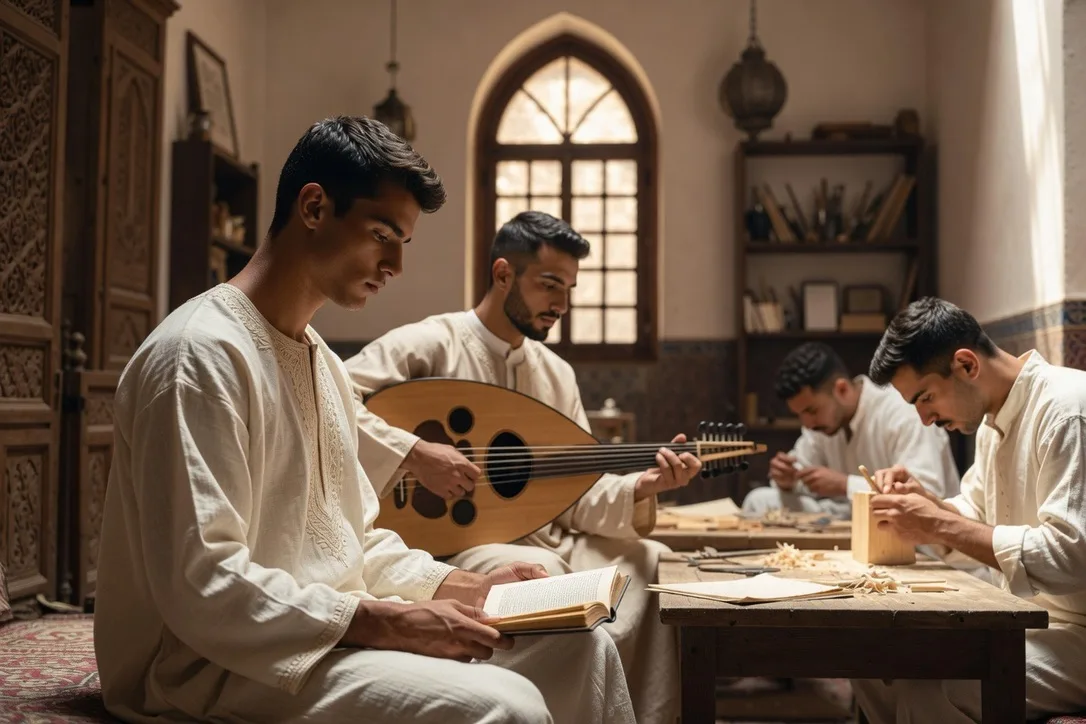
The workshops will open with the first masters trained in Fez who become available. The one described here is fine saddlery, in the combined working of leather, metal and wood. Three masters trained in Fez in the same atelier, one for each craft: cabinetmaking for the wood, leatherwork for the leather, including tooling with hot irons and gold leaf, and the metals, with a forge in a room of its own. Each has beside him an apprentice from the place, and the young men on trial and in first selection work at the bench in turn.
Opening one discipline at a time will let the house show that it knows how to run a workshop. If the first is saddlery, it is because fine saddlery is the only one of the crafts that holds three materials together in a single object, has an identifiable market, and joins up with the twenty-three hectares and with the horses, since whoever builds a saddle rides it.
Bookbinding would extend the saddlery instead of being added to it. High-end bookbinding shares with saddlery the hot irons, the gold leaf and the press: the master of leather teaches the binder half of the craft, and the two kinds of work have the same clients. It will open when the house in Fez has a master binder to send.
Zellige, plaster and muqarnas, weaving and brocade, wood and carving remain in the design of the institution and will open when the house in Fez, or a ḥānūt of the network, has trained the masters, and when there are the work and the hands to sustain them.
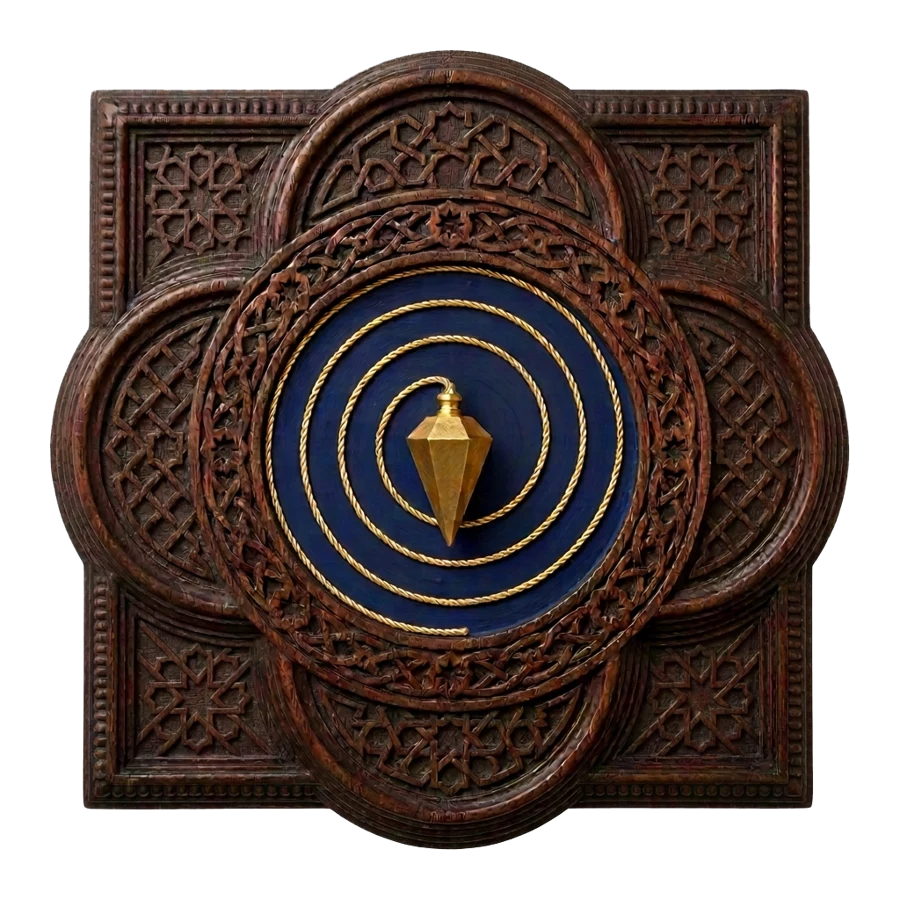
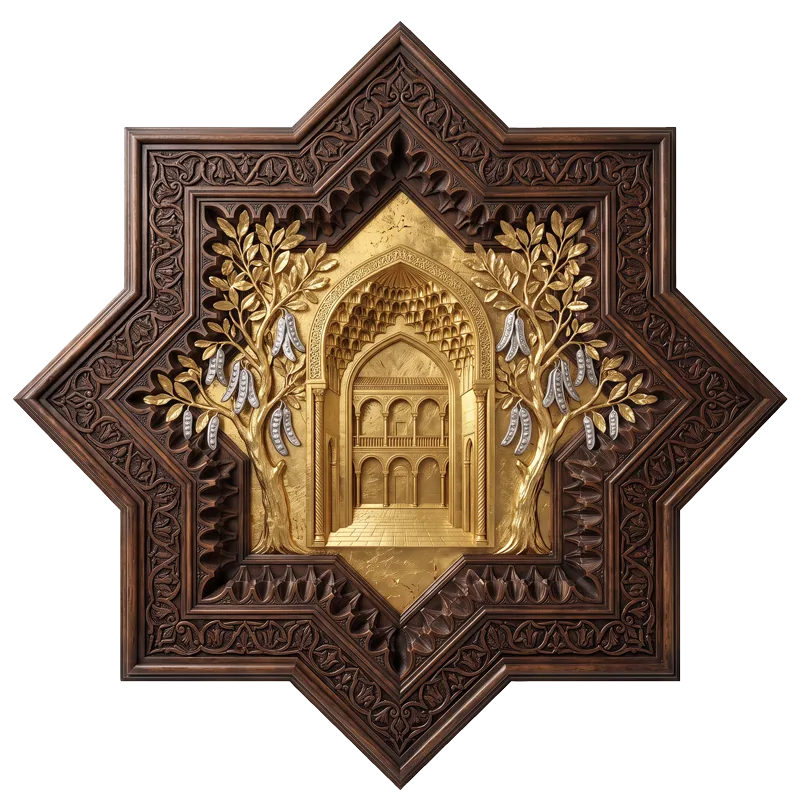
Each workshop has its sign, carved in wood and hung above the door: at the centre the tool that identifies it, on the ground the colour of the craft. It is the same series the house in Fez→ carries, gathered on the page The signs→, and through it the two houses recognise each other at a glance.
Fez red
The saddle. It may be the first workshop to open. →
Terracotta
The reed pen and the protractor. It may join the saddlery, with which it shares the hot irons. →
Fez blue
The menqach, the hammer with which the tile is cut. →
Pale sand
The compass, from which every layout starts. →
Indigo
The shuttle. →
Olive green
The bow drill. The third master of saddlery comes from here. →
Single pieces or short series to commission: made-to-measure saddles, harness, fine luggage, for stables, collectors, fashion houses, institutions. The house works to commission, far from the catalogue and from sales to the passing visitor, and the constraint is arithmetical before it is a matter of taste: only commissioned work sustains properly paid masters, and a workshop remains a house of craft as long as it makes real pieces, whereas with small objects it becomes a shop within two years.
The workshop’s techniques are old; its work is of today: it is sold, delivered and paid for. It is living work, far from reconstruction in costume, and it is what the Faro Convention asks of the States that have ratified it:
“[The Parties undertake to] promote the use of materials, techniques and skills based on tradition, and explore their potential for contemporary applications”
Council of Europe Framework Convention on the Value of Cultural Heritage for Society, Faro, 27 October 2005 (CETS No. 199), Article 9(d)
The house works to commission: pieces conceived for whoever orders them, far from the catalogue, from sales to the passing visitor and from souvenirs.
Architecture and interior practices, for elements made to drawing and for cladding.
Restoration sites, for operations that require documented historical techniques.
Institutions and museums, for fittings, inscriptions, bindings and reproductions.
Collectors, for single pieces.
Art publishers, for limited editions and for bindings.
1.Technical discussion. What is being asked for is established, with which materials and in what time. At this stage the house accepts only the commissions it can carry out at the level required, and declines the others at once.
2.Drawing and sample. A physical sample always precedes the piece, and is invoiced. It serves to bring client and workshop to agreement on a thing rather than on a description.
3.Execution. The master answers for the work; the apprentices work on it under his technical responsibility.
4.Delivery. With the record of operations and materials, which is also the document that makes a future restoration possible.
The times are those of manual work: a dado of hand-cut zellige, a leather binding tooled in gold or a harness stitched with two needles take the weeks they take. Prices follow hours and materials, and are higher than those of an equivalent industrial product for the same reason.
The house prefers to say so first: a client looking for a saving will find better terms elsewhere, and a client looking for an operation that only the hand can perform will find here the reason this house exists.
Selling outside disciplines the house better than any internal rule, because if the house let its work decline it would lose its clients long before it loses its reputation with the other houses: the client judges sooner and better than any inspection, and his judgement weighs more than any public grant.
The words of this page are in the common glossary; the works cited in the sources; the sister house is Riyāḍ al-Uns.