The passage to master
The ṣāniʿ is promoted to muʿallim
when the master who trained him judges him capable of it,
and on this the house adopts the rules of the guilds of Fez.
The passage to master will as a rule take place in Fez, where the apprenticeship is completed. At the Funduq it will be obtained by the local apprentices who work beside the masters, with the same test and the same judgement, according to the rule common to the two houses.
The master’s judgement
The master of the workshop decides, and he decides on the skill of the ṣāniʿ, because the only thing that can be judged with any exactness is the work, and the only one who sees it every day is the one who directs it. The majlis governs the house (the shifts, the table, the rules, the admission of new members), and in the workshop its competence stops at the conditions of work: putting a technical qualification to an assembly vote would turn it into a matter of internal relations, which a house of craft keeps away from the bench.
The term, consequently, stays open. The title ripens with the hand, and time spent in the house is not enough by itself: whoever acquires the hand sooner passes sooner, whoever takes longer remains ṣāniʿ for as long as it takes, as in the guilds of Fez, where the length varies by craft and by person.
The test of mastery
Fez red
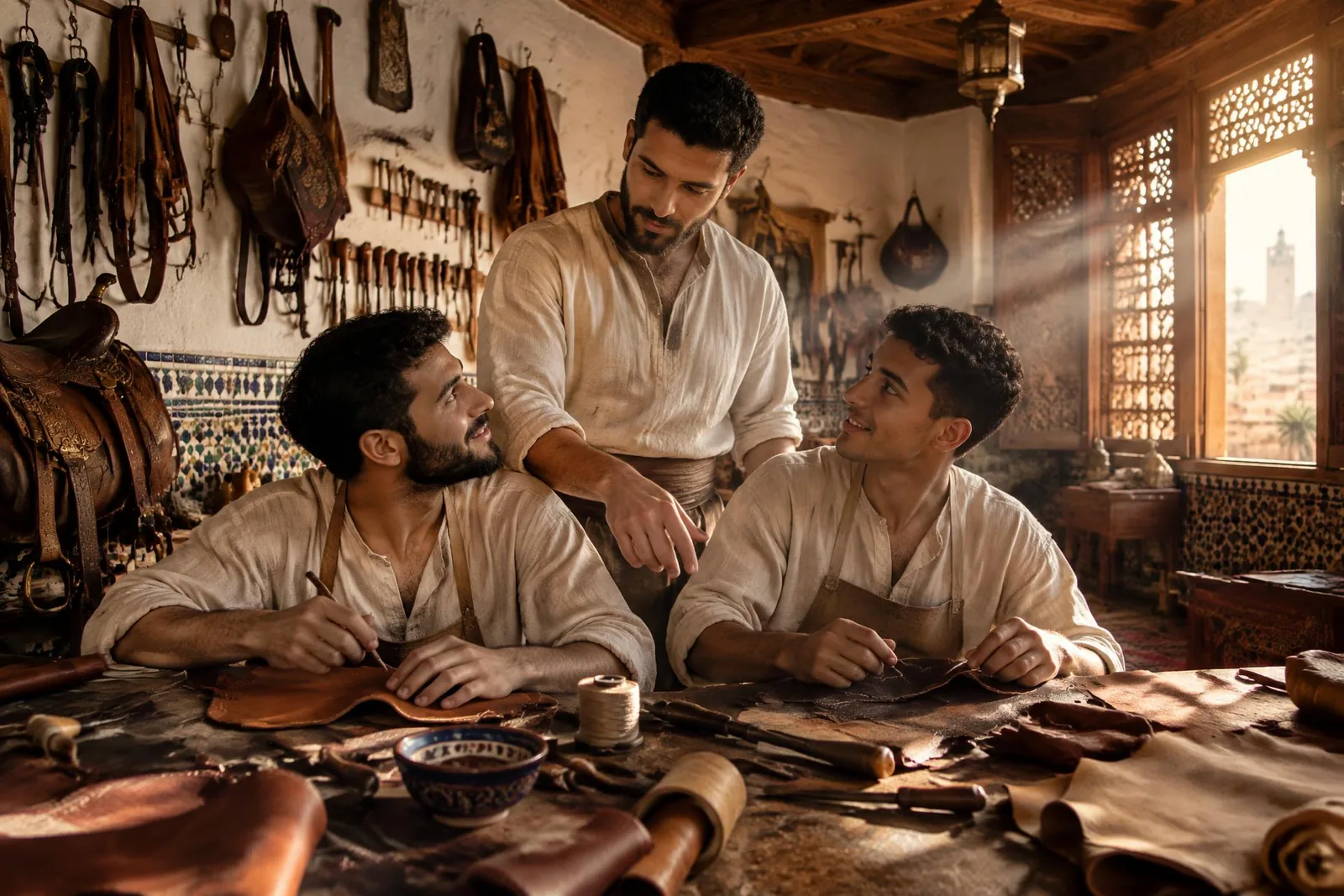
The test is that of the guilds: a complete piece, made alone from beginning to end, with the materials, the tolerances and the times of a real commission. For saddlery it is a complete harness (leather tanned, cut and stitched with two needles, a shaped wooden tree, buckles, stirrups and spurs forged and finished), because that piece obliges whoever makes it to answer for the three materials together, which is after all why the workshop→ keeps them together.
The ṣāniʿ makes the piece alone, without the master’s corrections along the way. It is judged on how it holds under load, the precision of the assemblies, the finish in the places that are not seen, and its behaviour in use, which for a harness means some months in the riding ring, far more than an afternoon’s examination. A rejected piece is made again, and the house leaves the number of attempts and the time taken out of its records.
The value of the title
Inside the house the title carries precise things: one runs a bench, answers for the work that comes from it, welcomes one’s own ṣunnāʿ. In the majlis the vote remains one, by express provision of the statute: the workshop function concerns the organisation of work and technical responsibility.
Outside the house the title, to be worth anything, needs a recognition that comes from outside. The road that will be tried, when there is someone to present, is that of the guild of Fez, which has issued that recognition for centuries and whose masters are the same who teach here; the terms are still to be negotiated. Meanwhile the title is worth what it is inside the house and among the workshops that know it.
The Faro Convention asks States to encourage the passing on of a craft outside school as well, and so grants the workshop’s path its dignity:
“[The Parties undertake to] encourage continuous professional training and the exchange of knowledge and skills, both within and outside the educational system”
Council of Europe Framework Convention on the Value of Cultural Heritage for Society, Faro, 27 October 2005 (CETS No. 199), Article 13(d)
Prospects of work
The title leaves free whoever receives it. A master trained in Fez may work for some years in the workshop of a funduq, open a workshop of his own, join a khayma, a restoration team, or be called by another place of the network that needs his craft; and the Funduq, in the same way, may call in a master it lacks. If one day there were a fondaco in Granada, it could ask Ragusa for a master of saddlery and send Ragusa its masters of plaster and muqarnas, which this house lacks and which that city has known for seven centuries. The internal market spoken of on the page on the network→ is made of this too: pieces and materials passing from one house to another, and masters who go where their craft is needed.
The house in Fez is the source of the masters, and will be able to receive within its walls, as a guest, a master trained here. But the horizon of the ṣāniʿ become master is the network of houses, more than a single city, and the first commitment the houses would take towards one another is to place him where his craft and his circumstances allow.
The recognition
The title is announced at table, before the whole house, by the master who judged the piece, with no handing over of signs. What changes the next day is the bench one runs and the work one answers for. Between ṣāniʿ and muʿallim there are no intermediate conditions, at the Funduq as in Fez; the nāʾib, the master’s deputy in the workshop, is an operational function: whoever has the competence to stand in for the master puts himself forward, and the workshop companions, masters and apprentices, elect him.
The words of this page are in the common glossary; the works cited in the sources; the sister house is Riyāḍ al-Uns.