The glossary
The words that recur in the papers of the houses — Arabic for the most part, Persian, Berber, Andalusian and Sicilian for the rest — gathered in a single lexicon. Where the Riad and the Fondaco each defined them in its own way, the entries have been merged; beside each one is named the house that keeps it. 263 entries.
The name of the house
- Riyadرياضriyāḍ
An Arab-Andalusian dwelling organised around a garden or a courtyard open to the sky. The word is an Arabic plural — of rawḍa, garden — and names the gardens first, only then the house that encloses them.
- Al-Unsالأنسal-uns
Cordial intimacy, reassuring familiarity, the company that drives out solitude. Not noise nor confusion: the full quiet of one who knows he is not alone.
- Wahshaوحشةwaḥsha
Inner desolation, the isolation that estranges a man from himself and from others: the exact opposite of al-uns.
- Darدارdār
“House”, in the full sense: the building and those who live in it. The word opens the name of any institution that understands itself as a household — Dar al-Hiraf, dar al-tirāz.
- Dar al-Aslدار الأصلdār al-aṣl
The house of the origin. It is one of the two houses inside Al-Munya, and lodges the guests of the house without charge; the costs fall on the company Al-Munya. It is not the lodging of the members of An-Nudama, who are paying guests of Dar al-Diyafa, and it is not the trial wing: whoever is on trial or on a fixed-term stay sleeps in the common dormitories.
- Al-Funduq as-Siqilliالفندق الصقليal-funduq aṣ-ṣiqillī
The kindred house in Sicily, in the province of Ragusa: the same rule, the same signs, another scale, and countryside instead of a medina. In Ragusa the threshold is mixed in faith and culture, and secular; in Fez it is proper to the house. The Riad is not a branch of the Funduq, nor its proof.
- Al-Mithaqالميثاقal-mīthāq
The charter: the paper common to the houses of the family, which every member signs on entering. It sets the rule of life, the charges and the arbitration, so that a man formed in one house recognises the other.
In the Arabic sources on Sicily gathered by Michele Amari, the pact (ʿahd, dhimma) is what allowed different communities to live side by side while keeping faith, statutes, workshops and property, and guaranteed the passage and the respect of the guest.
- Baytبيتbayt
The room, the chamber, and by extension the household; in poetry, the verse. The chambers of the hammam bear the name.
Moral ideals and futuwwa
- Futuwwaالفتوّةfutuwwa
The companionship ideal of the medieval Islamic world: it bound gesture to honour, hand to given word, ṣāniʿ to master. Generosity, loyalty, courage, self-mastery, service.
- Fataفتىfatā
“Young man.” Futuwwa is the quality of the fatā — not youth in years, but an inner disposition: generous to the point of sacrifice, loyal unto death, brave without vanity, master of himself before he is master of anything else.
- Javanmardiجوانمردیjavānmardī
The exact Persian counterpart of Arabic futuwwa — same structure, same demand: generosity, loyalty, self-mastery, service. The two traditions fed one another for centuries.
Persian, not Arabic: it is written with the final Persian yāʾ (ی).
- Pahlavanپهلوانpahlavān
The hero of the zurkhane. He is honoured not for strength alone but for generosity and uprightness — exactly like the fatā of futuwwa.
- Adabأدبadab
Etiquette, bearing, rightness of conduct and of speech. The master of a craft does not transmit technical gestures alone, but also an adab, a way of standing in the craft and in life. It is also what traditional dress carries within itself — measure and dignity.
- Tahdhib al-akhlaqتهذيب الأخلاقtahdhīb al-akhlāq
The refining of character: the gradual work by which a man corrects his dispositions as the craftsman straightens a material. It is the title of Miskawayh’s treatise (eleventh century) and of the book of the Iḥyāʾ that al-Ghazālī devotes to riyāḍat al-nafs. Character is cut by repetition and under an authority, and is never received ready-made.
- Sidqصدقṣidq
Truthfulness: word and deed coincide, without gap, without exception of circumstance.
- Wafaوفاءwafāʾ
Faithfulness to the given word, to the master, to the brothers, to the pact — until it costs, and above all then.
- Sakhaسخاءsakhāʾ
Radical generosity: to give before being asked, to give what costs.
- Shajaaشجاعةshajāʿa
Courage — not only before danger, but in self-mastery: the capacity to contain one’s own force rather than deploy it without measure.
- Nafsالنفسal-nafs
The lower soul, seat of appetite and pride. It is what the fatā learns to govern before claiming to govern anything else: his workshop, his house, one day perhaps a family.
- Khidmaخدمةkhidma
Service rendered — to the house, to the brothers, to the guest. Workshop dress remains the same gandoura worn throughout the house, cut short: even in the gesture of service, the traditional form is never set aside.
- Sadaqaصدقةṣadaqa
Almsgiving, the free gift. In the Islamic tradition its worth lies precisely in the discretion with which it is done.
- Rafiqرفيق · رفاقrafīq · pl.rifāq
The companion of the road: the man one travels with and answers for. The word carries equality and duration, where ṣāḥib carries only acquaintance.
- An-Nudamaالندماءan-nudamāʾ · sing.nadīm
The companions of the table. The name designates the association of the supporters and founders of the House, distinct from the House and from Al-Munya. They are the ninety-nine founders: a distinct body, with a treasury of its own, which funds the House. It is not a house and has no lodging of its own: when they stay, its members lodge in Dar al-Diyafa and pay the rate like the other guests. It has no voice in the resolutions.
- Shaddشدّshadd
The knotting of the belt: the gesture by which the futuwwa brotherhoods sealed a commitment taken.
- Asnafأصنافaṣnāf
The craft guilds (sing. ṣinf), to which many futuwwa brotherhoods were bound. The craft was never merely a technique, but the vehicle of an ethic.
- Futuwwatnameفتوتنامهfutuwwatnāme
The medieval futuwwa manuals: required virtues, rules of common life, master-disciple relation, outward signs and degrees of commitment. They codified wrestling, archery and horsemanship as formative disciplines on a par with craft and prayer.
A Persian title (nāme, “book, epistle”), for a corpus that is largely Arabic-Persian.
- Tawhidتوحيدtawḥīd
Divine oneness. The geometric interlace that repeats with no visible beginning or end is read, in Islamic thought, as its image: unity behind the multiplicity of forms.
Governance, grades & transmission
- Atharأثرathar
The trace, the vestige, what remains after a passage — and, in religious vocabulary, the report transmitted from one generation to the next. At the Riad, the name given to the work each resident leaves in the walls at the end of his training. Its use as the name of a house rule is proper to this project.
- Ijazaإجازةijāza
The authorisation to transmit, granted by a master to his student. One does not teach because one has learned, but because a master attests that one has learned from him.
- Sijillسجلّsijill
The register. At Dar al-Hiraf, the book in which the works received are entered — the piece, the hand, the master, the year — together with the undertaking to transmit in turn. It stays in the house and is not published.
- Hubusحبسḥubus
The Maghrebi name for the waqf: a property immobilised in perpetuity, which can no longer be sold, given, inherited or mortgaged, and whose fruits are devoted to the purpose for which it was constituted. The madrasas and fountains of Fez lived on this instrument for centuries.
- At-Tadbirالتدبيرat-tadbīr
The art of conducting a household: the measured governance of the home and of oneself. It is the classical word that Islamic political thought reserved for the government of the house.
- At-Tahkimالتحكيمat-taḥkīm
Recourse to a third party to decide. At Riad Al-Uns: first arbitration (muqaddam, majlis, shaykh), then — only if words do not close the matter and both consent — a trial drawn from the disciplines of the house (wrestling, archery, furūsiyya, craft), under rule and under witnesses. The outcome closes the question.
- Nizam ad-darنظام الدارniẓām ad-dār
The ordering of the house: hours, turns of duty, use of the common spaces, custody of the tools, internal sanctions. Deliberated by the majlis and reviewed at least once a year.
- Hayat at-tahkimهيئة التحكيمhayʾat at-taḥkīm
The arbitral college of three members to which disputes between rifāq in contractual and associative matters are referred. It carries into the order of law what taḥkīm settles in the order of honour.
- Aminأمينamīn · pl.umanāʾ
The one to whom something is entrusted: the keeper, the trustee. In the guilds of the medina the amīn answers for the craft before the city; in the houses of the family he sits on the council.
- Majlis al-umanaمجلس الأمناءmajlis al-umanāʾ
The council of trustees, of three or five members elected by the majlis from among the rifāq. It corresponds to the administrative body; each of its members is an amīn.
- Tazirالتعزيرtaʿzīr
In Islamic law, the correction left to the judgement of the one who holds authority, as against the penalties the text itself fixes, the ḥudūd. At the Riad it is always bounded in time and pronounced before the arbitration of the house.
- Ramyرميramy
Shooting, especially with the bow. A discipline of furūsiyya and a possible form of trial under the gaze: calm, precision, breath. Tradition reads in Qur’an 8:60, among other things, the practice of shooting.
- Tadbir al-manzilتدبير المنزلtadbīr al-manzil
“The government of the house.” Ibn Sīnā made it, at the scale of the household, the counterpart of the siyāsa that governs the city.
- Siyasaسياسةsiyāsa
The government of the city — the political order, of which tadbīr is the domestic equivalent.
- Al-Hawkamaالحوكمةal-ḥawkama
The modern Arabic calque of “governance”, borrowed from corporate vocabulary. The Riad does not use it, for it understands itself as a house, not an institution.
- Ash-Shaykhالشيخash-shaykh
The head of the house. He wears the colour of no craft: belonging to no guild, he stands for them all.
- Al-Muqaddamالمقدّمal-muqaddam, pl. al-muqaddamūn
The two counsellors who assist the Ash-Shaykh in the conduct of the house.
- Faqihالفقيهfaqīh
The scholar trained in law and the religious sciences. At the Riad it is a charge of the house: he sets the hours, teaches, and lives among the residents, under the same disciplines and at the same table as they.
- An-Naibالنائبan-nāʾib
“The deputy”: one of the most advanced pupils of each guild, who assists the other ṣāniʿ when the maʿallem is busy or absent — without ever substituting himself for his authority. A responsibility, not a rank.
- Maallemمعلّمmaʿallem, pl. maʿallemīn
The master of a craft: the one who possesses both technical mastery and the moral authority to transmit. To transmit a gesture is to transmit a way of being in the craft.
The Maghrebi form (also maalem) of classical Arabic muʿallim. “The one who teaches.”
- Saniصانعṣāniʿ
In Moroccan workshop usage, the apprentice placed under the authority of the maʿallem, who accepts the discipline of the workshop.
In classical Arabic the word means “the one who makes, the craftsman”; the sense of apprentice belongs to the dialectal usage of the guilds.
- Hizam al-Itqanحزام الإتقانḥizām al-itqān
“The belt of mastery”: the leather belt with a plain buckle, without prong or holes, whose three tones — beige, cognac, brown — state the grade within the workshop. Before the first grade, the ṣāniʿ wears no belt; outside the scale, the gold-thread belt of the Ash-Shaykh. Nothing is gained by seniority alone: progression follows competence actually shown.
- Itqanإتقانitqān
Accomplished execution: work carried through to its right perfection, without negligence and without excess.
- Malakaملكةmalaka
The stable quality acquired by repeating a gesture until its form takes root in the soul. Ibn Khaldūn, in the Muqaddima, applies it indifferently to crafts, to language, to faith and to art: the craftsman’s trade and the believer’s virtue are acquired in the same way. If riyāḍa is the operation, malaka is what it deposits.
- Madrasa al-ulaالمدرسة الأولىal-madrasa al-ūlā
“The first school”: the family. Formation is not separable from preparation for the home — a man able to practise a craft must also be able to run a house.
- Bawwabبوابbawwāb
The gatekeeper, the one who keeps the door. At the Riad the charge falls to a resident and not to an employee: keeping the threshold is his work and his share in the house, as another holds his in the workshop.
- Al-Khazinالخازنal-khāzin
The keeper of the deposit of volumes. In the tradition of the khizāna, one reads in the study rooms, in one’s chamber, in the gardens or at the patio. Al-Khazin carries the book, takes it back, tends its condition, has it restored if need be, and watches over what may enter. A resident’s charge, as the Bawwab keeps the threshold — not a librarian of an open hall.
- Al-Khizanaخزانةkhizāna
Chest, cabinet, deposit of the volumes. It is not a reading room, for the books are kept there under lock; one reads them in the study rooms, in one’s chamber, in the gardens or at the patio. Access is a gesture — to ask, to receive, to return — not a stroll among the shelves.
- Al-Jannanالجنّانal-jannān
The one who tends the gardens of the house: garden, green spaces, orchard and kitchen garden. A resident’s charge, not a workshop craft. Dress of the same cut as the Bawwab and Al-Khazin, in deep green — distinct from the olive of the mashrabiyya. In winter, the Al-Farwa in the same tone.
- As-Sanduqالصندوقaṣ-ṣandūq
The common chest of the futuwwa: the coffer that the craft guilds kept for centuries for the sick man, the widow, the burial and the setting up of the young master. Separate from the accounts of the house, and administered by members who hold no authority over the residents.
- Qard hasanقرض حسنqarḍ ḥasan
The “goodly loan”: made without interest or profit, repaid for what it is worth. The phrase comes from the Qur’an (II, 245). It is the form in which the chest advances a newly established master the price of his first tools.
- Al-Warshaالورشةal-warsha
In Moroccan Arabic the word means both the workshop and the building site. At Dar al-Hiraf it names the principle of the school itself: to have a real piece of work in hand at all times, and to learn the trade upon it rather than on practice pieces.
Crafts & workmanship
- Dar al-Hirafدار الحِرَفdār al-ḥiraf
“The House of Crafts”: the school-residence of the Riad, where the first workshop — saddlery, iron, wood, around the saddle and the ʿudda — opens the gesture, transmitted by a maʿallem.
Ḥiraf (حِرَف) is the plural of ḥirfa.
- Hirfaحرفةḥirfa, pl. ḥiraf
The traditional art craft. It implies not merely a technical skill of the hand but a moral discipline: learning to answer for a craft as one answers for a responsibility.
- Hirafiحِرَفيّḥirafī, pl. ḥirafiyyūn
The artisan who possesses a ḥirfa: the one who works matter, bringing to it intention and exactness.
- Sinaaصناعةṣināʿa
Making, manufacture: the art of manual skill in its highest sense.
- Sarrajالسرّاجas-sarrāj
The saddler: the man who cuts, sews and trims leather — saddle, harness, fine leatherwork. It is the first workshop opened at Dar al-Hiraf, around which iron and wood are arranged. Its colour is Fez red.
- Qarbusقربوسqarbūs
The saddle tree: the wooden frame of the saddle, which the carpenter delivers bare to the saddler. In orange, olive or cedar wood, covered with goatskin shrunk by drying. Every horse has a back, and the wrong tree injures it.
- Tarshihترشيحtarshīḥ
The felt pad that goes first on the horse’s back, beneath everything else: seven to ten sheets of wool fulled with beldi soap. It is the feltmakers’ work, not the saddler’s, and limits friction between the tree and the animal.
- Saffarالصفّارaṣ-ṣaffār
The coppersmith: the man who beats copper and brass, and by extension, at the Riad, wrought iron. Seffarine Square in Fez carries the guild’s name, and the hammer there still paces the day. Its colour is verdigris.
- Najjarالنجّارan-najjār
The joiner and cabinetmaker: framing, doors, painted ceilings, turned-wood screens. The square and the funduq Nejjarine in Fez carry the guild’s name. Its colour is olive.
- Mujallidالمجلّدal-mujallid
The bookbinder: the man who sews, covers and restores the book. At Dar al-Hiraf the book workshop gathers binding, restoration, calligraphy and the gilding of leather — the same hide and the same irons as the saddlery, its neighbour in work and in colour. Its colour is terracotta.
- Nassajالنسّاجan-nassāj
The weaver: the man who sets up the loom and carries the weft. The cloth workshop gathers weaving, tatrīz embroidery, passementerie and cutting. Its colour is deep indigo.
- Fakhkharالفخّارal-fakhkhār
The potter. The word means both the fired earth and the man who works it. The workshop brings together pottery and zellīj: one earth, one kiln, two uses. Its colour is Fez blue.
- Jabbasالجبّاصal-jabbāṣ
The plasterer: the man who carves plaster on a fresh wall, with no second attempt possible, and builds the muqarnaṣ. Its colour is the plaster itself, a warm white.
- Attarالعطّارal-ʿaṭṭār
The perfumer and herbalist: the man who distils, macerates and composes. The madrasa al-Attarine in Fez takes its name from the neighbouring souk of the ʿaṭṭārīn. At the Riad he runs the essences laboratory, beside that of the preserves. Their colour is pale blue.
- Munawalaمناولةmunāwala
The handing over from hand to hand. In the tradition of hadith it is one of the recognised modes of transmission: the master does not dictate the book, he hands it over. At the Riad the object of a charge — the key, the register, the dial — is handed over in the same way, on the day it is taken and on the day it passes.
- Al-Liwaاللواءal-liwāʾ
The standard of the house. Black and gold, sqalli brocade: with the mantle of investiture, the only use of that cloth. It carries neither title nor rank, and for one year it goes to the last man whose work was received into the walls.
- Shamsaشمسةshamsa
“Little sun”: the radiating or polylobed medallion of manuscript frontispieces. At the Riad it is the shape of the signs hung above the workshops and of the cartouche carrying the name of the house on the standard — a form from books, not a shield.
- Khiyataخياطةkhiyāṭa
Sewing and cutting. The dress of the Riad is cut by hand by the craftsmen of the house or of the medina, never borrowed from the industrial register.
- Tatrizتطريزtaṭrīz
Embroidery. At the Riad it marks the grade belt and the borders of the ceremonial pieces.
- Khatt maghribiالخط المغربيal-khaṭṭ al-maghribī
The Maghrebi script, distinct from eastern naskh and thuluth. Born in al-Andalus, it settled in Fez after the Reconquista.
- Khattatخطّاطkhaṭṭāṭ
The calligrapher. “Calligraphy is a geometry of the spirit appearing through an instrument of the body” — Ibn Muqla.
- Qalamقلمqalam
The reed pen: the cut reed whose angle of nib determines the stroke.
- Basmalaالبسملةal-basmala
The formula bismillāh al-raḥmān al-raḥīm, which opens the Qur’an and paces daily life. It is the first exercise of every apprentice calligrapher: a founding gesture before it is a decorative motif.
It is also pronounced before crossing the threshold of the hammam, as before any bath. The usage goes back to a prophetic tradition associating the formula with the passage into places of ritual impurity; popular memory later grafted onto it the belief that the jinn — invisible beings mentioned in the Qur’an, made of smokeless fire — favour damp and little-frequented places.
This second explanation belongs to popular memory and not to the core of doctrine — one more example of the way the sacred and the everyday remain, in Morocco, intimately mingled.
- Zillijزليجzillīj (zellige)
The art of glazed ceramic tesserae, cut one by one and assembled according to geometric grids. It was born in Fez under the Merinids, in the 13th–14th centuries.
The term comes from an Arabic root denoting the small polished stone.
- Minqashمنقاشminqāsh
The zillīj cutter’s hammer: each piece is struck by hand from a monochrome glazed tile.
- Gebsجبسgebs (jibs)
Carved plaster. Worked fresh with the knife, it covers walls, arches and domes with a vegetal, epigraphic and geometric web.
- Alfizالحيّزal-ḥayyiz · esp.alfiz
The rectangular frame that encloses an arch and binds it to the wall, in Andalusi and Maghrebi architecture. From Arabic al-ḥayyiz, the bounded space.
- Yeseriayesería · esp.
The Spanish name for the carved plaster of Andalusi architecture, what the Maghreb calls gebs: interlace, epigraphy and cut arches, carved in the mass before it sets.
- Tadelaktتادلاكتtadelakt
Lime plaster burnished with a hard stone and treated with black soap, which becomes waterproof without joint or tiling: the finish of hammams, basins and tubs. The name comes from the verb dellek, to rub.
- Muqarnasمقرنصmuqarnaṣ
The honeycomb or stalactite cells that cover domes, portals and capitals — the mocárabe of the Iberian languages. Brought to its height in the madrasas of Fez.
- Mashrabiyyaمشربيةmashrabiyya
The closed, projecting latticed window of turned wood. In French, moucharabieh. It filters light and sight without stopping the air. A geometric assembly without nail or glue.
- Tirazطرازtirāz
The woven or embroidered inscription running along a garment or a house textile — and, by extension, the workshop that produces it.
- Dar al-tirazدار الطرازdār al-tirāz
The state tirāz workshop, from Fatimid Egypt to Umayyad al-Andalus. There the inscribed cloth sealed the khilʿa.
- Tiraz khassa / ammaطراز خاصّة · طراز عامّةtirāz khāṣṣa · tirāz ʿāmma
The tirāz reserved first for the sovereign (khāṣṣa), then extended to dignitaries (ʿāmma).
- Khilaخلعةkhilʿa
The gift of a robe of honour: a political gesture as much as a textile one, by which a sovereign both recognised and bound to himself.
- Sqalliسقلّيsqallī
In Fez, gold and silver thread. An entire guild, the maʿallemīn sqallī, is devoted to its making: gold beaters, rollers, wire drawers, spinners.
A widespread hypothesis, without settled academic confirmation, links the name to Sicily (Siqilliyya).
- Mrema bejebbadالمرمة بالجبّادmrema bejebbad
The drawloom of brocade, where the roles divide: the zouaq draws the pattern, the nyar mounts the loom, the medewar winds the bobbins, the jebbad weaves — under the authority of the maʿallem.
- Al-inbiqالإنبيقal-inbīq
The alembic. The Arabic word is inherited from Greek ambix and gave, through Spanish, the “alembic” of the European languages.
- Itrعطرʿiṭr (attar)
The concentrated essence, obtained by slow distillation: for skin and linen, where rose water remains for the face, the table and the rite.
- Madrasaمدرسةmadrasa (medersa)
The school. Bou Inania and al-ʿAttarin, in Fez, remain the most accomplished witnesses of carved plaster, zillīj and cedar wood meeting on a single wall.
Dress — Al-Kiswa
- Libasلباسlibās
Dress, clothing. It denotes not merely a covering of the body but visible dignity, composure, and the respect owed to the place and the community.
- Al-Kiswaالكسوةal-kiswa
Dress. At Dar al-Hiraf, al-kiswa al-khāṣṣa names the house’s own system of vestimentary signs: gandora, craft cap, grade belt, khirqa.
- Zinaزينةzīna
Adornment. “O children of Adam, wear your finest garments at every prostration” (sūrat al-Aʿrāf, 7:31) — understood here as cleanliness and decency, not as finery.
- Satr al-awraستر العورةsatr al-ʿawra
The covering of what must be covered, according to the propriety of tradition and of prayer: from shoulders to ankles, in clean cloth.
- Awraعورةʿawra
Those parts of the body it is proper to cover. In prayer, equality among the pupils prevails over any sign of grade or craft.
- Qamisقميصqamīṣ · kamis
A straight, light tunic, hoodless, to the ankles. White cotton or satin. It is the garment of prayer: no embroidery, no belt, no sign.
- Ghanduraغندورةghandūra (gandoura, gandora)
A hoodless indoor tunic, a variant of the qamīṣ. At the Riad it is the base garment: cut to suit a trained body, without ever falling into Western fitted tailoring.
- Djellabaجلابةǧallāba · jellaba
A long loose robe with a pointed hood (qob). Everyday and outdoor garment: cotton or linen in summer, wool in winter. The backbone of the Maghrebi men’s wardrobe.
- Qobقبqob
The pointed hood of the djellaba: it shields from sun and cold.
- Selhamسلهامsilhām · selham
A wide woollen mantle, open, sleeveless, hooded. Worn over the djellaba in cold weather or on horseback. A sign of dignity and protection.
- Al-Farwaالفروةal-farwa
The house’s winter mantle, cut for the cold of mornings and open courtyards.
- Jabadurجبادورǧabādūr · jabador
The straight jacket, closed by a row of hand-braided ʿaqad buttons and worn over the serwal. At the Riad it is undyed on a man who exercises no charge, and takes the colour of the charge for as long as he exercises it.
- Sirwalسروالsirwāl (serwal)
Wide trousers. At the Riad they replace jeans: in daily life, traditional dress is the norm, not the exception.
- Madammaمضمةmaḍamma (mdama)
The plaited cord, knotted over the jacket in the colour of the charge, for as long as it lasts. With the jacket and the mantle it forms the three pieces that state a function; it does not take the place of the leather belt, which a man with a grade keeps underneath.
- Aqadعقدʿaqad · aakad
The hand-braided spherical buttons that close the jabādūr, in the tone of the jacket.
- Sfifaسفيفةsfīfa
The traditional Moroccan embroidered cord. It edges the front opening of the gandora in a single colour, recognisable at a glance as the mark of the house.
- Belghaبلغةbelgha
The soft leather slipper (babouche), without a stiffened back. At the Riad it is dyed in the colour of the craft, like the whole guild.
- Taqiyyaطاقيةṭāqiyya · taguia
A small round cap, close-fitted to the skull: the simplest and commonest piece, worn for prayer as in daily life. In Morocco, taguia.
- Tarbushطربوشṭarbūsh (tarbouche, fez)
A cylindrical red felt cap, often with a black silk tassel. An Ottoman and Maghrebi urban legacy.
- Qubbaat al-hirfaقبعة الحرفةqubbaʿat al-ḥirfa
The craft cap of Dar al-Hiraf: stiff felt, vertical sides, flat crown, no tassel, with a fine embroidered border — halfway between the ṭāqiyya and the ṭarbūsh, but plainer. Its colour states the wearer’s craft.
- Imamaعمامةʿimāma · rezza
The turban: a length of cloth wound around the head or the ṭāqiyya. A more solemn variant, still present in traditional circles.
- Shashiyyaشاشيةshāshiyya (chechia)
A form close to the ṭāqiyya, softer, sometimes of wool or felt. For daily and prayer use.
- Al-Hullaالحُلّةal-ḥulla
The overgarment of the maʿallem, in the colour of his craft, in tone-on-tone woven damask — the passage from a collective visual identity to a fully personal one.
- Al-Khirqaالخرقةal-khirqa
The mantle of investiture, bestowed and not merely worn: the master himself clothes the pupil, sealing his entry or his advancement. On the model of the dervish tradition of the khirqa.
- Hibaهيبةhiba
The bearing that commands respect. It is the one moment in which the dress of the house openly seeks it — that of the khirqa; everywhere else, sobriety prevails.
- Futaفوطةfūṭa
The hammam cloth: a single panel of light linen, knotted at the waist. Training closes in the hammam, not in the changing room.
- Izarإزارizār
The length of cloth knotted at the hips, worn beneath the tunic. First term of the layering: izār → serwal → qamīṣ → djellaba or jabādūr.
- Tonbanتنبانtonbān
The short breeches of worked leather, tight at the waist and below the knee, proper to the wrestling of the zurkhane.
- Lungلنگlung (loang)
The simple length of cloth wound at the waist, worn for ordinary exercise in the zurkhane.
- Kispetkispet
The leather breeches of Ottoman wrestling. When any loose cloth becomes an obstacle to the grip, only fitted leather remains: two distinct traditions arrived, each in its own way, at the same answer.
A Turkish term. Ottoman wrestling (yağlı güreş) is a lineage distinct from muṣāraʿat al-nūba.
- Thawb · Dishdasha · Kanduraثوب · دشداشة · كندورةthawb · dishdāsha · kandūra
The long everyday tunics of the Gulf, worn with the ghutra held by the ʿiqāl.
- Ghutra & iqalغترة · عقالghutra · ʿiqāl
The Gulf head cloth and the black cord that holds it.
- Kufiyyaكوفيةkūfiyya (keffiyeh)
The square of cloth draped over the shoulders — the Mashreq and Levantine variant.
- Bishtبشتbisht
The ceremonial mantle of the Gulf, open, often gold-bordered.
- Qabaقباqabā
The long Persian coat, often open at the front, worn over the pirahan and the shalvār.
- Salvar · Cepken · Kusakşalvar · cepken · kuşak
The Ottoman wardrobe: baggy trousers, short jacket with open sleeves, cloth sash. No hooded djellaba with qob in this line.
Turkish terms, given here for the comparison of vestimentary lines.
Discipline of the body — Furusiyya
- Furusiyyaالفروسيةfurūsiyya
The Arab-Islamic chivalric tradition, uniting body, bow, wrestling and sword under a single system of formation. Before specialising, the body first had to be made capable.
- Farasفرسfaras
The horse — the very root of the word furūsiyya: in the strictest sense, horsemanship, the first and oldest of the chivalric disciplines, the one that names all the others.
- Al-uddaالعُدّةal-ʿudda
The tack, the horse’s equipment. What is placed on the horse figures what the house places around the man: the frame that lets him stand firm, not break.
- Al-Lijamاللجامal-lijām
The bridle: what links the horse’s head to the rider’s hand. Figure of the rule that joins impulse to a direction.
- Al-Hakamaالحكمةal-ḥakama
The part of the bridle that encircles the horse’s mouth and chin — from the same root as ḥakama, to govern; the bit proper is ash-shakīma. Figure of the brake a man sets on what, within him, would carry him away. Passions are bridled rather than extinguished.
- Al-inanالعنانal-ʿinān
The reins: the line by which the hand guides. Figure of fine direction — not brute force, but indication.
- As-Sarjالسرجas-sarj
The saddle: the rider’s seat. Figure of the rule that lets one last — the seat without which one does not stay the course.
- Al-Jullالجلal-jull
The horse-cloth, the covering. Figure of what protects and honours the body at work — not luxury, the dignity of effort.
- Al-Bitanaالبطانةal-biṭāna
The girth that secures the saddle. Figure of what tightens just enough: too loose, everything slips; too hard, one wounds.
- Ar-Rikabالركابar-rikāb
The stirrups. The foot’s point of support: figure of the stable prop without which the body can neither mount nor keep its seat.
- Al-Mihmazالمهمازal-miḥmāz
The spurs. They do not exist to wound, but to remind. Figure of just incentive — the start, not the violence.
- Al-Labab wa-l-haqabاللبب والحقبal-labab wa-l-ḥaqab
Breastplate and crupper: what holds the saddle before and behind. Figure of the limits that keep the frame from sliding when the pace quickens.
- Al-Farisالفارسal-fāris
The rider. The one who sits the horse and commands himself as he commands the mount. Without him, the ʿudda is only leather and metal.
- As-Saisالسائسas-sāʾis
The groom, the horse’s attendant. Figure of discreet service without which the rider has no mount ready — care before parade.
- Al-Muhrالمُهرal-muhr
The unbroken colt. Figure of the one who enters Dar al-Hiraf: the community provides bit, bridle, spurs and saddle; it is he himself who must stand firm.
- Al-Furusiyya al-Muhammadiyyaالفروسية المحمديةal-furūsiyya al-muḥammadiyya
Ibn al-Qayyim’s treatise, which made furūsiyya a spiritual discipline as much as a physical one.
- Rimayaرمايةrimāya
Traditional archery: a discipline of posture, breath and presence — the hand settles on the breath before it settles on the target.
- Sayf wa-l-tursالسيف والترسsayf wa-l-turs
“The sword and the shield”: traditional fencing, where the two hands learn two inseparable tasks.
- Tursترسturs
The shield: leather stretched over a wooden core, bearing an eight-pointed star, held by a forearm strap and a central grip.
- Musaraaمصارعةmuṣāraʿa (Musara)
Wrestling. Body to body with a brother: a school of restraint as much as of strength — mastery of the gesture that could injure and does not. An admissible form of the honour trial under At-Tahkim.
- Musaraat al-nubaمصارعة النوبةmuṣāraʿat al-nūba
Nubian wrestling, attested since ancient Egypt and alive today in Sudan. On sand, with no submission or ground pinning: only the controlled fall of the opponent counts.
- Yagli guresyal gre
Ottoman oil wrestling, in leather breeches (kispet): a tradition documented for centuries, but distinct from muṣāraʿat al-nūba — the one is fought standing, the other works on the ground.
A Turkish term. The two lineages are not to be conflated.
- Zurkhaneزورخانهzūrkhāne
“The house of strength”: the traditional Persian gymnasium where javānmardī is practised in the body. Recognised by UNESCO as intangible cultural heritage of humanity.
- Gowdگودgowd
The slightly sunken octagonal pit at the centre of the zūrkhāne, beneath a dome pierced by a single zenithal opening.
- Morshedمرشدmorshed
The master seated apart who paces the exercise with drum and heroic song: he does not command the bodies, he tunes them.
- Mil · sang · kabbadeمیل · سنگ · کبادهmīl · sang · kabbāde
The instruments of the zūrkhāne: the wooden clubs, the weighted shields, the chained practice bow.
- Tahtibتحطيبtaḥṭīb
The art of the stick, born in ancient Egypt and alive in Upper Egypt. It is a dialogue rather than a fight: two men, two sticks, a drum rhythm that governs every gesture. The victor is the one who touches without losing measure, not the one who strikes hard.
- Asa · Nabbutعصا · نبوتʿaṣā · nabbūt
The taḥṭīb stick: 1.20 to 1.50 metres — long enough to demand precise management of distance, too light to wound gravely if handled rightly.
- Tabla baladiطبلة بلديṭabla baladī
The drum that governs the taḥṭīb duel, quickening in steps: each change of tempo forces both men into a new reading of the space and of the other’s gesture.
- Riyadaرياضةriyāḍa
The exercise of the body. The word first meant the schooling of a horse — the same root as riyāḍ — and keeps from that origin its exact sense: a strength that is educated, not displayed.
- Riyadat al-nafsرياضة النفسriyāḍat al-nafs
The training of the soul — the very word that names the exercise of the body, applied to the correction of character. Al-Ghazālī makes it the title of the twenty-second book of the Iḥyāʾ ʿulūm al-dīn and speaks there of the vices in the vocabulary of the physician. The house joins the two — riyāḍat al-badan wa riyāḍat an-nafs — rather than opposing them: one gesture, two materials.
- Jasadجسدjasad (anchebadan, بدن)
The body. In this tradition it is neither an obstacle to mortify nor an instrument to flatter, but a debt one answers for: “your body has a right over you” (إن لجسدك عليك حقا), a prophetic saying reported by al-Bukhārī (no. 1975) to a man who fasted every day and kept vigil every night. Physical formation is thus a matter of justice before it is a matter of strength.
- Al-aql as-salim fi l-jism as-salimالعقل السليم في الجسم السليمal-ʿaql as-salīm fī l-jism as-salīm
“A sound mind in a sound body”: a modern Arabic calque of Juvenal’s line, which entered through French and English in the age of the nahḍa and was spread by the school. It is not a classical Arabic proverb — it is absent from the great collections, such as al-Maydānī’s Majmaʿ al-amthāl. The house does not use it, for it has riyāḍat al-badan wa riyāḍat an-nafs, which says the same thing without supposing that body and soul were separated in the first place.
- Ribatالرِّبَاطar-ribāṭ
The tie that holds and the post one keeps. The Qur’an says ribāṭ al-khayl (al-Anfal 8:60) — horses held ready: the word means both the tether and the watch. From the same root come the ribāṭ of the Maghreb, the fortified posts where men kept guard and were formed. What the rope does for the horse, the order of the day does for the man: it keeps him available.
- Rifqالرِّفقar-rifq
Gentleness, forbearance in the use of force. It is owed to beasts as to men: “gentleness is not in anything without adorning it, and is not taken from anything without disfiguring it” (Muslim, no. 2594). It is the measure of the brake — a bit too harsh closes the horse, and a hand that wounds no longer leads, but constrains.
- As-Sarbaالسَّرْبَةas-sarba
The aligned troop of the tbourida: some fifteen riders under a muqaddam who holds the centre of the line and gives the start. Honour does not go to the fastest — the troop is judged on the start taken together and on the guns fired as a single sound. One man who goes ahead loses it for all.
- Tbouridaالتبوريدةat-tabūrida
The Moroccan equestrian game inherited from cavalry charges: the sarba sets off at the gallop down a straight track and fires its powder guns at the same instant. What is learned there is the holding of the line rather than speed — the most exact figure of the common life.
- Al-Inayaالعِنَايَةal-ʿināya
The daily care of the horse: grooming the coat, picking out the feet, greasing the leather, wiping the buckles once the animal is back in. It is the part of the work that is not shown and which makes the tack possible. A man is judged by what he does when no one is watching; the horse, for its part, is not deceived.
- An-Nalالنَّعْلan-naʿl
The horseshoe, and by extension the shoeing. A badly set nail shows at the third mile and not at the start. The same word means the sole and the sandal — what carries, and what is never looked at.
- Al-Labadاللَّبَدal-labad
The felt laid under the saddle so that the wood of the tree does not wound the back. Nothing of it shows once the saddle is girthed: which is precisely why it matters.
- Ar-Rasanالرَّسَنar-rasan
The lead rope. It does not hobble the horse, but keeps it available. A horse that wanders is not free — it is nowhere to be found on the day it is needed.
- Jinetaزناتةalla jineta (diZanāta)
The Andalusi seat with short stirrups and bent leg, the horse led by the voice and by shifts of weight rather than by the strength of the arm. The name comes from the Zanāta, Berber horsemen who crossed into al-Andalus. The Maghrebi saddle descends from it: a school of finesse before it is a school of force — and Spain, which learned it from this side of the sea, left it their name.
- Hilyat al-fursanحلية الفرسانḥilyat al-fursān wa-shiʿār ash-shujʿān
“The adornment of horsemen and the device of the brave”, a treatise by Ibn Hudhayl al-Andalusī, written in Granada in the fourteenth century. It describes the equipment piece by piece and constantly refers it to the moral bearing of the man who wears it: the book that ties the ʿudda to character most explicitly.
- Ibn Akhi Hizamابن أخي حزامibn akhī ḥizām
The caliph’s equerry in ninth-century Baghdad, author of the Kitāb al-furūsiyya wa-l-bayṭara: the oldest surviving Arabic treatise that brings training and care together. Riding and grooming are not separated there — they are one craft.
- At-Tarsusiالطرسوسيaṭ-Ṭarsūsī
Author, in the twelfth century, of the Tabṣirat arbāb al-albāb, composed for Saladin: arms and tack described piece by piece, together with their making. Tack is a matter of the workshop there as much as of riding.
Sound, word and listening
- Al-Alaالآلةal-āla
The classical Arab-Andalusian music of the Maghreb, for an orchestra of instruments: the repertoire brought to North Africa by the exiles of al-Andalus and preserved in collections of nawbat. It is the music of the concerts of the public programme.
- Nubaنوبةnūba (nouba)
The structuring form of al-āla: a long musical suite in movements of rising tempo, each with its own sung poems. Eleven survive today of the twenty-four the oral tradition reports.
- Munshidمنشدmunshid
The lead singer: he carries the poem as much as the melody. The voice is carried, not forced.
- Malhunالملحونal-malḥūn
Sung poetry in dialectal Arabic, born in the craft guilds of the Moroccan cities. It is a repertoire of the crafts, and not of the court like al-ala: that is why it sits well in a house of the crafts.
- Shaykh al-malhunشيخ الملحونshaykh al-malḥūn
The master who transmits a malḥūn repertoire to a few disciples, at the same rhythm of learning as zillīj or calligraphy.
- Qasidaقصيدةqaṣīda
The long poem, often of several dozen verses, sung a cappella then taken up by a small ensemble. Its themes range from mystical love to the very concrete evocation of the craft world — tools, gestures, materials.
- Gnawagnawa
A music of transmission inherited from the brotherhoods of sub-Saharan origin settled in Morocco for centuries: an oral repertoire, outside the written canon of classical Arabic poetry.
- Guembriguembri
The three-stringed lute-drum that carries the gnawa: the struck body serves as percussion as much as resonator.
- Qraqebqraqeb
The metal castanets of the gnawa, held in pairs and struck on the offbeat.
- Lilaليلةlila
“The night”: the complete gnawa ceremony, which may last a whole night. To each colour of cloth and each rhythm it attaches a precise spiritual entity, which the singing calls up and then quiets.
- Samaسماعsamāʿ
Literally “listening”: the recollected hearing of mystical song and poetry, practised to free the heart from the world’s dispersion. Some vigils of the house close upon it.
- Hadraحضرةḥaḍra
In the Maghreb, the vigil of collective dhikr, often in a circle, carried by the bendir and sometimes the nāy, with a measured swaying of the body.
Quite distinct from the turning of the Mevlevi dervishes, an order born in Konya, foreign to the Riad’s tradition.
- Dhikrذكرdhikr
The repeated invocation of the divine name — the heart of the ḥaḍra.
- Bendirبنديرbendir
The single-headed frame drum with snare strings: the rhythmic voice of the ḥaḍra.
- Nayنايnāy
The oblique reed flute, low and veiled in tone, long associated with spiritual as much as profane expression.
- Udعودʿūd
The short-necked, round-bodied lute: the harmonic heart of the Andalusian ensemble.
Architecture, water and garden
- Wast ad-darوسط الدارwasṭ ad-dār
“The middle of the house”: the patio, the inner courtyard open to the sky around which light, water and common life turn.
The word ṣaḥn (صحن), sometimes given as an equivalent, rather denotes the courtyard of a mosque.
- Funduqالفندقfunduq · fondouk
The merchants’ inn of the medina: a courtyard, workshops and stores on the ground floor, unequal cells opening onto a gallery on the upper floor, a single door and a doorkeeper. The word comes from the Greek pandokeion, and gave the Italian fondaco and the Spanish alhóndiga.
It is from this type that the house takes its work and its sleeping, while the riad gives it the courtyard, the water and the common life.
- Munyaالمنيةmunya
In Umayyad al-Andalus, the walled property outside the city to which one withdrew: irrigated gardens, running water, orchards, chosen company. The word gave the Spanish almunia. In the project, Al-Munya is the guesthouse: the body, and the company that holds it. Inside: Dar al-Asl, where the guests of the house lodge without charge (costs on the company), and Dar al-Diyafa, where the nudamāʾ and their guests lodge (proceeds to the company). The company pays the House — Riad or Funduq — a fixed annual sum, never a percentage of the takings; in Sicily it is Dar al-Diyafa, carried by a distinct vehicle with its own investors, that pays it to Al-Funduq.
- Wahaواحةwāḥa
The oasis. It is no gift of chance, but is born of a human group’s decision to stay and make scarce water fruitful. The principle that governs the least courtyard of the Riad is already there — water ordered, never wasted.
- Salsabilسلسبيلsalsabīl
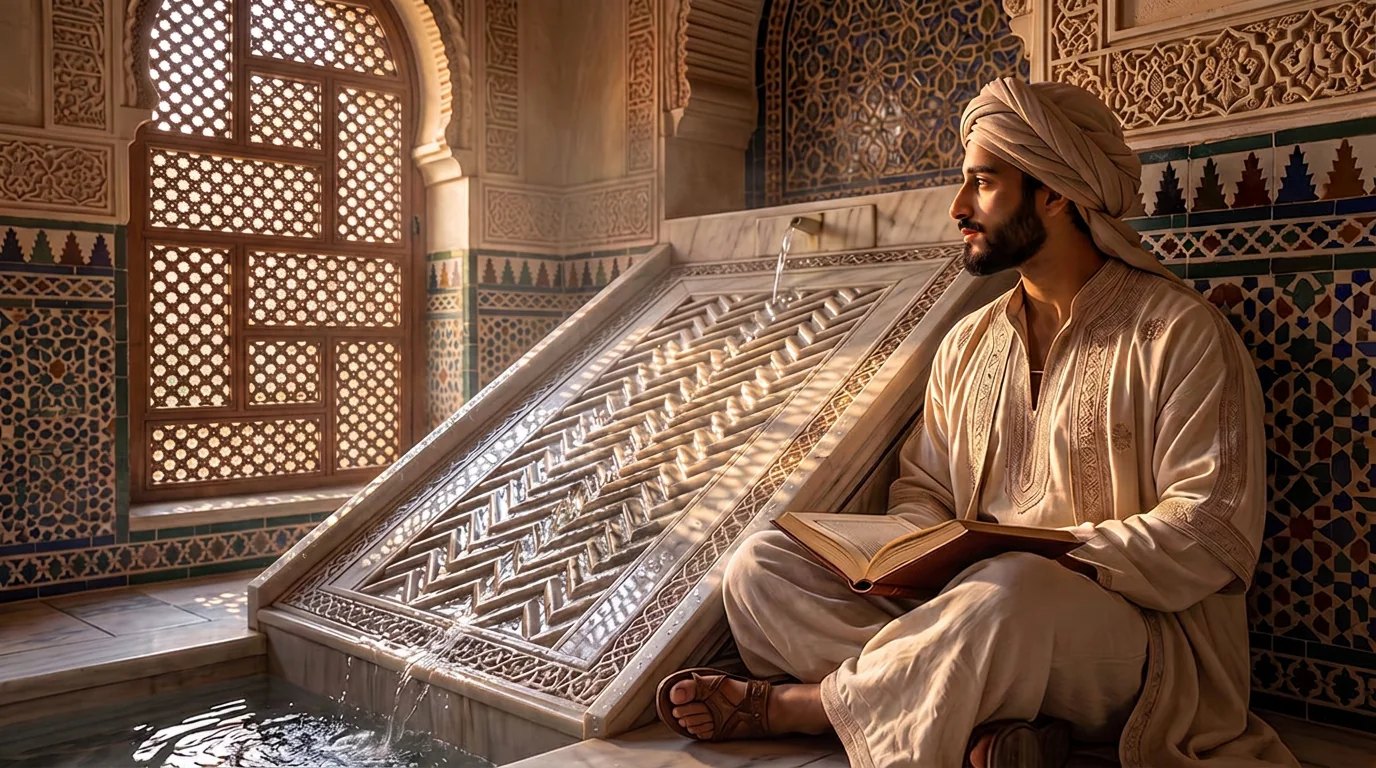
Inclined slab, often rippled, down which water runs in a thin sheet. The form maximises the surface exposed to the air, and with it evaporation, oxygenation and the sound that covers voices.
- Fisqiyyaفسقيةfisqiyya (fisqiya)
The basin flush with the floor at the centre of the patio: it gives the sky’s reflection and the murmur that accompanies conversation. It is found in the Patio de los Leones and the Patio de la Acequia of the Alhambra.
- Khettaraخطارةkhettāra, pl. khettarāt
An underground drainage gallery, inherited from Persian and Berber techniques: for centuries it brought water to oases and gardens without mechanical pumping.
- Seniaالسانيةas-sāniya · esp.aceña, sic.senia
The bucket wheel turned by an animal to raise water from a well into the garden channel. The word followed the wheel into Spain and Sicily, where it also names the garden it waters.
- Aljibeالجبal-jubb · esp.aljibe
The covered cistern, where rainwater or water from the conduit is kept away from the heat and from evaporation. From Arabic al-jubb, the well.
- Albercaالبركةal-birka · esp.alberca
The rectangular basin of the Andalusi garden, a reservoir for irrigation as much as a mirror in which the architecture stands. From Arabic al-birka, the pool.
- Qanatقناةqanāt
The slightly sloping underground gallery that taps a water table and carries the water by gravity to the garden, without pump or machine. Born in Iran, the technique is called khettara in Morocco.
- Acequiaالساقيةas-sāqiya
The open irrigation channel of Muslim Spain, which carries the water from the division point to the beds. The word comes from Arabic as-sāqiya, and the Alhambra keeps its most famous example, at the Patio de la Acequia.
- Malqafملقفmalqaf
“The catcher”: the tower that captures the wind and drives it into the house. Its trace appears as early as pharaonic Egypt; the Islamic period took up and refined the technique.
- Badgirبادگیرbādgīr
In Persia and the Gulf, the multidirectional wind tower — rather than one turned to a single prevailing wind. A variant of the same architectural gesture, born of the same need.
- Bustanبستانbustān
The walled garden, the orchard. At the Riad it is the secret garden, distinct from the main garden and the kitchen garden without being separate from them.
- Chahar baghچهار باغchahār bāgh
The Persian fourfold garden: four channels evoking the four rivers of paradise. Direct continuity in Isfahan and Shiraz, monumentalised in Mughal India.
- Paradeisos · pairi-daezaπαράδεισοςparadeisos · pairi-daēza
The Greek word behind our “paradise” comes from Old Persian pairi-daēza, “circular enclosure.” From the Achaemenid period the garden is already the image of the cosmos and of royal power.
- Ibriqإبريقibrīq
The ewer. To every guest who crosses the threshold the house offers hands washed in rose water, poured from an ibrīq into a ṭisht, before the first word is exchanged.
- Tishtطشتṭisht
The copper or tin basin that receives the water poured from the ibrīq: purification as much as welcome.
- Auleαὐλήaulē
The courtyard of the Greek house. At Olynthus, houses already opened onto an inner court oriented to catch the low winter sun and to shade itself in summer.
- Atrium · domusatrium · domus
The Roman domus is organised around the atrium, an open court gathering rainwater — the same principle that would become, centuries later, the Andalusian and then Moroccan patio.
- Bagliobaglio
The fortified Sicilian masseria: closed courtyard, blind outward façades, life turned inward. The same logic as the Andalusian and Maghrebi patio, reached by distinct paths rather than by direct borrowing.
The name most probably comes from Norman-French ballium; a minority hypothesis sees a borrowing from Arabic bahah, “courtyard.”
- Nevieraneviera · sic.
Pit or buried dome where the winter snow, covered with ferns and leaves, was kept until summer. A trade documented on the Iblei and on Etna between the seventeenth and the nineteenth centuries.
- Camera dello sciroccocamera dello scirocco · sic.
The cool room cut into the rock beneath Sicilian houses, where one withdrew on days of hot wind. Often linked to a water gallery or a cistern, it cools the air by the earth and by moisture.
- Funnacufunnacu · sic.
The Sicilian form of fondaco, in the sense of an inn with a stable. Nineteenth-century lexicography records the funnacaru, the man who keeps one.
- Atabaعتبةʿataba
The threshold. In the Islamic tradition it carries a rule, beyond the simple boundary of property: one crosses it only after having announced oneself and been received.
- Dribaدريبةdrība
The bent vestibule that follows the entrance door and prevents the eye from reaching the courtyard. It is onto the driba, before the bend, that the parlours open.
Moroccan form, a diminutive of derb; classical Arabic says rather saqīfa or dihlīz.
- Maqṣūraالمقصورةmaqṣūra
The closed room where the house receives without opening its interior. At the Riad there are three: they open onto the driba, before the bend, and it is there that the khitbah meeting is held, in the presence of relatives. In the mosque, originally, the reserved enclosure that separates without excluding.
- Sqifaسقيفةsaqīfa
The covered vestibule, the porch that shelters the entrance of a house. A classical term for which the Moroccan driba is the everyday equivalent.
- Dahlizدهليزdihlīz
The entrance corridor, between the door and the courtyard — the space that is no longer the street and not yet the house. A word of Persian origin that passed very early into Arabic.
- Istidhanاستئذانistiʾdhān
The asking of permission before entering another’s house, prescribed in Qur’an XXIV, 27. The verb used by the verse, tastaʾnisū, comes from the root ʾ-n-s — the very one that gives al-uns: to announce oneself is to seek to become familiar.
- Hurmaحرمةḥurma
Inviolability — of a house, a person, a pledge. What is protected not by a lock but by a rule that each one acknowledges.
- Ghurfaغرفةghurfa
The room, and first of all the upper chamber. In the madrasas, the student’s cell: a few square metres and a window — narrow by design, so that life is held elsewhere.
- Majlisمجلسmajlis
The meeting room of the house and, by extension, the assembly of the rifāq; the formula “member of the majlis of An-Nudama” designates a founder. The deliberations of the House belong to the majlis al-umanāʾ. The room in which one receives is the maqṣūra.
- Gebbiaجبّjubb
The square masonry tank which, in the Sicilian countryside, gathers the water for the kitchen garden. The name comes from the Arabic jubb, the cistern, the well.
- Saiaساقيةsāqiya
The surface irrigation channel that carries the water from the gebbia to the beds: the same Arabic word that in Spain became acequia.
- Favaraفوّارةfawwāra
The spring that gushes. It has given its name to several places on the island, and to the royal residence of Maredolce, near Palermo, with its basin.
- Zagaraزهرzahr
The blossom of the orange and the lemon. In Arabic zahr is the flower in general; Sicilian has reserved it for that of the citrus trees.
- Rahlرحلraḥl
The country farmstead, the rural estate, in the Arabic sources on Sicily. It gives its name to Ar-Rahl, the agricultural cooperative of the Funduq, and survives in the place-names in Rega- and Raca-.
- Dammusoداموسdammūs
The vault, and by extension the vaulted room; on Pantelleria, the domed stone house.
- Noriaناعورةnāʿūra
The great wheel that lifts water from a river or a well. From the same Arabic word comes noria; the senia of the Sicilian kitchen gardens is its younger sister, driven by an animal.
- Qalʿaقلعةqalʿa
The rock, the hilltop fortress. In Sicily it has given the names in Calta- and Cala-: Caltanissetta, Caltagirone, Calatafimi.
- Manzilمنزلmanzil
The halting-place, the dwelling along the road. It survives in the Sicilian place-names in Misil- and Mezzo-: Misilmeri, manzil al-amīr, the dwelling of the emir; Mezzojuso, manzil Yūsuf.
The hammam
- Hammamحمّامḥammām
The steam bath, direct heir of the Roman baths. In the house it belongs to the working day and not to the courtesy services, since the hot room, heated from the floor, and the circuit of the outfit that passes through it make it part of the work.
- Al-maslakhالمسلخal-maslakh
The disrobing room: here one undresses before entering the sequence.
- Al-bayt al-baridالبيت الباردal-bayt al-bārid a Fès:el-barrani
The first room, the least hot. The body acclimatises there on entering; one returns to rest there at length, over tea, once the bath is done. In Fez it is called el-barrani, “the outer one”.
- Al-bayt al-wastaniالبيت الوسطانيal-bayt al-wasṭānī a Fès:el-wasti
The middle room: the largest, where most time is spent, between light steam, massage and scents. In Fez, el-wasti.
- Al-bayt al-sukhunالبيت السخونal-bayt as-sukhūn a Fès:ed-dakhli
The inner room, the hottest, backing onto the hearth: it is here that the body is prepared for black soap, then for the kessa glove. In Fez, ed-dakhli, “the inner one”.
- Bayt al-narبيت النارbayt an-nār — in Fez: el-farnatchi
The furnace room: unseen by the bathers, backing onto the inner room, it feeds heat to the whole system. In Fez, el-farnatchi.
- Kessaكيسةkessa
The coarse glove. It lifts away what the black soap has softened deep down — never the reverse, never on dry skin.
- Sabun beldiصابون بلديṣābūn beldī
Black soap: a dark olive-oil paste, sometimes enriched with crushed olives, historically tied to centres such as Essaouira. Applied to warm damp skin, it is left to rest several minutes.
- Tayyeb · tayyabaطيّب · طيّابةṭayyeb · ṭayyāba
The massage master of the Maghrebi hammam — and his female counterpart for women’s hammams, the two worlds remaining strictly separate. This is no spa masseur, but a craft transmitted inside the hammam itself, by repeated practice.
- Farnatchiالفرناتشيel-farnatchi
The hearth of the hammam — and, by the same word, the man who keeps the fire in it day and night. It sits outside the bath, backing onto the wall of the inner room, and opens onto the alley, through which the fuel comes in and the ash goes out. Also bayt an-nār.
The fire burns wood — hammams are among the country’s largest consumers of wood — and alongside it what the city has no further use for: sawdust and shavings from the joiners, olive pomace and pits, orchard prunings.
- Bormaالبرمةel-borma · ancheburma
The hot-water basin of the hammam, set against the hearth, where bathers fill their buckets. The water is heated at the hearth — in a vessel set over the fire and in the basin itself — before the gases pass under the floor.
- Chebkaالشبكةech-chebka "la rete"
The network of flues cut beneath the paving of the inner room and the middle room. The gases of the hearth enter it after heating the water, and then reach the chimney.
The hypocaust under its Moroccan name. The heat radiates from no visible source, but rises from the floor, and the floor gives it back long after the fire has died down.
- Tractatiotractatio
The oil massage after the bath, already practised in Roman and Byzantine thermae — a gesture the hammam inherited and passed on in its own way.
The institution
- Funduqفندقfunduq
A walled house, in a foreign city, where a community lodged, stored goods, prayed and settled its own disputes. From the Greek pandokeion, the inn open to whoever arrives. From funduq derive the Italian fondaco, the Venetian fontego, the Castilian alhondiga and the Catalan alfondec.
- Al-Munyaالمنيةal-munya
In Andalusian usage, the suburban villa with garden. In the project it is the guesthouse, the body — own entrance, the same crest in both seats, a distinct subject with its own assets. It gathers Dar al-Asl, where the guests of the house lodge, and Dar al-Diyafa, where the nudamāʾ and their guests lodge. The structure is the same in Fez and in Sicily.
- Tahkimتحكيمtahkim
Arbitration. In the project it designates the settlement of disputes among members before a panel of three.
The names of the house
- Rafiq, rifaqرفيق، رفاقrafīq, pl. rifāq
The companion, the companions. It is the name by which the members of the house call one another, and corresponds to the member and members of the founding documents.
- Al-majlisالمجلسal-majlis
The body of the rifāq gathered to deliberate. It corresponds to the assembly of the members: it approves the accounts, elects and removes the majlis al-umanā, decides on exclusions and on the niẓām ad-dār.
- Muallimمعلّمmuʿallim
The master of the workshop. The function pertains to the organisation of the work and to technical responsibility, and confers no further right in the majlis.
- Na’ibنائبnāʾib
The muʿallim’s deputy in the workshop. Like all operational functions, it is not worth one vote more.
The crafts
- Zellijزليجzillij
Mosaic of tiles cut with a chisel one by one and composed by geometric tessellation. From the same term derives the Spanish azulejo.
- Mocarabeمقربصmuqarnas
Honeycomb construction in plaster or wood that joins a curved surface to a flat one. In Italian muqarnas is also used.
Water and climate
- Fisqiyaفسقيةfisqiya
Basin at floor level, at the centre of the courtyard, designed to expose to the air the largest possible surface of water.
- Malqaf e badgirملقفmalqaf
Wind-catching devices belonging respectively to Egypt and the Levant the first, to Persia and the Gulf the second. They are not used in the project, because they answer climates different from that of the Iblei.
Note on sources
The Sicilian Arabisms gebbia, saia, senia and margio are confirmed by academic lexicography. Catusu and dammusu reach Sicilian through Arabic but go back to a Greek base, and must be cited with that qualification. In the headings of the site the words are written in plain form; the vocalised form appears here.