
Choreutic discipline
Two gestures transmitted as a craft — the staff and the rhythm — never a spectacle.
At Dar al-Hiraf, the body is learned like matter: through repetition, patience, and the quiet authority of a master. What follows brings together two disciplines of this kind — one governs gesture, the other rhythm. What belongs to sound and speech — Andalusian music, the sung qasida, listening — is treated apart, in Music and chant.
These two disciplines come under a single word. In Arabic, riyāḍa (رياضة) denotes the exercise of the body as much as the work a man conducts upon himself: al-Ghazālī gives the name riyāḍat al-nafs (رياضة النفس), the training of the soul, to the book of the Iḥyāʾ he devotes to the correction of character, and there speaks of the vices in the vocabulary of the physician. The staff and the rhythm of the guembri are therefore two materials offered to the same work, and not two separate techniques.
DISCIPLINE OF THE BODY
Tahtib — The art of the staff
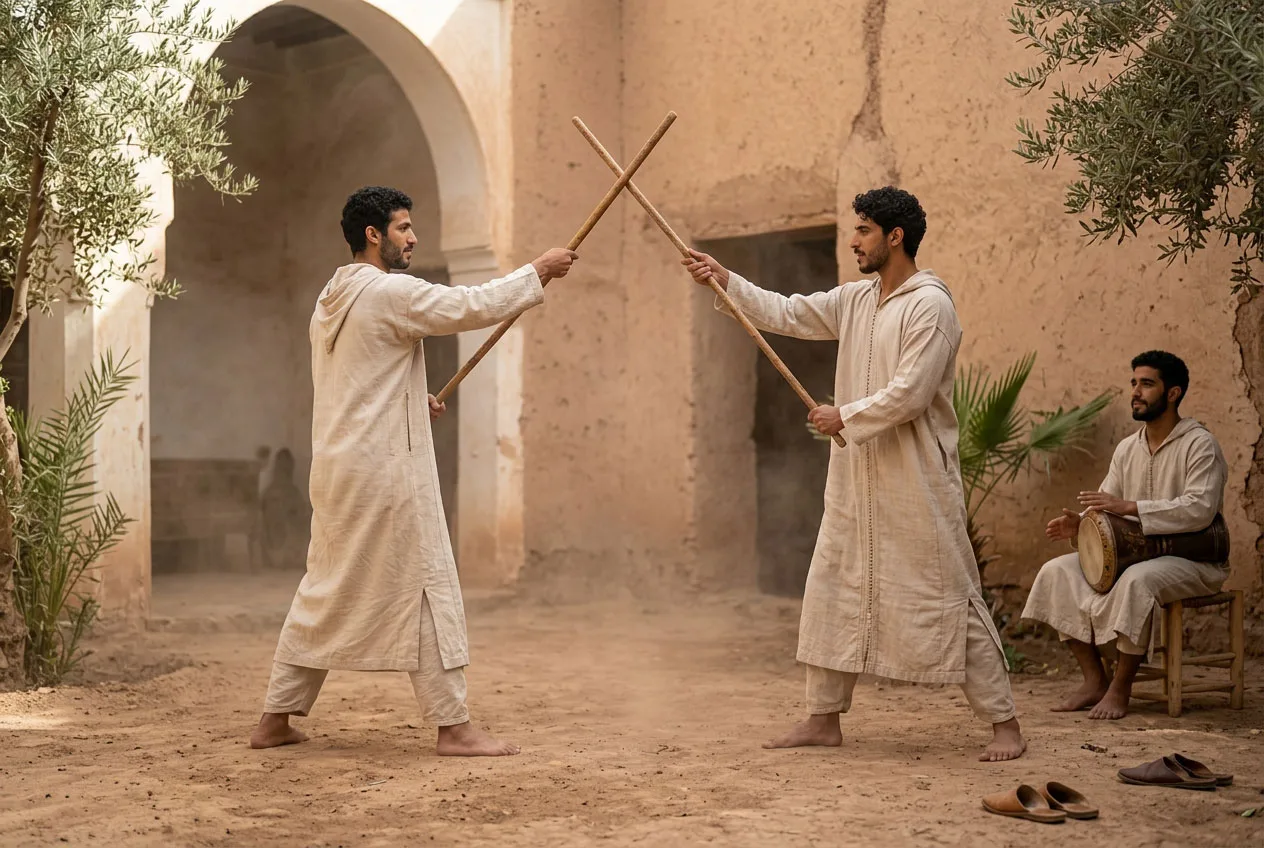
Born in ancient Egypt — traces of it are already found in pharaonic bas-reliefs — and still alive today in Upper Egypt, taḥṭīb is a dialogue rather than a fight: two men, two staffs, a drum rhythm that governs every gesture. It is an exercise in precision, restraint and courage rather than a choreography learned to be shown — mastery of the body always preceding mastery of the weapon.
It is in this spirit that it finds its place at Dar al-Hiraf, alongside the other disciplines: not as an attraction, but as a practice of measured courage.
The staff used, called ʿasa (عصا) or nabboud (نبوت), generally measures 1.20 to 1.50 metres — long enough to demand precise management of distance, too light to cause serious injury if handled with precision. The duel is played to a drum rhythm (tabla baladi, طبلة بلدي) that accelerates in stages: each change of tempo forces both men to read anew the space and the other’s gesture. The winner is the one who touches without ever losing the measure, and not the one who strikes hardest.
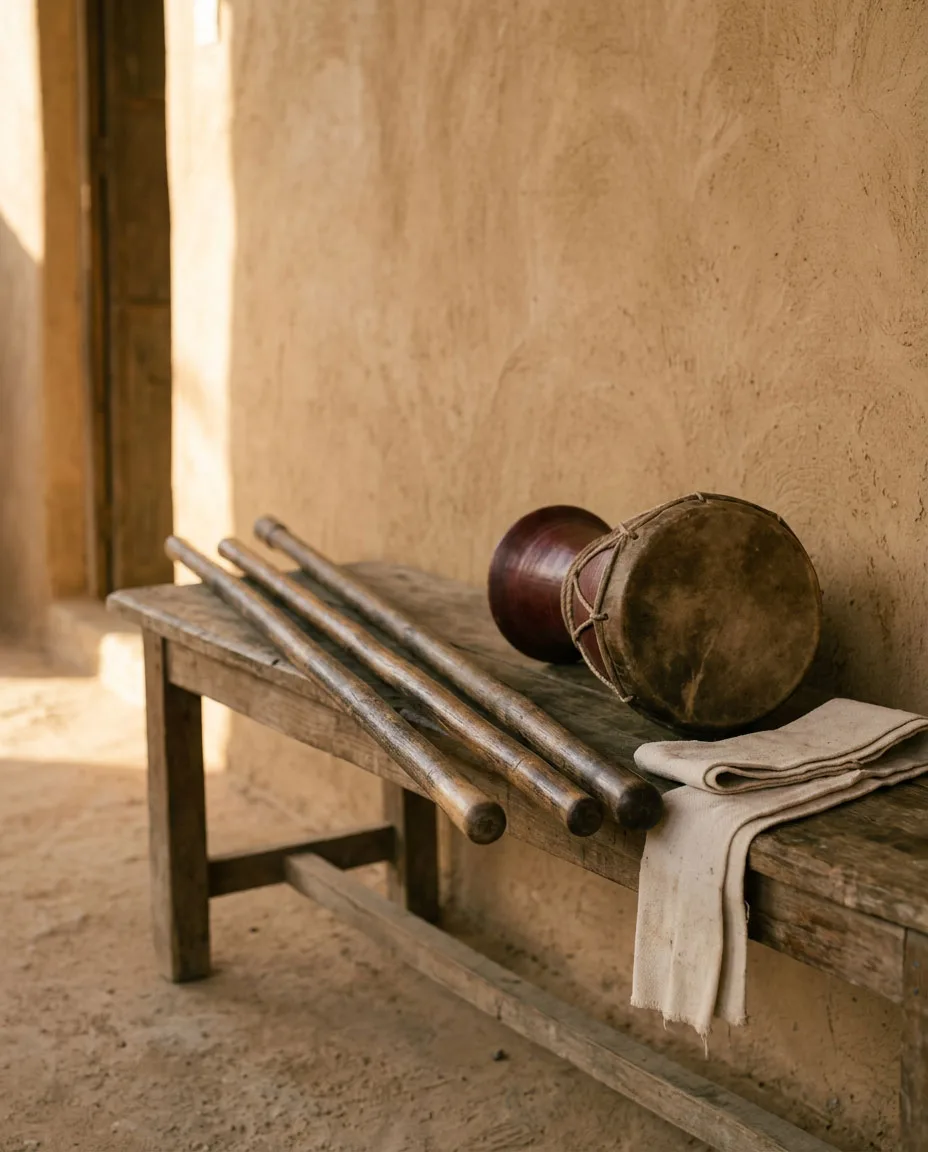
The staffs and the drum that governs the duel.
وَلَقَدْ شَفى نَفسي وَأَبرَأَ سُقمَها قَولُ الفَوارِسِ وَيْكَ عَنتَرَ أَقدِمِ
Wa-laqad shafā nafsī wa-abra’a suqmahā / qawlu-l-fawārisi wayka ʿAntara aqdimi
“My soul was healed, its ailment cured, by the horsemen’s cry: ‘Courage, Antar, advance!’”
ʿAntarah ibn Shaddād — Muʿallaqa, 6th century
This verse, one of the most famous in all pre-Islamic poetry, belongs to the Muʿallaqa of ʿAntarah ibn Shaddād — the poet-horseman par excellence. It does not describe taḥṭīb itself, born in a wholly different region and a wholly different era; but the spirit it carries — the body finding its peace in mastered trial — is what this discipline seeks to transmit.
DISCIPLINE OF SOUND
Gnawa — the transmission of the maalem
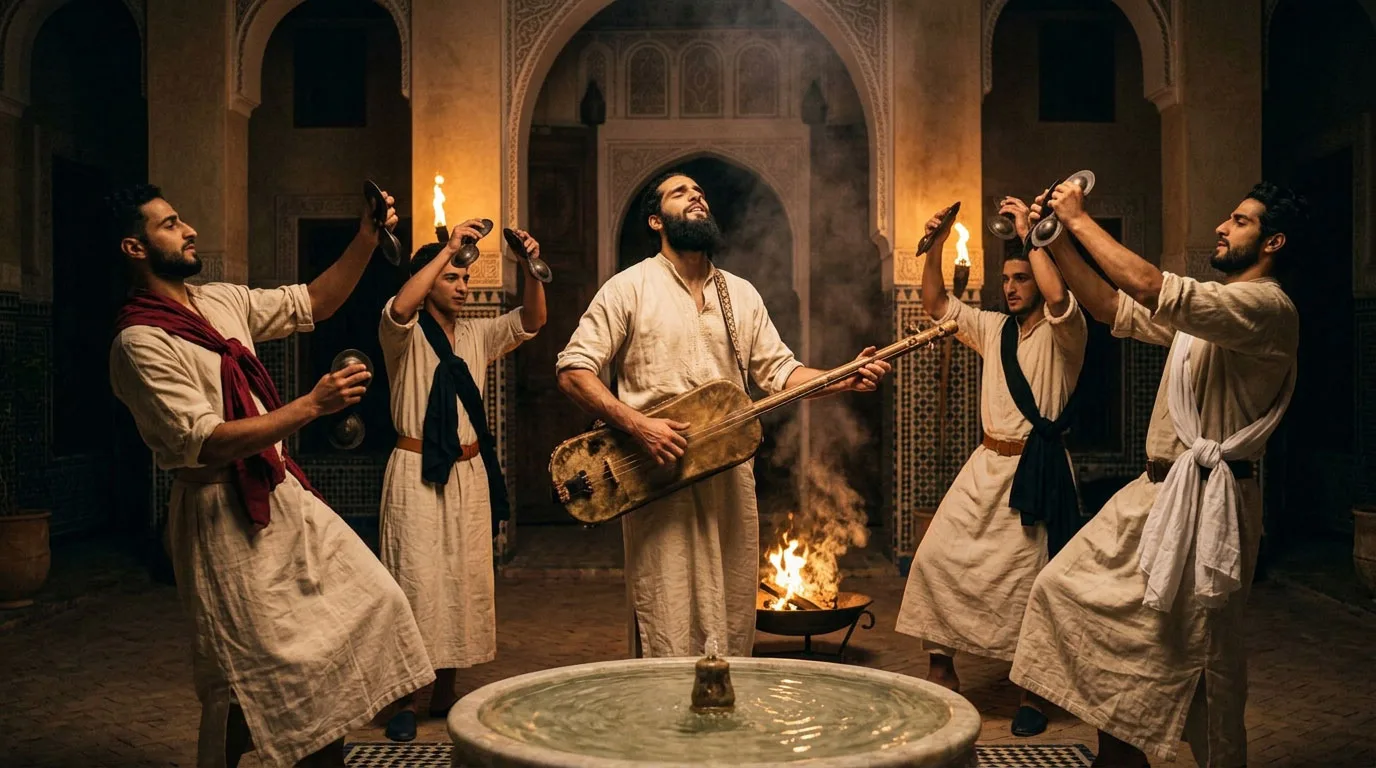
Carried by the three-stringed guembri and the metal qraqeb, gnawa is a music of transmission inherited from brotherhoods of sub-Saharan origin settled in Morocco for centuries — an oral repertoire, outside the written canon of classical Arabic poetry, but just as rigorous in its pedagogy. The master who teaches it bears a title that is no accident: maalem — the same word as that of the master craftsman, maalem zellige, maalem menbut.
A single system of transmission, applied now to stone, now to wood, now to sound: it is this link that justifies its place at Dar al-Hiraf.
The complete gnawa ceremony, called lila (ليلة, “the night”), can last a whole night: it associates with each colour of cloth, each rhythm of the guembri, a precise spiritual entity that the chant comes to invoke and then appease. The maalem gnawa does not merely play a repertoire, but leads the whole night, knowing when to slow, when to relaunch, when to close.
LISTEN TO AN EXAMPLE OF GNAWA
Maalem Said Damir — “Soudani Manayou”, from the repertoire of the lila.
“The master does not show a step, but transmits a rhythm that the body must learn to carry alone.”
The body also finds its rest in silent listening — the samāʿ that closes certain evening gatherings of the house.
The words of this page are in the common glossary; the works cited in the sources; the sister house is Al-Funduq aṣ-Ṣiqillī.