The economic model
How the house in Fez sustains itself over time
How the house in Fez sustains itself over time: the bodies, the funds, the path of apprentices and masters, the accounts of the first ten years.
01The principle
The house in Fez will train masters of a craft by the method of direct transmission, in the workshop and on the building site, and will accompany them to a workshop of their own. It will rest on an inalienable patrimony, the walls and a permanent endowment, whose yield will cover the ordinary deficit; the founders’ annual shares and the guesthouse’s rent will feed the reserve, the revolving fund and, once these have reached their set level, the endowment itself.
In the first decade there will be one house, at the reference size of three masters and twelve to fifteen apprentices, with the training site and a single teaching workshop at opening, the saddlery, and no obligation to grow. That is a declared choice: the value of the model lies in demonstrating a method and in the durability of its assets, more than in the number of those it trains. The fondouks will come into being on conditions, without dates.
02The model in one picture
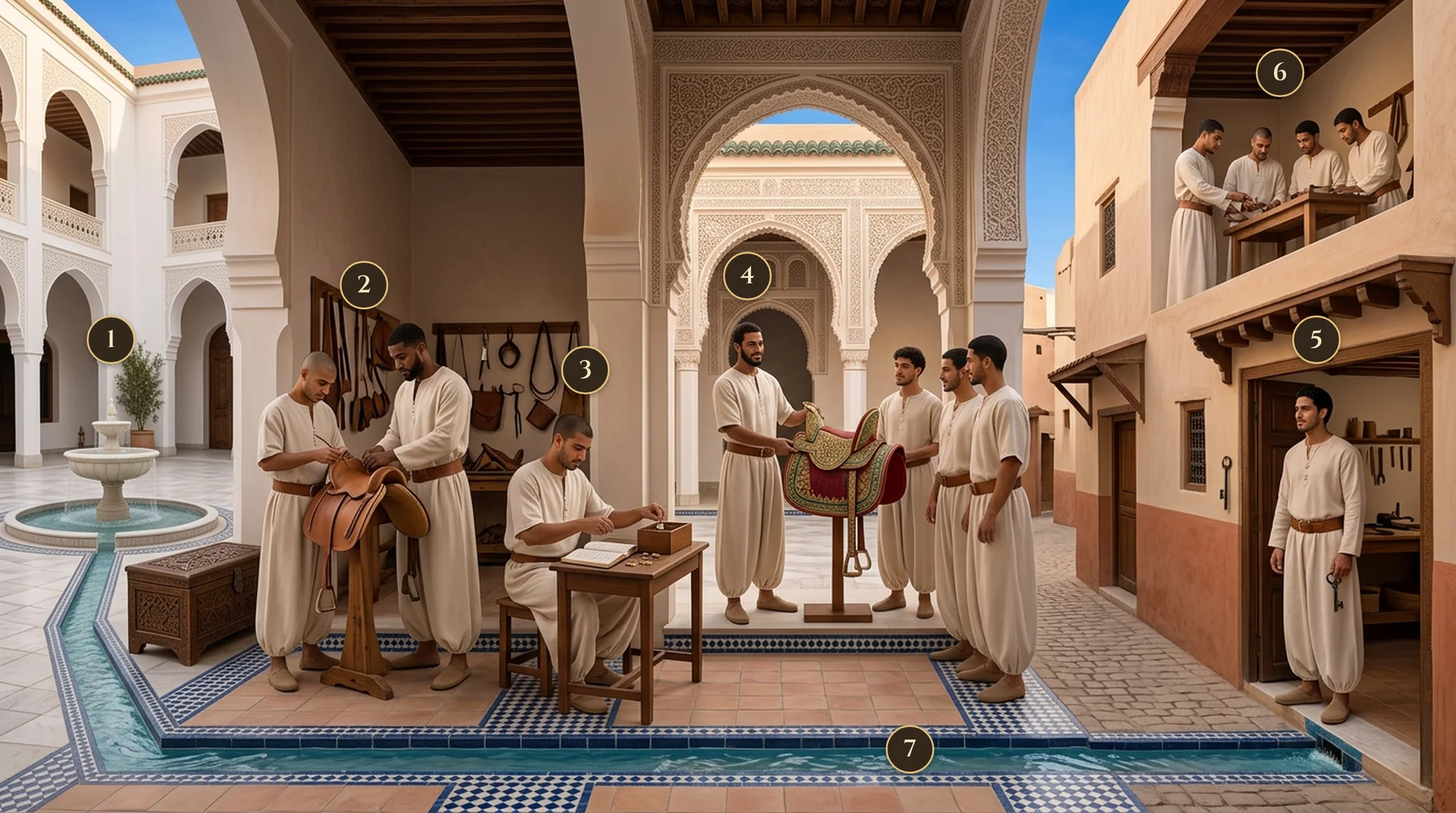
Seven places in the same house, from left to right, follow the money and the path of a young man.
- The patrimony. The walls and the permanent endowment, held by the Custody and inalienable. Only the yield of the endowment will be spent, as one uses the water of the fountain.
- The apprentice. He will learn at the bench, beside the master. The house will give him board, lodging, dress, working instruments and a scholarship.
- The account in his name. He will set aside part of the scholarship and the credits on work sold. Capital and return will remain his.
- The master. The title will be recognised on the piece left to the house. Then he will choose his path, and none will be imposed on him.
- The house-workshop. In the medina, restored by the school’s building site. The account will be the first share; the rest will be a loan in instalments, without interest.
- Ar-Riwāq. Or he will stay in the house, a master among masters, and teach the younger ones.
- The revolving fund. Like the channel: it will lend for the house-workshops, collect the instalments and lend again to the master who comes next.
03The bodies
Each body answers one question and is born at a declared threshold. Money intended for a body that does not yet exist will be held in escrow by a third party and returned to those who paid it if the threshold is not reached.
- The promoting association. It decides until the house exists: the surveys, the property, the restoration, the choice of the masters and of the first apprentices. It is the counterpart of patrons and institutions and, at the transfer of powers, it will dissolve or become a body of the House.
- The Custody (amāna). An independent council, bound by fiduciary duties, will own the walls and the permanent endowment, both inalienable, and will keep the register of commitments.
- The House. It lives and works: the workshops, the common life, the apprentices’ scholarships. It will be governed by the table of residents and by elected offices of service.
- Al-Munya. The guesthouse will have its own accounts and will pay the House a fixed rent, never a percentage.
- An-Nudama. The ninety-nine founders will support the house with an entry share and an annual share, with no voice in its government.
- As-Ṣandūq. The mutual aid fund will belong to the members, with separate assets.
- Il Fondaco Siciliano. The association already constituted in Italy is the project’s Italian body for Al-Funduq as-Siqilli, and receives European and Italian contributions.
04The five funds
The house’s money will sit in five funds, each with its own holder.
- The walls and the permanent endowment. They will be held by the Custody, which will invest the endowment in compliant instruments and allocate its yield to the House. They will come from the founders’ entry shares, from patrons’ custodies and from foundations.
- The reserve and the revolving fund. Twelve months of costs will be kept in reserve; the fund will advance the house-workshops and collect the instalments. They will come from the annual shares, from Al-Munya’s rent and from surpluses.
- The apprentice’s account. In each apprentice’s own name, with a participatory bank, it will gather the part of the scholarship he chooses to set aside and the credits on work sold.
- As-Ṣandūq. Mutual aid on the six occasions of a working life, fed by the members’ dues, by an annual contribution from the House and by restricted bequests.
- The takāful. The mutual cover of the outstanding debt on the house-workshop in case of death or disability, included in the master’s instalment.
No fund will rescue another, except through three passages written into the statutes: the reserve will make good each year the erosion of the revolving fund; the House will pay an annual contribution to the mutual aid fund, without a vote and without knowing whom the fund helps; the balance of the apprentice’s account will convert, if he so wishes, into the first share of his house-workshop.
05The rule of the operating account
The House’s ordinary deficit will be covered only by the yield of the endowment. The founders’ annual shares and Al-Munya’s rent will go to the reserve, to the revolving fund and, once these have reached their set level, to the endowment. Until the endowment suffices, the annual shares will cover the difference, and the house will declare this as a period of dependence on the company of the founders.
06The apprentice
The craft knows only two conditions, ṣāniʿ and maʿallem. The course will last a little over three years on average, shorter for some and longer for others. Each resident apprentice will receive a monthly scholarship, and may freely choose to set part of it aside in an account in his name, with a participatory bank in Fez. Board, lodging, dress, working instruments, training and health cover will be borne by the house.
The apprentices in the workshops of the training site will have the same condition as those in the saddlery, with the same scholarship and the same freedom to set part of it aside in their own account; during the restoration, the works budget will support them.
The capital and the return of the account will remain the apprentice’s, outside the assets of the Custody and of the House. The account will give no vote, will remain untouched in case of sanction and will pass to the heirs. To it will be added the credits on work sold: a fixed share of the value of each commission, divided among the apprentices who worked on it in proportion to their hours. On leaving, the holder will withdraw it, or convert it at par into the first share of his house-workshop.
07The master
Whoever receives the title of master, recognised on the piece left to the house, will choose among three paths, and the house will owe none of them to anyone.
- To stay in the stable community of young masters, Ar-Riwāq, with a salary as an internal master: these are the masters who will teach the following cohorts.
- To buy a house-workshop in the medina, at cost and without interest. The choice may be deferred for a few years while remaining in the house.
- To leave and open a workshop elsewhere, with the balance of the account, the tools advanced by the mutual aid fund and membership of the fund for as long as he pays his dues.
Beside these, employment with a client and work in the workshop of a funduq of the network remain open.
08The house-workshop and the revolving fund
The house-workshop will be a ruin in the derb restored by the school’s building site and passed on at cost. The house will buy these ruins only once it is itself open, from willing sellers and at market price, in a limited and declared number; an inhabited house will stay with those who live in it.
The first share will come from the apprentice’s account. The rest will be an interest-free loan from the House’s revolving fund (qarḍ ḥasan), repaid in instalments over ten years, with takāful on the outstanding debt with a participatory bank. The master will repay exactly what he received and, once the instalments end, will have full ownership: to live in, to mortgage, to bequeath.
The instalments will return to the revolving fund, which will use them for the next master’s house-workshop; they will not enter the mutual aid fund. The right to live in and redeem the house-workshop will rest solely on payment of the instalment, never on work for the network nor on a commitment to teach. The master will freely accept or decline the network’s commissions; the network will remain a steady client in lean periods, within a minority share of his activity; and he will keep his own signature and his own workshop mark.
09As-Sanduq
The common fund will belong to the apprentices and masters trained in the house, with automatic membership and equal dues; the House will contribute without governing it. It will cover, in the order of a lifetime, the tools of the first workshop through an interest-free loan, help towards marriage, illness, the outstanding debt on the house-workshop as a last resort after the takāful, burial and extraordinary relief.
It will be administered by three elected members, excluding all who hold authority in the house; three keys will open the chest; the accounts will be closed each year without names, before the members and an external auditor. An annual ceiling, with apportionment among applicants, will keep the fund from failing through an excess of claims. The covers will switch on by thresholds, from the first table of residents to the first sale of a house-workshop. See As-Sanduq, the chest→.
10The work of the network
A young master is exposed to the swings of private demand. The network will offer him a steady client: the continuous restoration of its own premises, the houses of the derb, the works of Al-Munya. Heavy works, structures, services and safety, will go to licensed contractors; traditional artistic works will go to the network’s workshops and masters, at a declared rate. Spending on the premises will thus support the payment of instalments, without becoming dependence.
11The first ten years
The accounts concern the house in Fez alone, at its reference size, without growth, for ten years; public and foundation funds are not counted. There are two cases, with all assumptions written down.
- Base case. The founders will join steadily up to ninety-nine, the endowment will yield what a prudent compliant portfolio yields, and Al-Munya will pay its rent from the second year. The rule of the operating account will be reached around the fifth year; the revolving fund will reach its level from surpluses by the third and lend from the fourth.
- Prudent case. The founders will join slowly, the return will be lower, costs higher, and Al-Munya will pay nothing. The model will hold from the fifth year, and the first four will need a bridge equal to one patron’s custody or a few more founders. The rule of the operating account will arrive around the eighteenth year, and until then the house will depend on the annual shares for half its deficit: that is the concentration risk, and it must be declared.
In both cases the house will train thirty masters in ten years. Beside each of them will stand a restored building, the house-workshops raised again in the derb and the crafts recorded in the Dīwān al-Ṣanāʾiʿ.
12What is measured and published
Three numbers decide between the two cases, none of them yet measured: the net real return of a compliant portfolio, the pace at which founders join after the first thirty-three, the actual stays in Al-Munya. The first two will be measured in phase zero, with a manager’s written proposal and the first commitments entered in the register; the third only once the house is open. The price of the house-workshop and the income of a master saddler, to be measured by a pilot in a Fez workshop, move the revolving fund and not the soundness of the house.
Each year the house will publish five indicators:
- the reserve, in months of costs;
- the yield of the endowment in relation to the deficit: when it exceeds one, the house stands on its own;
- the revolving fund in relation to the outlays of the next two years;
- masters trained and those still in the craft after five years;
- arrears on instalments.
13The fondouks
The network will grow by budding, without a programme. A fondouk will open when three conditions hold together: the mother house has reached the rule of the operating account; its revolving fund replenishes itself; there are masters trained in the house, from the stable community, willing to move and to lead the workshops. No date and no sequence precede these conditions.
Al-Funduq as-Siqilli has a function different from that of Fez: it is a house of work and of selection, with its own threshold and capital, sought in Italy through Il Fondaco Siciliano. Each fondouk will have its own Custody, its own house and its own mutual aid fund, recognised by the others. See The network: house, funduq, hanut→.
14The cautions
- The central figures are not measured. The income of a master saddler, the price and restoration cost of a house in the medina, the return of a compliant portfolio and the stays in Al-Munya are working assumptions. The model is a structure and not a forecast, until phase zero and the pilot have measured them.
- A single source does not carry the plan. No source will exceed half the capital raised, and the plan is built without counting sources not secured.
- Repayments to the revolving fund are a gross flow. Erosion, deed and survey costs and residual arrears must be deducted.
- The capacity of the buildings. It is verified, for structure, hygiene and fire safety, before any increase in the number of apprentices.
- Currencies. In Fez the revolving fund will keep separate accounts in dirhams, to avoid exchange risk on advances and instalments.
- What is declared in advance. Residence reserved to men and Al-Munya’s written rule of hospitality are made known to funders before any commitment.
15For those who want the figures
This page describes the structure of the model without amounts. The figures, with the assumptions of each case and the accounts year by year, are gathered in a confidential brief, which the house sends to anyone who asks. See Write to the house→. What becomes of the money of those who support the houses is told in The custody of the gift→.