Diwan al-Sanai
The register of the arts
The Dīwān al-Ṣanāʾiʿ will be the comparative register of the Mediterranean crafts. For each craft it will gather the regional variants, described in the technical language in which they are practised and by those who practise them, and it will keep them side by side without reducing them to a common model. The comparison will show where the variants agree and where they diverge: in tools, materials, the sequence of gestures, vocabulary, the organisation of the workshop and the forms of transmission.
The register will be born within the Al-Mithaq network, since every house, every funduq and every affiliated ḥānūt will document the variant of its own craft in it. It will nonetheless be open to workshops and masters outside the network, since its subject is the craft and not membership.
01Subject and method
The unit of record will be the variant: a craft practised in a given place, by a recognisable community of masters, according to a tradition that this community recognises as its own. Variants will be compared by families of crafts, and the comparison will move from gesture to object, describing first the operational sequence and then the products and their uses.
Each entry will keep three levels of attestation apart: what the master declares, what is observed in the workshop and what written and material sources document. The three voices will remain separate, so that the reader can always trace where a piece of information comes from. No chain of transmission will be published without the consent of the master who reports it, and no entry will be made public before the workshop documented has read its text.
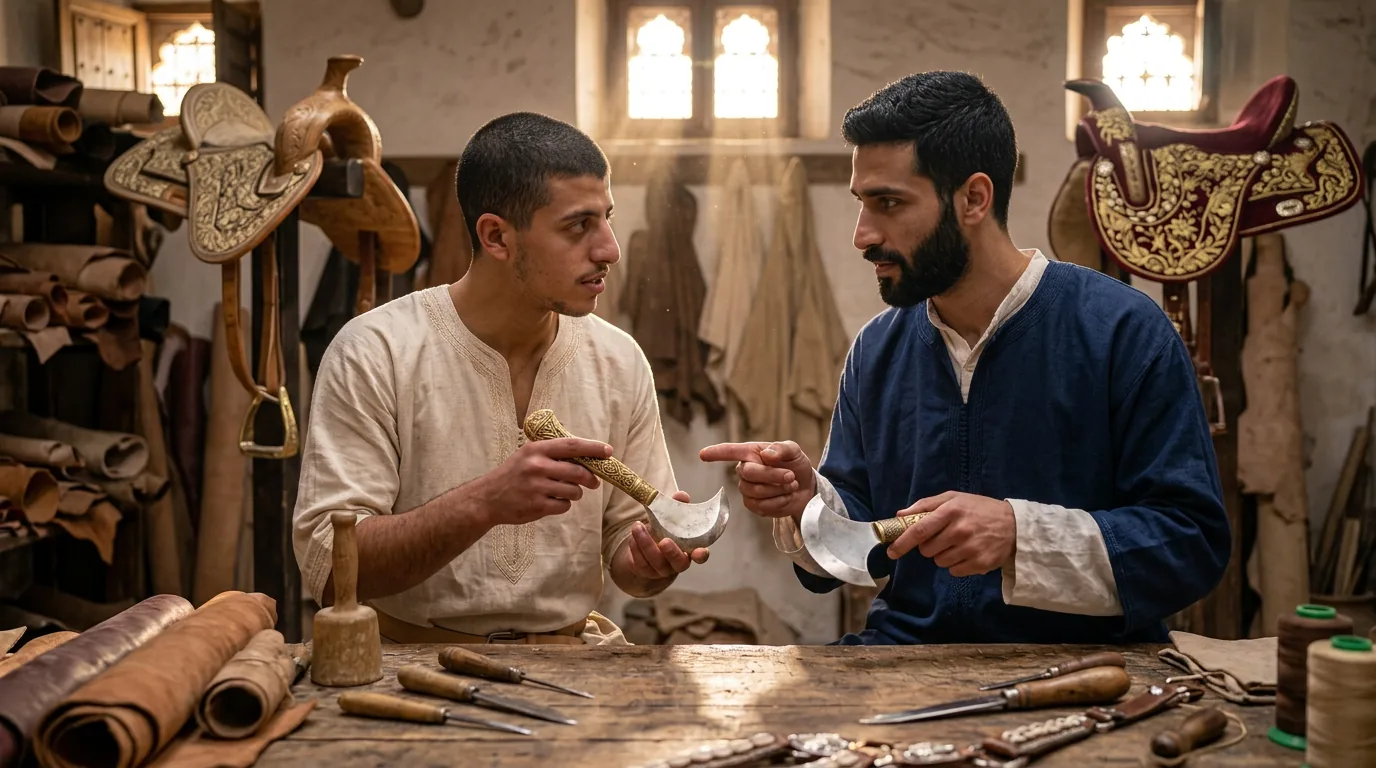
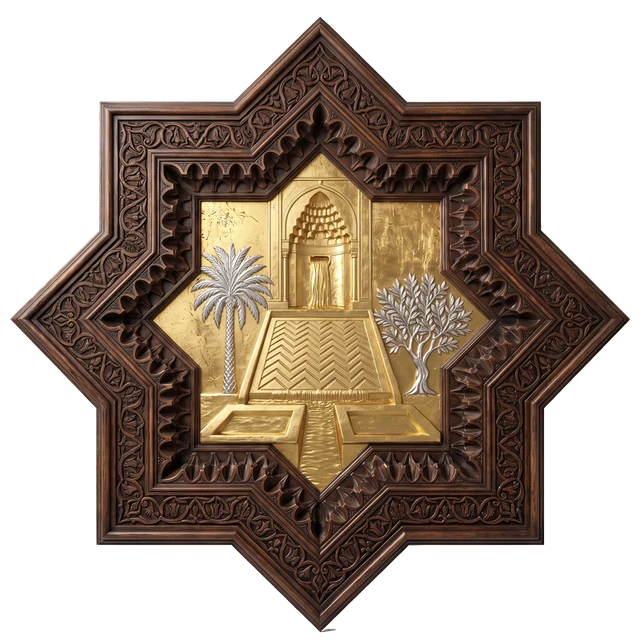
The emblem of the register shows two fine-saddlery knives that serve the same cut of the leather, with different shapes and names: one Spanish, the other Moroccan. In the same way the register will record the regional variants of each craft, one gesture in the forms each shore has given it.
02The entry
For each variant the entry will record the name of the craft in the local language, with transcription and translation; the tools, with their local name, shape, material and maker; the materials, their origin and preparation; the operational sequence, gesture by gesture, documented in photographs and film; the products and their uses; the organisation of the workshop, the grades and the length of the apprenticeship; the chain of masters, with the consent of the one who reports it; the workshops still at work, where their number can be established; the state of the craft, assessed by criteria stated in the entry itself; the technical vocabulary, recorded from the masters’ own voices.
Entries will be written in the language of the craft and translated into Italian, French, English and Arabic.
03The first campaign: glazed ceramics
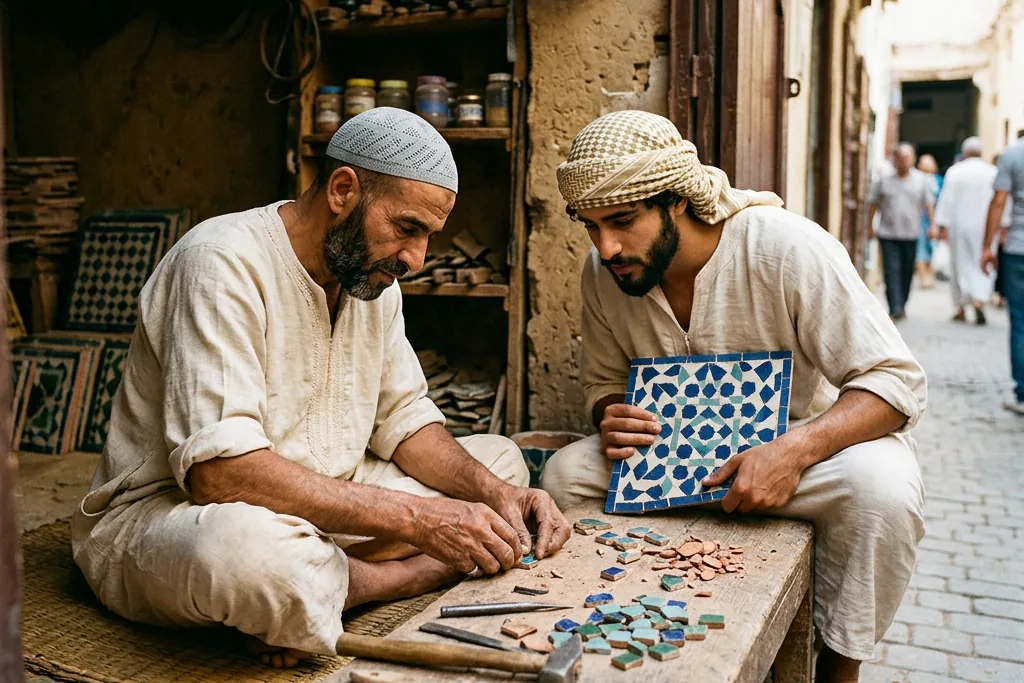
The register will begin with glazed ceramics, in the two forms of architectural cladding and vessels. It is the family of crafts in which Mediterranean circulation is best documented: tin glaze, cuerda seca and metallic lustre travelled between the Near East, al-Andalus, the Maghreb and Italy, and each place bent them to its own repertoire of forms, colours and names.
From the outset the campaign will cover eight countries.
- Morocco — The zellīj of Fez, cut by hand with the minqāsh from glazed tiles, and the ceramics of Safi.
- Tunisia — The ceramics of Nabeul and of Guellala, on the island of Djerba.
- Spain — The azulejos of Seville, the cuerda seca technique, the metallic lustre of Manises and the ceramics of Talavera de la Reina and El Puente del Arzobispo, inscribed by UNESCO in 2019 together with those of Puebla and Tlaxcala.
- Portugal — The azulejo and the black pottery of Bisalhães, inscribed by UNESCO in 2016.
- Italy — The maiolica of Caltagirone and Santo Stefano di Camastra in Sicily, of Vietri, Deruta and Faenza.
- Turkey — The çini of İznik and Kütahya, inscribed by UNESCO in 2016.
- Syria — The tiles of Damascus.
- Palestine — The ceramics of Hebron.
04The following campaigns
After ceramics, the register will follow other families of crafts in which the Mediterranean preserves a large number of variants, including those of countries at war.
- Leather and saddlery — Saddlery is the workshop with which the Al-Mithaq houses will open, and the second campaign will follow its variants: the saddlers of Fez, the Andalusian saddlery of Jerez de la Frontera, the painted and gilded leather of Córdoba (guadamecí), the embroidered leather of Ghadames in Libya. The emblem of the register comes from this campaign.
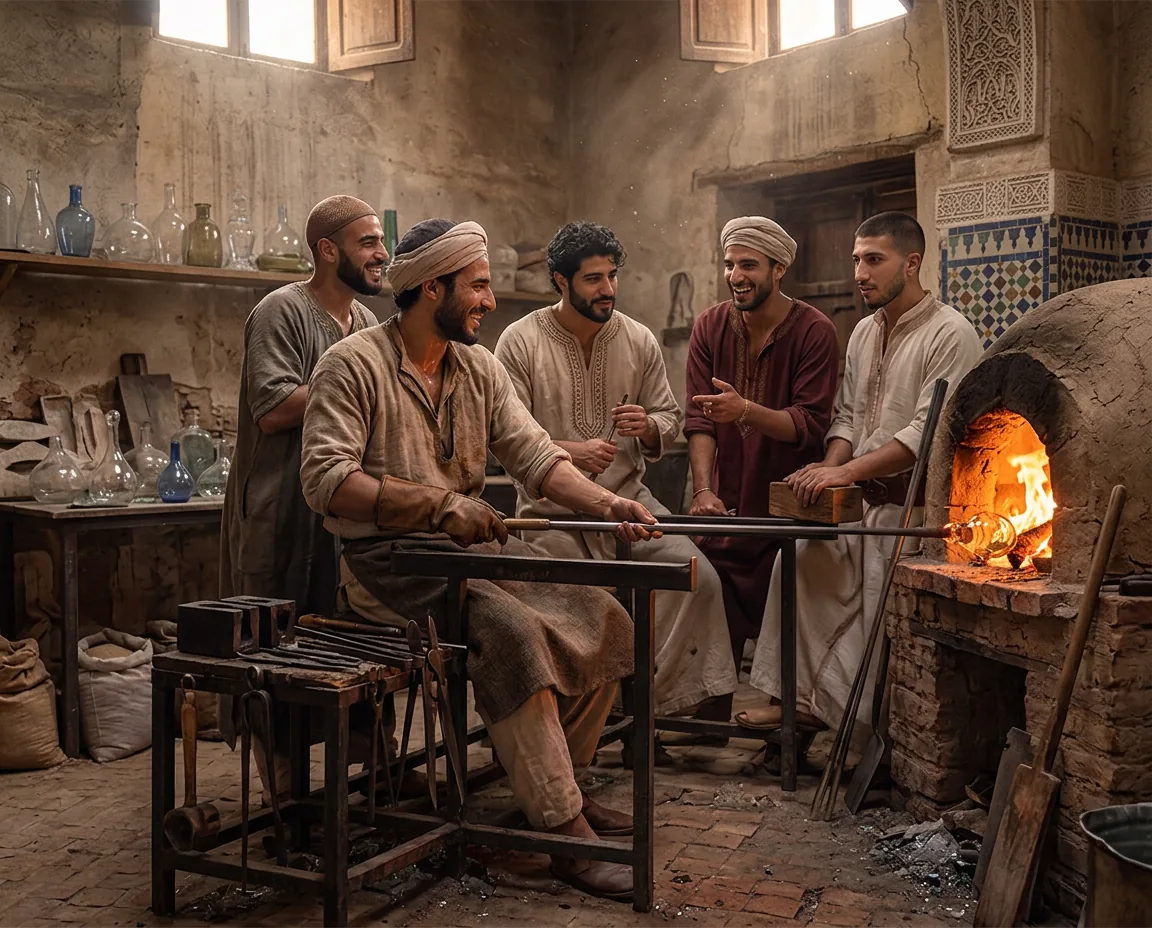
- Blown glass — Syria, where traditional glassblowing has been inscribed since 2023 on the UNESCO List of Intangible Cultural Heritage in Need of Urgent Safeguarding; Hebron, in Palestine; Murano, where the art of glass beads has been inscribed since 2020, together with France; Cairo. The campaign will be linked to the glass workshop the network will open to take in master glassmakers from lands at war.
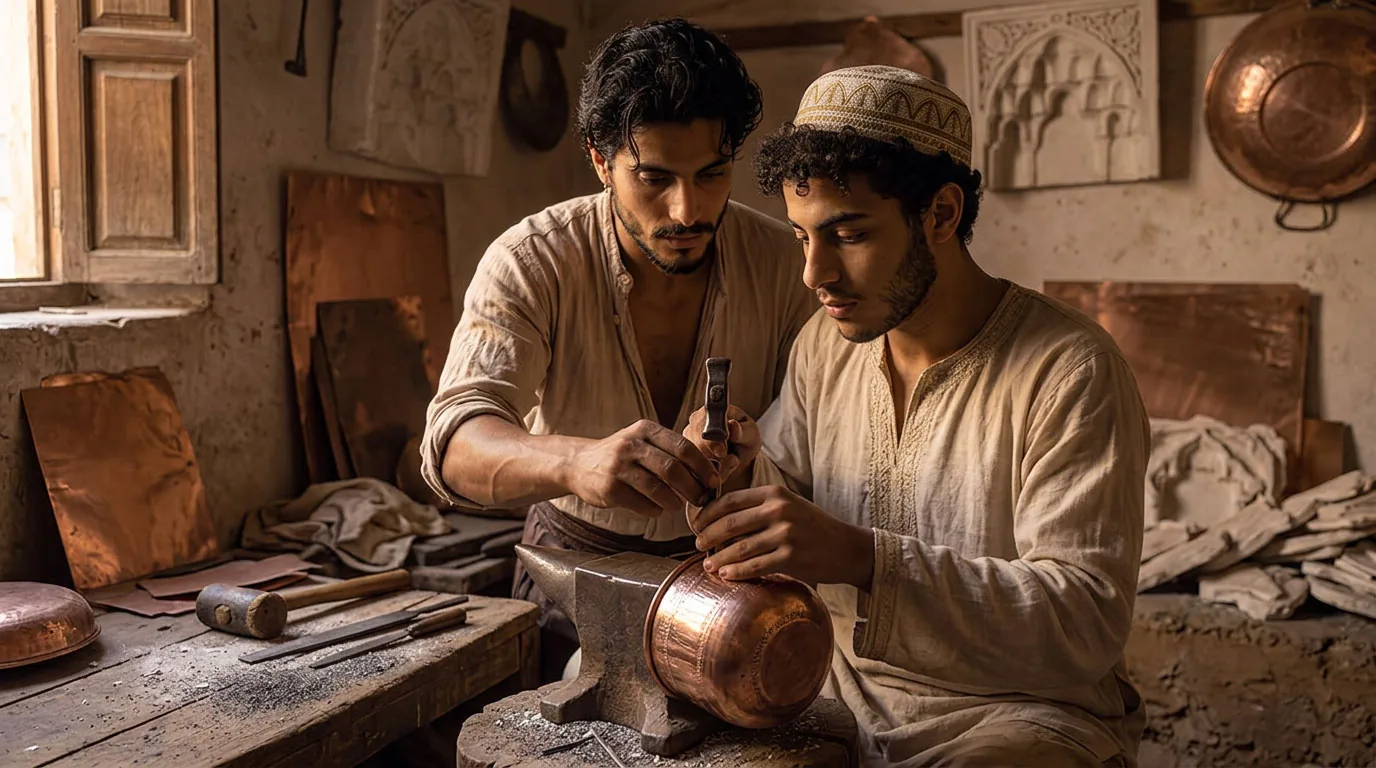
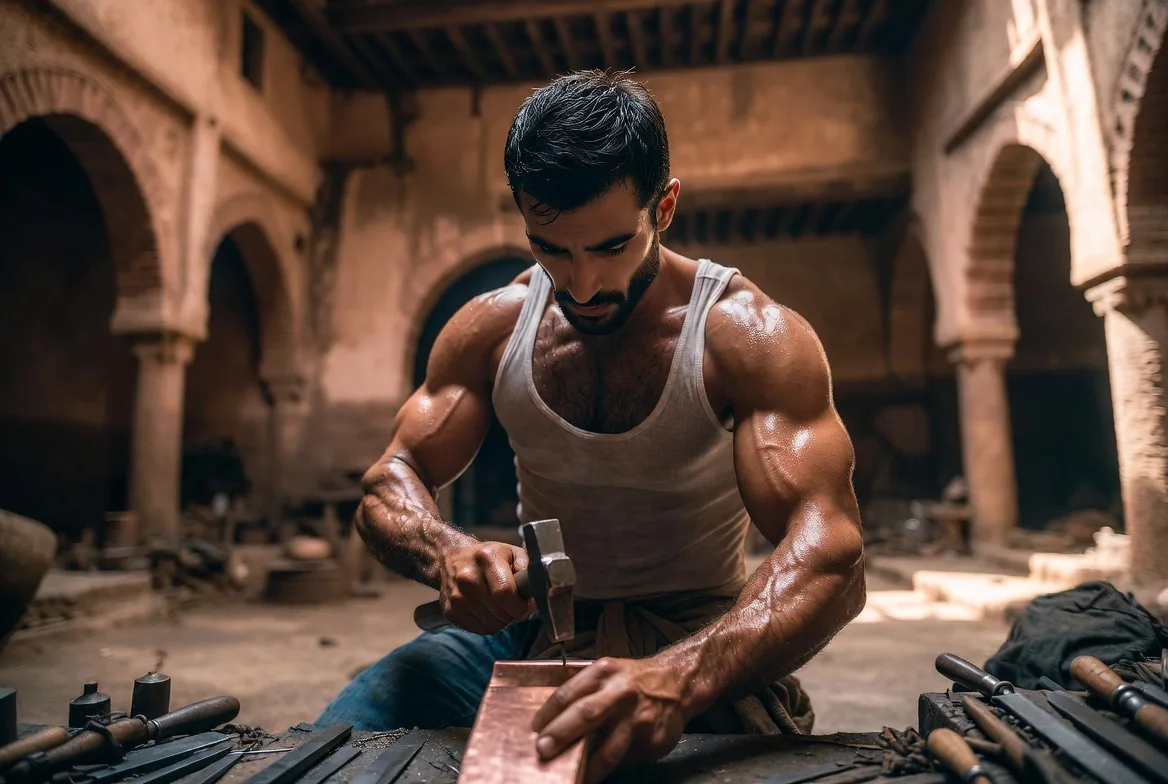
- Metals — The coppersmiths of Seffarine in Fez, the silver-inlaid copper of Damascus, the damasquinado of Toledo, the repoussé and chasing of the Florentine silversmiths, the knife-makers of Maniago, Scarperia, Frosolone and Pattada. Italian damascening, practised in the Renaissance by the armour workshops of Milan and Florence, will enter the register as a historical reference.
- Wood — The mother-of-pearl inlay of Damascus, the taracea of Granada, the inlay of Sorrento, the thuya wood of Essaouira, the mashrabiyya of Cairo.
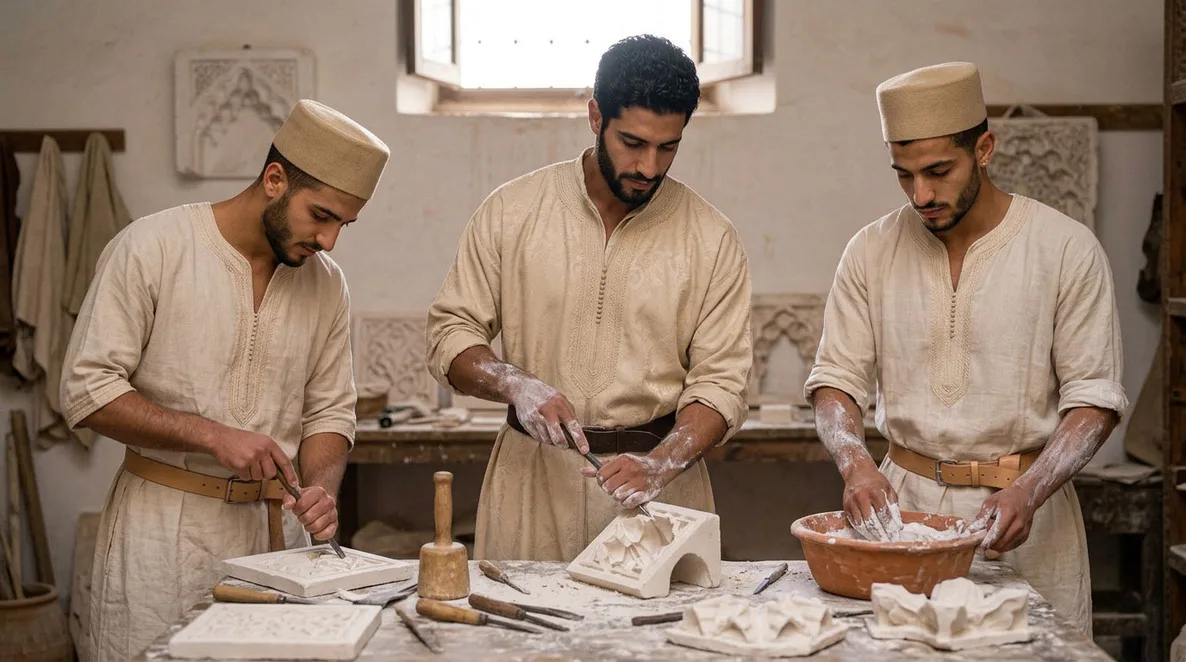
- Carved plaster — The carved plaster of Fez, the Andalusian yeserías, the Tunisian naqsh ḥdīda.
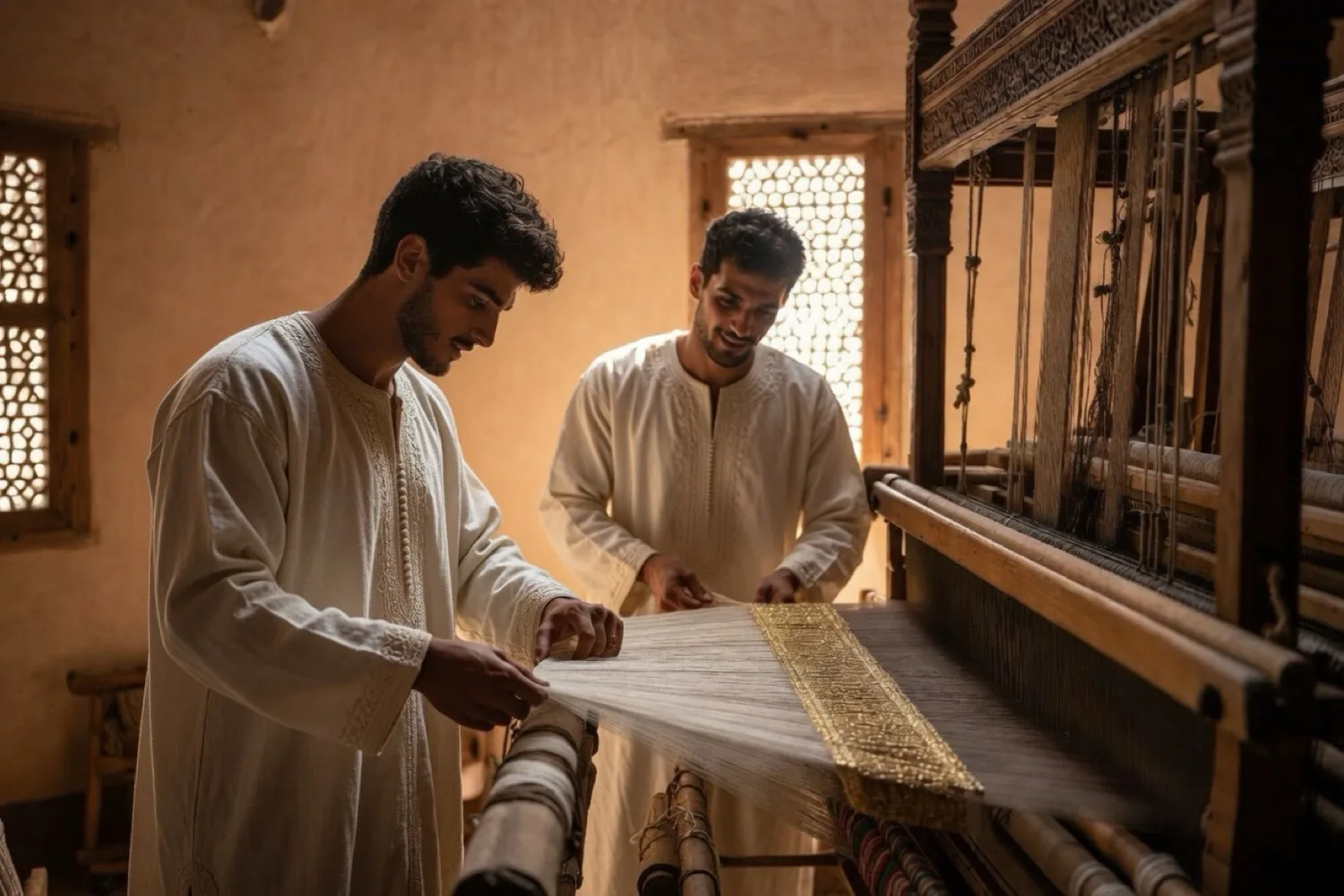
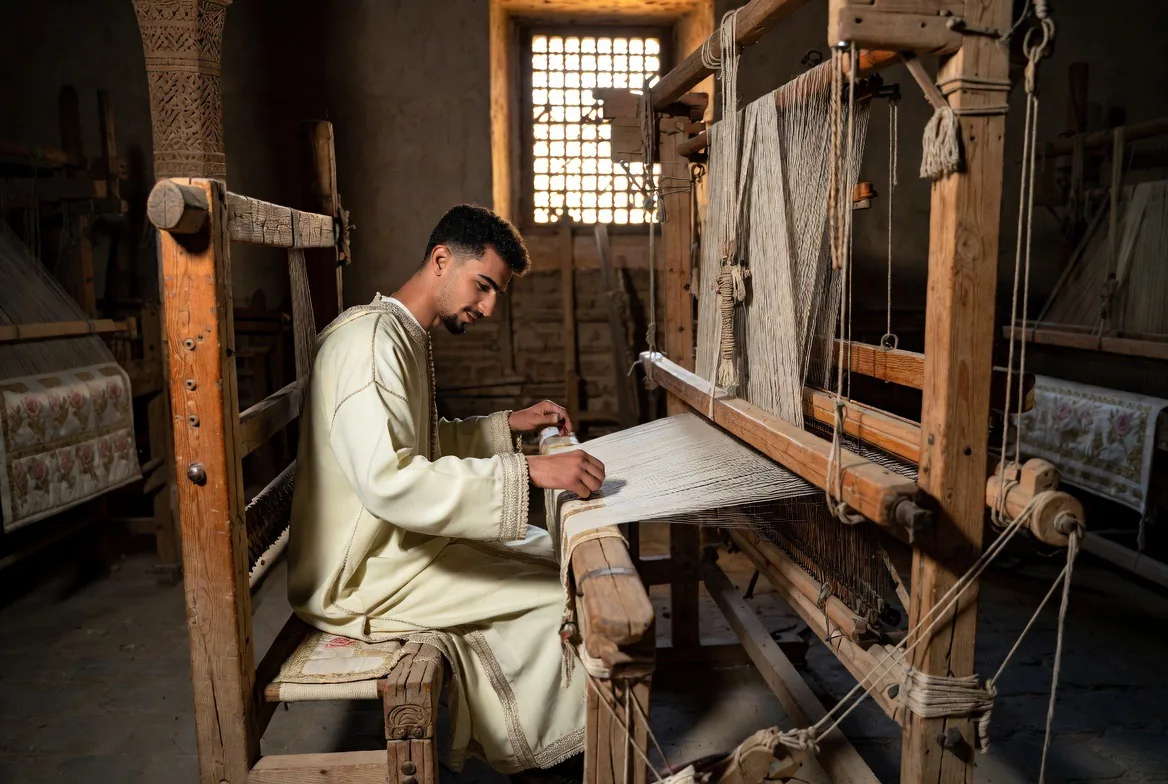
- Loom weaving — The brocade of Damascus, the weaving of the drrāz of Fez, the silk weavers of Valencia; in Italy, the silk velvets of Zoagli, in Liguria, the Bevilacqua weaving workshop in Venice and the silk works of San Leucio, near Caserta.
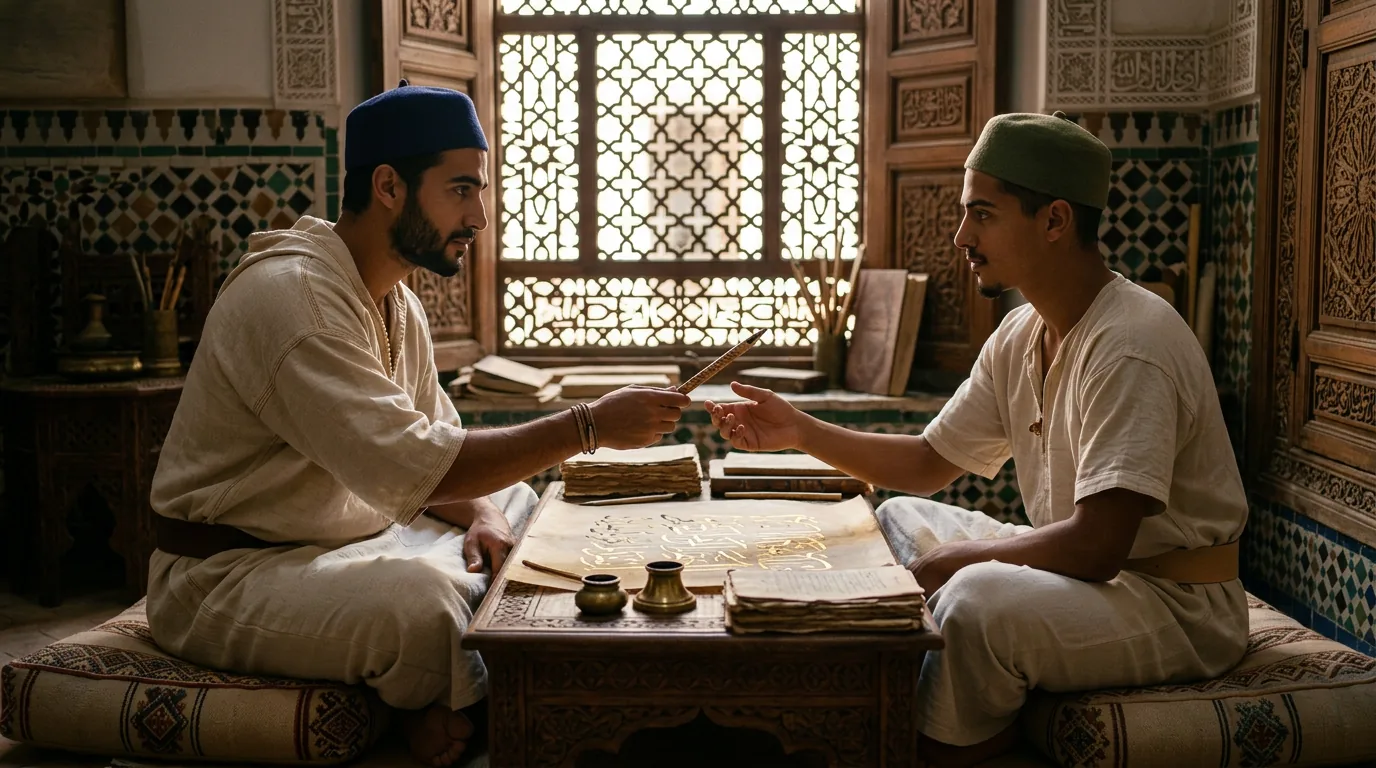
- The manuscript book — The preparation of parchment, inks and reed pens and writing in Ge’ez at the traditional school of Lalibela, in Ethiopia, now at risk of disappearing: with it the register will reach beyond the Mediterranean, along the Nile and the Red Sea. Beside it, Arabic calligraphy, inscribed by UNESCO in 2021, in the schools of Fez, Tunis and Cairo; Ottoman hüsn-i hat, inscribed the same year; the Hebrew scribes (soferim) of Italy and Morocco; the handmade paper of Fabriano and Florentine bookbinding.
05The traditions of countries at war
In Syria, Palestine, Lebanon and Libya war has scattered the workshops and broken the transmission from master to apprentice. The register will give priority to the variants of those countries, because there they run the most immediate risk of disappearing. Each will be recorded under the name and place of its origin, even when the masters work elsewhere, and, where conditions allow, in collaboration with the cultural institutions of those countries.
06Research
The register will be conceived both as an object and as an instrument of research. It concerns the anthropology of techniques, for the study of operational sequences and apprenticeship; the history of Islamic and Mediterranean art, for the circulation of forms; archaeometry, for the analysis of materials; linguistics, for technical vocabularies; social history, for the organisation of workshops and guilds.
Entries will be open to scholars, and the primary materials (film, recordings, samples) will be kept according to criteria that allow their reuse. The register will be offered to universities and research centres as a field for theses, projects and documentation campaigns, on condition that results are returned to the workshops documented. There are European precedents in the digital representation of crafts, among them the Mingei and Craeft projects, funded by the European Union’s research framework programmes; the register will differ from them in its comparative design and in the presence of the masters in the writing of the entries.
07Support
The register will be supported by institutional and private funds. The campaigns, as research and documentation activities, will be able to compete for public lines and foundation programmes; applications will be submitted case by case by eligible bodies under the calls in force. Private contributions will be accepted on condition that no funder gains a voice in the choice of campaigns or in the writing of entries.
Lines common to all campaigns
- UNESCO, Intangible Cultural Heritage Fund — International assistance, requested through the States Parties to the 2003 Convention.
- European Commission, Horizon Europe — The cluster “Culture, creativity and inclusive society”, for research projects in consortium with universities and research centres.
- Barakat Trust — Grants for research on the arts, architecture and heritage of the Islamic world.
- Max van Berchem Foundation — Grants for research on Islamic art, architecture and archaeology.
- Gerda Henkel Stiftung — Support for historical research and, through the Patrimonies initiative, for safeguarding cultural heritage in regions in crisis.
Ceramics
- Council of Europe — The European Route of Ceramics, a cultural route certified in 2012, and the networks of ceramic cities in Italy and in Europe, as a framework of cooperation between Italy, Spain and Portugal.
- Creative Europe — Cooperation projects between bodies from Italy, Spain, Portugal and Tunisia.
- Italian Ministry of Culture, Law 77/2006 — For the maiolica of Caltagirone, in partnership with the managing body of the UNESCO site of the late baroque towns of the Val di Noto.
- Cultural Emergency Response and Gerda Henkel Stiftung — For the variants of Syria and Palestine.
Leather and saddlery
- Fondazione Cologni dei Mestieri d’Arte — The call “Una scuola, un lavoro”, for placements of young people with master craftsmen in Italy.
- Trésors des arts traditionnels marocains — The Moroccan programme that recognises elderly masters of endangered crafts.
Blown glass
- UNESCO, Intangible Cultural Heritage Fund — It has already granted international assistance for the transmission of glassblowing in Syria.
- Corning Museum of Glass — The Rakow Grant for Glass Research.
- Cultural Emergency Response — For heritage threatened by conflict and disaster.
Metals, wood and plaster
- Union for the Mediterranean and UNESCO — The programme on traditional building skills in the countries of the southern Mediterranean.
Loom weaving
- Pasold Research Fund — For the history of textiles and dress.
- Cultural Emergency Response and Gerda Henkel Stiftung — For the brocade of Damascus.
The manuscript book
- British Library, Endangered Archives Programme — For the digitisation of archives and manuscripts at risk; it has already supported the documentation of Ethiopian manuscripts.
08Who will keep the register
The register will be directed by the association Il Fondaco Siciliano and placed under the Scientific Committee of Al-Mithaq. Each campaign will have a curator for each country, and each entry will carry the name of the master or workshop that made it possible, beside that of the person who wrote it.