The Scientific Committee
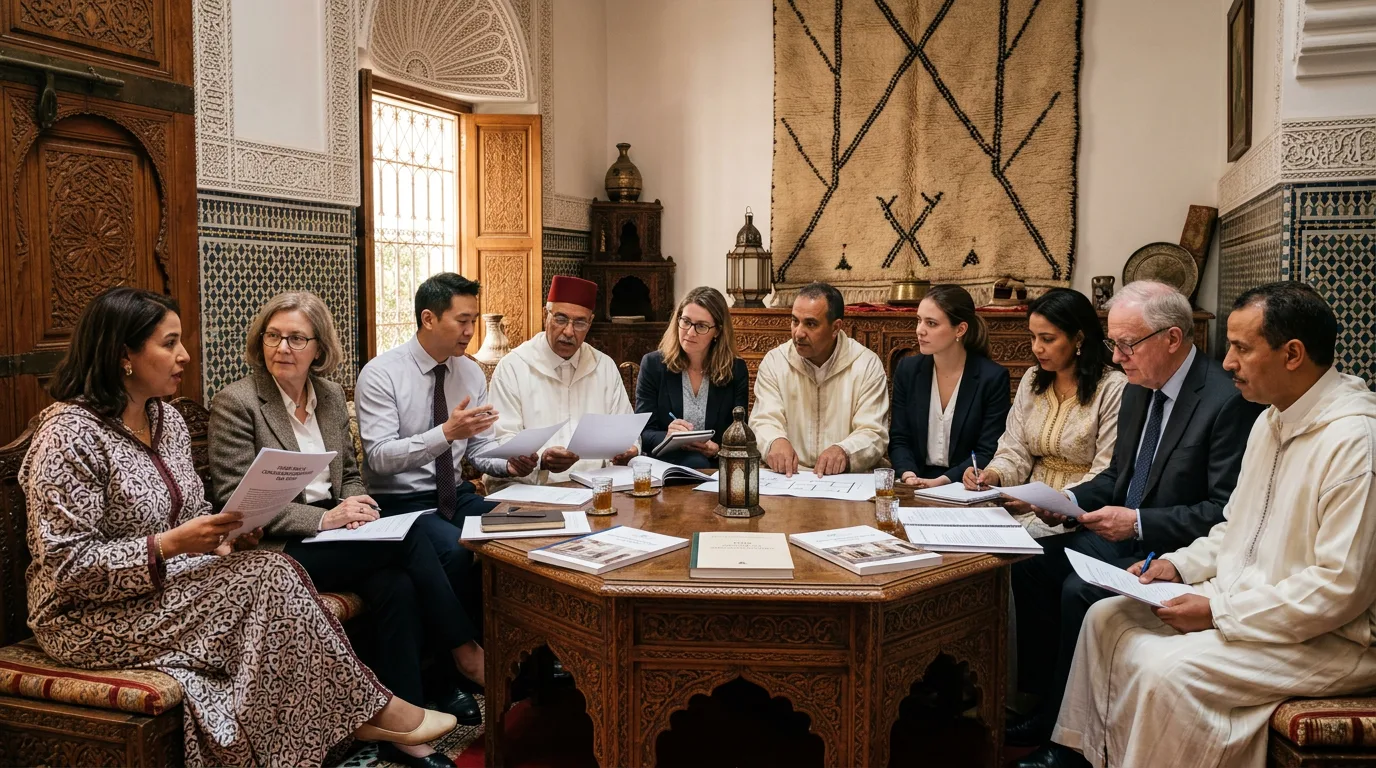
The two houses will publish their own data, including the readings that contradict the theory formulated at the design stage. A single Scientific Committee, for Fez and for Ragusa, will review them before publication. It will be composed by competence, not by prestige: each seat answers to an aspect of the two houses that must be measured or read. The Committee will have at most twelve members, among them at least one working in Morocco and at least one working in Italy. The list of the members of the Scientific Committee will be published after the first acceptances from the scholars approached.
01The house
Climate of the spaces
The patio at four in the afternoon and the bedrooms at night, in July, under today’s climate and that of 2050: someone who can measure the comfort of a house without compressors.
Hammam
Steam, mass, furnace: someone who has measured a living hammam, not a model.
Water and subsoil
Cisterns, wells, channels, the limestone beneath the house: someone who reads the subsoil before it is touched, and can say whether the old water bears the new use.
Structure
Stone vaults on seismic ground, under a protection order that admits no concrete: someone who can say whether the house stands, and with what it can be consolidated without betraying it.
Conservation
A medina and a listed masseria are two readings, not one: a seat for each.
Building site
Someone who has built with traditional techniques, in Morocco and in Sicily, and knows what they really cost.
The land
Twenty-three hectares without irrigation: someone who knows what grows there, and how water is held between cisterns and garden.
02Craft and common life
Transmission
How a gesture passes from a master’s hand to an apprentice’s, and what is lost when it is written down: someone who has observed it in the field, in Morocco.
The guild
What survives of the craft guilds as an institution, how one entered, how one left, who conferred the title of master: someone who knows because they lived it, not only because they studied it.
The rule
How a community of craft holds together workshop, table and given word, and where a written rule rings false to those who must live it.
03The limits of the mandate
It does not admit, does not judge practice, does not raise funds, does not sit in the majlis al-umanāʾ and has no say over the niẓām. No funder appoints anyone to it. Its name goes on the reports and on the method, never on the companions: no photographs of common life. Every opinion states what is measured, where, with which instrument and who reads; the data are published as they are. No fee; site visits are reimbursed; a three-year mandate, renewable; written opinions; one meeting a year, in one of the two houses or at a distance. The chair is chosen by the members, once there are at least three.
04The correspondents
Alongside the seats, the Committee draws on correspondents for an opinion or a measurement, on written request: the history of water in al-Andalus, passive cooling, leather and tanning, the legal form of an intermediate body. They do not appear on the frontispiece and do not count among the members of the Committee.
The air and water pages of the two houses (the Riad, the Funduq) say what is measured and what is not promised. Anyone who recognises themselves in one of these competences, or wishes to report an error, can write to the house.