Two houses, one rule
The Riyāḍ al-Uns in Fez and Al-Funduq aṣ-Ṣiqillī in the province of Ragusa are two houses of the crafts founded on the same rules, the nizam ad-dar, which members sign on entering and which govern the hours of work, conduct in the common rooms, the terms of apprenticeship, the ownership of tools and of what is made, the grounds and procedure of exclusion and the arbitration clause. Both are houses of common life for young men, masters and apprentices, and in both one enters by admission and leaves freely. They use the same series of signs, and whoever has lived in one recognises the other. They are kindred houses, not twin houses: what unites them is the statute; what distinguishes them is the threshold — mixed in faith and culture, and secular in Ragusa, proper and cultic in Fez — and the measure of space. The correspondences that follow say where they answer to one another and where they differ.
A house in Fez and one in Sicily are not an exotic twinning: whoever enters one of them enters a tradition that belongs to both shores, without having to disown another. This is the idea of the European Manifesto for Multiple Cultural Affiliation, presented in Strasbourg on 3 December 2007 within a Council of Europe project:
“At a given time or at different stages in their lives, people may adhere to different cultural affiliations.”
European Manifesto for Multiple Cultural Affiliation, Strasbourg, 2007.
The Manifesto draws on the Faro Convention, which binds Italy; Morocco is not a Party to it. Morocco is, however, a member of the Council of Europe’s North-South Centre, devoted to dialogue between Europe and the southern shore of the Mediterranean, and its Parliament holds “Partner for Democracy” status with the Parliamentary Assembly. The two houses stand within this dialogue.
01The space
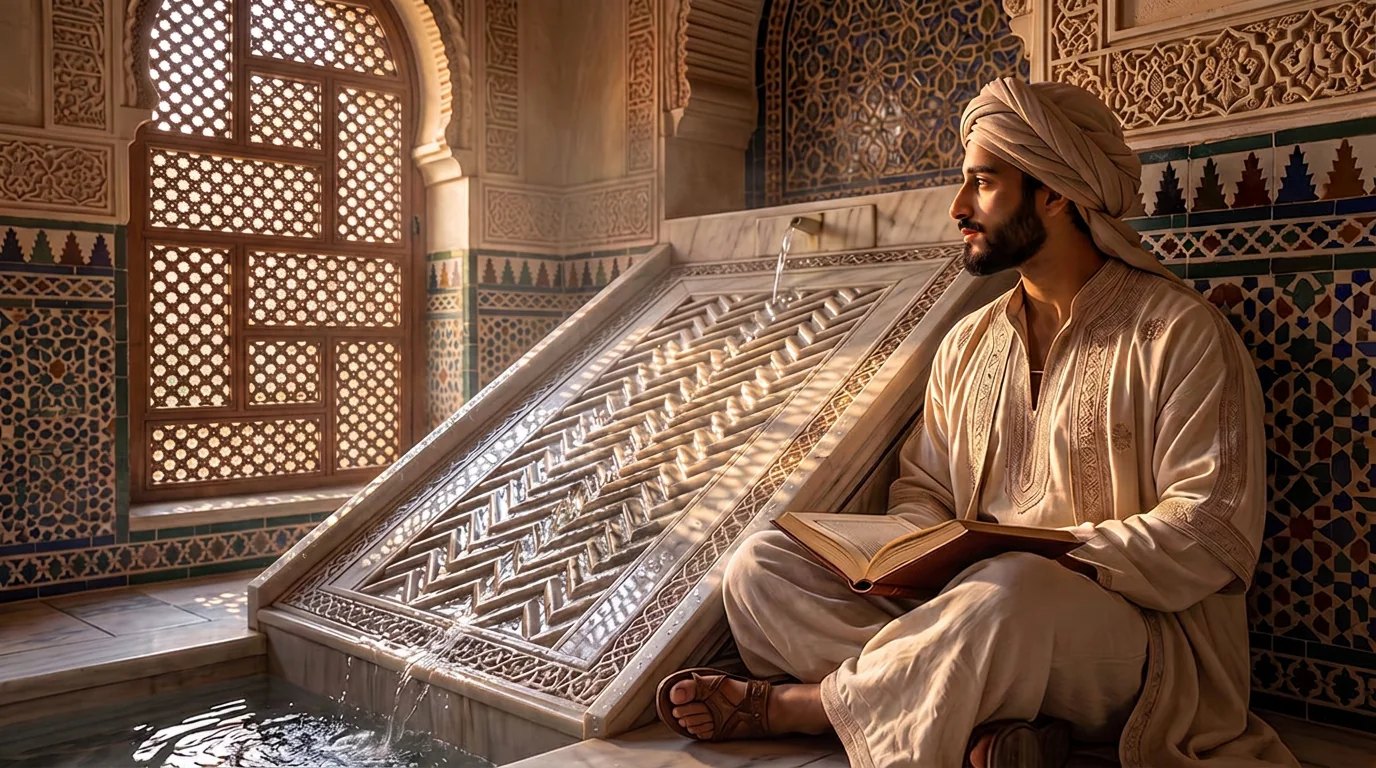
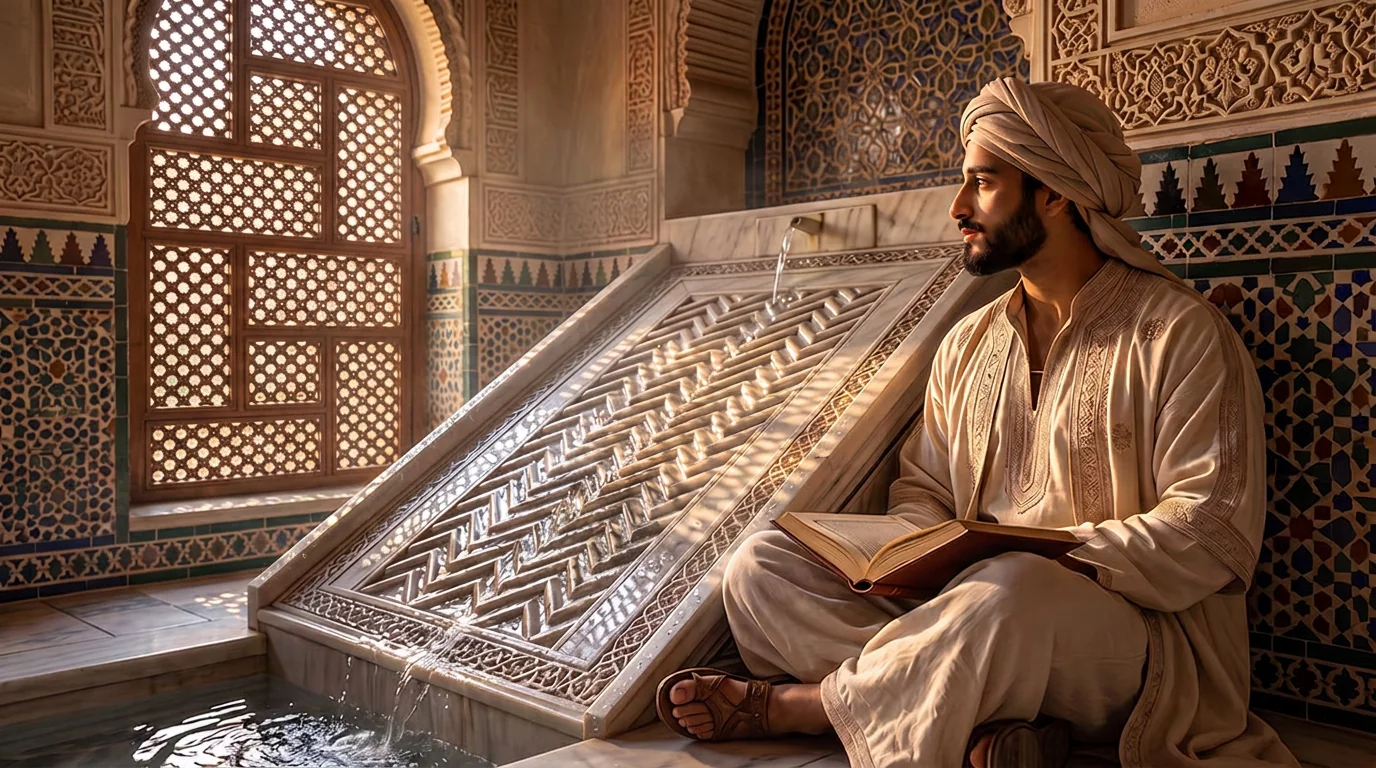
At the Riad the space is the patio: high lime walls, no window on the street, the open sky above, at the centre the basins with water in movement and all around the masonry mass that holds the cool in summer and the warmth in winter. This is why the house is called Al-Uns, the gathered company, and its plan obliges an ordered life because everything passes through the courtyard. At the Funduq the space is the courtyard of the Iblean masseria, in pale stone, with the entrance passage and the ranges of building on four sides, and beyond the walls the twenty-three hectares of olive, almond and arable land, the stream lower down and the cisterns for rainwater. The same rule of water and mass holds in both, and the pages on air and water of the two sites answer one another item by item; but in Fez the house measures itself against an alley, in Sicily against a landscape, and the restoration site of the masseria is, for the first intake, the first school of work.
02The work
At the Riad the crafts are those of the hand of Fez, calligraphy, zellij, plaster, weaving, wood, and the masters work in the house where they live; beside the workshops, the disciplines of the body: furusiyya — horsemanship, archery, swimming, endurance — with wrestling and the other practices of the body, under qualified instructors, without training in weapons, without grades and without rites of passage. There, furusiyya and futuwwa belong to the formation of character within the house. At the Funduq the opening craft is one alone, fine saddlery in leather, wood and metal, with the forge for stirrups and harness and the two-needle stitch learned on the offcuts of the saddles, and the work leaves on commission; the horse and the manège are tied to the workshop. The same disciplines of the body are practised there as sporting arts — horsemanship, archery, swimming, calisthenics, wrestling — with federations, instructors and known rules; futuwwa is there a workshop code, not a law of worship. The rule that binds the two houses lies in the saying carved over the portal of the Funduq, that no one has ever eaten better food than that which comes from the work of his own hand, and in the fact that every member, masters included, wears the same undyed raw linen and carries no mark of rank.
03The order
At the Riad the rules govern a single house, with its council, the majlis al-umana, and its arbitral panel, the hayat at-tahkim. Beside it, Al-Munya is the body, and the company that holds it: distinct from the House, with its own members and its own investors. Inside Al-Munya stand two houses: Dār al-Asl, where the guests of the house lodge without charge, whose costs fall on the company; and Dār al-Diyāfa, where the nudama and their guests lodge against payment, whose proceeds remain with the company. The company pays the Riad an annual fee, regardless of profits. An-Nudamāʾ is the body of the ninety-nine founders, with its own treasury to fund the Riad: it is not a house. At the Funduq the same rules hold four bodies apart — the House, the farming, Al-Munya and An-Nudamāʾ — each with its own assets and its own liability; inside Al-Munya, again, Dār al-Asl (the guests of the house) and Dār al-Diyāfa (the nudama and their guests). The structure is the same in both seats: the settings change, not the names or the functions. This is the part of the house that is not seen and that decides whether the other two last, because a community with rules of its own lasts as long as the contract it has written, and the contract is the same in both houses.
One building, two houses, the same in both seats. Dār al-Asl lodges the guests of the house; Dār al-Diyāfa lodges the nudama and their guests. An-Nudamāʾ does not appear in this drawing: it is not a house.
04The threshold
In Ragusa admission is mixed in faith and culture, and secular. One is admitted by name and by aptitude, not by faith; young men of Islamic and Arab culture and young men of Western and Christian culture may live in the same house. The association is not a religious body, exercises no worship, and does no proselytism: religious belonging is the member’s personal concern; a space is set aside for those who wish to pray, without attendance or abstention affecting admission, work or continuance. Common life — workshop, shared meals, horsemanship and the disciplines of furusiyya — constitutes a trial of mutual knowledge: not a programme of dialogue, but the concrete proof of an ordered coexistence. From it there may arise, if it arises, a civil bond between Europe and Morocco, or other Arab countries, held by craft and by the arts of the body, not by preaching.
In Fez the threshold is proper to the house. The five prayers are the frame of the day; the house forms craft, character and faith, in fidelity to the ideal of futuwwa. The motto states it without ambiguity: the riad is for its own, not its own for the riad. The Riad is not a branch of the Funduq, nor its proof. No shore is master of the other.
Whoever, in Ragusa, masters the craft in a house mixed in faith and culture is not thereby prepared for Fez as for a next degree. He acquires, if anything, an understanding of a civilisation through work and through the discipline of the body. If one day, as an adult and by his own choice, he approaches the Riad, he does so as a man already accustomed to the measure of the house, not as a stranger instructed by a European seat. The passage, should it occur, runs from workshop to workshop and from manège to manège — not from seat to branch.
Each of the two houses has its own site: www.al-uns.com for the Riad, www.al-funduq.org for the Funduq, www.al-munya.com for Al-Munya.