
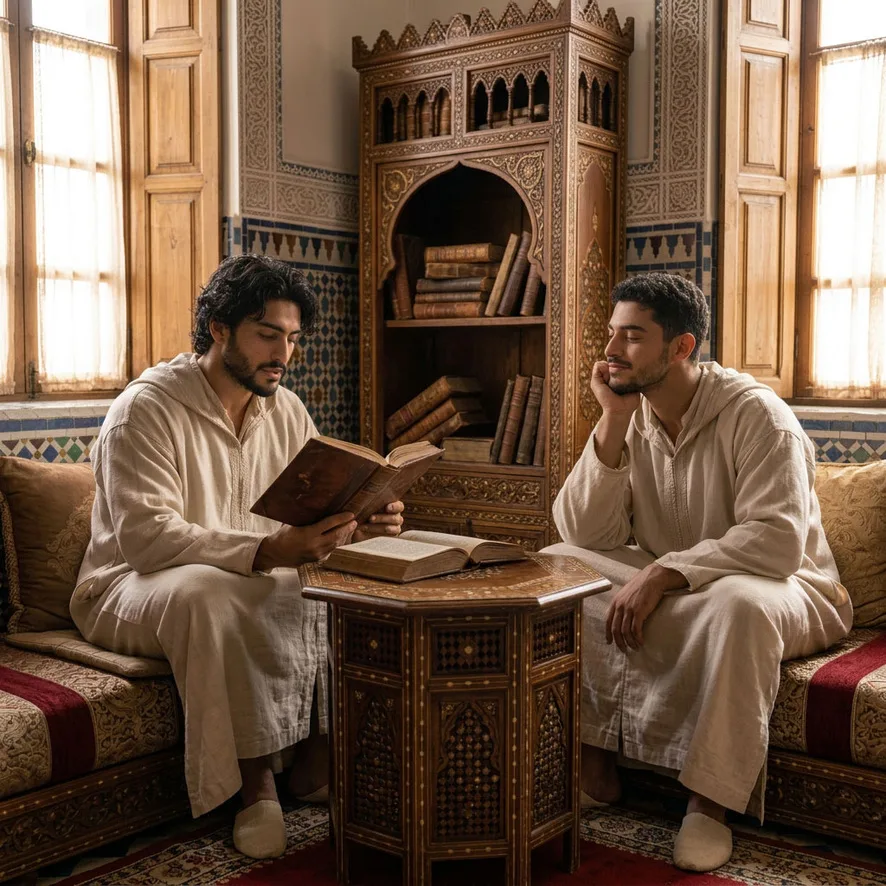
Studying the rule
The threshold of the scholar: reading the nizam ad-dar as one reads a living text.
A text that is lived
The nizam ad-dar is the rule that every member signs on entering and lives every day: a living text, far removed from an archive document. To study it means to read it in its context: the hours of work, the common conduct, the apprenticeship, the internal arbitration.
How the door is opened
The libraries of the houses receive scholars and researchers on application: the subject is stated, the house weighs its compatibility with the life under way and opens the right time for it. The dialogue passes through the text, not through folklore.
Whoever studies the rule writes with the house, not over it: the results return, readable, to those who made them possible, before they go to print.
Research in the houses
The houses receive university research and field studies, on written application and with the permission of the house. The disciplines closest to their life are these:
- The craft and the community: anthropology of apprenticeship and of the crafts, sociology of communities of life, studies of futuwwa and chivalry.
- History and law: history of guilds, of fondachi and of the urban institutions of the Maghreb; legal anthropology of the Arab countries; political philosophy of the commons.
- Economics: economic history of guilds, civil and cooperative economics, Islamic economics and waqf.
- The house: architecture and restoration, earthen building, climate and comfort of traditional spaces, neuroarchitecture.
- Water and land: historical hydraulics, geology and hydrogeology, dryland agronomy, historic rural landscape.
- Language and heritage: Arabic language and calligraphy, intangible heritage, international cooperation for heritage.
The application states the subject, the method, the duration and the home institution. The house weighs its compatibility with common life. Members take part only by their own choice and no study exposes individual persons; common life is not photographed without agreement. Studies that touch the fields of the Scientific Committee are coordinated with it, and the data gathered are published according to its method.
Universities, institutions and foundations
The same door is open to institutions. Universities, research centres, heritage bodies and foundations will be able to agree a joint programme with the houses: research carried out together, a study site, a placement for doctoral students, a publication. The agreement is written down, names who answers for each party and what each contributes, and follows the same conditions as individual research.
In research consortia the houses will be able to take part as a pilot site and study laboratory, leaving coordination to the university or centre that leads the project. Two places lend themselves to comparison: a stone masseria on the Hyblaean plateau, with its land, and a courtyard house in the medina of Fez. There it will be possible to measure the behaviour of massive masonry and cooling without mechanical systems, the recovery of historic hydraulic systems, the settling of workshops, and the effects of traditional spaces on the well-being of those who live in them, with volunteer residents and under an independent protocol. The data gathered will be made available to partners on the terms written into the agreement.
The path in brief
- Door
- Researchers, scholars and institutions
- The text
- The nizam ad-dar, the written rule
- The places
- The libraries of the two houses
- The disciplines
- Craft and community, history and law, economics, house and climate, water and land, language and heritage
- The path
- Application, assessment, open time

Where to begin
For those who read the rule as a text: its sources, its vocabulary, its precedents and the way it is tested.
The stops
- Al-Mithaq in brief
The houses as a subject of study: the disciplines called to observe them and the safeguards for those who live there.
- The network: house, funduq, hanut
The house that trains, the funduq that gives work and selects, the ḥānūt that affiliates; Al-Khayma and the register of the arts.
- The register of the arts
The comparative register of Mediterranean crafts: the method, the entry, the ceramics campaign and those that follow.
- The dress of the houses
The same dress in Fez and in the fondouks: linen and wool, simple lines, and the reasons for this choice.
- Two houses, one rule
Space, work, order and threshold: where the houses answer one another and where they differ.
See also: Nizam ad-dar
- The futuwwa
The ideal that gives the house its shape and direction.
- What a fondaco was
From the Greek pandokeion to the Arabic funduq and the Venetian fontego; and the Sicilian precedent.
See also: The Sicilian precedent
- The legal framework of the Funduq
The Sicilian association: the tools Italian law already offers every association, and the statute. The legal form of the house in Fez is under study.
See also: The statute
- Natural coolness
How the houses get through summer without machines, in the patio of Fez and in the Sicilian farmstead: the figures before the pictures.
See also: Air, water and shade in Sicily
- Garden and kitchen garden
The garden of the Riad and the irrigated garden of the Arabs of Sicily: tanks, channels, the Andalusi treatises and the plants with their names.
See also: The nuara, the irrigated garden
- The chain of masters
The isnad applied to the craft: declared and attested are kept apart.
- Solidarity among artisans
Masters from cities struck by conflict beside the young people of the place: a conditional horizon.
- The sources
The historical, documentary and scientific sources of the papers, in a single list.
See also: The glossary · Sayings and quotations
- Emblems and signs
The houses’ visual grammar: the emblems of the common series, the threshold emblems, the workshop signs.
See also: The signs
- The frame of reference
The 2003 UNESCO Convention, Faro, the New European Bauhaus, research and its safeguards.
- The Scientific Committee
The expertise that will read the houses’ data, including the findings that contradict the theory.