Air, water and shade
How a masseria of the Hyblaean plateau gets through the summer without machinery: the mass, the built shade, the counted water, the cool of the ground — and the figures, before the images.
أَلَمْ تَرَ إِلَىٰ رَبِّكَ كَيْفَ مَدَّ ٱلظِّلَّ وَلَوْ شَآءَ لَجَعَلَهُۥ سَاكِنًا ثُمَّ جَعَلْنَا ٱلشَّمْسَ عَلَيْهِ دَلِيلًا
“Have you not seen how your Lord has spread the shade? Had He willed, He would have made it still; then We made the sun its guide.”
Qur’an, al-Furqān, 25:45.
The house will have no mechanical air conditioning in its living and working rooms. The absence of machinery concerns the devices that regulate the climate of the rooms, which are the Arab-Andalusian ones described in these pages and work by difference of temperature and pressure. Three things remain mechanical, and have nothing to do with the climate of the rooms: the extraction of the kitchen and of the workshop, which are requirements of hygiene and of safety at work; the fan of the buried duct, if the scirocco gallery is built; and, for the hammam, an extraction to be assessed at design stage, since the draught of the flue may suffice.
The figures of the place, before everything else
On the Hyblaean plateau the summer is not that of Fez, and it is better to say so with figures before adjectives. The Ragusa station, at five hundred and fifteen metres, gives for July and August mean maxima of 32.3 and 32.6 degrees and minima of 20.2 and 20.7: a range of about twelve degrees, against the seventeen of the basin of Fez; summer relative humidity stays around sixty-two per cent, against the Moroccan fifty-five; and the rain, which falls from October to April, leaves June and July eleven millimetres each.1 The meteorological reanalysis on the cell that contains the masseria, at four hundred and seventy-nine metres, is milder still — maxima of twenty-eight or thirty degrees, a range of nine — because the cell feels the sea; the true figure for the courtyard will lie between the two, and it will be the first the house measures.2
The climate of the Hyblaean plateau, with that of Fez beside it
Reading. The coloured band is the range between the mean maxima and minima of the Ragusa station (515 m): in July and August it runs from 32.3–32.6 °C to 20.2–20.7 °C, that is about twelve degrees. The thin lines are Fez, for comparison: the peak is three degrees higher, the night two degrees colder, the air drier (55 % against 62 %). The rains (617–715 mm a year according to the source) fall from October to April; June and July receive eleven millimetres each. What it does not prove: the station stands on the hill of the town; the ERA5 reanalysis on the cell that contains the masseria, at 479 m, gives maxima of 28–30 °C and a range of nine degrees, because the cell feels the sea. The true figure for the courtyard will be that of the first August measured. Sources: Ragusa 1991–2019 (SIAS/AM data reported by a secondary source, to be checked against the ISPRA 1991–2020 normals); humidity from the PVGIS-TMY typical year (ERA5, 2005–2023); Fez: WMO 1991–2020 normals, station 60141.
The difference has a precise design consequence, and it is worth stating at once, because it is the mistake into which almost every project that appeals to Mediterranean architecture falls. In Fez the strategy consists in charging the mass of the walls with the cold of the night and crossing the day on the accumulated reserve; here the night is milder and the air more humid, so that the walls, radiating towards a sky laden with vapour, lose less heat than they lose in the desert, and night ventilation, which remains useful and must be designed, cannot be the main engine of cooling.3 The mass works well for another reason: the daytime peak to be damped is contained, and thirty-two degrees damped and shifted by a few hours become a bearable indoor temperature without any input of energy. The other three levers — shade, moving water and contact with the deep ground — carry more weight here than in Fez, and each has its own page.
The frame within which these figures are to be read is no longer that of the last century. On 11 August 2021 the Floridia station, some forty kilometres from the masseria, recorded 48.8 degrees, the highest value ever measured in Europe, which the World Meteorological Organization validated in January 2024 after examining the instrument; in July 2023 eighty-four of the ninety-six stations of the Sicilian agrometeorological network exceeded forty degrees; in May 2024 the Council of Ministers declared a national state of emergency for the island’s water deficit.4 Meanwhile Sicily has become the Italian region with the most households owning an air conditioner, seventy-three in a hundred, when in the country, eleven years earlier, they were twenty-nine in a hundred; and worldwide air conditioners and fans already absorb a tenth of the electricity produced.5 A house that does without them is not a whim: it is the case the literature on adaptation is looking for, and that is why it deserves to be described with exactness and measured with honesty.
The four levers, and the order in which they count
Those who have measured the courtyards of the Mediterranean arrive at the same ranking of the causes, and it holds here too: first shade, which decides at the design stage; then mass, which damps and delays; then water, which gives back to the air by evaporation a part of the heat; finally the ground, which a few metres down keeps in August the temperature of April.6 The four pages that follow treat each lever with its data, its model and its source, and say each time what the model does not prove.
Mass and shade
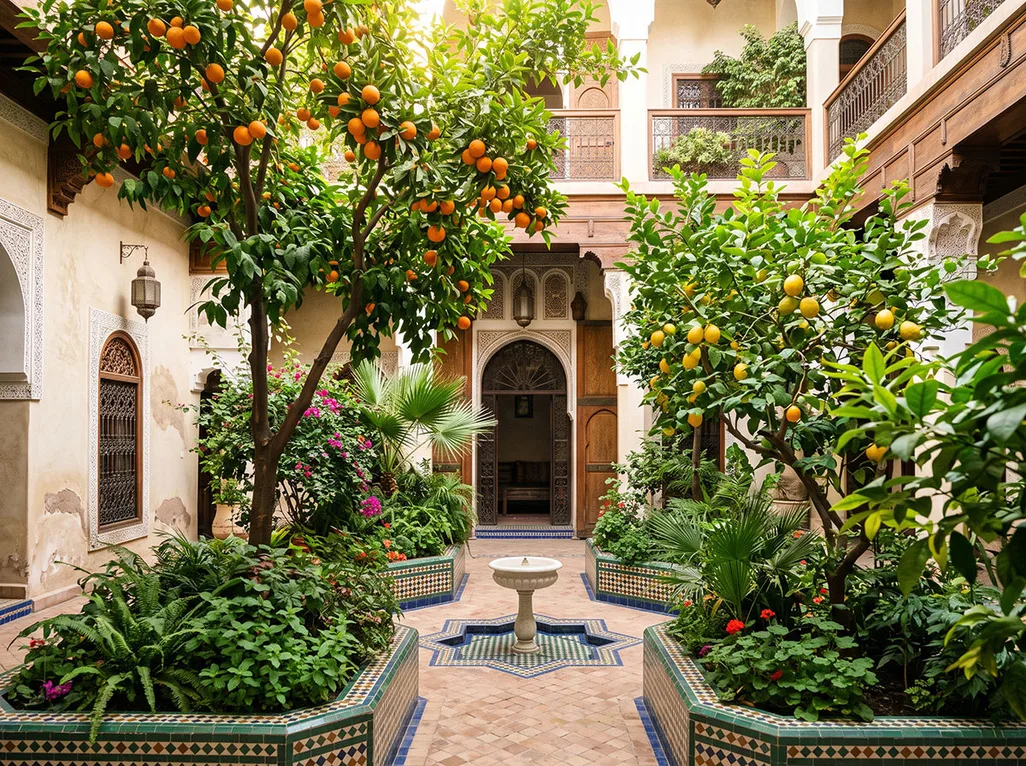
Why the proportion of the courtyard decides before the materials, and how shade is built in a courtyard born wide: the model, the manoeuvre, the awning.
Water
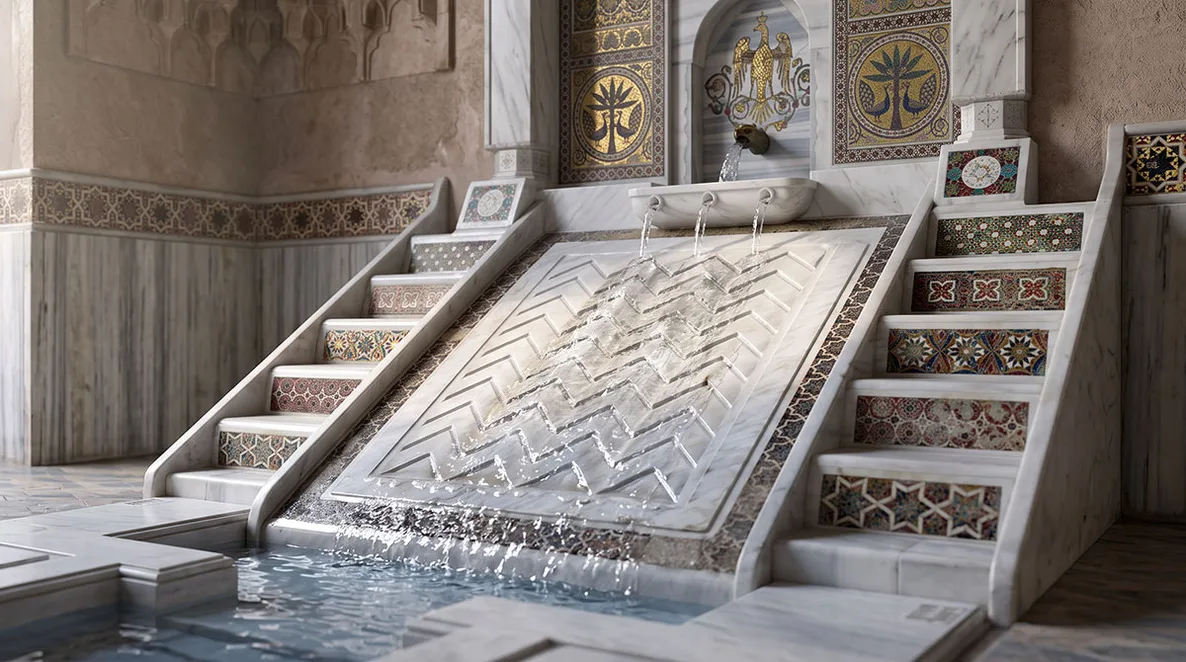
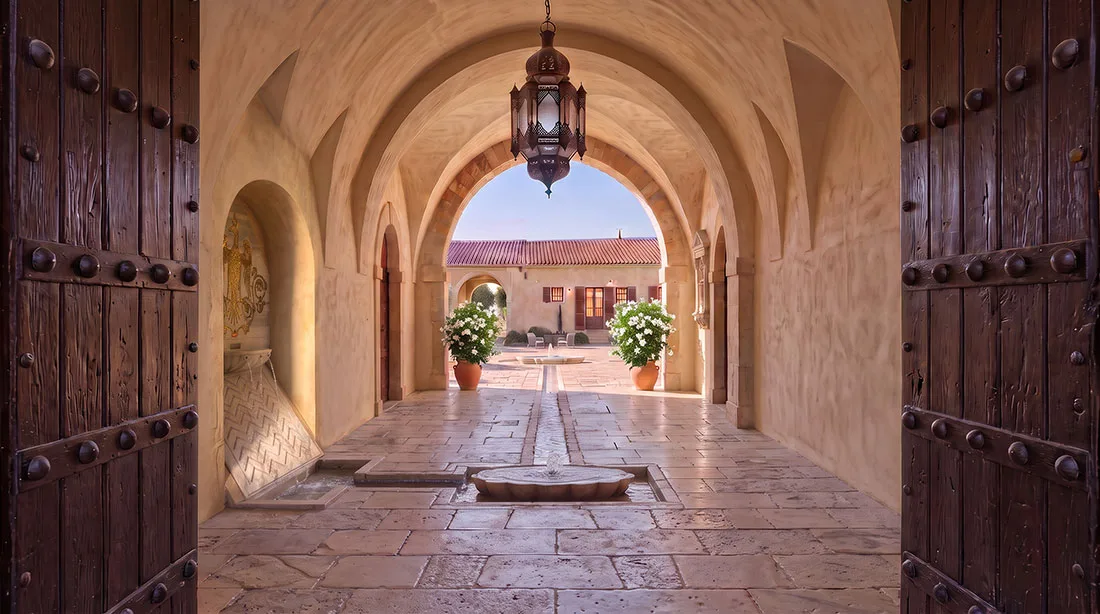
Gebbia, saia, fisqiya and salsabīl: the cascade of uses, the balance of the rain on the roofs, how much cool a metre of water yields, and the Sicilian lexicon that comes from Arabic.
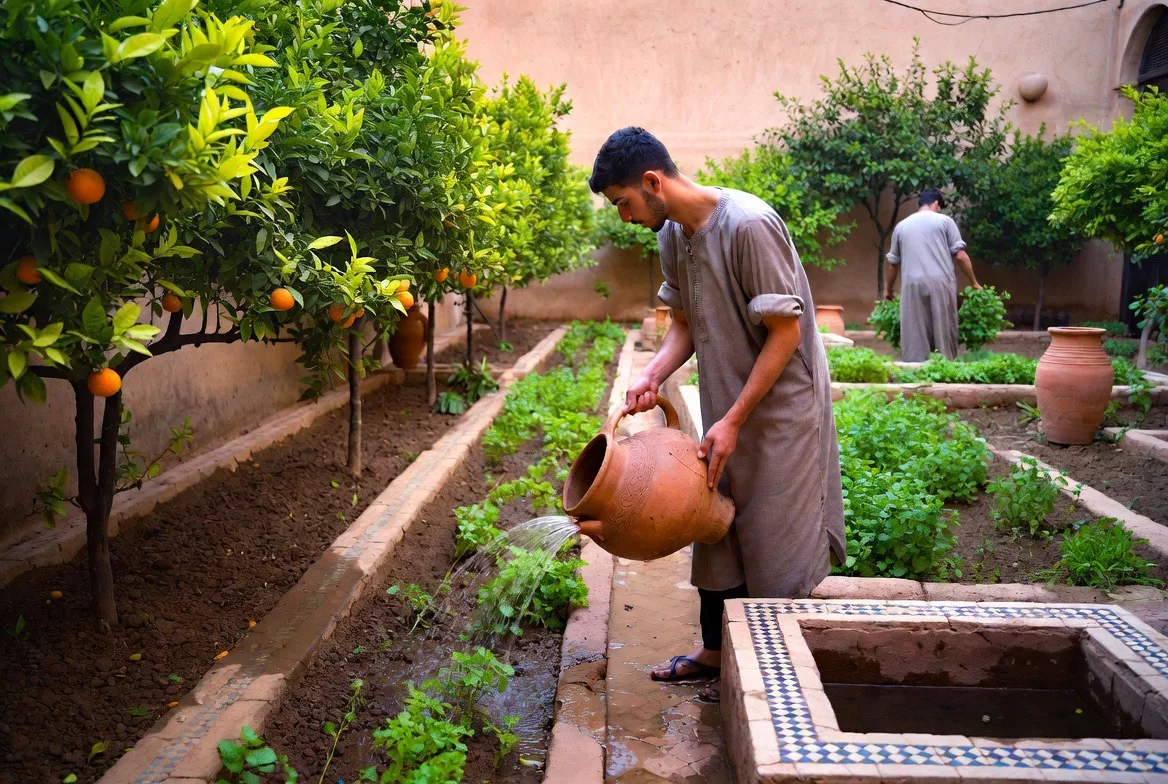
The cool of the ground
The temperature of the ground at different depths, the buried duct with its model, and what the qanāt and the scirocco chambers really teach.
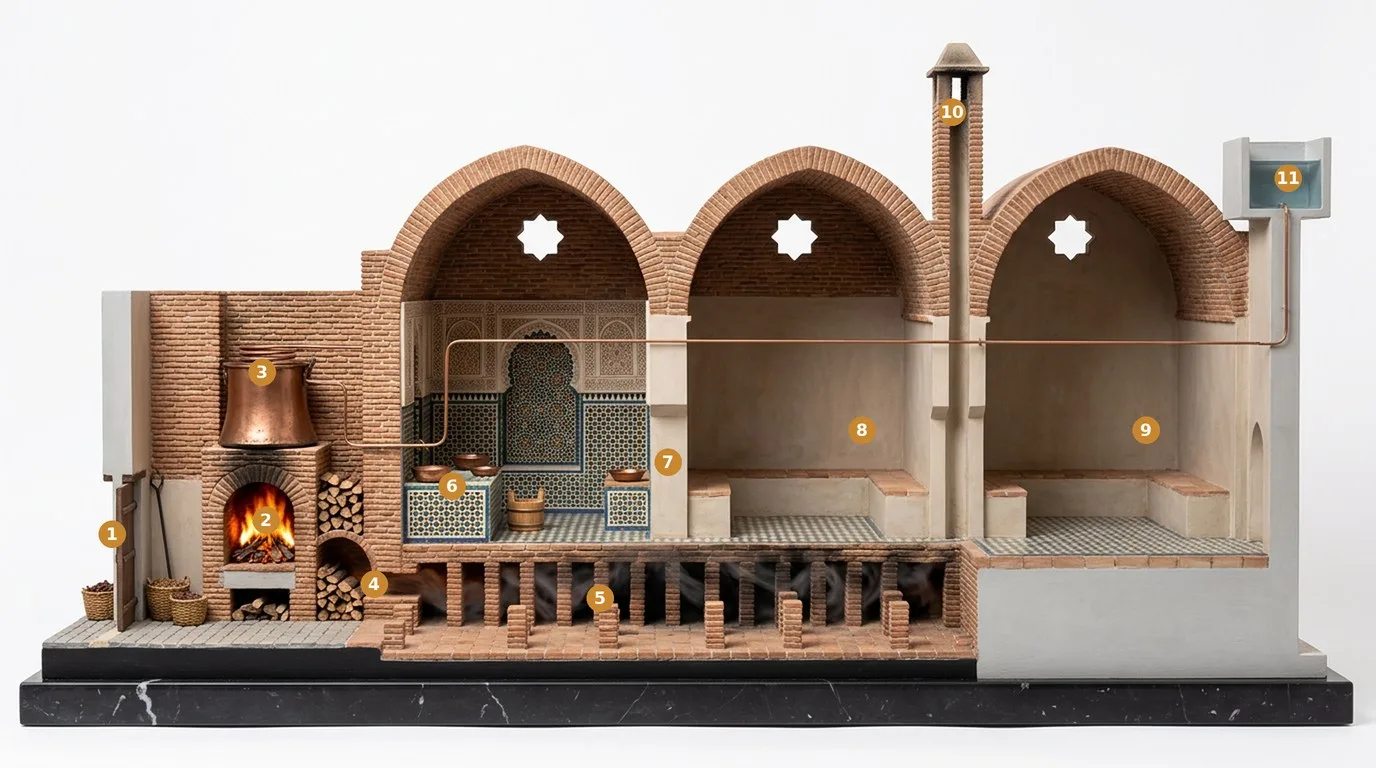
Heat, light, energy
The sun on the collectors month by month, the demand of the showers, biomass from the prunings, and a ground-mounted array out of sight instead of on the roofs.
The four interventions on the envelope
Before any device, the restoration repairs four things that today work against the building; none is evocative, and all four weigh on summer comfort more than any fountain.
— The cement plasters. Six thousand square metres of plaster must be removed and redone in lime. The grey band applied in past decades is the main cause of rising damp, because it prevents the masonry from giving up the moisture it absorbs.
— The underfloor void. Seven hundred square metres of floor levels lowered with a ventilated void: it recovers headroom and interrupts the rise of damp from the ground.
— The roof. Two thousand two hundred square metres of covering to be remade, with insulation laid at the same time. It is the surface that receives more sun than any other, and it is also the one that collects the rain.
— The rooflights. Sixteen in-plane rooflights, openable and motorised, for light, ventilation and the night draught of the dormitories: they are the instrument with which the house, in a climate where the night is not enough on its own, helps it along.
The fountains have their reason, which is discussed on the page about water, but they come afterwards. The Italian thermal regulations place Ragusa in climate zone C, with 1 324 degree-days: a zone of short winters, in which the building’s problem is the summer, and in which historic heritage may be exempted from the obligation to integrate renewable sources into the envelope where the integration would alter its character — an exemption the house does not intend to use, and that is why the solar array stands on the ground.7
What is not promised
No number of degrees is promised. The measurements cited in these pages come from the courtyards of Andalusia, from the scirocco chambers of Palermo and from a buried duct in Emilia, not from the masseria, which is not yet restored; the climate data themselves come from a station and from a reanalysis that diverge by three degrees on the maxima, and the first true measurement will be that of the house. For this reason the project provides, from the first year of works, for a monitoring campaign — temperature and humidity outdoors, in the courtyard, in two rooms, in the walls and in the ground at the depth of the duct — whose data will be published as they are, under the review of the Scientific Committee the house is setting up. The quantities of the works come from an outline estimate on estimated surfaces, and are to be replaced by the bill of quantities of the engineer engaged: on a listed building never surveyed the expected deviation is of the order of thirty per cent.
هي بهذه الجزائر أم الحضارة، والجامعة بين الحسنين غضارة ونضارة … تتخايل بين ساحات وبسائط كلها بستان … يشقها نهر معين، ويطرد في جنباتها أربع عيون
“She is, among these islands, the mother of civilisation, and unites the two beauties, abundance and freshness … she shows herself among squares and plains that are all one garden … a river of running water cuts through her, and along her sides four springs flow.”
Ibn Jubayr, Riḥla, Palermo, 1184 (ed. Beirut, Dār Ṣādir, p. 305). Our translation.
Ibn Jubayr, who landed in Sicily in December 1184, saw a city that had made water and the garden its form; thirty years earlier al-Idrīsī, at the court of Roger, had described Scicli with its “abundant rivers on which stand many mills” and Ragusa as “a fine settlement, of solid construction, high, fortified, on a river that bears its name”.8 The house does not claim to restore that landscape: it claims to measure it again, with today’s instruments, and to state the figures.
Ragusa station (515 m), means 1991–2019: July 32.3/20.2 °C, August 32.6/20.7 °C; annual precipitation 617–715 mm according to the source (ISPRA 1971–2000: 617 mm). Data reported by a secondary source, to be checked against the ISPRA 1991–2020 climate normals (Fioravanti et al., I normali climatici 1991–2020 di temperatura e precipitazione in Italia, ISPRA 99/2022). Relative humidity: PVGIS-TMY typical year (ERA5, 2005–2023) for 36.93° N 14.73° E. Fez: WMO 1991–2020 normals, station 60141.
PVGIS 5.3, TMY typical year for the point of the masseria (479 m): hourly means for July and August with a minimum of 20.6 °C at 06:00 and a maximum of 28.9 °C at 13:00–14:00, local time. The ERA5 reanalysis works on cells of some tens of kilometres and smooths the extreme values.
D. Zhao et al., “Radiative sky cooling: fundamental principles, materials, and applications”, Applied Physics Reviews 6 (2019), 021306: 40–80 W/m² net at night under a clear, dry sky; water vapour in the atmosphere reduces the radiative power, down to a few tens of W/m² in humid climates.
WMO, press release of 30 January 2024: 48.8 °C on 11 August 2021 in the province of Syracuse (SIAS station) validated as the European record. SIAS, bulletin for July 2023, reported by a press source. Resolution of the Council of Ministers of 6 May 2024, “serious water deficit in the territory of the Sicilian Region”, extended on 9 May 2025.
ISTAT, Dotazioni energetiche delle famiglie – Anno 2024 (October 2025): 56.0 % of Italian households with an air conditioner (29.4 % in 2013), Sicily 73.1 %. IEA, The Future of Cooling, 2018: about 10 % of world electricity; stock from 1.6 to 5.6 billion units by 2050.
C. Rivera-Gómez et al., Sustainable Cities and Society 51 (2019), 101740; E. Diz-Mellado et al., Building and Environment 203 (2021), 108094 and 237 (2023), 110349; for the ground, T. Kusuda, P. R. Achenbach, Earth temperature and thermal diffusivity at selected stations in the United States, NBS Report 8972, 1965.
Presidential Decree 412/1993, table A: Ragusa zone C, 1 324 degree-days. Legislative Decree 199/2021, Annex III, as amended by Legislative Decree 5/2026: renewable shares for major renovations and exemption for buildings protected under Legislative Decree 42/2004.
Al-Idrīsī, Nuzhat al-mushtāq, fourth climate, section 2 (ed. Naples–Rome, Opus geographicum, pp. 598 and 613): “وبها أنهار غزيرة عليها أرحاء كثيرة” (Scicli); “ورغوص منزل حسن وثيق البنيان سامي العلو حصين منيع على نهر يعرف بها” (Ragusa). Our translation.
The Scientific Committee
The statements in these pages — on climate, on water, on the ground, on energy — will be read, corrected and, where necessary, refuted by the independent scientific review the two houses are building from the first measurements: a single Committee for Fez and for Ragusa, whose competences are described on al-mithaq.org. On it will sit scholars of the microclimate of courtyard houses, of hydraulics and water law in al-Andalus and in Sicily, of the vernacular architecture of the Mediterranean. The Committee does not sponsor the project: it sets its measurement programme, reads its data when there are any, and is free to say publicly that something does not work. The names will be published with the consent of each, once the Committee is constituted; anyone wishing to contribute to it, or to point out an error in these pages, may write to us.
What the masseria already did, said in today’s language
No target of the 2030 Agenda names cooling; those that follow describe, in today’s language, what a Hyblaean masseria did out of necessity. Air conditioners absorb about 10 % of world electricity and their stock will grow from 1.6 to 5.6 billion units by 2050 (IEA 2018); passive cooling alone can curb the growth in demand by 24 % (UNEP 2023).
Mass, built shade, counted water, ground: four levers without machinery — 7.3 double the rate of improvement in energy efficiency · 13.1 strengthen resilience to climate-related hazards
Lime, limestone, dry-stone walling, wood: the building site of the local masters — 11.c sustainable and resilient buildings using local materials · 12.2 efficient use of natural resources
Restoration of a masseria of the plateau, in the landscape of the Val di Noto — 11.4 safeguard cultural and natural heritage
The manoeuvre taught to those who enter; the measurements published; the Scientific Committee — 13.3 education and capacity on adaptation · 3.d reduction of health risks from extreme heat
The terms used in these pages are collected in the glossary and the sources on the sources page. The images are studio renderings: the masseria is not yet restored.
The words of this page are in the common glossary; the works cited in the sources; the sister house is Riyāḍ al-Uns.