
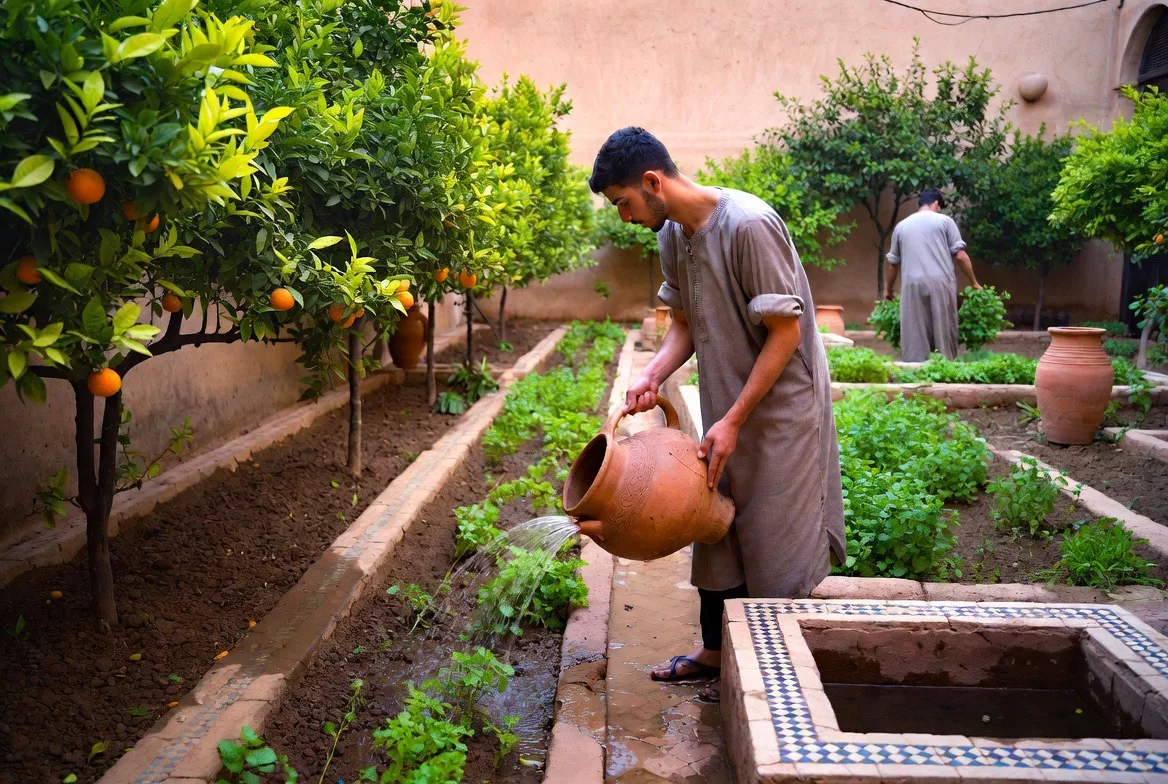
The cool of the ground
A few metres down, the ground keeps in August the temperature of April. It is the lever that in this climate is worth more than the night, and Sicily has used it for centuries, below ground.
وَٱللَّهُ جَعَلَ لَكُم مِّمَّا خَلَقَ ظِلَٰلًا وَجَعَلَ لَكُم مِّنَ ٱلْجِبَالِ أَكْنَٰنًا
“And God has made for you, of what He has created, shade; and has made for you, of the mountains, shelters.”
Qur’an, an-Naḥl, 16:81.
The figure, with its uncertainty
Undisturbed ground oscillates around the annual mean of the air — at Ragusa 17.1 degrees — with an amplitude that decreases exponentially with depth and a lag that grows with it; this is the model that Kusuda and Achenbach published in 1965 and that energy-calculation programs still use.1 The quantity that governs everything is the thermal diffusivity of the soil, which for soils and sedimentary rocks lies between 0.01 and 0.08 square metres a day; for the Hyblaean calcarenite no one has measured it, and the working model lets one choose between a low, a medium and a high value.2 With the medium value, at two and a half metres the annual amplitude falls to a third and the lag is about two months: in August the ground lies between eighteen and twenty-one degrees, and its maximum falls in October; below ten metres the oscillation is almost extinguished.
The temperature of the ground through the year, at different depths
Reading. The model is that of Kusuda and Achenbach (1965): the temperature of undisturbed ground oscillates around the annual mean of the air — at Ragusa 17.1 °C — with an amplitude that decreases exponentially with depth and a lag that grows with it. The black curve is the air (monthly means of the station); the others are the ground at one metre, at the chosen depth and at five metres. With a medium diffusivity, at two and a half metres the amplitude falls to a third and the lag is about two months: in August the ground lies between 18 and 21 °C, and its maximum falls in October. What it does not show: the diffusivity of the Hyblaean calcarenite has not been measured; the three options cover the published range for soils and sedimentary rocks (Andújar Márquez et al. 2016; Mathur et al. 2015). The figure is load-bearing for the duct, and must be measured on site before digging.
It is a model calculation and not a measurement on site. Since the figure is load-bearing for the sizing of the duct, it must be measured on the spot before the work is carried out — a probe at two and at three metres, for a year — and the measurement is among the checks of the current phase; its value will be published with the others.
The buried duct
The design provides for one hundred and fifty linear metres of buried duct that takes air from the north garden, runs it underground and delivers it to the rooms. The air gives up heat to the ground along the way and arrives cooler than it entered, with electricity consumption limited to the fan that moves it: it is the only motor that the climate of the house admits, and the reason it admits it lies in the ratio between what it consumes and what it yields. The working model uses the simplest law that describes the exchange — the air approaches the temperature of the ground exponentially along the pipe — and says what the length, the diameter and the flow rate change.3
The buried duct: what it yields, and at what price
Reading. One-parameter model: the air travelling along the pipe approaches the temperature of the ground according to an exponential law, with an effective heat-exchange coefficient between air and ground of 2.5 W/m²K, which sums up the convection in the pipe and the resistance of the soil around it. With one hundred and fifty metres of duct of twenty-five centimetres, six hundred cubic metres of air an hour and ground at 20 °C, the air enters at 32 degrees and leaves at a little under 23; the heat removed can be read alongside, together with the consumption of the fan estimated with a modest pressure head. Lengthening the pipe beyond a certain point no longer helps; raising the flow rate gives more power but less cool air. What it does not show: the model ignores the saturation of the ground around the pipe after days of operation (Mathur et al. 2015: two or three degrees of deterioration in twelve hours of continuous running), condensation, and the true geometry of the route. The yields measured in Italy are of the order of 14–21 kWh thermal per kWh electric (Grosso and Chiesa 2015, Imola); that of the masseria will be measured.
Published measurements confirm the order of magnitude. At Imola, a field of thirty-two pipes of twenty-five centimetres, seventy metres long and buried at two metres sixty, monitored for thirty months, yielded in summer between fourteen and twenty-one thermal kilowatt-hours for every electric kilowatt-hour spent; for Italian climates the literature places the payback time of the investment between five and nine years.4 Two conditions decide whether a device of this kind works or becomes a health problem: a continuous fall with collection and discharge of the condensate, because summer air that cools in the pipe deposits water and standing water feeds moulds; and accessibility for inspection and cleaning.5 Both must be resolved in the detailed design, and a duct that does not resolve them is better not built.
What the qanat and the scirocco chambers teach, and what they do not
The plain of Palermo preserves a network of draining galleries of the qanāt type, dug almost horizontally into the bank of calcarenite until they reach the water table: the oldest documented, at the Scibene and at Danisinni, date from the twelfth and thirteenth centuries; the Gesuitico Alto was dug at the beginning of the sixteenth century for Gerardo Alliata. Beside the qanāt the local tradition distinguishes the ingruttati, galleries connecting wells, and the catusi, terracotta pipes.6 Grafted onto the same network are the scirocco chambers, the camere dello scirocco: vaulted underground rooms, cooled by the passage of running water in a channel, sometimes provided with skylights and an air intake. Here a correction is needed that is rarely read: the type spreads in the villas of the nobility between the sixteenth and the eighteenth centuries, reusing a medieval hydraulic infrastructure — the oldest documented is that of Villa Naselli-Ambleri, built in 1552, and the expression “camera dello scirocco” appears in a notarial deed of 1691 — so that whoever presents them as an invention of the Islamic age is five centuries early. The exception is the grotto of the Uscibene, by the Arab-Norman palace of the Scibene, where the water of the spring ran through an underground room used for the same purpose.7
The one measurement of those chambers that we possess is old but eloquent: at the end of the summer of 1987, at Villa Naselli-Ambleri, the floor of the chamber stood at twenty-two degrees while outside thirty-three were measured; the analytical study of 2015 confirms the principle — water, air and limestone working together — and notes that the alterations of the early twentieth century have reduced its effectiveness.8 What these works teach, and what is worth taking up, is the combined principle: not air cooled by the ground alone, but air cooled by the ground and at the same time by the evaporation of running water along the way. The duct of the north garden can receive that addition at modest cost, and it is the point where the Sicilian precedent becomes a technical prescription instead of a quotation.
مُّتَّكِـِٔينَ فِيهَا عَلَى ٱلْأَرَآئِكِ ۖ لَا يَرَوْنَ فِيهَا شَمْسًا وَلَا زَمْهَرِيرًا
“Reclining there upon couches, they will see there neither sun nor bitter cold.”
Qur’an, al-Insān, 76:13.
Cold kept
On the Hyblaean hills and on Etna cold was kept in neviere, snow-pits: quarries and buried domes, lined with dry stone, where the winter snow, covered with straw, grasses and ferns, was preserved until summer. The trade is documented from 1619 between Buccheri and Malta, and in the eighteenth century the island exported more than a thousand tonnes of it a year; the centres were Buccheri, Palazzolo, Chiaramonte, Buscemi, Ferla, Monterosso and Giarratana, a few miles from the masseria.9 It is not an institution of the Islamic age, and is cited here for one reason only: in the same area, with the same materials, someone has already solved the problem of keeping an underground room cool for months, and their solutions can still be observed.
What is not promised
The outlet temperature of the duct is not promised, because it depends on a figure — the diffusivity of the soil — that no one has measured for the Hyblaean calcarenite, and on a phenomenon — the saturation of the ground around the pipe after days of operation — that the working model ignores. It is not promised that the duct will be built, if the detailed design does not resolve condensation and inspection. What is promised is the probe in the ground from the first year, and the publication of the measurement, under the review of the Scientific Committee the house is setting up.
T. Kusuda, P. R. Achenbach, Earth temperature and thermal diffusivity at selected stations in the United States, National Bureau of Standards, Report 8972, 1965; the model is the one adopted by EnergyPlus for the temperature of undisturbed ground. Annual mean air temperature at Ragusa (515 m): 17.1 °C (1991–2019, secondary source).
J. M. Andújar Márquez et al., “Ground thermal diffusivity calculation by direct soil temperature measurement”, Sensors 16 (2016), 306: 0.98·10⁻⁶ m²/s (≈ 0.085 m²/day) in a moist sandy-gravelly soil; J. Mathur et al., Energy Reports 1 (2015), pp. 17–21: 1.4–9.7·10⁻⁷ m²/s for the soils examined, and a deterioration of 2–2.6 K in the outlet after twelve hours of continuous running in the less diffusive soils.
One-parameter model: Tu = Ts + (Ti − Ts)·exp(−U·π·D·L / ṁ·cp), with U = 2.5 W/m²K effective between air and ground; fan power estimated from distributed pressure losses and an efficiency of 0.5. It is an order of magnitude, not a design.
M. Grosso, G. Chiesa, “Horizontal earth-to-air heat exchanger in Imola, Italy. A 30-month-long monitoring campaign”, Energy Procedia 78 (2015), pp. 73–78: effectiveness 0.7–0.9, cooling COP 20, 14 and 21 in the three years; F. Ascione, L. Bellia, F. Minichiello, “Earth-to-air heat exchangers for Italian climates”, Renewable Energy 36 (2011), pp. 2177–2188.
G. Chardome, V. Feldheim, “Heat transfer and condensation in an earth–air heat exchanger”, Energy and Buildings 205 (2019), 109532, on the risk of moulds and bacteria in stagnant condensate; H. Wei et al., Applied Energy 276 (2020), 115493, on the latent share of cooling in humid climates.
P. Todaro, G. Barbera, A. Castrorao Barba, G. Bazan, “Qanāts and historical irrigated landscapes in Palermo’s suburban area (Sicily)”, European Journal of Post-Classical Archaeologies 10 (2020), pp. 335–370; P. Todaro, Il sottosuolo di Palermo, Palermo 1988; id., Guida di Palermo sotterranea, Palermo 2002.
T. Firrone, “Le camere dello scirocco: archetipi bioclimatici della Palermo antica”, in Palermo città delle culture; for the early sources, V. Di Giovanni, Palermo restaurato (1615), and F. Baronio, De majestate panormitana (1630). On the Scibene, G. Spatrisano, La Zisa e lo Scibene di Palermo, Palermo 1982.
M. Saeli, E. Saeli, “Analytical studies of the Sirocco room of Villa Naselli-Ambleri: a XVI century passive cooling structure in Palermo (Sicily)”, Journal of Cultural Heritage 16/3 (2015), pp. 344–351; the 1987 measurement in Firrone, cit.
A. Patanè, I viaggi della neve. Raccolta, commercio e consumo della neve dell’Etna nei secoli XVII–XX, Palermo, Mediterranea, 2014; L. Lombardo, “Il viaggio della neve nel Mediterraneo: dalla Sicilia all’isola di Malta”, Dialoghi Mediterranei 8 (2014).
The Scientific Committee, now being constituted, that will read these measurements is described on the page Air, water and shade.
What the masseria already did, said in today’s language
The targets that follow describe, in today’s language, a use of the ground that Sicily has practised for centuries, and that returns here as a technical prescription.
Buried duct: cool from the ground with the fan alone — 7.3 energy efficiency · 13.1 resilience to climate-related hazards
Qanāt, scirocco chambers, snow-pits: an underground heritage studied before it is cited — 11.4 safeguard cultural heritage
Condensation, inspection, measurement of the ground: health before image — 3.d reduction of health risks · 13.3 capacity for adaptation
The terms used in these pages are collected in the glossary and the sources on the sources page. The images are studio renderings: the masseria is not yet restored.
The words of this page are in the common glossary; the works cited in the sources; the sister house is Riyāḍ al-Uns.