The twenty-three hectares
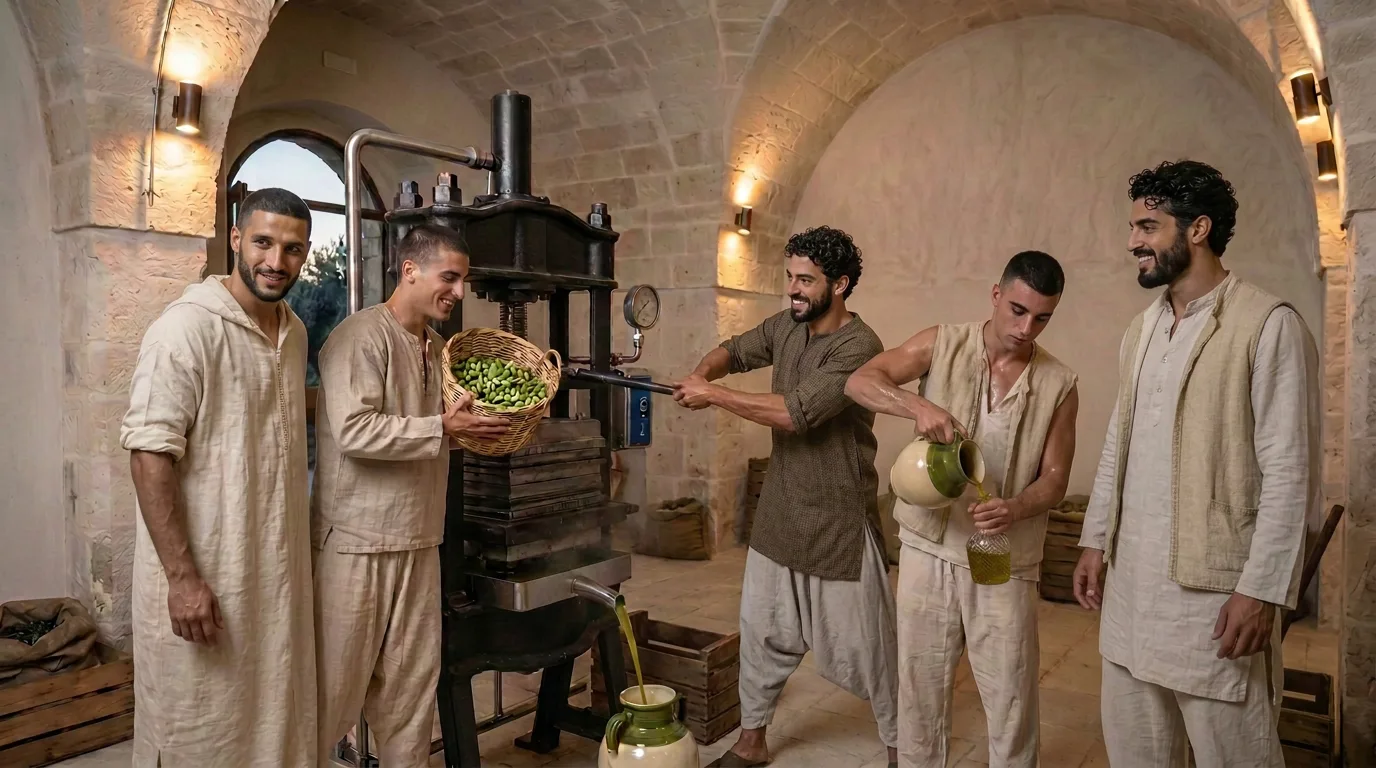
The twenty-three hectares are worked by a cooperative whose working members are the members of the House. The form has three functions, and none of the three is ornamental.
1. It keeps the buildings in agricultural use. It is the condition that holds together the original purpose of the property and the use made of it, and that makes the building application coherent.
2. It supplies the table. A community that eats together every day — seventeen people at the opening, about thirty at full strength — has a food bill that the vegetable garden and the field reduce perceptibly, and a calendar the harvest dictates.
3. It binds the apprentices to a season. It is the second thing on which every craft tradition has rested, together with the workshop, and it is the one that is missing almost everywhere today.
A farm run for the house’s table, with its tanks and its walls, is what the European Landscape Convention calls landscape: not a view, but the result of the work of those who live there. Italy ratified it by Law no. 14 of 9 January 2006:
“‘Landscape’ means an area, as perceived by people, whose character is the result of the action and interaction of natural and/or human factors”
“[Each Party undertakes] to recognise landscapes in law as an essential component of people’s surroundings, an expression of the diversity of their shared cultural and natural heritage, and a foundation of their identity”
European Landscape Convention, Florence, 20 October 2000, Articles 1(a) and 5(a). The English and French texts are authentic.
Ar-Rahl, the farmstead
The name of the agricultural cooperative comes from the raḥl, the country farmstead that al-Idrīsī, at the court of Roger II, records by the dozen across the island, alongside the ḥiṣn, the stronghold, and the manzil, the post station. Many Sicilian villages still carry its mark in their names, from Racalmuto to Regalbuto; and the vocabulary of water in those countrysides has remained Arabic in the dialect: the gebbia, the masonry tank of the vegetable garden, and the saia, the channel that distributes its water.
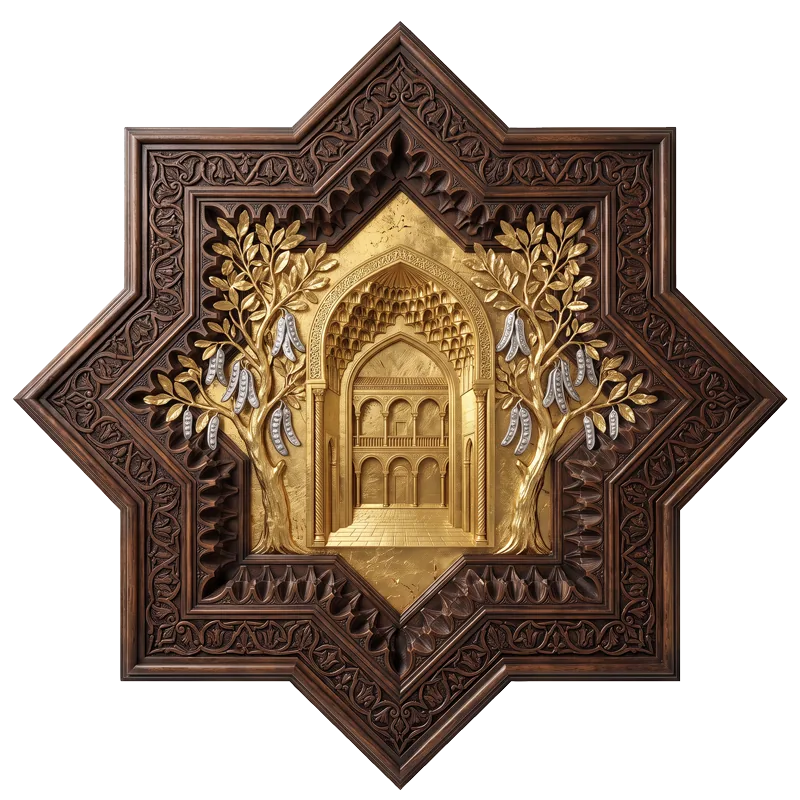
The crest of ar-Raḥl, the farmstead: the gebbia, the channel that feeds it and the one that carries water to the fields, between an olive and an almond in flower.
“The fertility of this island surpasses all description: suffice it to know that it may be called a daughter of Spain, for the extent of its tilled land, for its fruitfulness and for its abundance.”
Ibn Jubayr, Travels, Sicily, 1184–1185 (Italian version of M. Amari, Biblioteca arabo-sicula; translated from the Italian).
The sentence measures a twelfth-century island, not this holding. It says, though, what Ar-Raḥl means to be: the land as part of the rule, not as a setting.
What is grown
The crops follow what the Iblei plateau allows without forcing: olive grove, arable land, a vegetable garden for the table, and pasture where the ground carries nothing else. The olive grove has a second function: its prunings feed, together with the workshop offcuts, the biomass boiler that covers the part of the heating demand the solar does not.
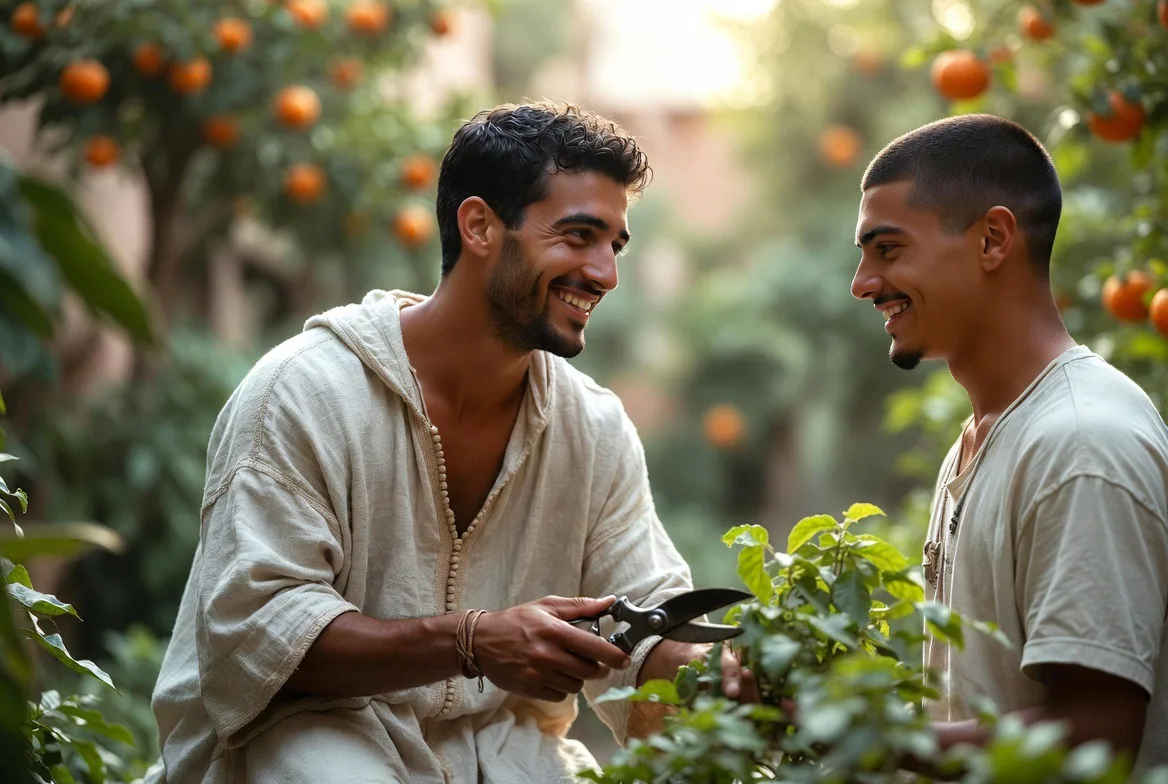
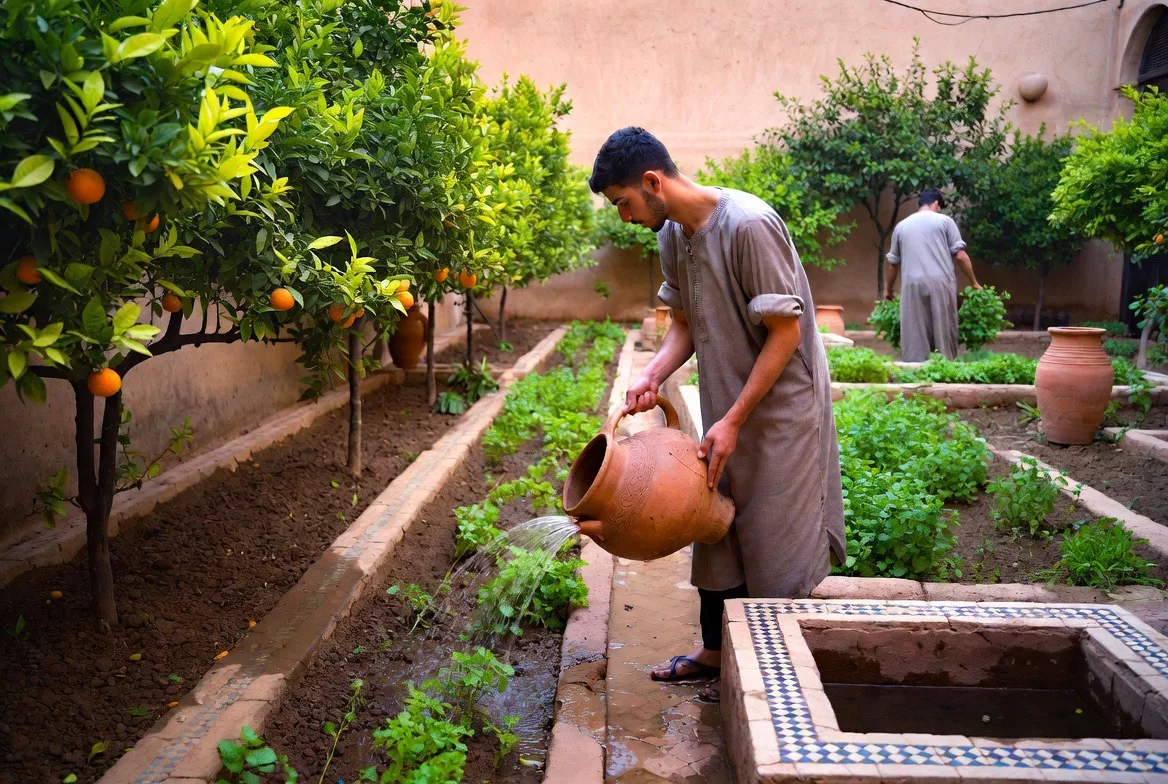
Agricultural production is sized for the house’s own consumption, and it is a deliberate choice. A farm that became the main source of income would shift the apprentices’ time from the workshop to the field, and the school of the crafts would become the farm’s side activity instead of the reverse. The road of certification is not taken either: the DOP is a control system that asks for the commitment of a business and not of a school. Good oil is sold without a label.
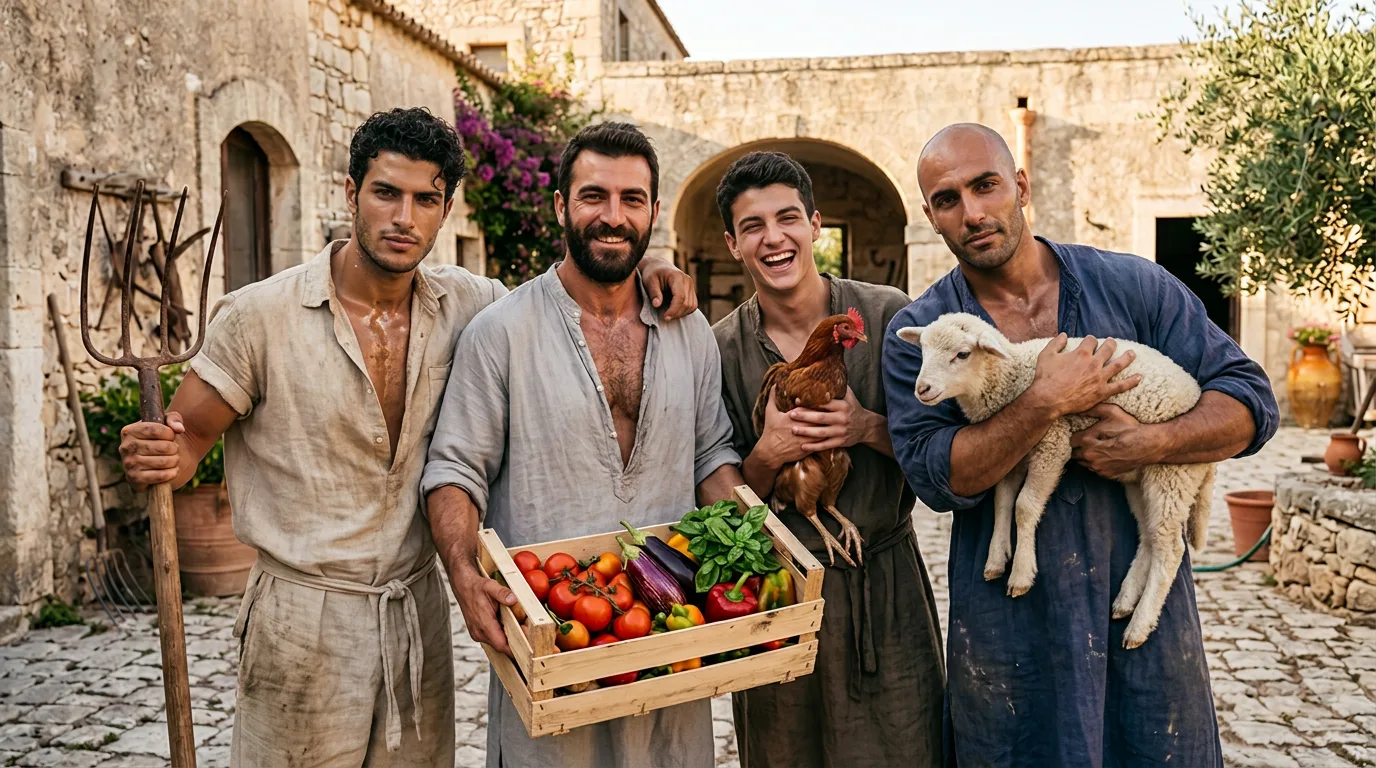
What the twenty-three hectares give to the table. Studio rendering.
The surplus is sold, and the proceeds go to the House. The cooperative operates like any other Italian agricultural cooperative, with the licences and permits the case requires.
Water for the fields
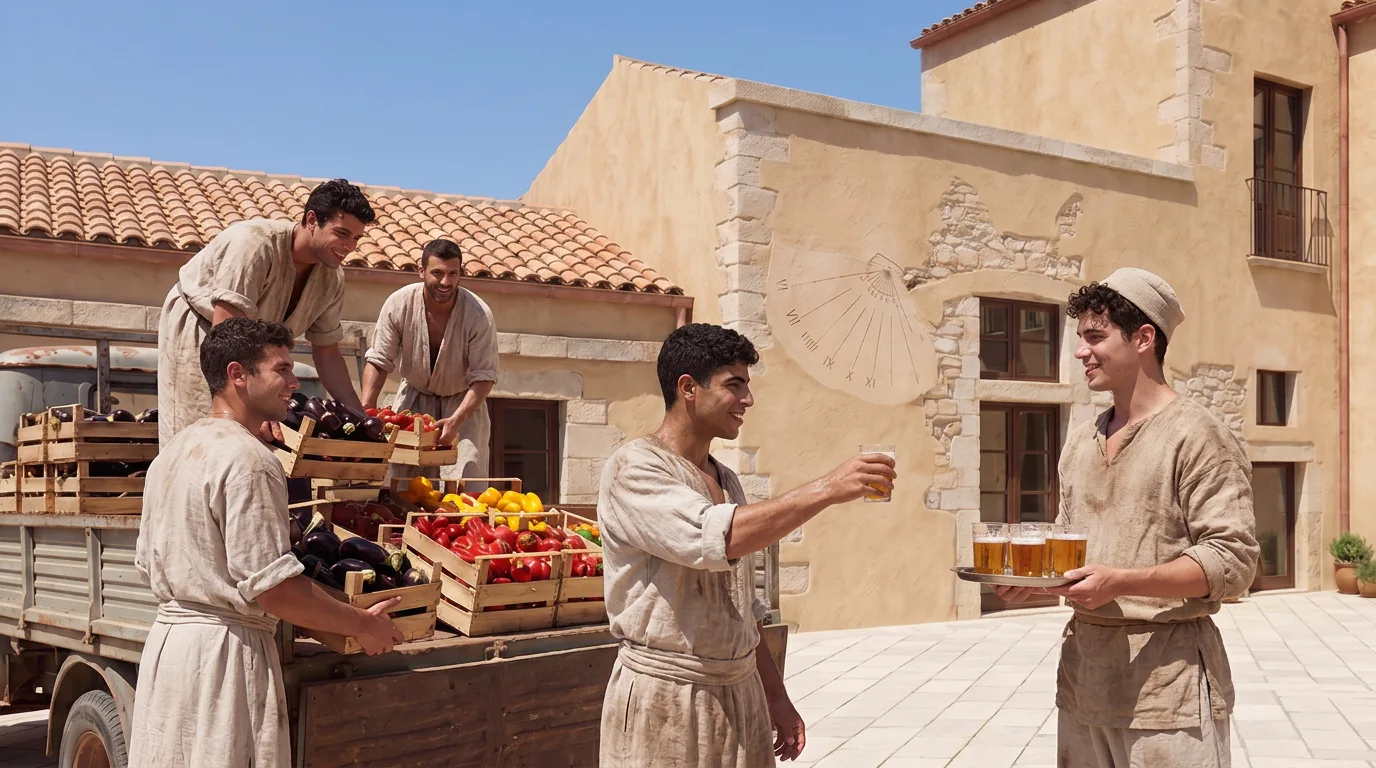
Irrigation rests on the collection of rainwater, on the existing cisterns to be recovered, on new underground cisterns beneath the courtyard, and on the well whose yield and licence are to be ascertained. Waste water is treated by constructed wetlands sized for forty population equivalents, since there is no public sewer and the twenty-three hectares allow it without difficulty.
On the island, conducted water has already had its verses. Of the park of the Favara, at Palermo, ʿAbd al-Raḥmān of Trapani wrote:
“Favara of the twin lakes, in you every desire is gathered: sweet to the sight and a wondrous spectacle. Your waters divide into nine streams. Where your two lakes meet, there love makes camp, and on your channel passion pitches its tents. O splendid lake of the two palms, and sovereign dwelling girdled by the lake. The clear water of the two springs seems liquid pearls. The branches of the gardens seem to lean out to watch the fish in the waters. The great fish swims in the clear waters of the park, the birds sing in its orchards.”
ʿAbd al-Raḥmān al-Iṭrābānishī (of Trapani), verses on the Favara of Palermo, twelfth century (Italian version of M. Amari, Biblioteca arabo-sicula; translated from the Italian).
The words of this page are in the common glossary; the works cited in the sources; the sister house is Riyāḍ al-Uns.