Water
Rule and cool — how an island that gave water the Arabic names it still uses teaches a house to count it, and how the house gives it back to the air.
وَلَولا مُلوحَةُ ماءِ البُكا / حَسِبْتُ دُموعِيَ أَنهَارَها
“And were it not for the saltness of the water of weeping, I would take my tears for its rivers.”
Ibn Ḥamdīs of Syracuse (c. 1056 – 1133), Dīwān, from the verses on Sicily (ed. I. ʿAbbās, Beirut 1960; qaṣīda “Qaḍat fī ṣ-ṣibā”, l. 36). Our translation.
A lexicon that has stayed
Sicilian still keeps to this day the hydraulic and agrarian lexicon of the Islamic age, and keeps it in the countryside, where the works it names are still in use: the gebbia, from the Arabic jābiya, is the collecting tank; the saia, from sāqiya, the walled channel; the senia, from sāniya, the noria; the margiu, from marj, the wet ground; the favara, from fawwāra, the spring; the catusu, from qādūs, the terracotta pipe made of spigoted truncated cones, with which water was carried under pressure even uphill.1 The circumstance has a significance that goes beyond erudition: a gebbia to be recovered on the property and an Andalusian alberca are the same object, and the mason who replasters it in lime does not need to be told what it is for.
Behind the lexicon stands a system. The plain of Palermo preserves a network of draining galleries of the qanāt type — sixty-three sites recorded by Todaro’s group, the oldest of the twelfth and thirteenth centuries, three still open to visitors, among them that of the Uscibene — which carried water by gravity to gardens, mills, baths and houses, and let it descend from one use to the next; the gebbie that collected its water reached twenty-eight metres a side, and its distribution among the users was regulated by turns, in forms that historians have likened to the irrigation communities of Spain.2 It is a cascade before it is a network, and the house repeats the principle on a small scale.
The cascade of uses in the masseria: rain, well, courtyard, bath, garden
Reading. It is the logic of the historic networks of Palermo and of Fez repeated on a small scale: each use receives water of the quality it needs and passes it on to the next. In the masseria the rain from the roofs — two thousand two hundred square metres of roofing, which with 615–715 millimetres a year yield, after discarding the first flush, between one thousand and one thousand two hundred cubic metres — goes into the cistern; the well tops it up, metered; the basin and the sheet are in recirculation, and only what the air has taken is replaced; the water of the bath and of the washing, after the constructed wetlands, reaches the gebbia and the vegetable garden. What it does not show: the dashed lines are the part that depends on the regional rules on the reuse of grey water, and must be written with the engineer. References: Todaro et al. 2020; Lofrano et al. 2013; Barbera 2007; Trillo 2004 for the rule of turns.
Rain cisterns, 300 m³ — roofs 2 200 m², 1 100–1 250 m³ a year.
Well, metered water — top-up, when the cistern is empty.
Drinking water — drinking, kitchen, ablutions; separate circuit.
Basin flush with the paving and salsabīl, in recirculation — only the evaporated water is replaced; evaporation is the cool.
Hammam and washing — grey water.
Constructed wetlands, 40 p.e. — treatment before reuse.
Gebbia and saia, vegetable garden and citrus — reserve, irrigation by turns, presence.
The order of uses is the order of the cleanliness required; the part that depends on the rules on reuse is the one marked with dashed lines.
The measure of today
The reason why this page cannot be merely a page of history lies in a date: on 6 May 2024 the Council of Ministers declared a national state of emergency for the water deficit of Sicily, after an autumn and a winter without rain, and extended it a year later.3 On such an island, laying out water at ground level in a courtyard to cool it is not a neutral gesture, and the house cannot do it without saying where the water comes from, how much of it it takes, and by what rule.
The first source is the roof. Two thousand two hundred square metres of roofing, with the six to seven hundred millimetres that fall in an average year, yield, after discarding the first flush that carries the dust with it, between one thousand and one thousand two hundred cubic metres; the cisterns buried beneath the courtyard hold three hundred of them, and they fill and overflow from October to March, to empty between June and September, when less than fifty millimetres fall in three months. The model does the sum month by month, and says in which month the reserve runs out and how much must be asked of the well.4
How much rain falls on the roofs, month by month, and how much of it the cistern holds
Reading. The bars are the monthly rainfall of Ragusa (mean 1991–2019) multiplied by the area of the roofs and by a run-off coefficient of 0.8; the line is the level of the cistern, simulated month by month with the chosen consumption: it fills from October to March, overflows, and empties between June and September, when less than fifty millimetres fall in three months. The figure at the bottom says in which month the reserve runs out and how much must be asked of the well. What it does not show: it is a monthly balance on averages: a summer like that of 2024, after a winter without rain, contradicts it, and that is the reason why the cistern is not the only source. Source: Ragusa precipitation 1991–2019 (secondary source; to be checked against the ISPRA normals).
The excavation of the cisterns precedes the restoration of the wings and is subject to prior archaeological verification; the existing tanks are recovered with the remaking of the internal plasters and filtration. The plumbing is a dual circuit, with rainwater and drinking water kept separate; waste water is treated by constructed wetlands sized for forty population equivalents, there being no public sewer, and its destination to the garden depends on the regional rules on reuse, which will be written with the engineer.
Water as rule
The communities of al-Andalus knew this, and wrote it down. Carmen Trillo, who has studied the water of the Nasrids for thirty years, sums up the doctrine in a few principles: the right to water is founded on its quantity and on the labour spent to capture it; the great rivers belong to all, and on the small watercourses whoever is upstream and whoever settled first has precedence; water won by digging may be owned, but remains subject to the right of anyone to drink and to water their beasts; it is divided by turns of time, marked on the calendar and on the hours of prayer, or by shares of volume; and its management belongs to the whole community.5 Al-Idrīsī, at the court of Roger, had found at Scicli a spring that carried that rhythm within itself: “the spring called that of the hours, which flows at the hours of the prayers and dries up otherwise”.6 The rule descends from a saying of the Prophet that the jurists have placed at the foundation of the law of water:
الْمُسْلِمُونَ شُرَكَاءُ فِي ثَلاَثٍ: فِي الْكَلإِ وَالْمَاءِ وَالنَّارِ
“Muslims are partners in three things: in pasture, in water and in fire.”
Abū Dāwūd, Sunan, Kitāb al-ijāra, no. 3477 (ṣaḥīḥ according to al-Albānī).
And from a second, which answered Saʿd ibn ʿUbāda, who asked which alms were the best: “water” — whereupon Saʿd dug a well and said: this is for the mother of Saʿd.7 On this model the house writes its own rule. Water has an order of uses, which is the order of the cleanliness required — drinking and cooking, the ablutions, the basin and the sheet, the bath and the washing, the gebbia and the vegetable garden — and nothing descends to a use that demands more cleanliness than the one it comes from; the rain goes into the cistern; the basin and the salsabīl are in recirculation, and only what the air has taken is replaced; consumption is measured, and the measurement is published. Who decides the use, in case of scarcity, is the assembly of the house, with a written rota: it is target 6.b of the 2030 Agenda, the participation of local communities in the management of water, said in the language of a gebbia.8
Water as cool
Every kilogram of water that passes into vapour takes about 2.44 megajoules from the air, and it is this quantity, the latent heat, that makes a basin an instrument of climate.9 In a Mediterranean summer the evaporation from a free surface is of the order of five to seven millimetres a day — an order of magnitude, not a measurement of the masseria, and lower than at Fez because the air is more humid — so that a basin of eight square metres gives back to the air of the courtyard some tens of megajoules a day, an average power of about one hundred and seventy watts per square metre. The calculation says how much energy leaves with the vapour; it does not say by how many degrees the courtyard cools, which depends on the volume of air, on the wind and on the shade; and it reminds us that cool by evaporation is paid for in water: a basin of eight square metres with the sheet running consumes, in a summer, four or five cubic metres. Hence the small basin, in shade, fed from the cistern and metered.
How much cool a metre of water yields
Reading. Every kilogram of water that evaporates takes about 2.44 MJ from the air (latent heat at 25 °C). With a summer evaporation of 5–7 millimetres a day — the order of magnitude that FAO-56 gives for Mediterranean climates, not a measurement of the masseria, and lower than at Fez because the air is more humid — a basin of eight square metres gives back to the air of the courtyard some tens of megajoules a day, that is, an average power of about one hundred and seventy watts per square metre. The sheet of the salsabīl increases the exchange surface without increasing the water stored. What it does not show: the calculation says how much energy leaves with the vapour, not by how many degrees the courtyard cools; and it reminds us that cool by evaporation is paid for in water, on an island that in 2024 declared a state of emergency for drought. That is why the basin is small, in shade, fed from the cistern and metered.
The measurements available come from the Alhambra. In the Court of Comares, with its basin of 252 square metres, the patio was found to be about three degrees cooler than the outside at the peak hours, the halls up to eight, with the indoor peaks delayed by at least four hours; in the Hall of the Two Sisters, where the water runs in a channel and widens the evaporating surface, the differences reached eight to eleven degrees. Those who measured warn that mass, ventilation and evaporation act together and cannot be separated.10
Fisqiya and salsabil, and the Zisa
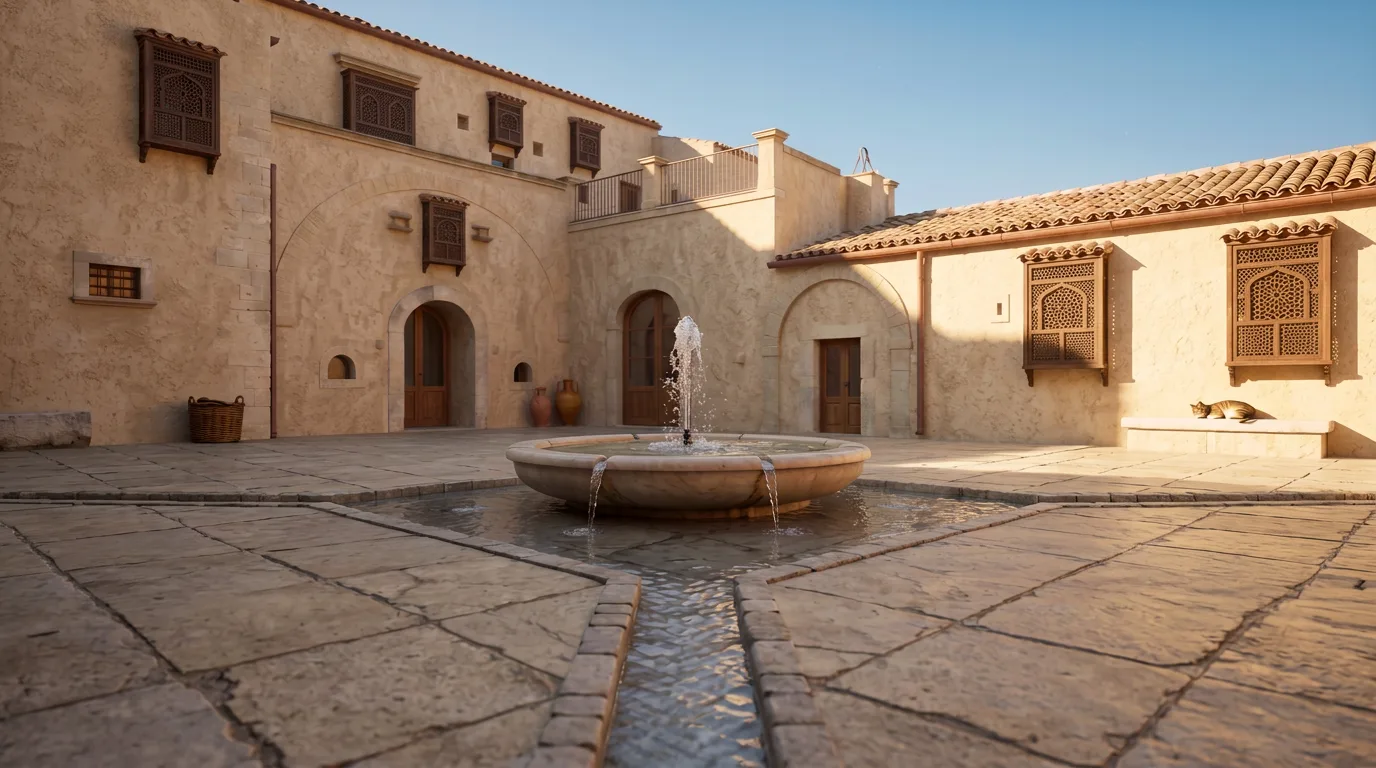
At the centre of the courtyard stands a basin at ground level, heir to the fisqiya of the Arab-Andalusian houses: not an inclined sheet, but a surface flush with the paving, which offers the air the greatest extent of water and gives the sky back to whoever looks at it. The salsabīl — a sheet of water on inclined stone, whose name is that of the spring of paradise — stands against the wall of the garden and not at the centre of the courtyard, which keeps its own basin.11 A Sicilian example is still in working order: in the Hall of the Fountain of the palace of the Zisa, in Palermo, begun by William I around 1165 and completed by his son, the water comes out beneath a panel of mosaic, slides down a marble slab carved in a herringbone pattern, runs along a floor channel with two small basins and reaches the fishpond in the open air; ventilation shafts in the towers and opposed openings gave the hall a continuous exchange of air, and the sea breeze, entering through the three arches, was humidified over the water.12 It is on that model, Sicilian and Norman-Arab, that the two houses of this project draw their own.
وضراغمٌ سَكَنَتْ عرينَ رئاسةٍ / تركتْ خريرَ الماء فيه زئيرافكأنّما غَشّى النّضارُ جُسومَهَا / وأذابَ في أفواهِها البلّورا
“And lions that dwell in a lair of lordship, and have turned the murmur of the water into a roar; as though gold clothed their bodies and melted crystal in their mouths.”
Ibn Ḥamdīs, Dīwān, qaṣīda in praise of al-Manṣūr of Bijāya (ed. I. ʿAbbās, Beirut 1960). Our translation.
The poet of Syracuse, an exile in Ifrīqiya, thus described the basin of the palace of Bijāya, with the golden lions from which the water came out: a century before the Fountain of the Lions of Granada and in the same language. In Arab-Sicilian poetry water is a motif in its own right, and when Ibn Ḥamdīs remembers the lost island it is its rivers that return to him in his tears. What the poet sees in his basin — the curve, the reflection, the cool that edges beauty — is the same thing the architect tries to enclose in a few square metres: water as a presence, before water as a resource. Only that today, to keep it, one must also count it; and the house does the two things together.
The munya to come
At Dar al-Diyafa, the house of hospitality within Al-Munya, water comes first, because the guest sees it. The ṣāniʿ of the house, for the time being, have the courtyard, the basin flush with the paving, and the work. The intention is to give them more: when the collapsed part of the east wing is raised again, the workshops will move there, and the spaces facing the central courtyard will be able to receive a salsabīl against the wall and a floor channel running to the flush basin — the arrangement of the Hall of the Fountain, made again for those who work rather than for those who are received. It is an intention and not a chapter of the project under way; it is written here because the order of the works makes it possible, and because a house that trains young people and keeps beauty for those who pay would end by teaching something it does not wish to teach.
What is not promised
No drop in temperature in degrees is promised, because no published measurement separates the effect of water from that of mass and shade, and the masseria is not yet restored. No consumption is promised, because the top-up depends on the wind and on the hours the sheet runs, and it will be known only from the meter. It is not promised that the reuse of grey water in the garden will be permitted in the form described here, because it depends on the regional rules and on the treatment. What is promised is the register, the measurement campaign from the first year, and the reading of the data by the Scientific Committee the house is setting up, with the freedom to say that something does not work.
G. Caracausi, Arabismi medievali di Sicilia, Palermo, Centro di studi filologici e linguistici siciliani, 1983; G. B. Pellegrini, Gli arabismi nelle lingue neolatine, Brescia 1972; R. Sottile, Il «Siculo Arabic» e gli arabismi medievali e moderni in Sicilia, Palermo 2013. For catusu < qādūs, G. Barbera, “Parchi, frutteti, giardini e orti nella Conca d’Oro di Palermo araba e normanna”, Italus Hortus 14/4 (2007), pp. 14–27.
P. Todaro, G. Barbera, A. Castrorao Barba, G. Bazan, “Qanāts and historical irrigated landscapes in Palermo’s suburban area (Sicily)”, European Journal of Post-Classical Archaeologies 10 (2020), pp. 335–370; G. Lofrano et al., “Water collection and distribution systems in the Palermo plain during the Middle Ages”, Water 5 (2013), pp. 1662–1676; H. Bresc, “Les jardins de Palerme (1290–1460)”, Mélanges de l’École française de Rome – Moyen Âge 84 (1972), pp. 55–127.
Resolutions of the Council of Ministers of 6 May 2024 and of 9 May 2025.
Monthly precipitation of Ragusa 1991–2019 (secondary source; to be checked against the ISPRA normals 1991–2020); run-off coefficient 0.8 and first-flush diversion according to current practice. The capacity of 300 m³ is that of the outline estimate.
C. Trillo San José, Agua, tierra y hombres en al-Andalus. La dimensión agrícola del mundo nazarí, Granada 2004; ead., Agua y paisaje en Granada. Una herencia de al-Andalus, Diputación de Granada 2003.
Al-Idrīsī, Nuzhat al-mushtāq, 4th climate, sect. 2 (Opus geographicum, p. 598): “وبها العين المعروفة بعين الأوقات، ومن غريب أمرها أنها تجري في أوقات الصلوات وتجف في غير ذلك”. Our translation.
Abū Dāwūd, Sunan, Kitāb al-zakāt, no. 1681 (ḥasan according to al-Albānī): “يَا رَسُولَ اللَّهِ إِنَّ أُمَّ سَعْدٍ مَاتَتْ فَأَىُّ الصَّدَقَةِ أَفْضَلُ؟ قَالَ: الْمَاءُ. قَالَ فَحَفَرَ بِئْرًا وَقَالَ: هَذِهِ لأُمِّ سَعْدٍ”.
Targets 6.4 and 6.b of the 2030 Agenda (sdgs.un.org).
Latent heat of vaporisation at 25 °C: 2 441.7 kJ/kg; FAO, Irrigation and Drainage Paper 56, table 2: ET₀ 5–7 mm/day for hot Mediterranean climates in summer.
B. Jiménez Alcalá, “Natural cooling in Hispano-Moslem residential architecture: the case-study of the Court of the Lions and the Court of Comares in the Alhambra (Granada)”, PLEA ’99, Brisbane 1999, pp. 399–406; L. J. García-Pulido, “The mastery in hydraulic techniques for water supply at the Alhambra”, Journal of Islamic Studies 27/3 (2016), pp. 355–382.
Qurʾān 76:18: “عَيْنًا فِيهَا تُسَمَّىٰ سَلْسَبِيلًا”.
U. Staacke, Un palazzo normanno a Palermo. La Zisa: la cultura musulmana negli edifici dei Re, Palermo 1991; G. Bellafiore, La Zisa di Palermo, Palermo 1994; G. Caronia, La Zisa di Palermo: storia e restauro, Bari 1982. The complex has been inscribed since 2015 in the UNESCO site “Arab-Norman Palermo and the Cathedral Churches of Cefalù and Monreale”.
The Scientific Committee, now being set up, that will read these measurements is described on the page Air, water and shade.
What the masseria already did, said in today’s language
The targets that follow describe, in today’s language, a measure the island knew. The tension between cool by evaporation (goal 7) and the scarcity of water (goal 6) is real, and the house declares it instead of hiding it.
Rain cisterns, basin in recirculation, cascade of uses, constructed wetlands — 6.4 increase water-use efficiency · 12.2 efficient use of natural resources
Rule of use written and resolved by the house: turns, priorities, measurement — 6.b participation of local communities in the management of water
Water exposed to the air in place of the machine — 7.3 energy efficiency · 13.1 adaptation to climate-related hazards
Gebbie, saie and qanāt as living heritage — 11.4 safeguard cultural heritage
The terms of these pages are collected in the glossary and the sources on the sources page. The images are studio renderings: the masseria is not yet restored.
The words of this page are in the common glossary; the works cited in the sources; the sister house is Riyāḍ al-Uns.