How one enters
Individual application, paid trial, apprenticeship contract, and the vote after six months. →
The members of the house are selected, and the selection is strict. Once admitted, the rule applies to everyone in the same way.
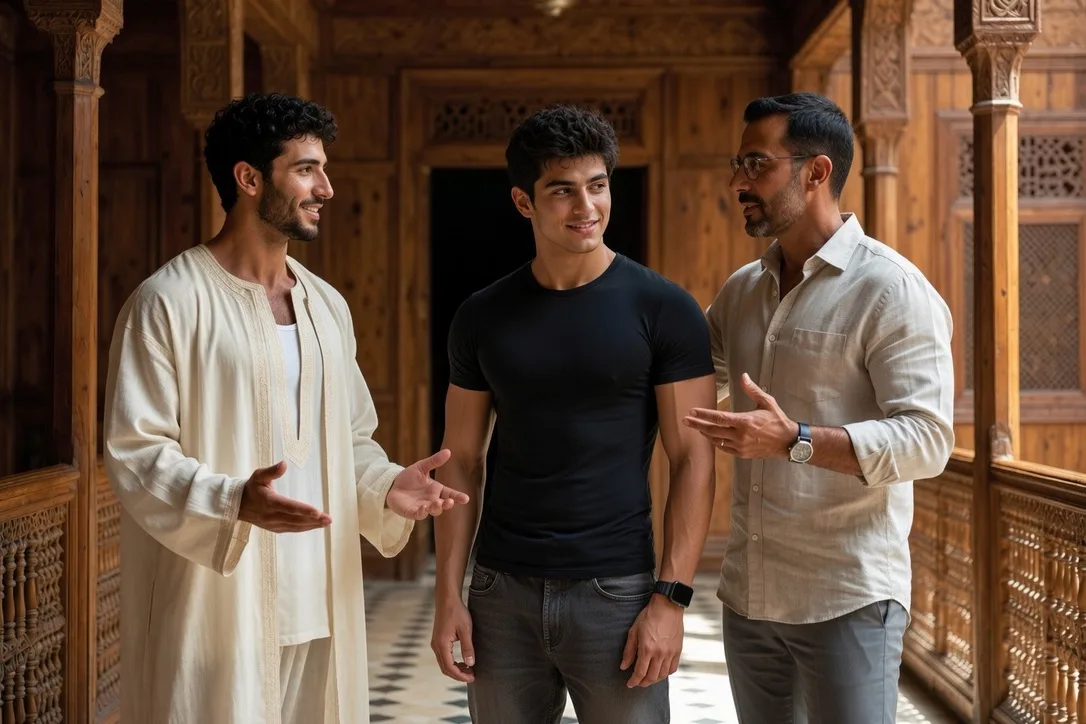
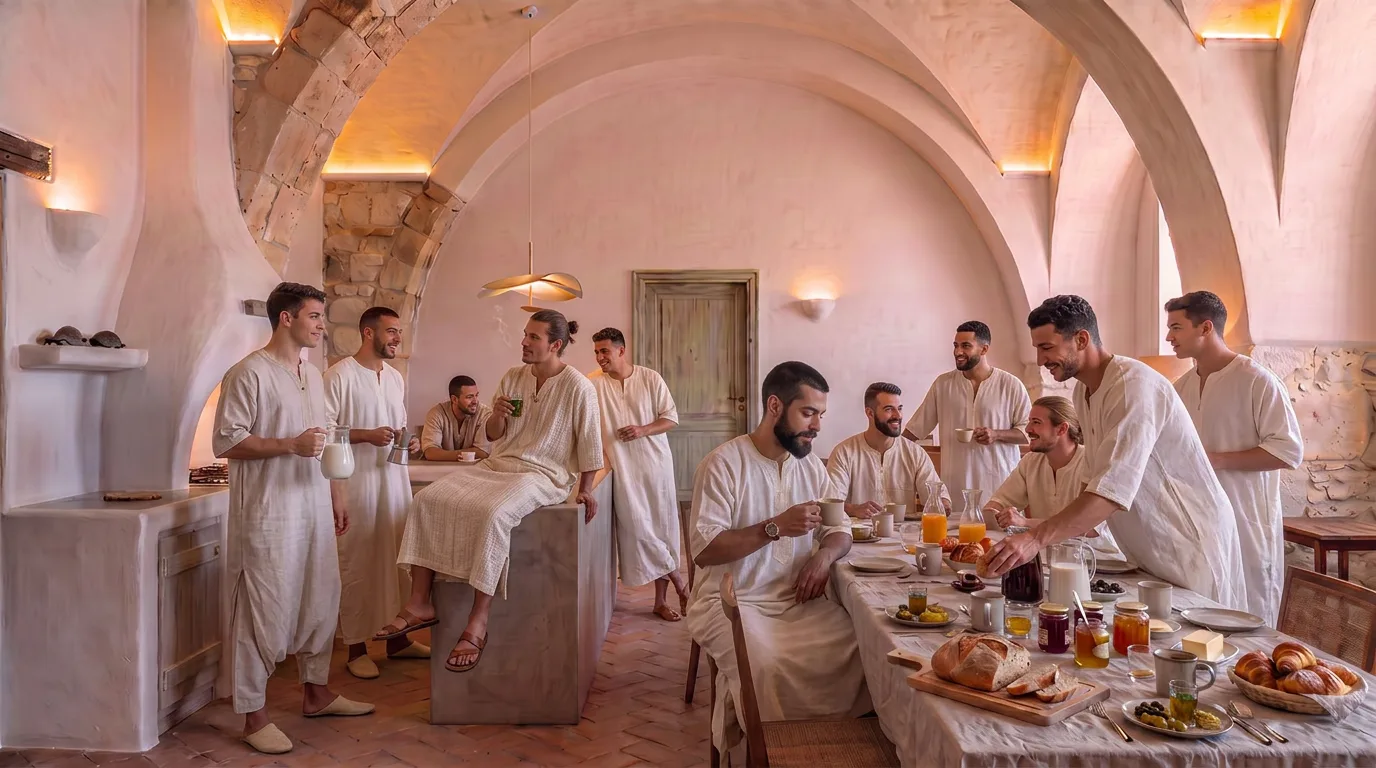
The members of the house call one another rifāq, companions. The same hours, the same table, the same service shifts, the same working dress. The son of a well-off family sweeps on the same terms as an apprentice who arrived with nothing, and each of them leaves at the door what he arrived with. The statutes say so in express terms: treatment is equal among the rifāq, whatever anyone’s economic or family circumstances.
The rule aims to make a difficult thing possible: that a small and changing community, of masters who stay some years and young men who come to put themselves to the test, should work together without the differences of origin turning into hierarchies.
Individual application, paid trial, apprenticeship contract, and the vote after six months. →
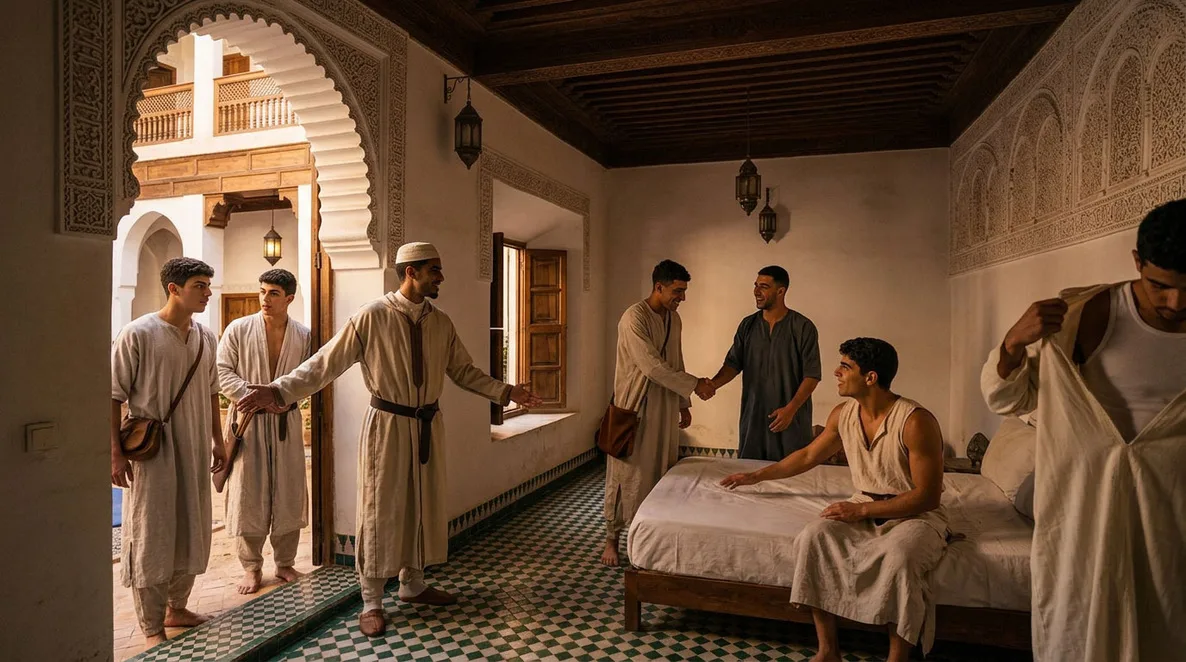
The house of origin, inside Al-Munya: the guests of the house lodge here without charge, and the costs fall on the company. →
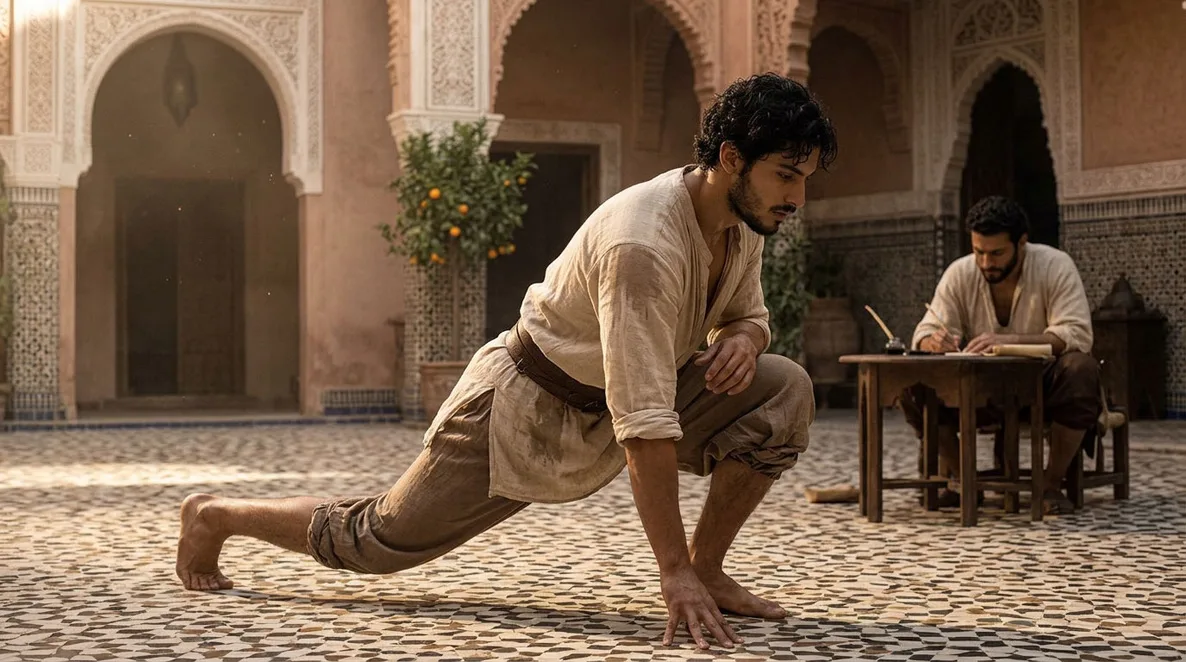
Riding, archery, swimming, gymnasium, hammam, and the matches with the local boys. The riding ring is also the testing ground of the saddlery. →
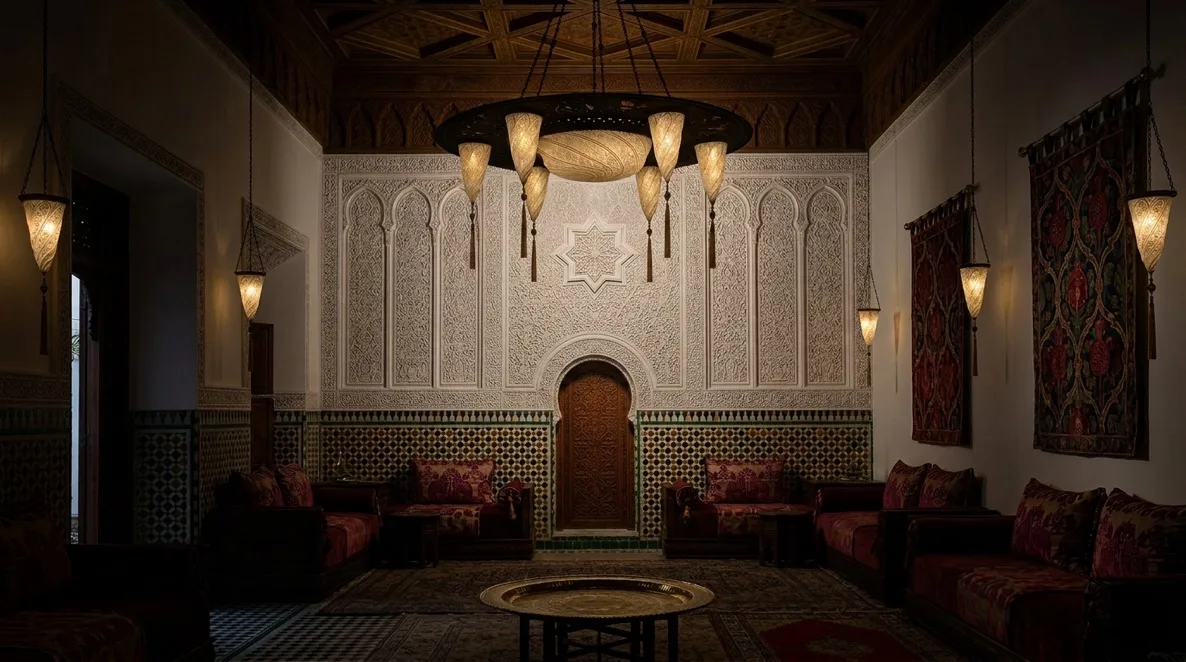
Rooms with fine furnishings, reading rooms, summer and winter sitting rooms, spaces for study and shared work. →
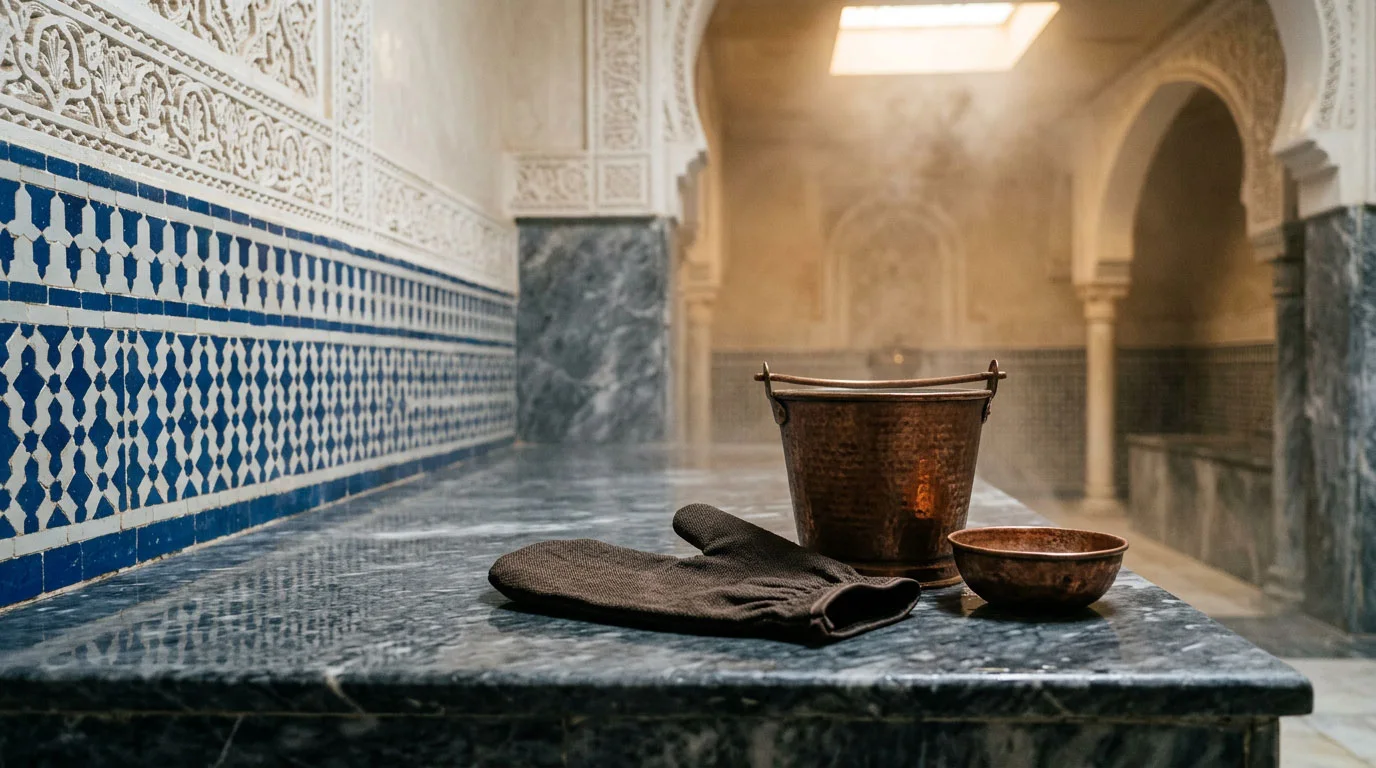
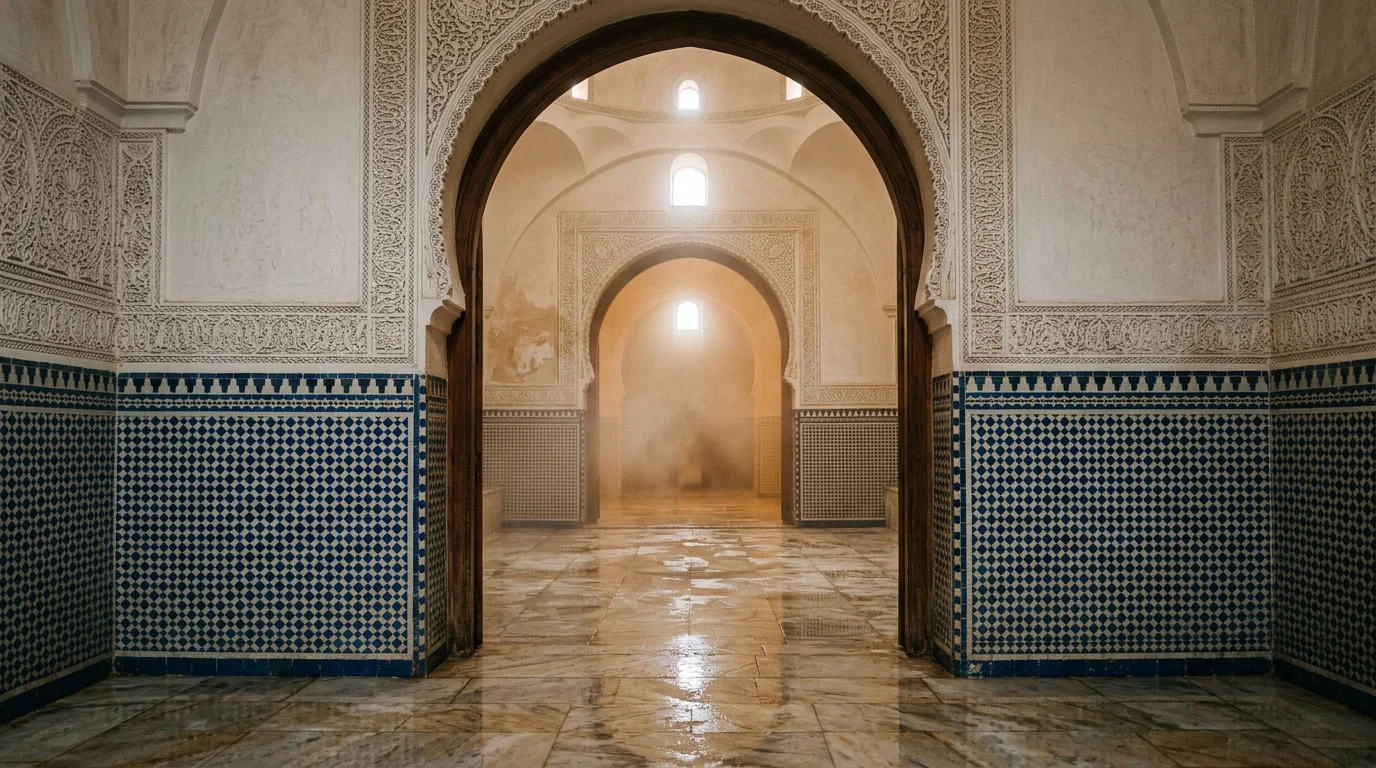
The hot room of the house: steam, marble and the rule of the bath. →
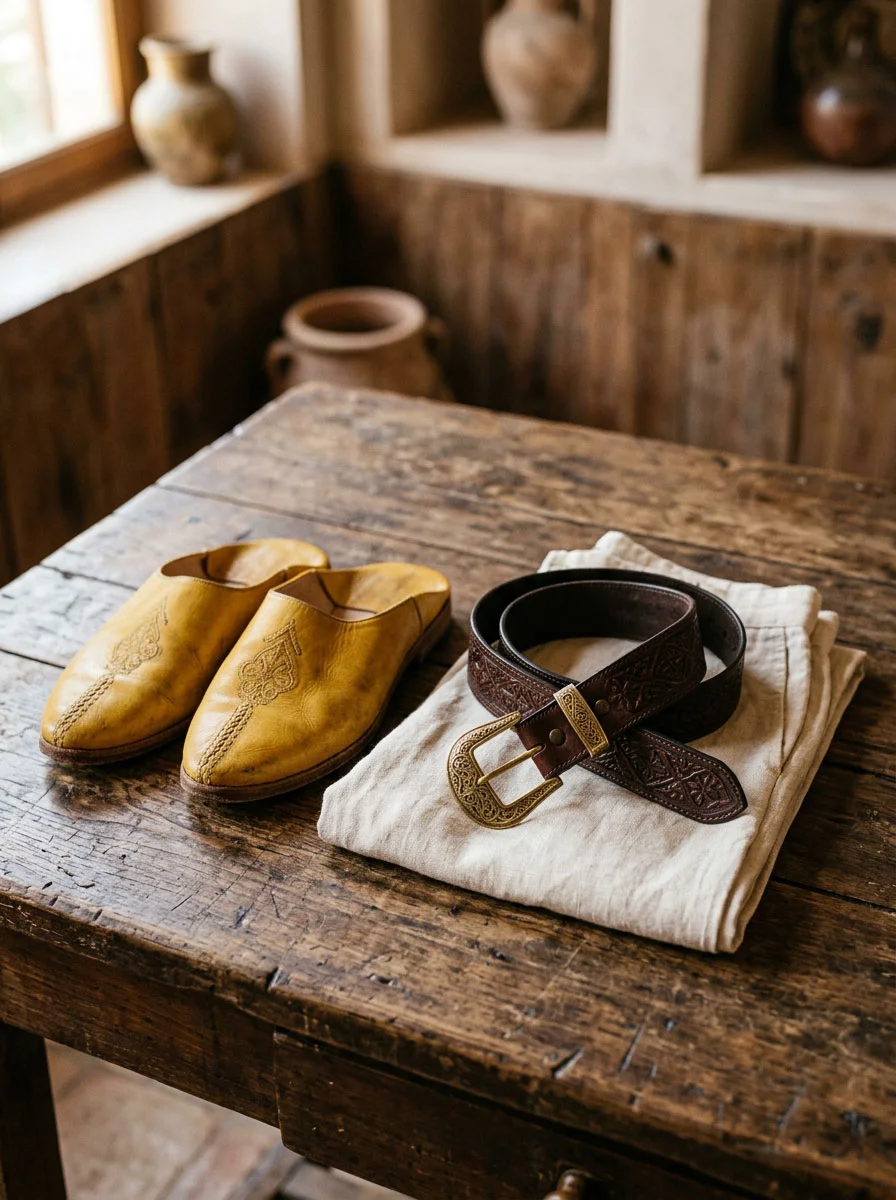
The same dress as in Fez, the same for all: the Al-Kiswa page describes its garments and its reasons. →
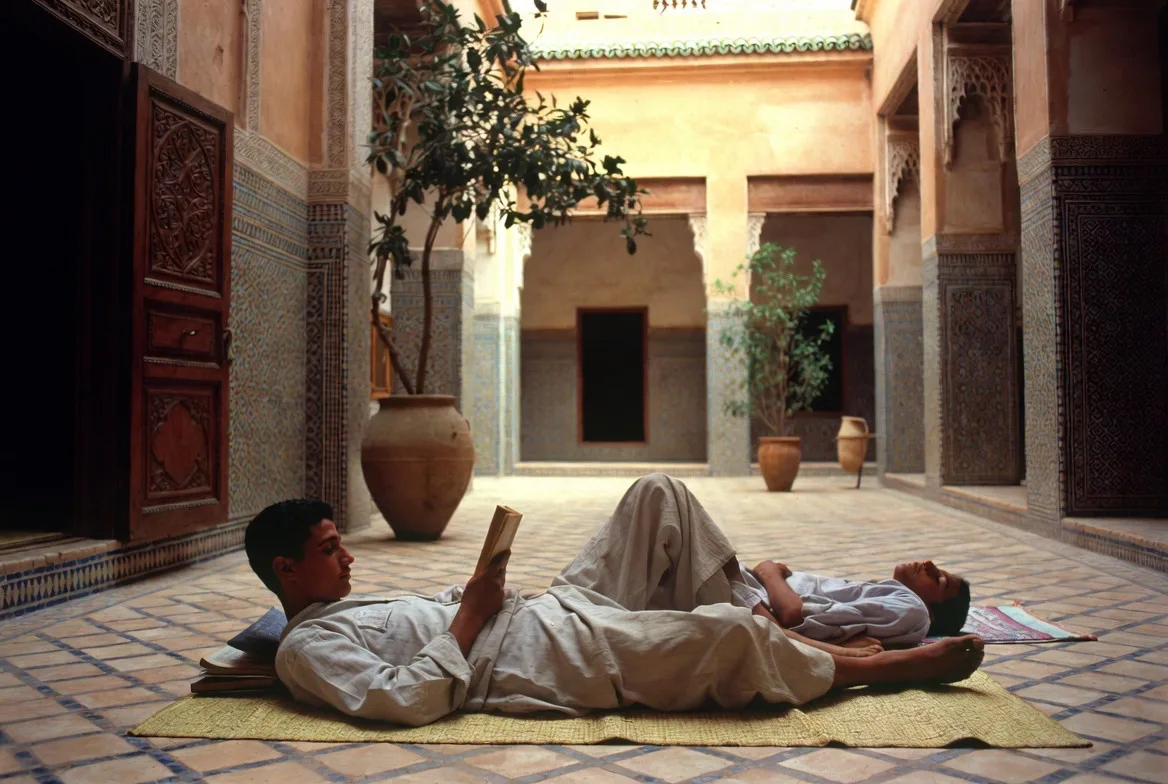
The house provides the clothing, and in the house one dresses from it: the same dress as in the house in Fez, identical in every fondouk of the network, linen in summer and wool in winter, in shades from light ecru to taupe. Equality lies in the common wardrobe, before any uniform: the son of well-off parents and the one who arrived without a penny dress from the same cupboard, and each leaves at the door what he was wearing. The garments, the outfits and the reasons for this dress are described on the page Al-Kiswa, the dress→.
In the workshop the master’s language is spoken. Whoever does not know Arabic learns it by working, from the companions and the master; whoever does not know Italian learns it the same way, and the Moroccan masters have the same obligation towards Italian; at table, once a week, only Arabic is spoken.
The Arabic of the workshop is dārija, the spoken language of Morocco; the written and literary language, fuṣḥā, comes later, for those who need it. Those who enter the calligraphy and book workshops, or prepare to move to Fez, learn to read and write Arabic with a teacher, a few hours a week. Those who already speak Arabic at home begin with reading and writing.
So the language is learned from both sides, as the language of the craft and of the house, with no bearing on admission or on the passage to master.
One evening a week the house holds a class for young men from the surrounding area, aged eighteen to thirty and up to thirty-five: dārija for Italian speakers, Italian for Arabic speakers, taught by the companions and the masters, each in his own language.
In the house, people call one another by their first name. The family name stays at the door with the rank it announces, and the first name is what each man carries inside: it is the name the neighbourhood ends up knowing.
Italian has the formal lei; Arabic, which is the masters’ language, does without a formal lei or a plural of politeness: one says anta to everyone, and respect goes through what is placed before the name. The house follows Arabic in Italian too: everyone is on first-name terms, from the youngest to the master.
Among apprentices, the first name. Those who speak Arabic put khūya, “my brother”, before it, the most ordinary way two North Africans of the same age address each other; those who speak Italian say the name and nothing more. The Sī stays outside among them, whatever the difference in age: Moroccan usage grants it to anyone older, and it would restore a ladder of seniority that the common dress has precisely removed.
In the workshop he is “maestro”, and in Arabic a maalem, since the masters come from Fez. The word names a bond, like “father”, before it names a rank, and an apprentice who called his master by his first name at the bench would pass, in Fez, for a badly raised boy rather than a free man. Outside the workshop (at table, at play, on horseback) it is the first name, in Arabic preceded by Sī, the small prefix of respect a Moroccan gives any man older than himself. So the first name holds for all, and the one distinction falls where the one hierarchy of the house stands, that of work.
The master, for his part, calls each man by his first name, and a wuldī, “my son”, is what a master of Fez says to his apprentice.
Workshop nicknames, which exist in Fez and are often mocking, arise on their own, and the house lets them arise on their own. The kunya (“Abū So-and-so”) presupposes fatherhood, and the members of the house are single.
The tradition calls futuwwa loyalty among companions, obligation towards those who have less, self-mastery and the duties that run in both directions between a master and his apprentice: the medieval collections gave this name to a set of verifiable behaviours, which are learned by living.
وَمِنَ الْفُتُوَّةِ تَرْكُ طَلَبِ عَثَرَاتِ الْإِخْوَانِ
“It is part of futuwwa to give up looking for the stumbles of one’s companions”
Al-Sulamī (d. 1021), Kitāb al-futuwwa, part one
The skill of the work, and the part of a civilisation that Europe now rarely sees: charity as an obligation before it is an impulse, the education of the young through work, and rank left at the door. These things are shown by being seen at work: the public programme brings the work of the workshops, and those who do it, into the spaces open to the public, under the rule of the house.
Hours, shifts, use of the common spaces, custody of the tools, internal sanctions and the manner of settling disagreements are governed by the niẓām ad-dār, the rules of the house, resolved by the majlis.
The niẓām is reviewed at least once a year, and any rafīq may propose an amendment. What matters, more than the frequency of the review, is who carries it out, since it is the young men who live under those rules who rewrite them, which is also how the house trains in self-government.
Removed from the deliberation of the majlis are the rules on safety and hygiene at work, the prescriptions on the restoration of listed buildings and the obligations of law; on everything else the majlis decides.
The initial text is provisional and lapses by right at the first majlis in which the rifāq other than the signatories of the deed of constitution form the majority; there it is readopted, amended or replaced, and until the new resolution the provisional text remains in force. The automatic lapse prevents the text written by the founders from weighing for years more than those who come after.
To observe the statutes, the niẓām ad-dār and the resolutions of the bodies of the house.
Loyalty towards one’s companions, care of the tools and the common spaces, participation in the service shifts resolved by the majlis.
Hours, table, lodging and common services are the same for everyone, without outward distinctions of treatment.
Disputes among rifāq in contractual and associational matters are referred to the hayʾat at-taḥkīm, the arbitral panel of three members, under the rules annexed to the statutes. Outside it in every case are matters not within the parties’ power to dispose of, criminal matters, family law and the non-waivable rights of the worker.
Among the conditions that would mark the project’s negative outcome→ there is one that concerns precisely this: if the arbitration clause stayed unused, or were used and the outcome ignored by the parties, the internal settlement of disputes would be decorative, and with it a good part of the framework.
The words of this page are in the common glossary; the works cited in the sources; the sister house is Riyāḍ al-Uns.