The building site as first school
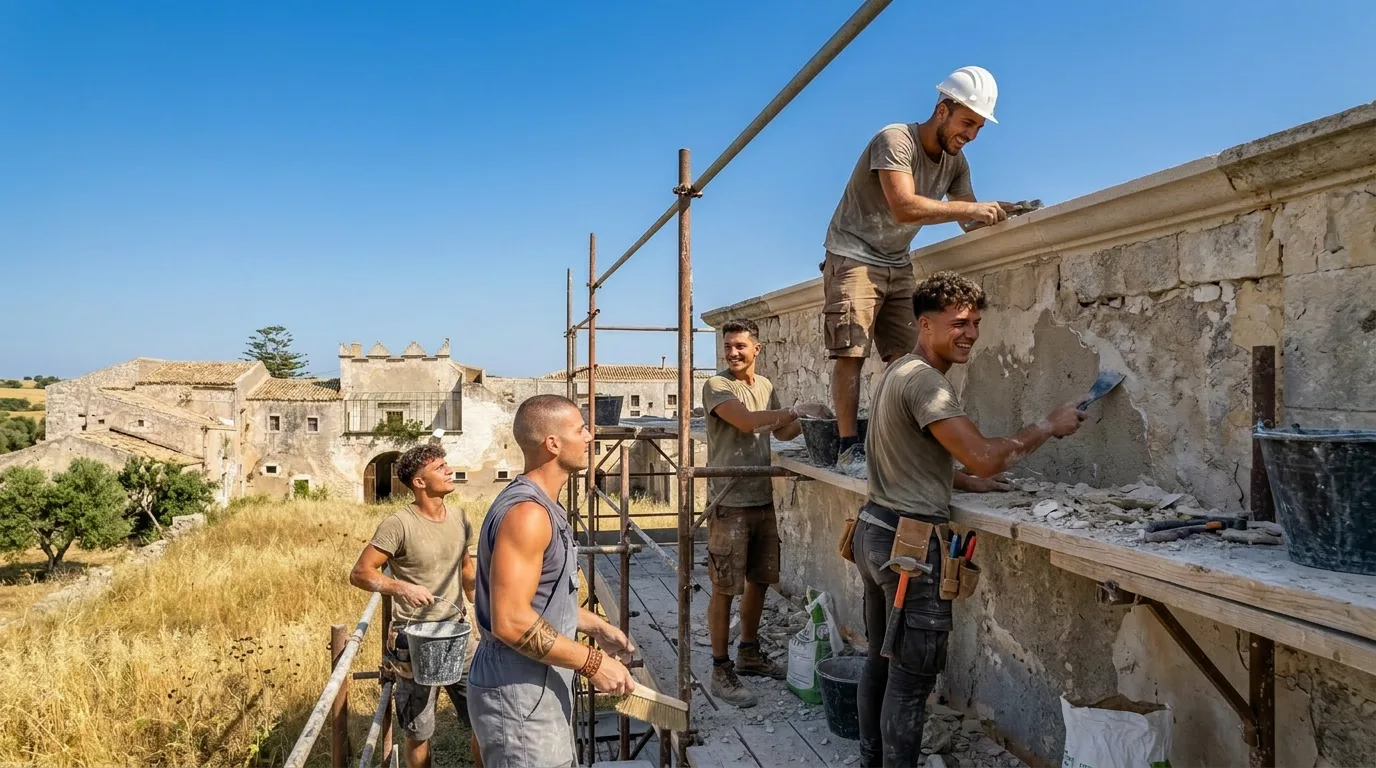
The restoration works are the first occasion for training, and the first commission the house carries out, rather than a wait that precedes the activity.
The operations compatible with learning — plasters and stucco, stone, joinery and window frames, floors, dry-stone walls — are carried out by the masters with their apprentices, who take part as members admitted on application. Structural works remain with qualified firms, and the apprentices work alongside them without replacing them.
“Every day the death of an old man, the abandonment of a village by a farmer, means the disappearance of a library of local knowledge indispensable for facing the new challenges.”
Pietro Laureano, address at the Africa Forum, Rome, 4 June 2008.
Among the site’s works, the dry-stone walls carry one title more. Rebuilding and maintaining them is not land improvement: it is the exercise of a know-how that UNESCO inscribed in 2018 on the Representative List of the Intangible Cultural Heritage of Humanity, on the nomination of eight States including Italy, and which since 2024, extended to further States, appears there as Art of dry stone construction, knowledge and techniques. UNESCO’s entry describes it thus:
“The art of dry stone construction refers to the practice of building with stone without using binding material. […] Dry stone construction is achieved through the careful selection and arrangement of stones to ensure the long-term stability of the structure and its adaptation to the local terrain and climate.”
UNESCO, Representative List of the Intangible Cultural Heritage of Humanity, element 01393 (decisions 13.COM 10.b.10, Port Louis, 2018, and 19.COM 7.b.57, 2024).
What the site teaches that a workshop would not
A restoration site imposes a sequence the apprentice cannot choose and that tolerates no second thoughts: first the excavation of the cisterns, then the restoration of the wings; first the removal of the cement plasters, then replastering in lime; first the remaking of the roof covering, then any finish on the floor below. It is the discipline the workshop alone does not transmit, because in the workshop a mistake is discarded and one starts again.
It also imposes scale. Two thousand two hundred square metres of roofing, one thousand two hundred of masonry to consolidate, six thousand of plaster to remove and redo in lime, two thousand five hundred of floors in Iblean stone and terracotta: these are quantities no teaching exercise reproduces, and they teach the apprentice what an hour of his own work is worth.
The sequence the site imposes, removing the cement and replastering in lime, is not a matter of taste. The Nara Document on Authenticity counts traditions and techniques among the sources on which the authenticity of a work is judged, alongside its materials:
“Aspects of the sources may include form and design, materials and substance, use and function, traditions and techniques, location and setting, and spirit and feeling, and other internal and external factors.”
The Nara Document on Authenticity, drafted at the Nara Conference (1–6 November 1994) in co-operation with UNESCO, ICCROM and ICOMOS, para. 13.
Admission, and how recruitment is done
Admission is by individual application, with selection on aptitude and commitment and never by category of belonging; the path — paid trial, apprenticeship, vote — is set out in full on the page How one enters.
Recruitment is carried out where the young population of the province is to be found, through associations, places of worship and cultural mediators of the agricultural district.
Regular employment as a precondition
Every relationship is framed under the construction industry agreement, with safety training, regular contributions and verification of the right to work in Italy. In a province where the exploitation of agricultural labour is a known and monitored matter, an unimpeachable record on this point is worth more than any economic result, and a single well-founded complaint in this matter would outweigh any result obtained elsewhere.
The words of this page are in the common glossary; the works cited in the sources; the sister house is Riyāḍ al-Uns.