The Sicilian precedent
The institution is not being imported into the island. It has existed there, under Islam and after, and the word survives in the dialect to this day.
Under Islam
Ibn Hawqal, writing in 973, records that the royal quarter of al-Khalisa in Palermo had neither markets nor fondaci, which tells us by implication that the rest of the city had them. Letters from the Cairo Geniza name fondaci in Palermo in the first half of the eleventh century. No excavation has so far yielded one of those buildings, and the most careful survey of the Palermo area speaks of faint indications in the absence of material traces.
The Normans did not abolish it
They made use of it. Al-Idrisi, at the court of Roger II, describes the Cassaro and the suburb full of fondaci, shops and markets. In 1143 George of Antioch gave two Palermo fondaci to the church of the Martorana, and a fundacus olagiorum, almost certainly a warehouse for oil, appears near Santa Maria della Grotta. Roger, William and later Frederick II found the institution already in being and adapted it to their own purposes: lodging, storage, customs and exchange.
Ibn Jubayr, 1184
The decisive testimony is later still. In 1184 and 1185 the Andalusian traveller Ibn Jubayr lodged in fondaci at Messina, at Termini and at Palermo, and in Palermo he chose the one where Muslims were accustomed to stay. A full century after the Christian conquest, a house in which a community lodged among its own was still standing and still recognisable to a man come from Granada.
“We lodged in a fondaco, in which we stayed nine days.”
“We turned to one of the fondachi of the city, and there we took lodging.”
Ibn Jubayr, Travels, at Messina (December 1184) and at Palermo (Italian version of M. Amari, Biblioteca arabo-sicula; translated from the Italian).
The name and the privileges
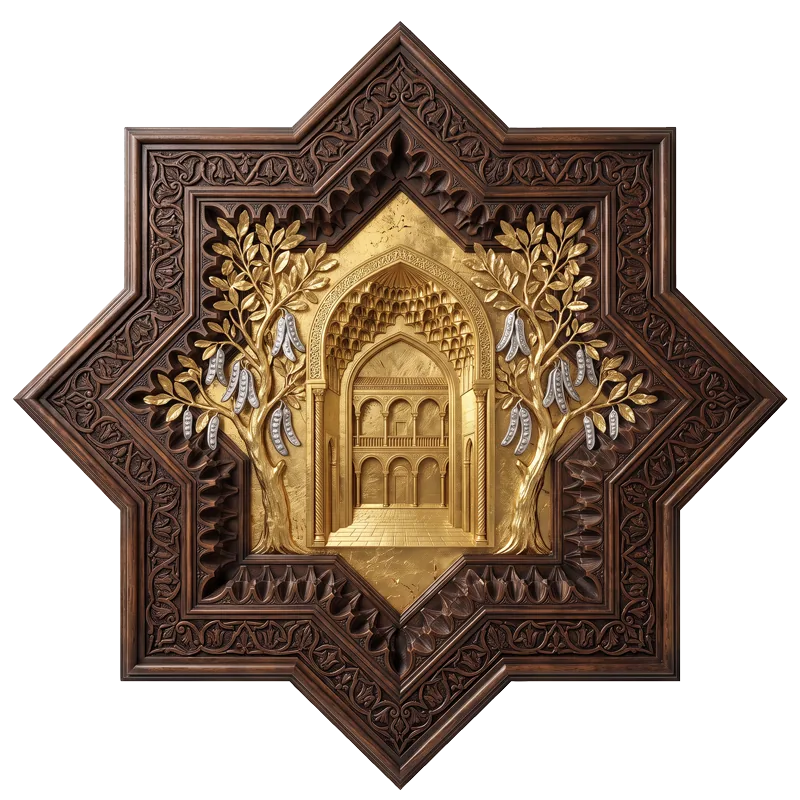
The word comes from the Greek pandocheîon, “the house that receives everyone”, passed into Arabic as funduq and into Sicilian as fondaco. The Arabic sources gathered by Michele Amari describe it as a courtyard building, often planted with trees: on the ground floor shops, warehouses, stables and the weighing-house; on the upper floor the rooms of foreign merchants and travellers. After the Norman conquest it returns in the privileges by which the court of Palermo granted the merchant nations — Genoese, Pisans, Amalfitans, Venetians — an enclosure of their own in the city: a consul, a notary, recognised weights and measures, sometimes a chapel, all under royal safe-conduct. The fondaco was thus a place governed by a pact, before it was a lodging.
Of Ibn Jubayr’s passage on Sicily there is a current Italian edition: Viaggio in Sicilia, edited by Giovanna Calasso, Adelphi, Milan 2022. The reference corpus for all the Arabic sources on the island remains the Biblioteca arabo-sicula of Michele Amari (Leipzig 1857, Italian version Turin-Rome 1880-1881), fully digitised.
What cannot be claimed
What cannot be demonstrated must be said with the same precision. Of those fondaci no walls survive in Sicily, and there is no unbroken line from the emirate to this project. In the fourteenth century the documents say fundacus and the Sicilian fondaco has by then become a warehouse and a royal concession rather than the house of a nation. What survives is the word: in Sicilian a fondaco is still a funnacu, though the meaning has fallen away together with the thing. Nineteenth-century lexicography records the funnacaru, the innkeeper.
The claim of this project rests on that, and on no monumental continuity: the island has already had this institution, it called it by its name, and a twelfth-century Muslim slept in one, as a Muslim, in a city that was already Norman.
Ibn Hamdis
The voice that best says what Arab Sicily was is that of a poet born in Syracuse in 1056, who left the island young and never returned, writing of it for the rest of his life from Andalusia and the Maghreb.
فَإِنْ كُنْتُ أُخْرِجْتُ مِنْ جَنَّةٍ • فَإِنِّي أُحَدِّثُ أَخْبَارَهَا
Fa-in kuntu ukhrijtu min jannatin / fa-innī uḥaddithu akhbārahā
“If I have been driven out of a paradise, I nonetheless tell its news.”
Ibn Hamdis of Syracuse (1056-1133). Text attested in Yaqut, Mu’jam al-buldan, s.v. Siqilliya, and in al-Himyari, al-Rawd al-mi’tar; cf. Ihsan Abbas, al-Arab fi Siqilliya, p. 255.
The verse is quoted here for a precise reason. The project sets out to put back into use an institution of which the island has documentary and lexical memory, and not to reconstruct Islamic Sicily, which cannot be reconstructed. Whoever tells the news of a place keeps it nameable, which is a different thing from bringing it back to life.
The words of this page are in the common glossary; the works cited in the sources; the sister house is Riyāḍ al-Uns.