Al-Kiswa
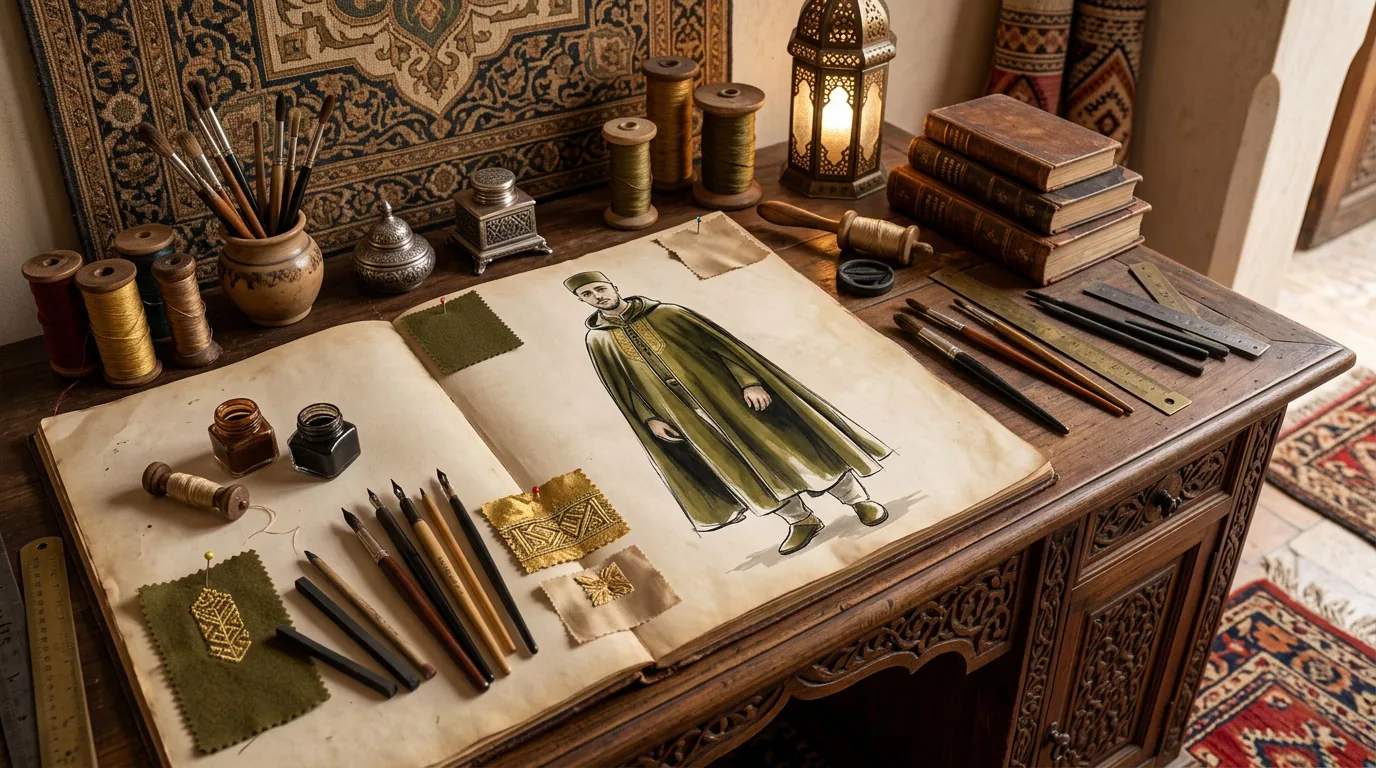
The workshop notebook — what the house cuts, and what each piece states.
الْبَسْ لِكُلِّ حَالَةٍ لَبُوسَهَا
al-bas li-kulli ḥālatin labūsahā
“For every state, put on the dress that suits it.”
Classical Arabic proverb.
THREE RULES
The whole system in three sentences
FOR LIFE
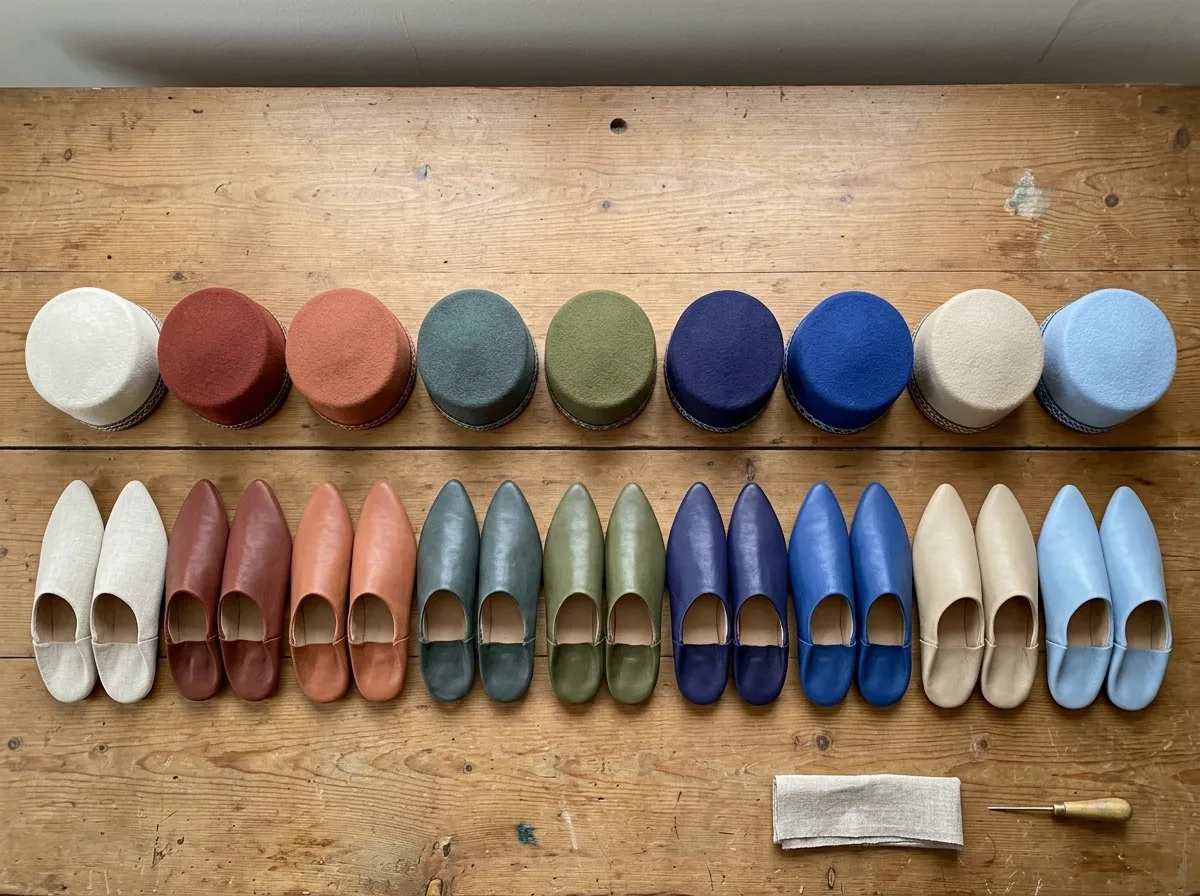
The cap and the babouches
Their colour states the workshop. Undyed for as long as a man has not been received into one, they are dyed once in a lifetime — the day a maalem takes him into his shop — and never again: not on becoming nāʾib, not on becoming maalem in his turn.
WITH THE YEARS
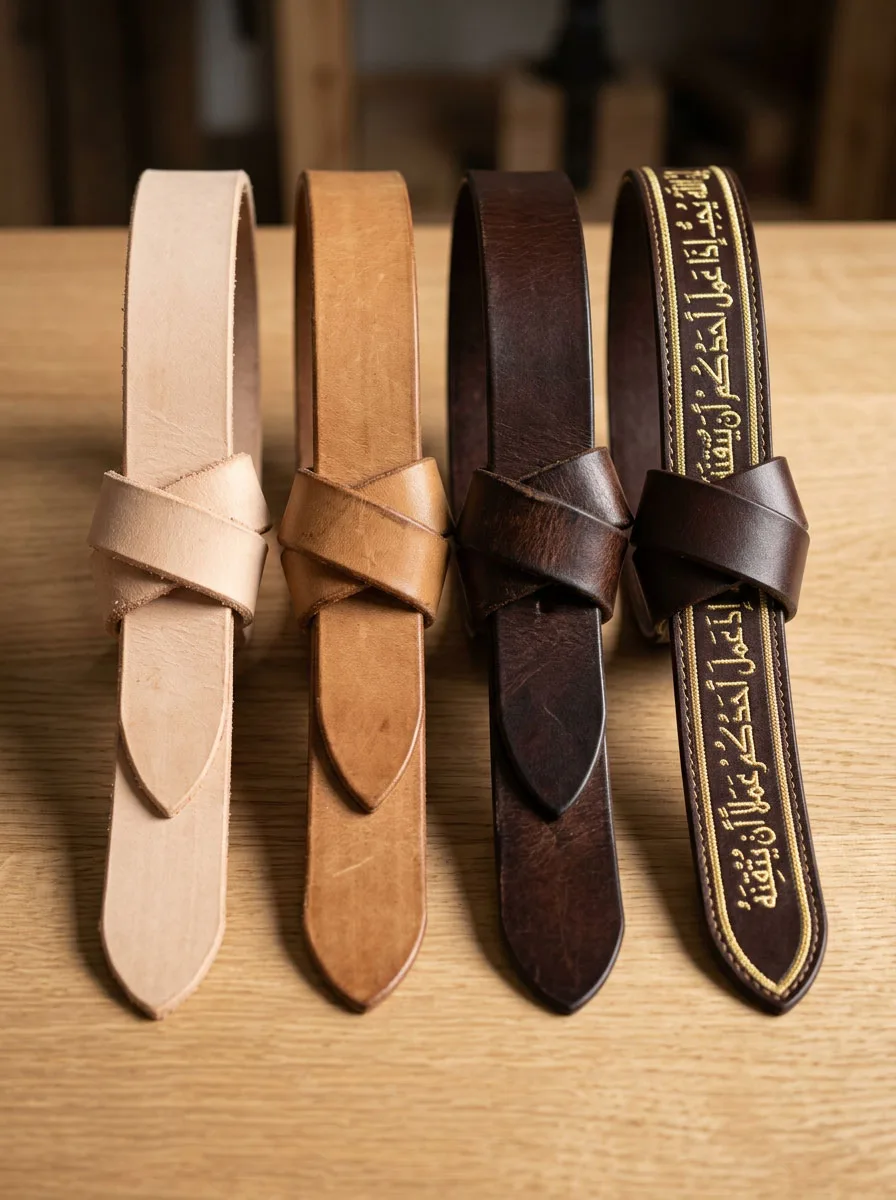
The leather belt
Its three tones state the grade — the distance covered in the craft. They run one way only, and nothing there is won by seniority.
FOR AS LONG AS IT LASTS
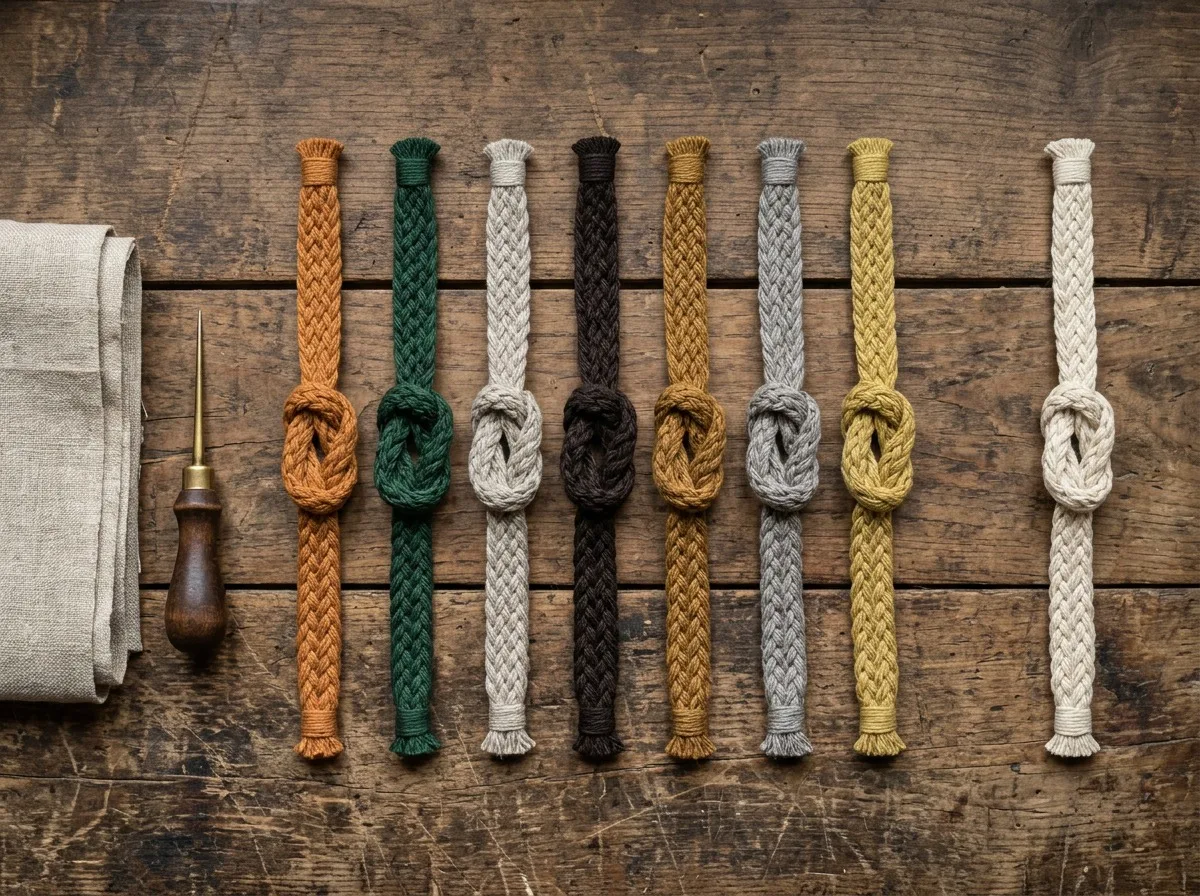
The jacket, the coat, the cord
These three pieces take the colour of the function for as long as a man exercises it; the object says which one. They are undyed on a man who exercises none, and are handed on to the man who follows.
Three durations, three signs, and each says one thing only. A man enters the house dressed wholly in undyed cloth, is received into a workshop, and leaves it having left a work behind. The cap says where he comes from; the belt, the distance covered in the craft; the jacket, what he answers for to the others for as long as he exercises it.
The rest of this page only sets out those three sentences in detail.
FASHION AND MEASURE
Dress and time
Fashion has to change, and that is its function. A garment that lasted twenty years would not keep the people who sell it alive: last season must stop being wearable for the next one to exist. Novelty is not progress, it is a means.
The dress of this house does not change, for the opposite reason: it was finished long ago. Centuries of use settled its cut, its cloth, the length of the sleeves, the way the fabric falls and lets the air through. What has found its measure is not improved — it is learned.
The house does not keep the remains of an extinguished world. It rekindles, in young men, what never needed a season in order to be true, and which, belonging to no fashion, cannot go out of fashion.
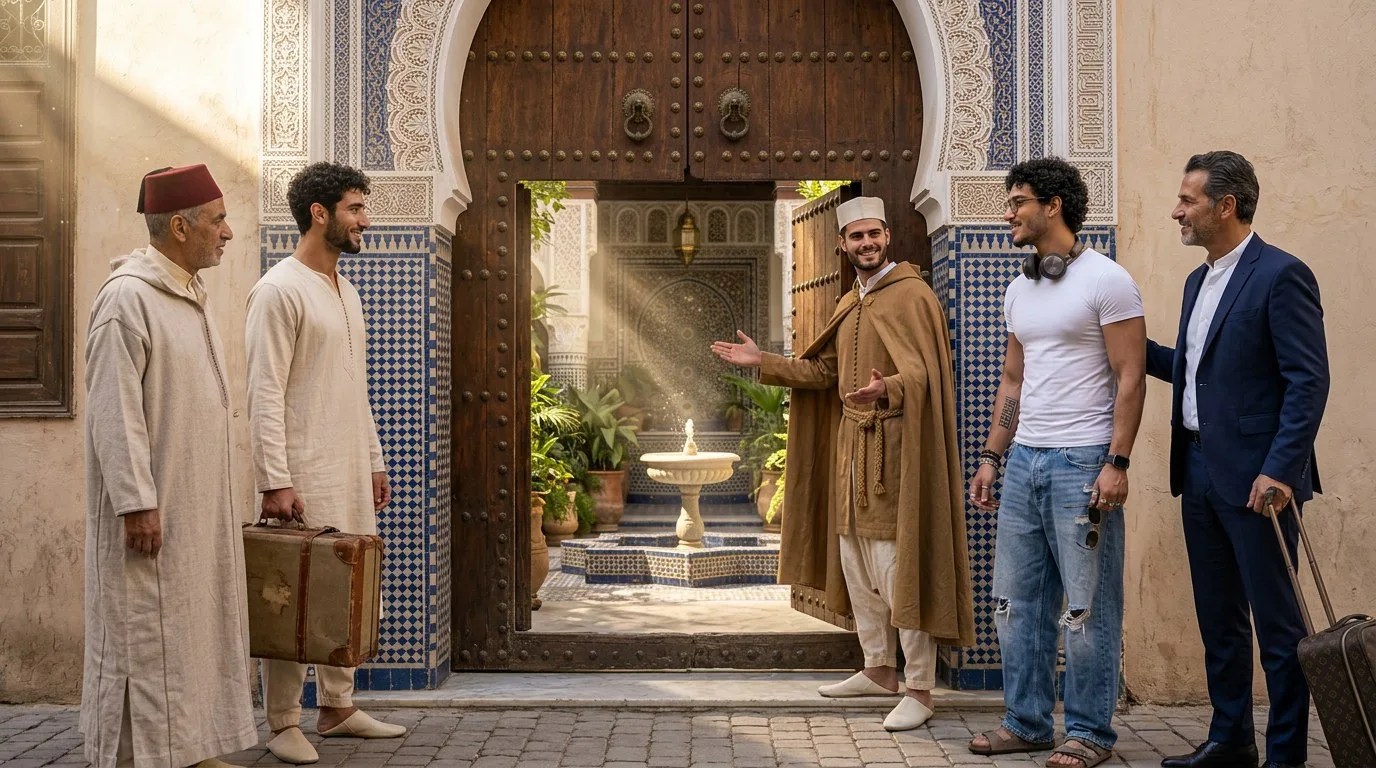
Two young men may cross the same door on the same day, one in a djellaba, the other in jeans, and not come from the same world. They are given the same clothing, the same room, the same table, and the same work. After a few weeks, no one remembers any more how either of them was dressed on the day he arrived.
What this produces is seen elsewhere than here. The man who has nothing stops letting his clothes speak in his place. And the son of a wealthy house, having learned to be rather than to appear, will be known by his bearing, his speech and his manner with others — even on the day he wears a suit or an old pair of jeans.
WHAT THESE SIGNS DO NOT SAY
No colour says what a man is worth
Dress within the riad
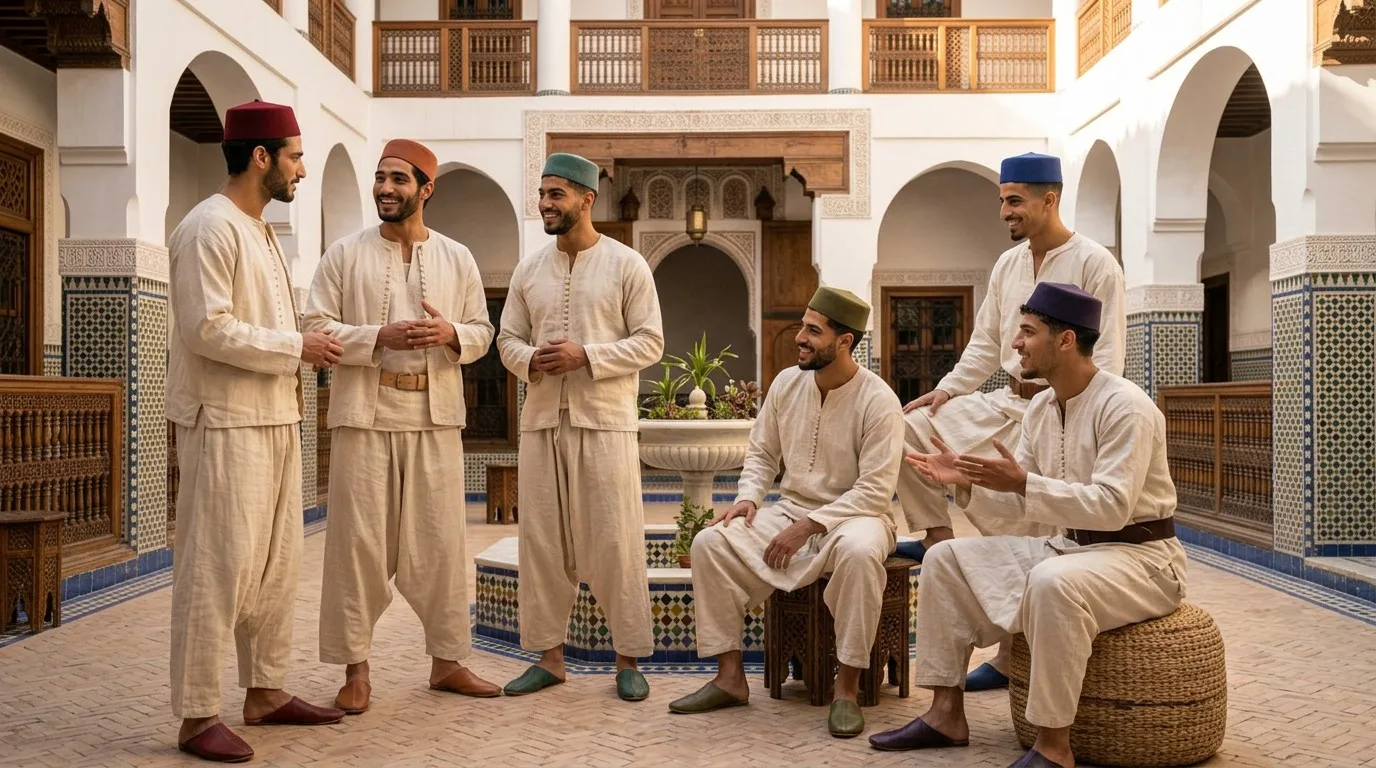
Unlike what happens outside, dress inside the riad says what a man does in the community, what he has learned and what he answers for to the others. It does not say who he is, and it does not rank him. A maalem is not more important than a ṣāniʿ; he has only come further along a road in a craft, and he carries a greater responsibility for it.
Outside, dress ranks: it states what a man can afford before he has said a word. Here it does not. The garments and the cloth are the same, and it is the house that provides them. Whether a man arrives with a fortune or with nothing, he dresses in the same way. Among the residents every human difference remains, except that one.
The common standard
What the house holds to be true, it has put where the system falls silent. The serwal is undyed linen for everyone, from the youngest to the shaykh. At prayer, each man wears a linen qamīṣ of an immaculate white, without embroidery, without a belt, without anything that sets him apart from his neighbour. In the same way, a guest is given a complete set of clothing on arrival, identical for the son of a well-off family and for the man who owns nothing.
A man who arrives is dressed wholly in undyed cloth, cap and babouches included: he has no craft yet, and nothing pretends otherwise. Undyed is not a uniform for all that — untreated fibres do not give the same white, flax pulling towards grey, hemp towards honey, cotton paler, and the wool of the coat something else again. They are not matched to one another.
A house without keys
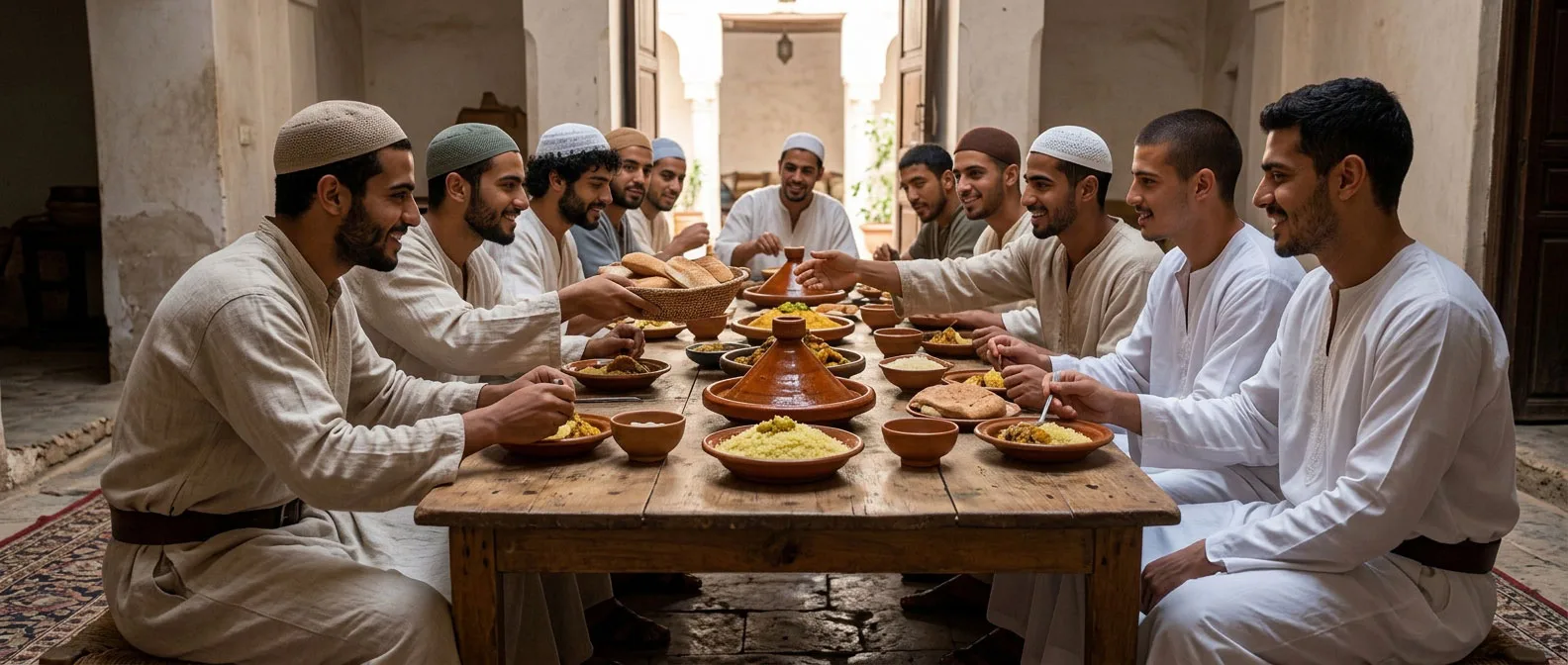
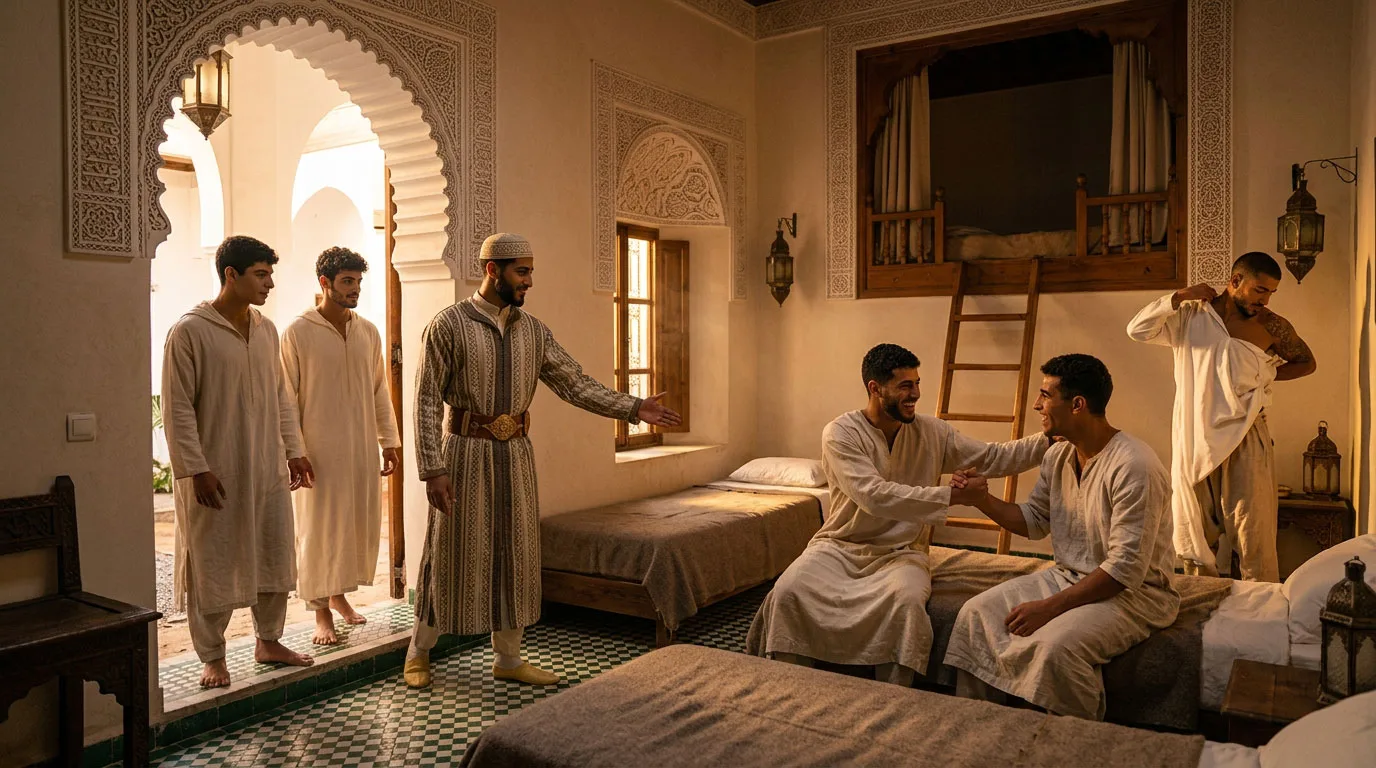
Dress, moreover, only follows the spirit of the house: the common spaces are shared, meals taken together, nights spent in the same quarter, the hall and the hammam used by all. The nights are spent in a shared room, six beds to a room; only the maʿallem has a room of his own, adjoining that of his ṣāniʿ. No door locks: what divides the spaces are carved wooden screens and hangings, cut in the community’s own wood workshop. Each man keeps his freedom, for the spaces of privacy are designed to prevent total isolation: those who live here hold one another to be brothers and companions, not strangers to hide from.
In the spaces of the body and of work
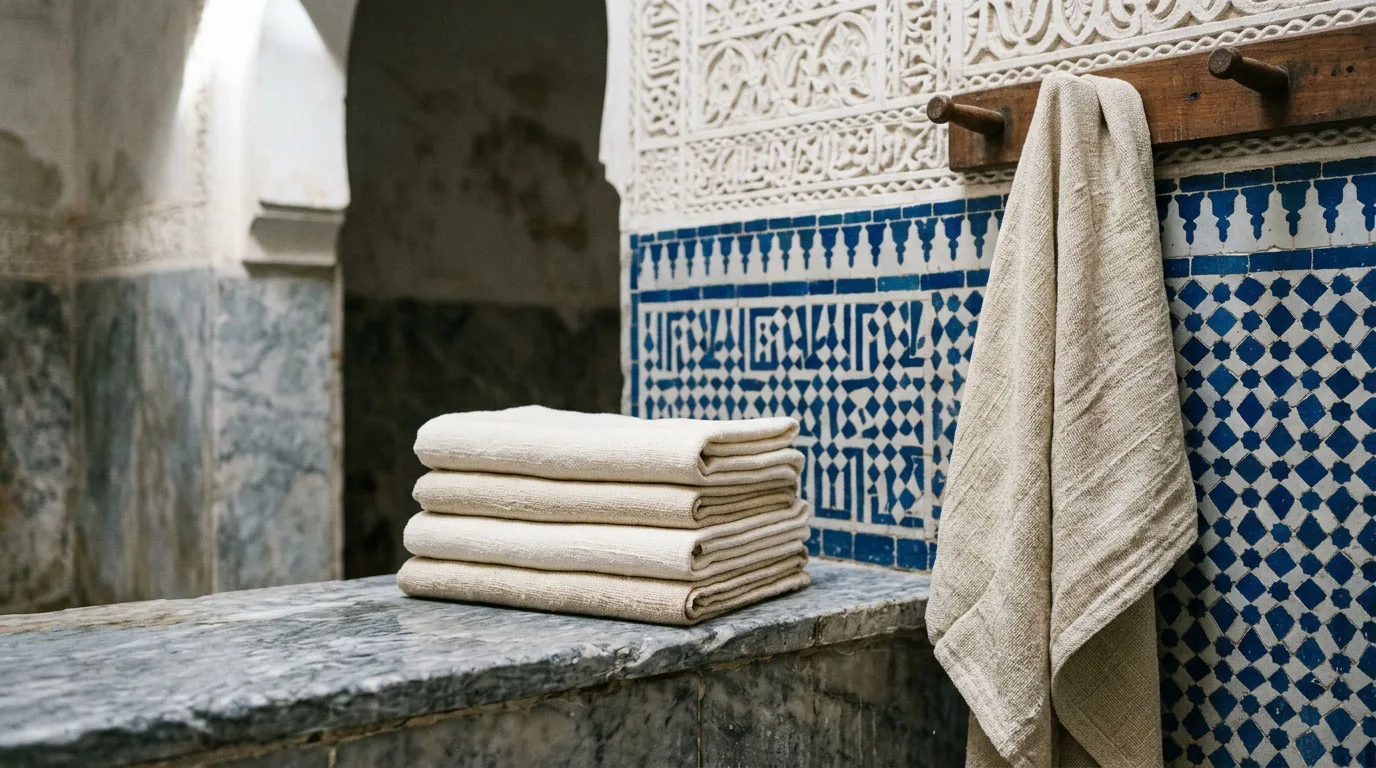
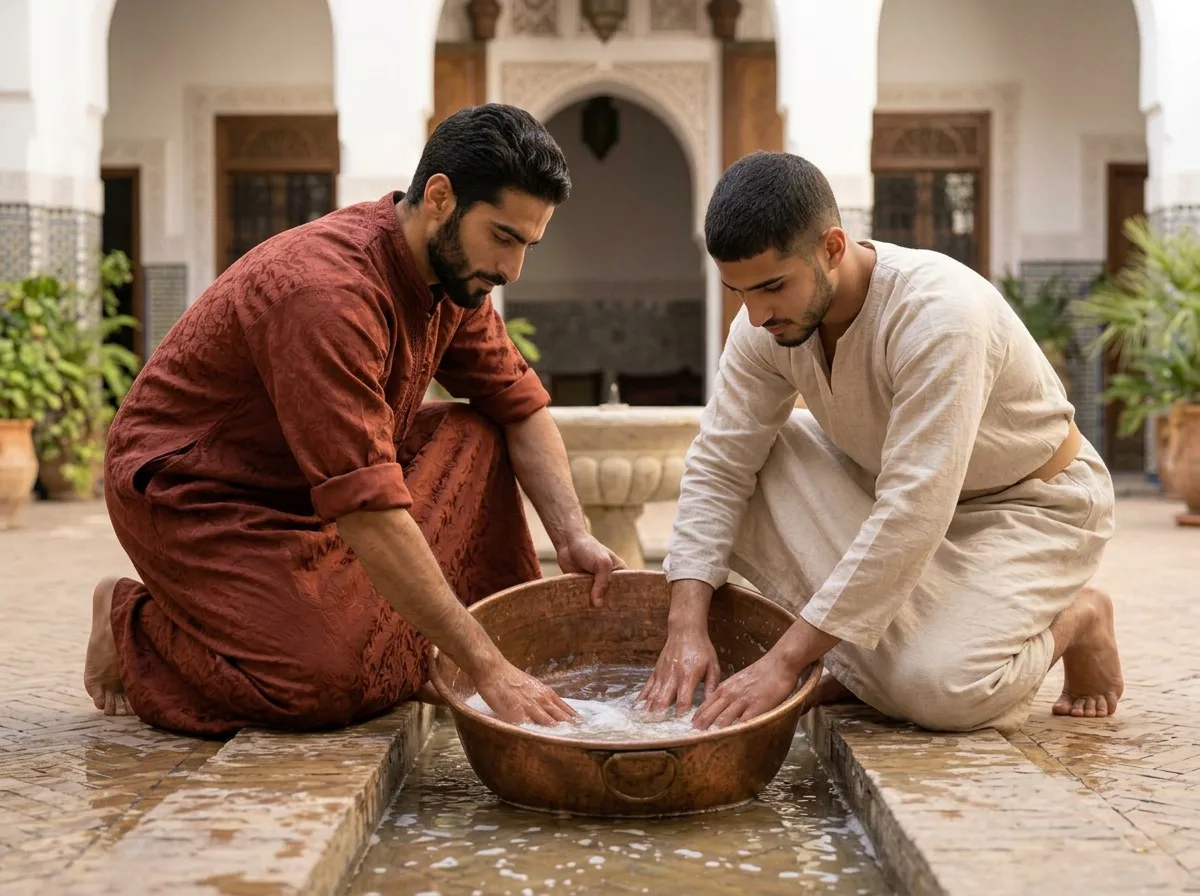
As in the workshop, where the residents work side by side, training dress is plain and common, with no workshop colour and no cord: what distinguishes a man in the hall is what he is able to do, and that shows at once. At the hammam, the same rule: nothing but a fūṭa, the same for everyone. The maalem, the nāʾib, the muqaddam and the Ash-Shaykh wash there alongside the ṣāniʿ, and the principle holds for guests too. A sign that were true only in dress would not last three days.
Rank and responsibility
Charges are work and not honours, ordered to the lasting of the house and not to the greater standing of the man who performs them. In the same way, in the workshops, a defter hand does not make one man greater than another. The respect owed to the man who commands does not come from homage but from the form responsibility takes — on one side that of directing, on the other that of conforming, not out of fear but out of trust and conviction. Both answer for the same thing, and what binds them across rank has three names: futuwwa, brotherhood, furūsiyya.
THE MEASURE
A way of wearing, not a uniform
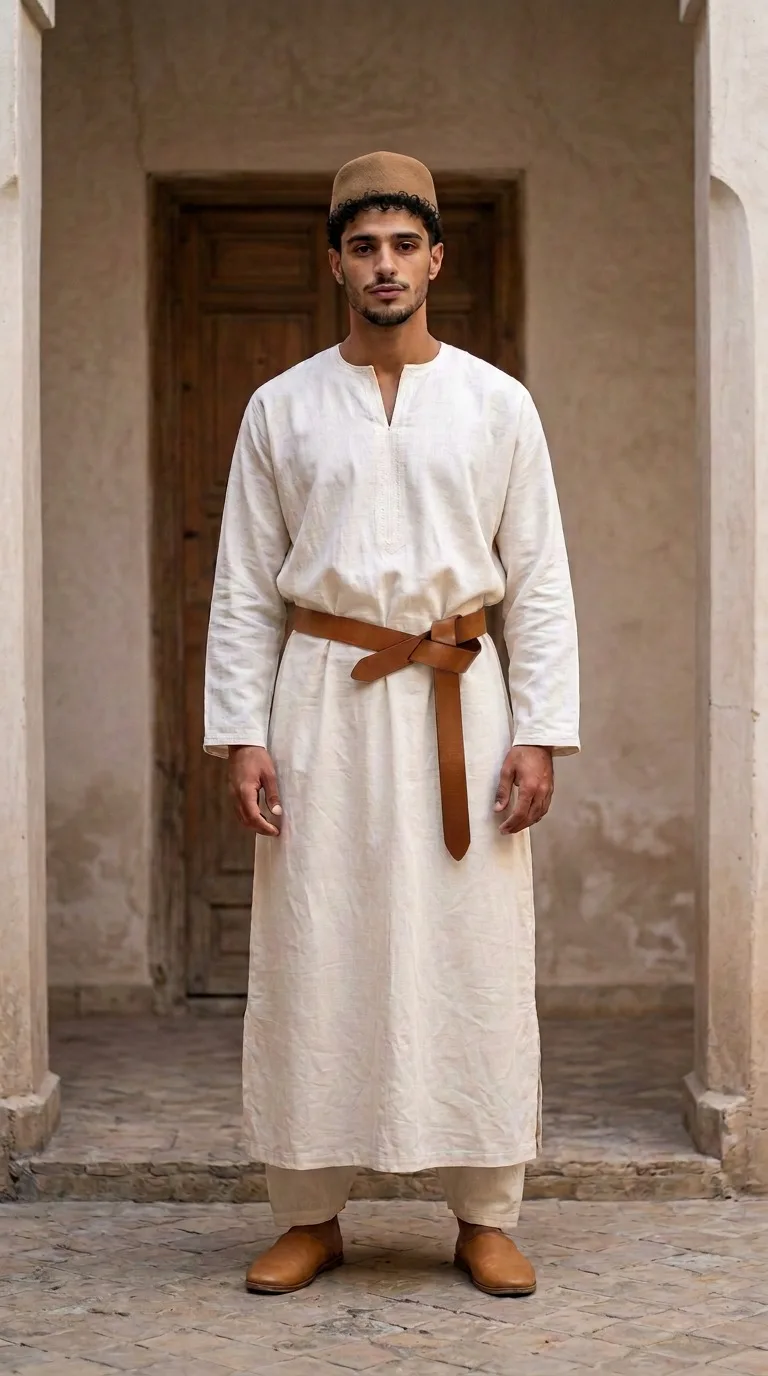
In the daily life of the Riad — meals, prayer, conversation, work in the workshops — traditional dress is the rule and not the exception. The serwal replaces jeans, the ghandūra replaces the t-shirt, not by outward constraint but because the old form carries in itself the measure the house is after: adab (أدب).
Sobriety extends to the detail: no close-fitting cuts, no branded trainers, no caps, no printed or torn clothes. Outside the Riad — in town, travelling, and during holidays spent with family — each man dresses as he sees fit. What the house asks, it asks only within its walls: it lends its dress to the man who comes in, it does not impose it on the man who goes out.
That freedom proceeds from no indulgence; it follows from what the dress is. It is not a personal garment — the man who wears it stands for the Riad, whether he means to or not. It therefore goes with him where he goes as a man of the house: to the medina, the souk, a master’s workshop, a visit; and not where he goes on his own account. What a man does outside is his own affair: he simply does not do it under the signs of the house.
The choice is not only a moral one. The full, layered volumes of the Maghreb regulate the temperature of the body in a riad: they keep the coolness of the courtyards in summer and keep the damp cold of the stone at bay in winter. Here dress does the same work as the architecture — composing with the climate rather than fighting it.
إِنَّ الْبَذَاذَةَ مِنَ الْإِيمَانِ
inna al-badhādha min al-īmān
“Plainness of dress is part of faith.”
Reported by Abū Dāwūd.
WHAT A ṢĀNIʿ WEARS
Two forms, and nothing more
A ṣāniʿ’s wardrobe comes to two outfits. Both are completed by the cap and the babouches in the colour of his workshop — the only two pieces that never vary.
FIRST FORM
The qamis and the belt
Qamīṣ of undyed linen, belt at the waist, cap and babouches of the workshop. This is the dress of common life: the table, the evening conversation, prayer.
SECOND FORM
The serwal and the light jabador
Serwal of undyed linen, light jabador closed with braided buttons, cap and babouches of the workshop. The jabador stays undyed for as long as the man exercises no charge. This is the dress of the workshop and of the town.
Winter
A hooded woollen coat is added to either form. It follows the jacket: natural undyed wool for a man who exercises no charge, the colour of the charge for a man who exercises one. Hood and collar are edged with Andalusian Kufic embroidery, the same for everyone.
At work, plainer still
Some tasks call for less cloth, and the house provides for it: the qamīṣ alone, or the serwal with a short qamīṣ. The gardener in the rain and the hammam man in the steam do not work in table dress. This is the rule following the gesture, and not an exception to it.
In the hammam itself, only the fūṭa is worn — see The hammam.
THE PIECES
The vocabulary
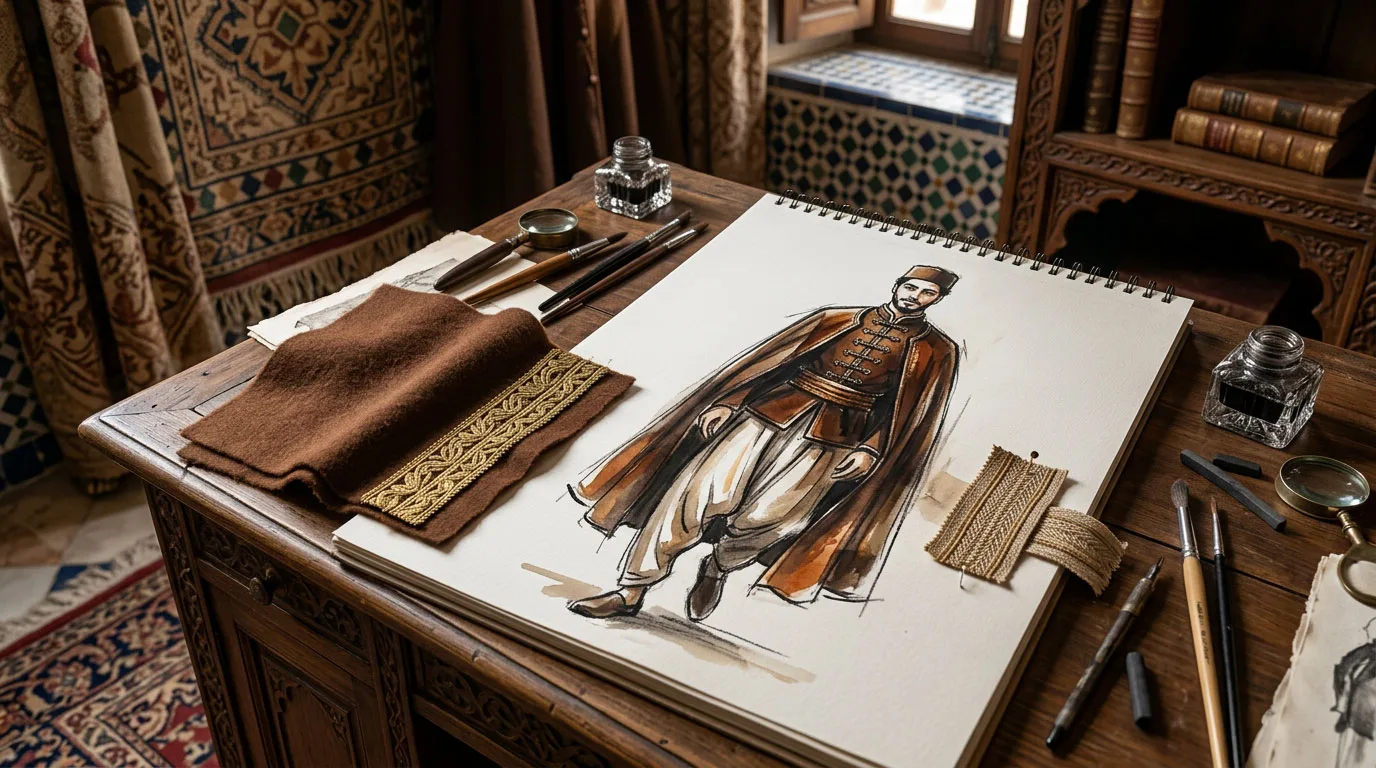
Al-Ghandura الغندورة
The tunic. Undyed linen, the opening edged with a sfifa cord. Two lengths: mid-calf for common life, short for the workshop.
Al-Qamis القميص
The long shirt, in undyed linen, without embroidery. It is worn next to the skin, and makes an outfit on its own.
As-Serwal السروال
The wide low-crotch trousers, in undyed linen. They stay undyed for everyone: colour does not go down to the legs.
Al-Jabador الجبادور
The jacket, closed with hand-braided ʿaqad buttons. Undyed on a man who exercises no charge; dyed in the colour of the charge for as long as he exercises it.
Qubbaat al-Hirfa قبعة الحرفة
The craft cap. Rigid and cylindrical, clean vertical sides, flat top, a fine geometric border at the base, no tassel. Its colour states the workshop, and nothing else; it stays undyed for as long as a man has not been received into one.
Al-Belgha البلغة
The babouches, dyed like the cap, and undyed like it for as long as the workshop has not come.
Hizam al-Itqan حزام الإتقان
The leather belt. Plain buckle, no prong and no holes: one draws it tight, then knots it. Three tones, which state the grade.
Al-Mdama المدمة
The plaited cord, knotted over the jacket in the colour of the charge, for as long as it lasts. It does not take the place of the leather belt: a man who has a grade keeps it underneath.
Al-Farwa الفروة
The winter coat. A full cape with a structured hood, open at the front, on the model of the burnous. Felted wool, Kufic border. It follows the jacket: natural, or dyed in the colour of the charge.
Al-Hulla الحُلّة
The maalem’s overtunic. To the ankle, damask tone on tone in the colour of the workshop, with no metallic thread.
Al-Khirqa الخرقة
The mantle of investiture. Black and gold, sqalli brocade, given once in a lifetime.
Al-Futa الفوطة
The hammam wrap. A single panel of light linen knotted at the waist — the only piece worn at the bath.
Materials follow three levels: raw natural fibres — linen, hemp, cotton — for all daily use; damask tone on tone for the masters’ overtunic; gold-thread sqalli brocade for the mantle of investiture alone and for the standard of the house. Richness of material rises only where it means something.
THE EIGHT WORKSHOPS
The colours go by families
A family of tones covers one domain of the house. Within it, the full tone belongs to the workshop and, where a charge of the house falls in the same domain, it takes the muted tone: neighbours in colour because neighbours in work. Three charges belong to no workshop and remain outside the families.
The two colours never share a place and never mix: that of the workshop is on the cap and the babouches, for life; that of the charge on the jacket, the coat and the cord, for as long as it lasts.
Leather and the book
The same hide, the same irons: the binder gilds a cover as the saddler does a housing.
Il cuoio السرّاج
Fez red — saddlery, harness, leatherwork
Il libro المجلّد
Terracotta — binding, restoration, calligraphy, leather gilding
The librarian — charge
Ink brown — the iron-gall ink of the manuscripts; he keeps what the binder repairs
Metal and wood
The joiner works the tree the gardener grows; metal supplies its tool and its fittings.
Metal الصفّار
Verdigris — coppersmithing, forge, fittings and buckles
Il legno النجّار
Olive green — cabinetmaking, saddle trees, mashrabiya, carving
The gardener — charge
Deep green — he grows the tree the joiner works
Cloth, ceramics and the laboratories
The tones of the vat and the kiln, in three plainly separated values.
Cloth النسّاج
Indigo — silk, cloth, embroidery, passementerie, sewing
Ceramics الفخّار
Fez blue — pottery and zellige
The laboratories العطّار
Pale blue — essences, soaps; preserves and the garden’s aromatics
Plaster and the threshold
The material the house is made of, and the man who keeps its limit.
Il gesso الجبّاص
Pale sand — gebs and muqarnas
The porter — function
Rampart ochre — the muted tone of the same family
Three charges belong to no workshop — the steward, the chambrier and the qayyim of the hammam — and remain outside the families, in dulled tones: oil brown, flax grey, ash.
The crafts of the hand are described one by one in The crafts of the hand.
THE SIGNS
What a workshop hangs above its door
The colour says which workshop a man belongs to. It does not say what is done there. Each guild therefore also carries a sign, and that sign is the tool of the trade — the one the hand holds every day, not a symbol chosen to mean something.
The shape is the polylobed cartouche and not the European shield — the shamsa of manuscript frontispieces — cut in cedar: the tool in wrought iron or brass in relief at the centre, the ground in the colour of the workshop, and nothing else. No inscription: a man who has spent a week in the house does not need one, and a man who arrives learns the sign as he learns the craft.
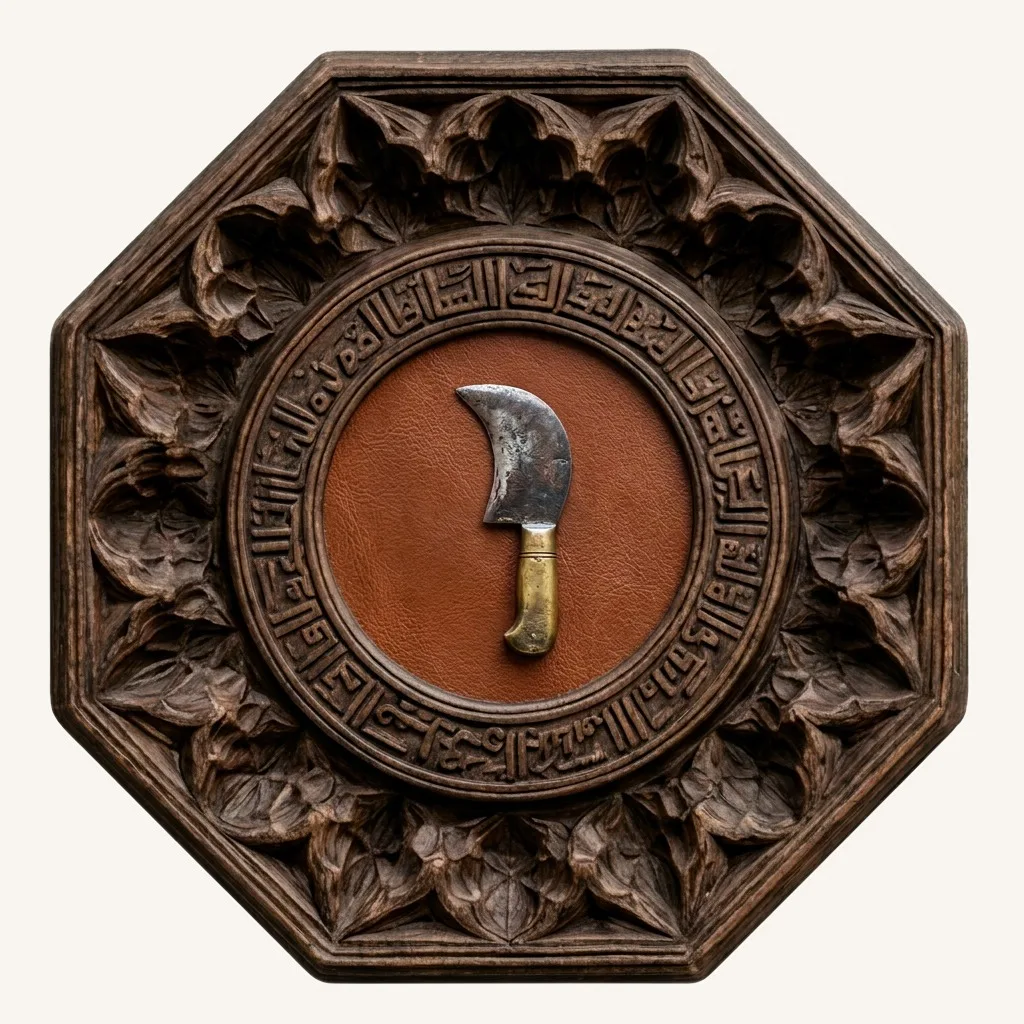
Il cuoio السرّاج
The saddler’s half-moon knife
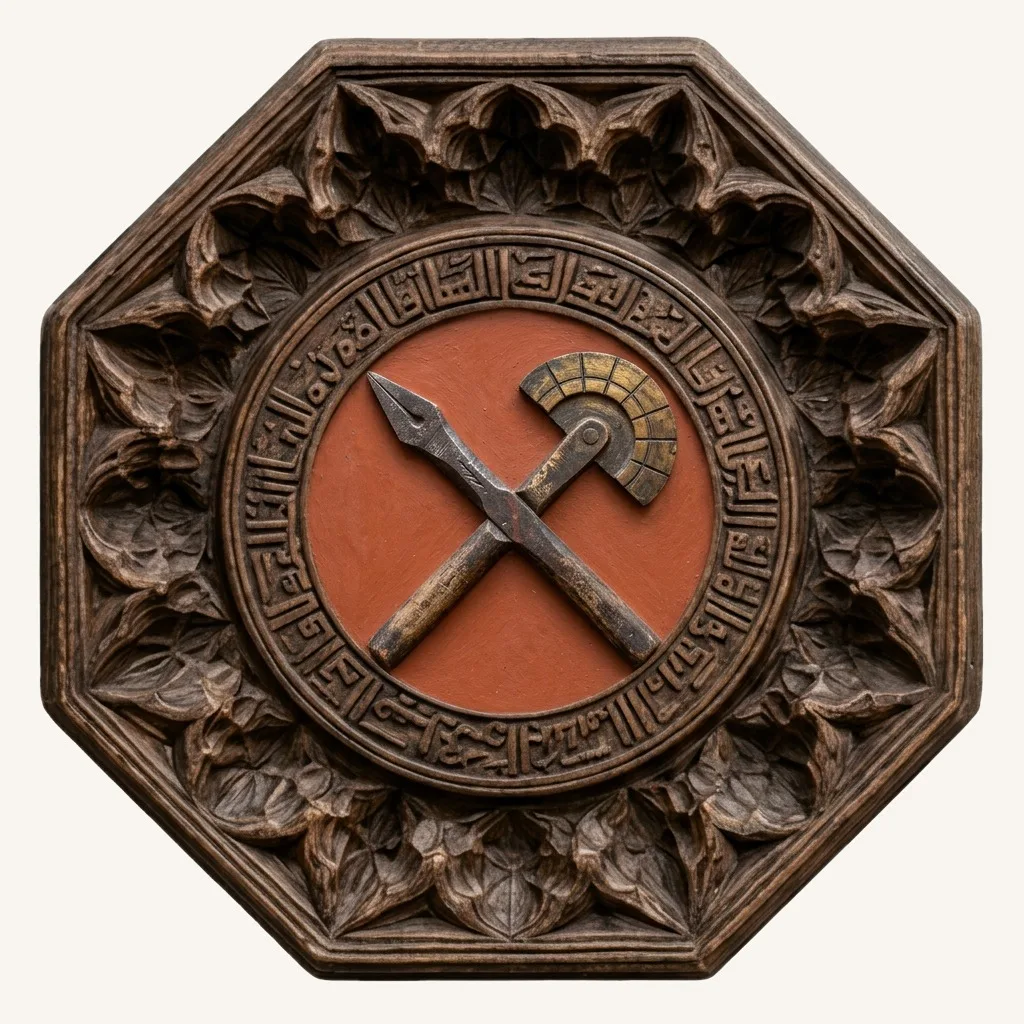
Il libro المجلّد
The qalam crossed with the gilding wheel
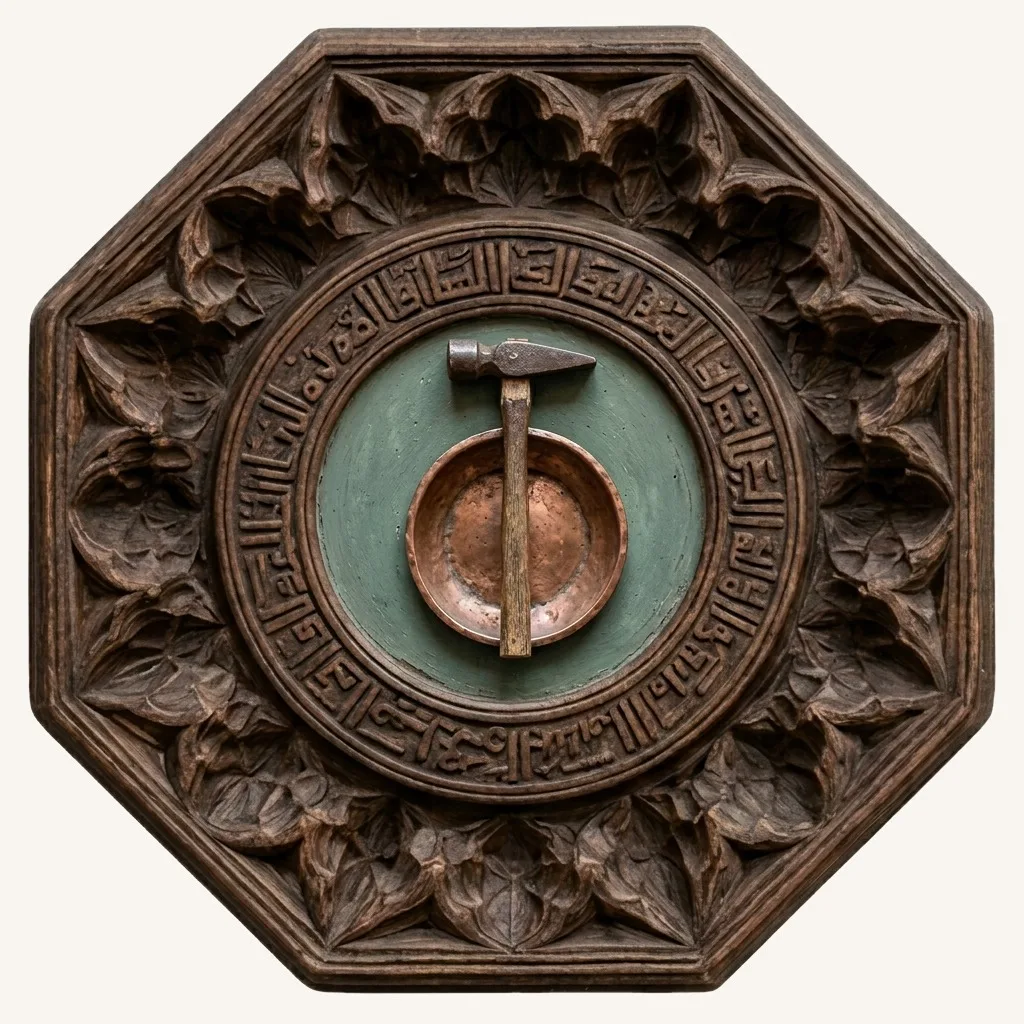
Metal الصفّار
The hammer on the copper basin, as at Seffarine
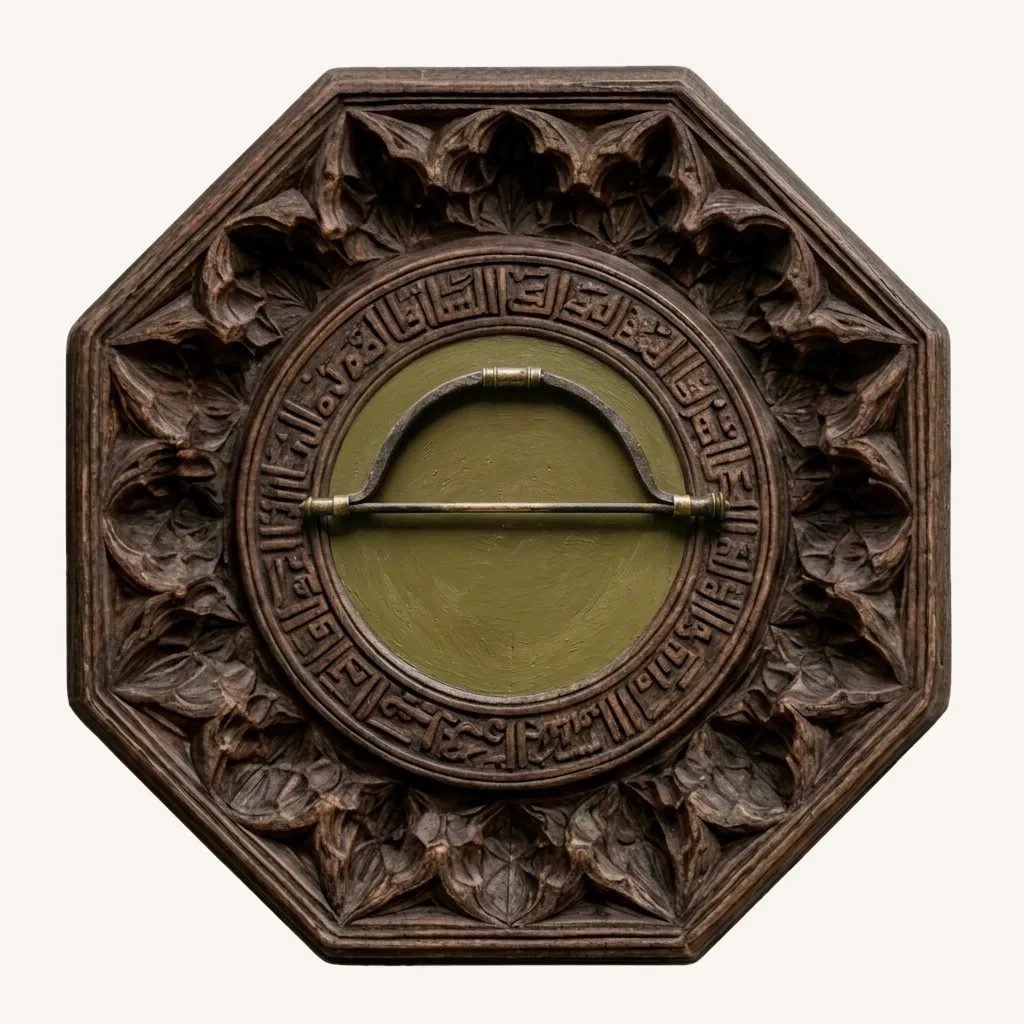
Il legno النجّار
The bow of the wood lathe
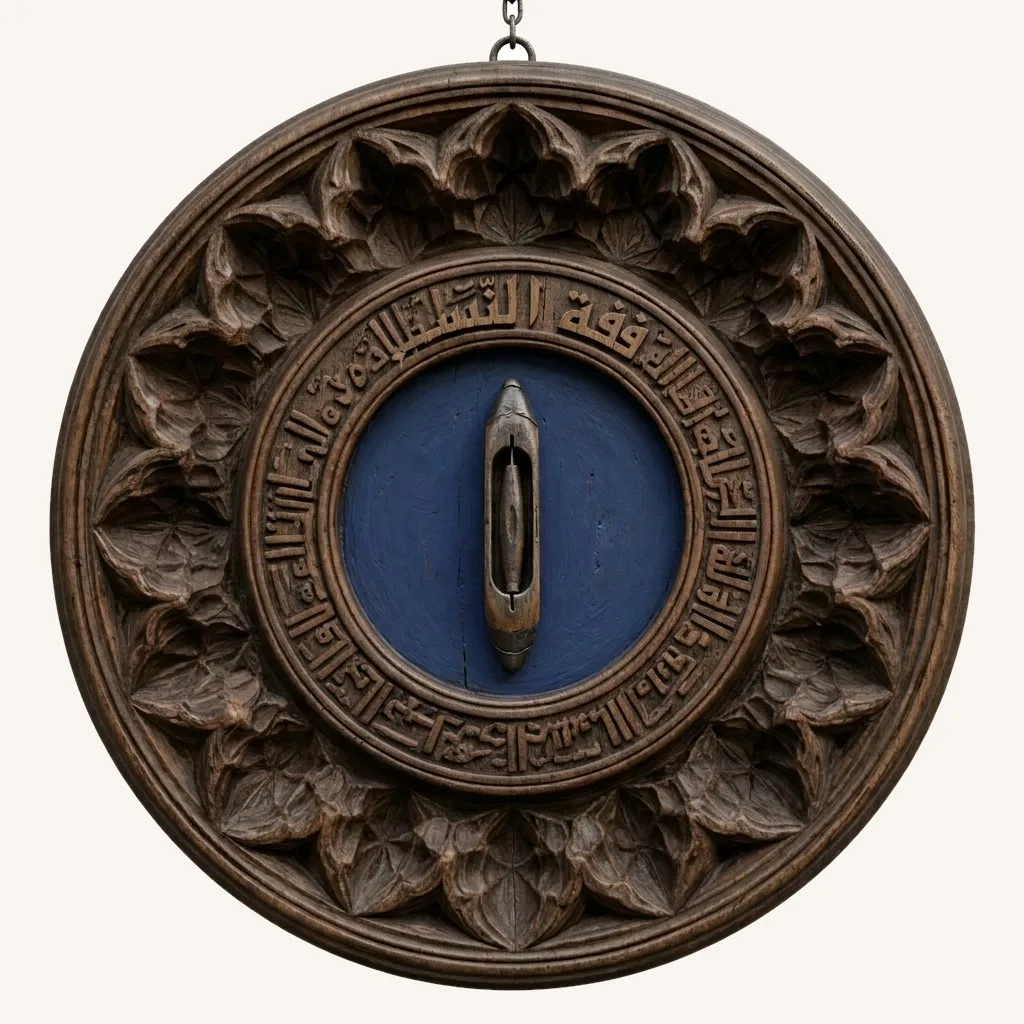
Cloth النسّاج
The shuttle, makkūk
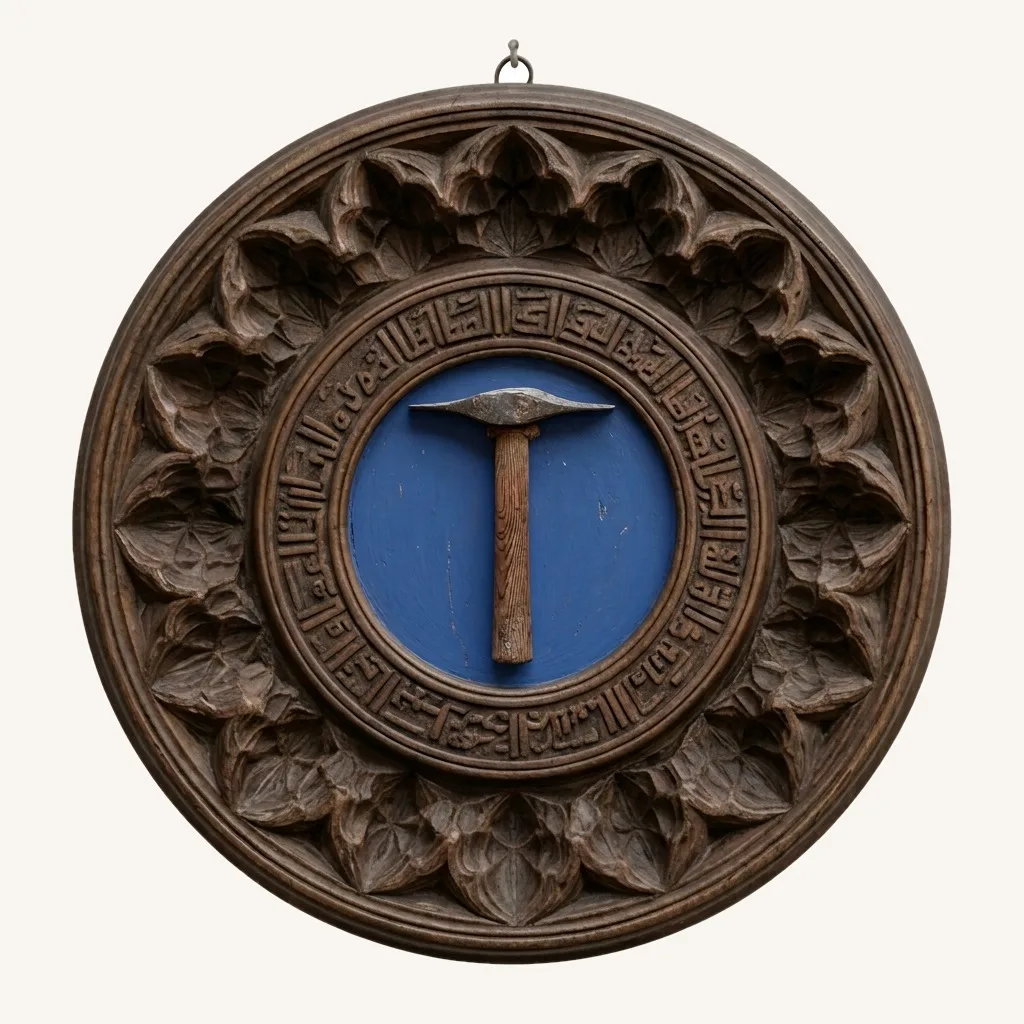
Ceramics الفخّار
The minqāsh, the little hammer that cuts zellige
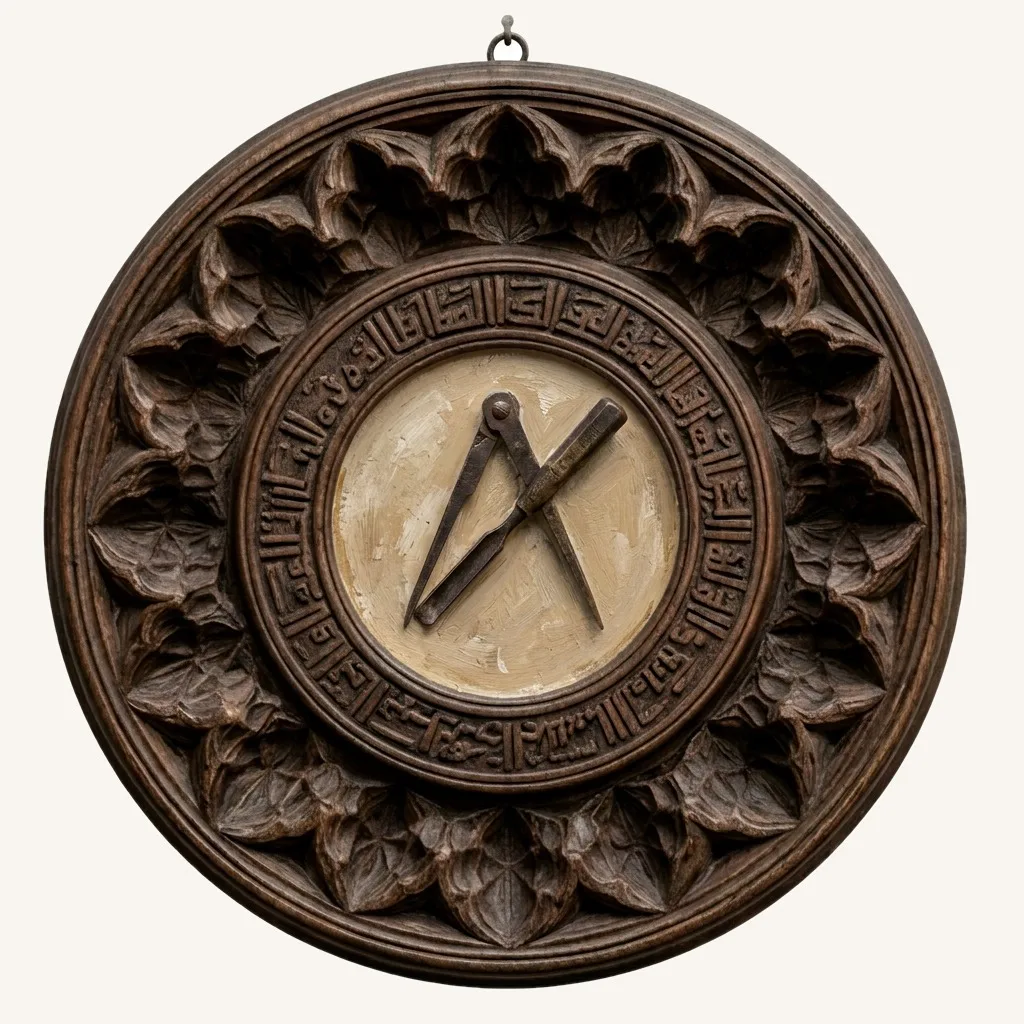
Il gesso الجبّاص
The compass and the gouge — geometry before the hand
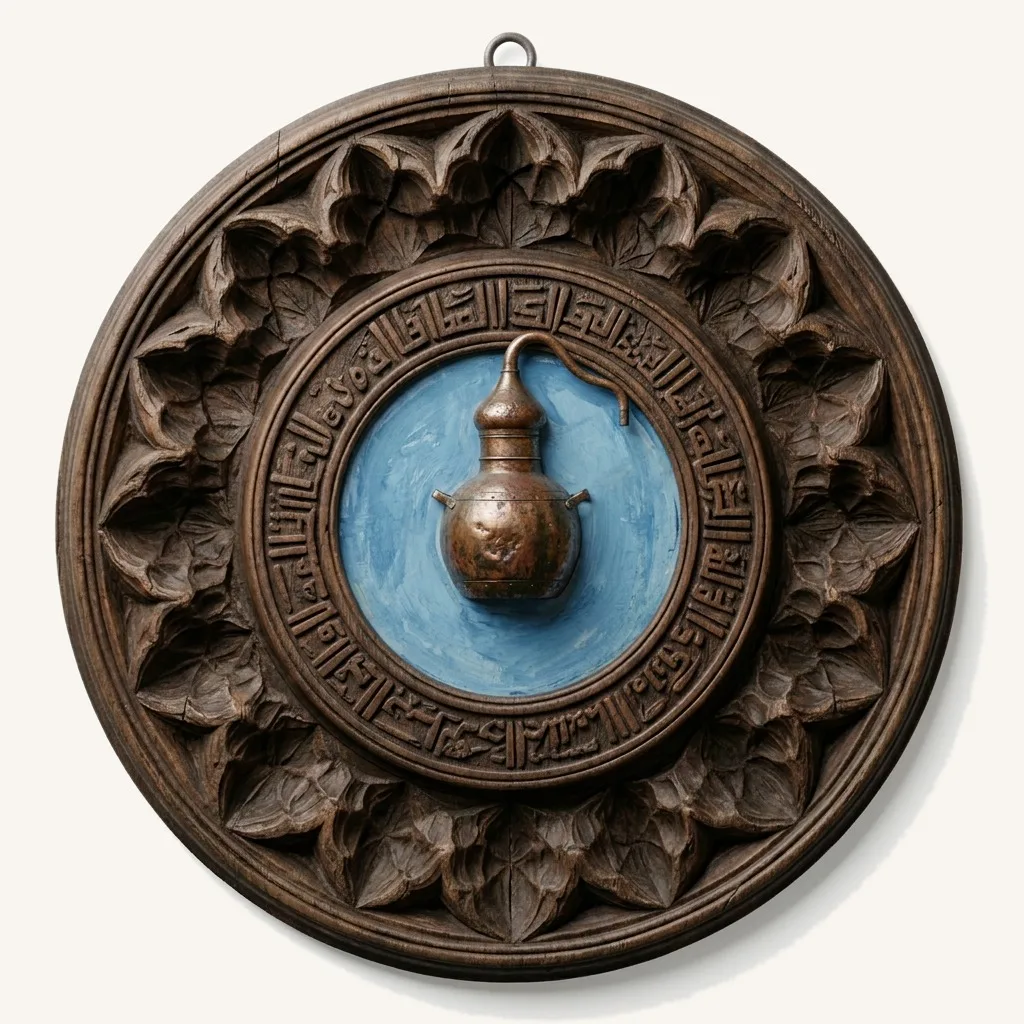
The laboratories العطّار
The alembic, al-inbīq
No workshop makes its own
Wood cuts the panel, metal forges the tool, the book paints and burnishes the ground. There is therefore not one sign in the house that came from the hands of those it names, and wood itself receives its own from the other two.
It is the demonstration, hung above eight doors and visible from the courtyard every day, that no guild is sufficient to itself.
The same sign is embroidered on the guild’s banner: a plain cloth, in the colour of the workshop, with no gold — a guild is not the house. The standard of the house itself is described elsewhere: Al-Athar.
THE SIX THRESHOLDS
What the wood says above a door
Beside the workshop signs, the house carries six emblems, and six only. They are cut in the same cedar, on the same ground of night blue, with the same gold figure in relief, and they resemble one another enough for it to be understood that they belong to a single order.
They do not mark rooms, but limits. Each stands where a man stops being anyone at all and becomes someone of this house — or where he stops.
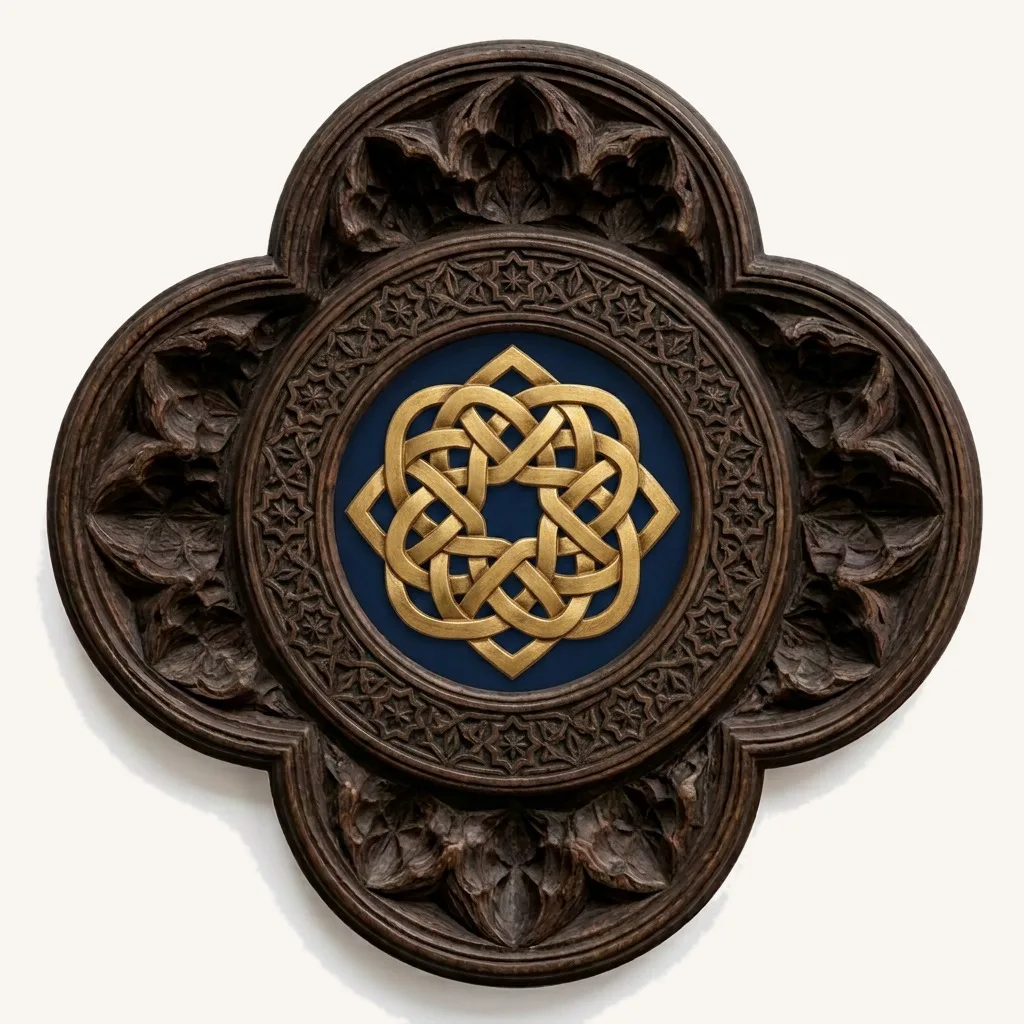
THE STREET
The knot
On the sqifa. A single band that folds over itself and never ends: one does not receive a sign here, one ties one.
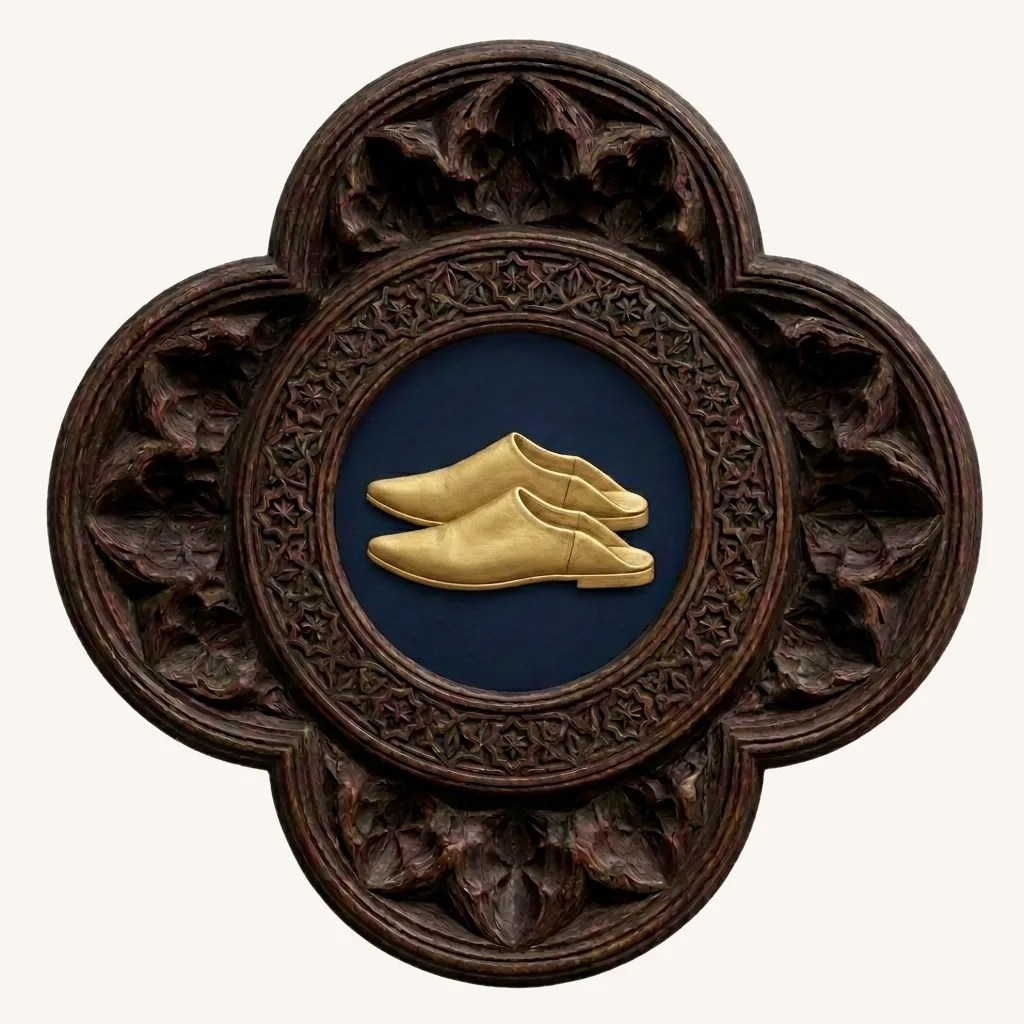
THE RESIDENTS’ QUARTER
The babouches
Where a man takes off his shoes. The one door in the house that no lock defends, and that is not crossed all the same.
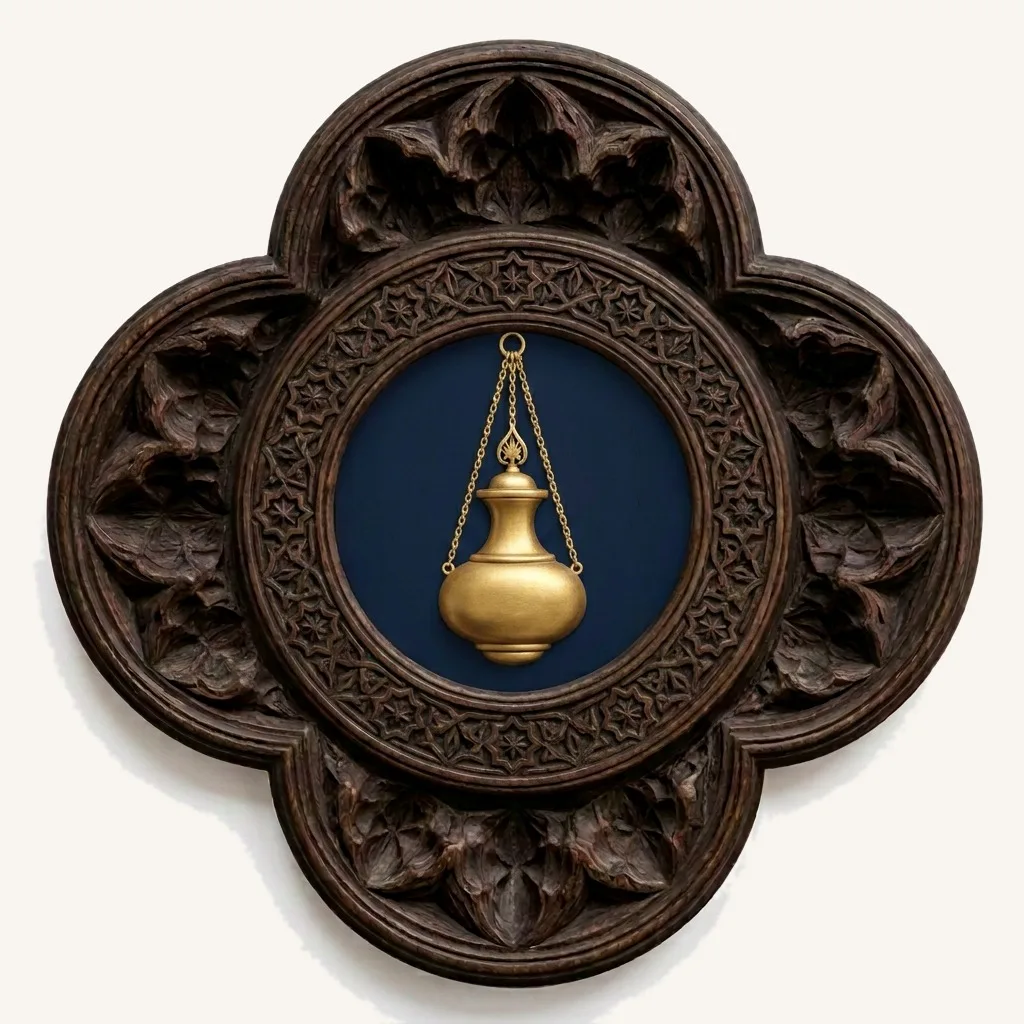
THE KHIZANA
The lamp
On the only door that a single key closes. What is locked is what one answers for before the others, not what belongs to oneself.
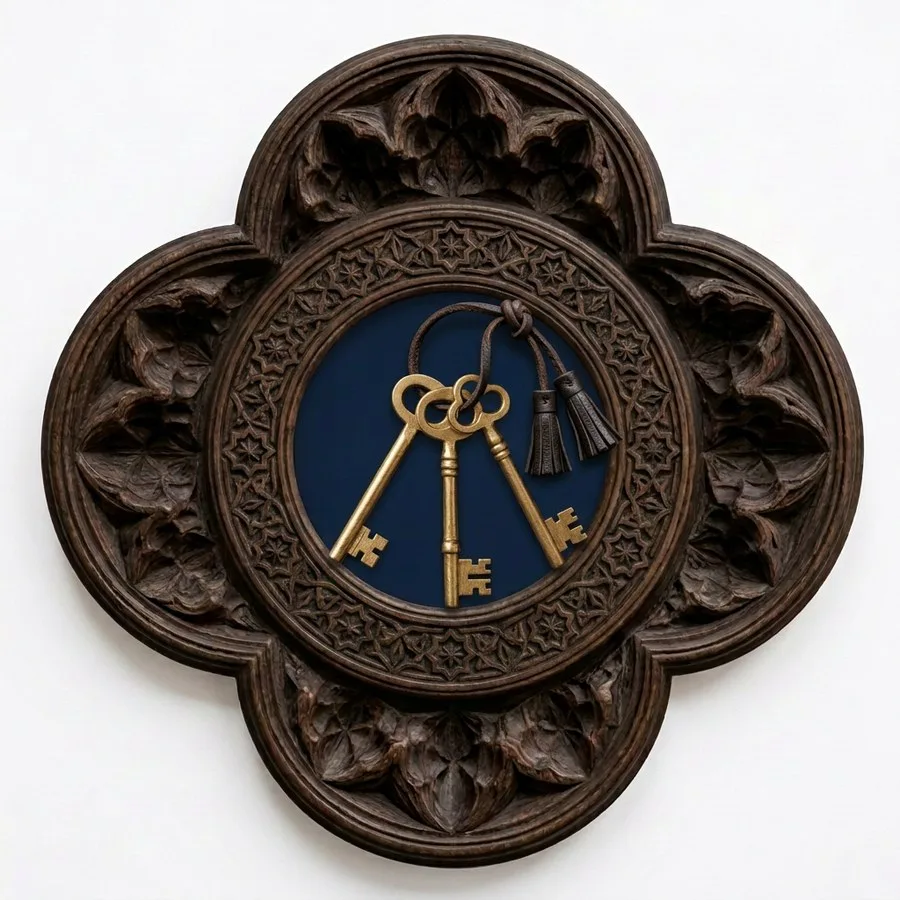
THE TREASURY
The three keys
On the armoured door of the treasury. The only one that three keys open together: what one answers for before all, no one answers for alone.
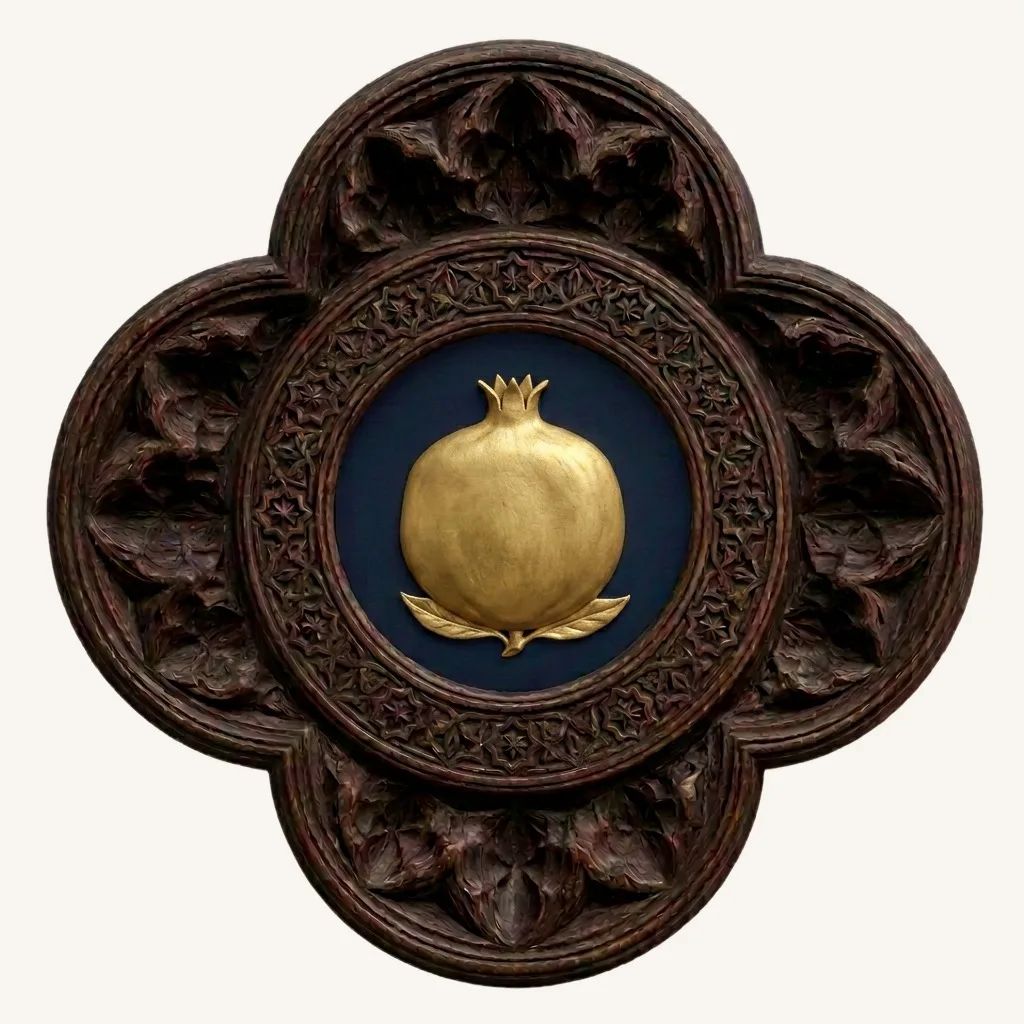
THE SECRET GARDEN
The pomegranate
The fruit that shows nothing of what it holds. One does not enter when one pleases: what is received all at once is not absorbed.
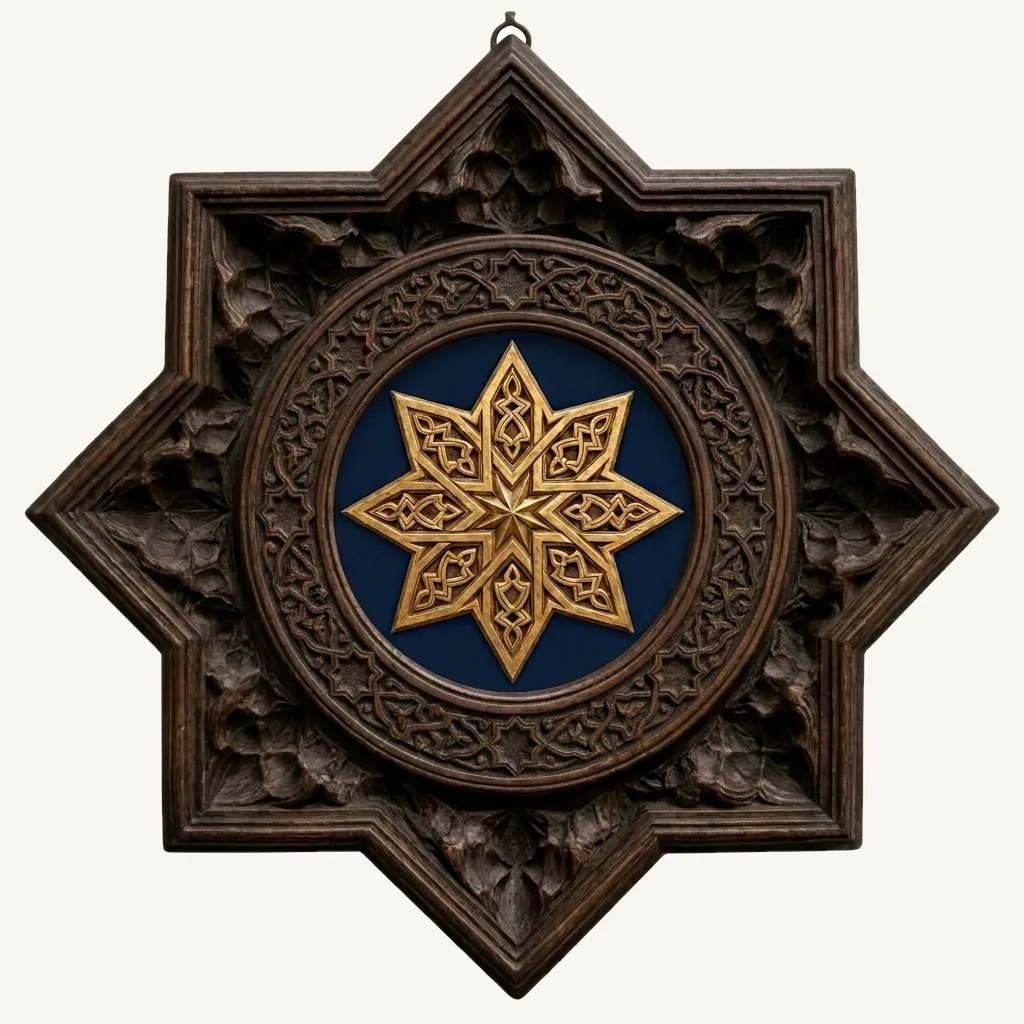
THE COMMON WALL
The star
On the door that leads from Al-Munya into the house. Its frame is not that of the other four, since this threshold does not belong to the house alone.
The hammam, the refectory and the oratory carry none, and will carry none. They are places, not limits — and a sign that repeats itself stops being a sign.
THE ROAD INSIDE THE WORKSHOP
From sani to maalem
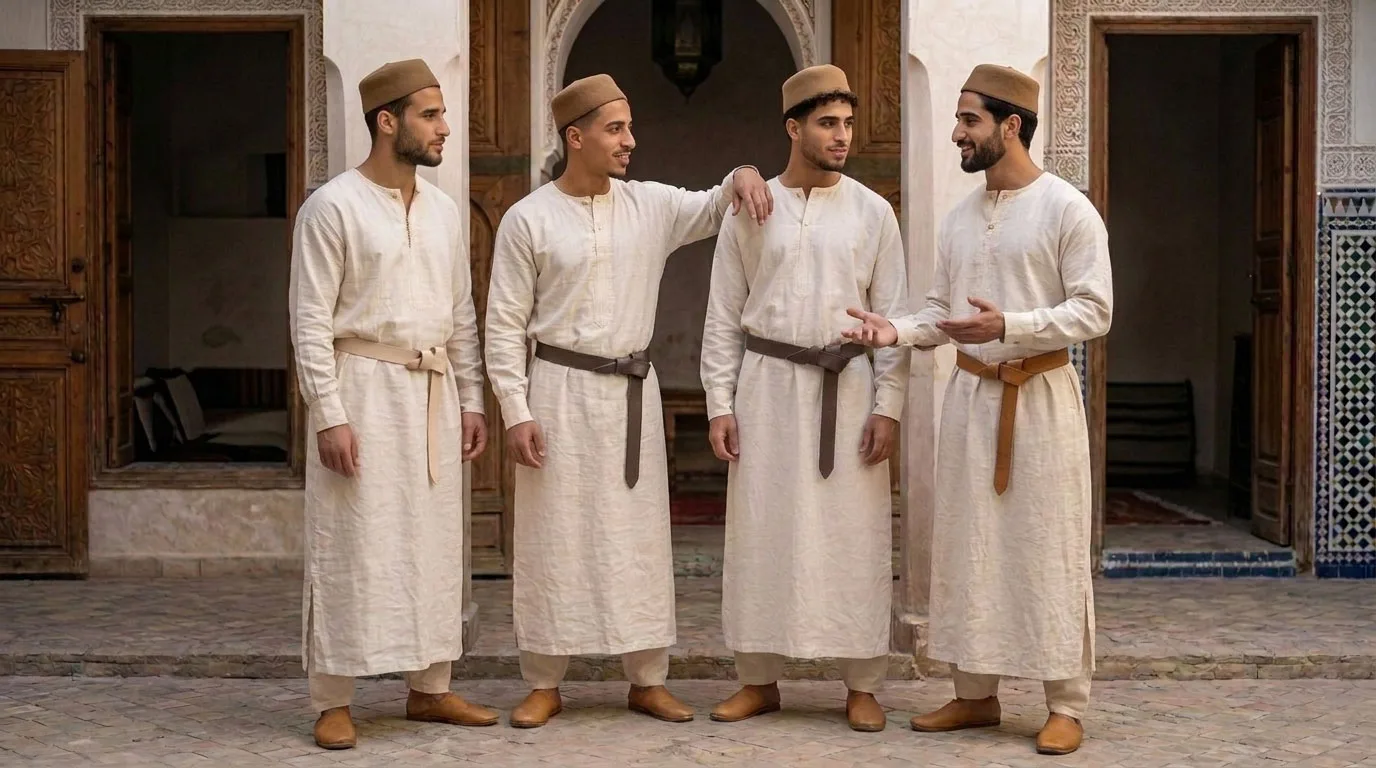
The leather belt is worn at the waist, plain buckle and knot, and its three tones state what the hand is really able to do. Nothing there is won by seniority alone.
Beige
The entrance. The threshold has been crossed and the rhythm accepted.
Cognac
The hand has acquired a sure gesture. The craft has begun to take root.
Brown
The nearness of mastery. He can be relied on; he does not yet transmit.
The naib
One of the most advanced ṣāniʿ of each workshop assists the others when the maalem is busy or away, without standing in for his authority. Since his function is exercised inside his own guild, the colour of his charge is that of his own workshop: he is the only man in the house in whom the two coincide, and his jacket repeats what his cap already says. He remains a ṣāniʿ among ṣāniʿ, marked out by a responsibility and not by a rank.
The maalem
The master no longer shows a belt: the ḥulla overtunic, ankle-length and woven tone on tone in the colour of his workshop, takes over by itself what the belt used to say. It is the passage from a collective identity to a personal one. A workshop that trains new masters keeps them: they remain of their guild.
THE FUNCTIONS OF THE HOUSE
Six charges
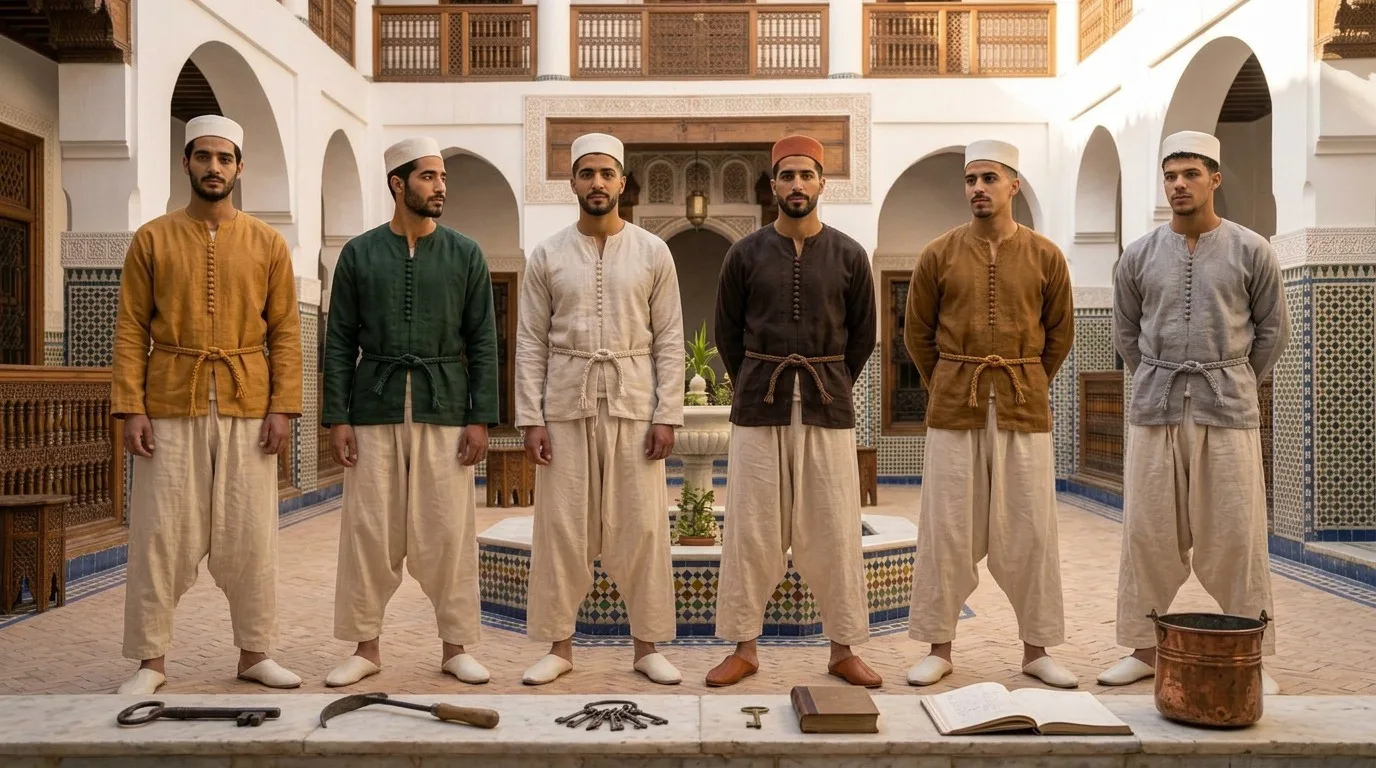
Six charges keep the house alive, and they are whole days’ work: the man who keeps the door is there all day long, the man who looks after the rooms remakes twenty beds, the man who answers for the hammam watches over a fire that never goes out. None of them is added to a day in a workshop, and the house does not pretend otherwise.
Each is taken up with a colour: the man who exercises a charge wears its tone on the jacket, the coat and the cord, and gives it back on the day the charge passes on. Nothing else moves — the cap keeps the workshop, the belt keeps the grade.
Each is also taken up with an object, and that object is not carried in daily life, for no one walks through the house with a bunch of keys or a dial at his belt. It is placed in the hand on the day the charge is taken, and returned into the hand on the day it passes.
The gesture carries a name borrowed from the transmission of learning: munāwala (مناولة), the handing over from hand to hand. In the tradition of hadith it is one of the recognised modes of transmission — the master does not dictate the book, he hands it over. What the house entrusts is entrusted the same way.
Two functions carry a colour without being among those six, and it must be said here for the count to be right: the muezzin, whose charge follows the hours and not the day, keeps his workshop and takes the cord alone; and the standard-bearer, the one charge of the house that is not given — it falls to a man — and that lasts a single year.
A charge is held for two years. That is long enough to learn the work properly and to train the man who will take it on; beyond that, a man would end up merging with the door or with the garden, and that is not what is asked of him.
The porter
al-bawwāb · البوّاب
Colour — Rampart ochre. Object — the iron key of the gate.
The gardener
al-jannān · الجنّان
Colour — Deep green; on days of earth, the short qamīṣ over the serwal. Object — the pruning hook.
The chambrier
al-farrāsh · الفرّاش
Colour — Flax grey. Object — the keys of the rooms.
The librarian
al-khāzin · الخازن
Colour — Ink brown. Object — the key of the khizāna.
The steward
al-wakīl · الوكيل
Colour — Oil brown. Object — the register and the key of the store.
The qayyim of the hammam
al-qayyim al-ḥammām · قيّم الحمّام
Colour — Ash; at the bath, the fūṭa alone, like everyone. Object — the copper pail.
The guests’ wardrobe
The chambrier looks after the guest wardrobe: complete outfits, down to the babouches and the belt, ready and in every size. One outfit is handed to whoever enters the house — to the man of standing as to the man who arrives with nothing, and without either receiving better than the other.
The guest wears what he is given, and returns it when he leaves. No one, then, enters here owing his recognition to his clothes: for as long as he is in the house, where he comes from can no longer be read on him.
AROUND THE PRAYER
The faqih and the muezzin
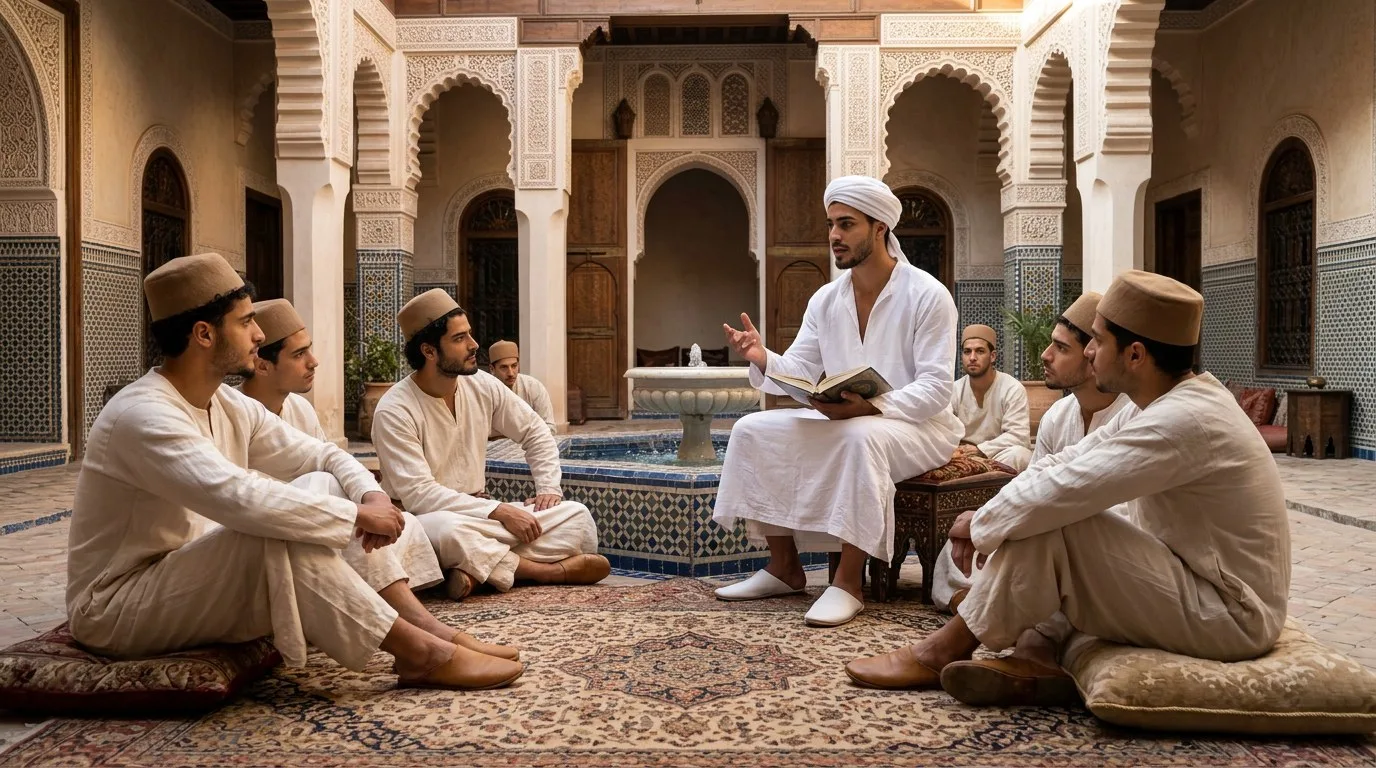
The faqih
The faqīh (فقيه) teaches and leads the prayer. He is bound by the same rule of age as the whole house: if he is of the same age as the others, he lives here as they do; past that age, he comes, teaches and leaves, for a house of this size holds its rhythm only among men of one age.
Resident, he wears white, and he alone: what everyone puts on for prayer, he wears all day. White belongs to no workshop, is not confused with the black of the direction, and stands distinctly lighter than the undyed of raw linen. Non-resident, he comes in his own scholar’s dress — and that is better: he is then visibly a master and a guest, not a member of the house.
The muezzin
A resident with a full voice — the muʾadhdhin (مؤذّن) — gives the call at the hours of the day. The same man, or a second if needed, holds the function of muballigh (مبلّغ): the one who repeats the imam’s voice so that it reaches the back of the hall.
The call is given from the upper gallery of the patio, and falls of itself into the courtyard and the rooms that open onto it. The house has no minaret and will have none: in the medina the call belongs to the mosques of the quarter, and ours goes no further than our walls. For the prayer, the dakka (دكّة) — the low wooden platform — serves as the muballigh’s place in the hall.
His charge is the hour and not the voice. His object is therefore the dial — a small sundial, or an astrolabe — taken up on entering the function and set down on leaving it, like the porter’s iron key. Fez made an office of this measure: the muwaqqit, with his dār al-muwaqqit at the Qarawiyyin and the water clocks of the Dār al-Magana. His cord is brass, the colour of the instrument he holds — and the cord alone: his charge follows the hours of prayer and does not take his day, so he keeps his workshop and his jacket.
SPEECH
How people address one another
In the house, people call one another by their first name. The family name stays at the door with the rank it announces, and the first name is what each man carries inside: it is the name the quarter ends up knowing.
Arabic has no formal you and no plural of politeness. One says anta to everyone, and respect goes through what is placed before the name. The house keeps to that usage in English too: everyone is on first-name terms, from the youngest to the shaykh.
Among sani
Among ṣāniʿ, the first name, and before it khūya (خويا), “my brother”, the most ordinary way two Moroccans of the same age address each other. No Sī among them, whatever the difference in age: Moroccan usage grants it to anyone older, and it would restore a ladder of seniority that the common dress has precisely removed. The grade is read on the belt, and the form of address does not repeat it.
The maalem
In the workshop he is a maalem. The word names a bond, like “father”, before it names a rank, and an apprentice who called his master by his first name at the bench would pass, in Fez, for a badly raised boy rather than a free man. Outside the workshop — at table, at play, on horseback — he is Sī followed by his first name, the small prefix of respect a Moroccan gives any man older than himself. The first name for all, and the one distinction placed where the one hierarchy of the house stands, that of work.
The maalem, for his part, calls each man by his first name, and a wuldī (يا ولدي), “my son”, is what a master of Fez says to his apprentice.
The shaykh and the charges
The shaykh is sīdī in full, or a sīdī sh-shaykh. The naib, the faqih, the muezzin and the other charges are called by their first name like everyone else: the charge is on the jacket or the cord, and it stays out of the address.
What is not done
Workshop nicknames, which exist in Fez and are often mocking, arise on their own or do not arise; the house institutes none. The kunya — Abū So-and-so — presupposes fatherhood, and the residents are unmarried. The family name is not used within the walls.
THE DIRECTION
Outside every workshop
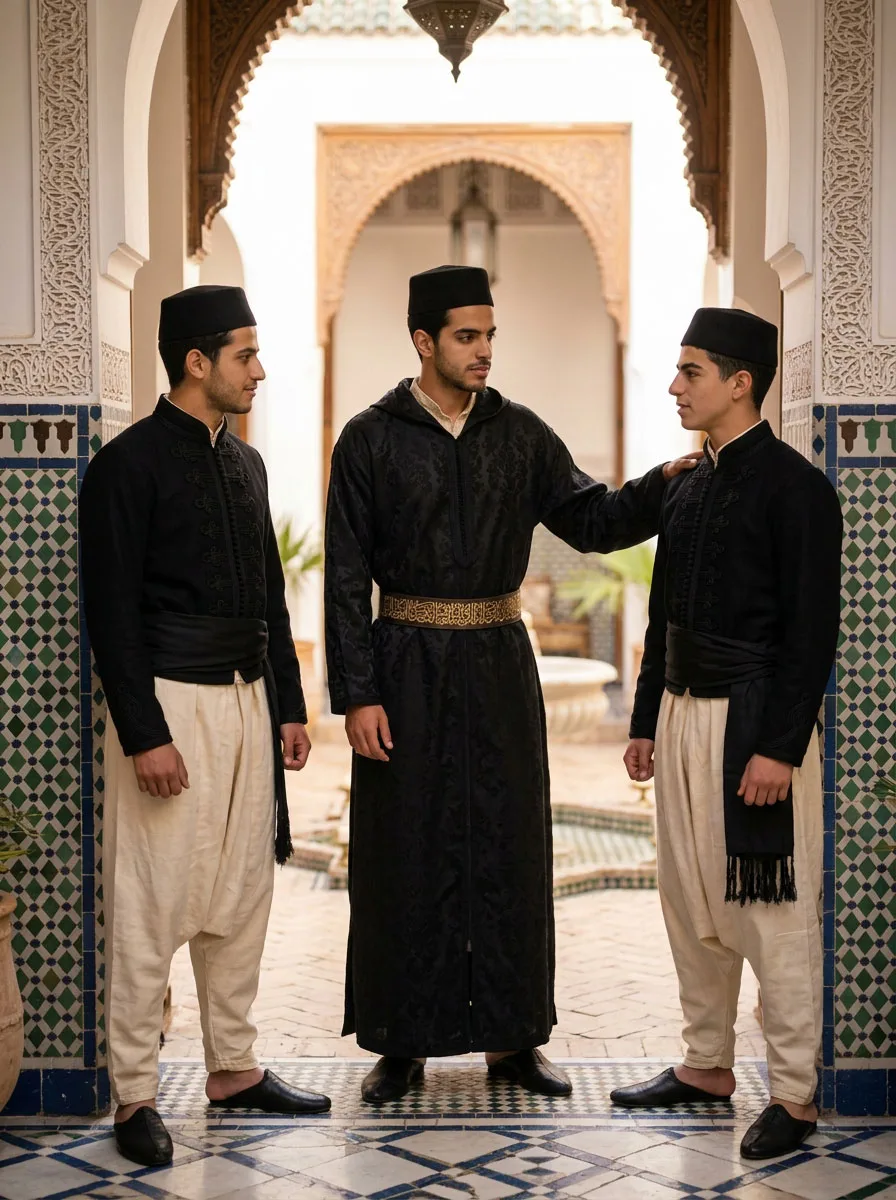
The Ash-Shaykh (الشيخ) has the colour of no workshop, belonging to no guild and standing for them all. His overtunic is black, to the ankle — the only tone in the system that comes from no workshop material. His belt carries the Kufic gold-thread embroidery at all times, not for ceremonies alone: his authority does not need a scale in order to be stated.
Two muqaddam (المقدّمون) assist him permanently, one for the inner life of the house, the other for what comes from outside. Their dress follows the same cut as that of the ṣāniʿ, in black, with the plaited cord of the function. They live beside the Ash-Shaykh — see The residency.
With these three, and with them alone, the rule of the three signs falls away: the function has become the state, and black clothes them entirely — cap and babouches included, even though they came out of a workshop like everyone else. In winter their coat is black too: the only use of that colour for this piece. It is the one exception in the system, and the house names it rather than hiding it.
OUTSIDE THE EVERYDAY
What is not worn every day
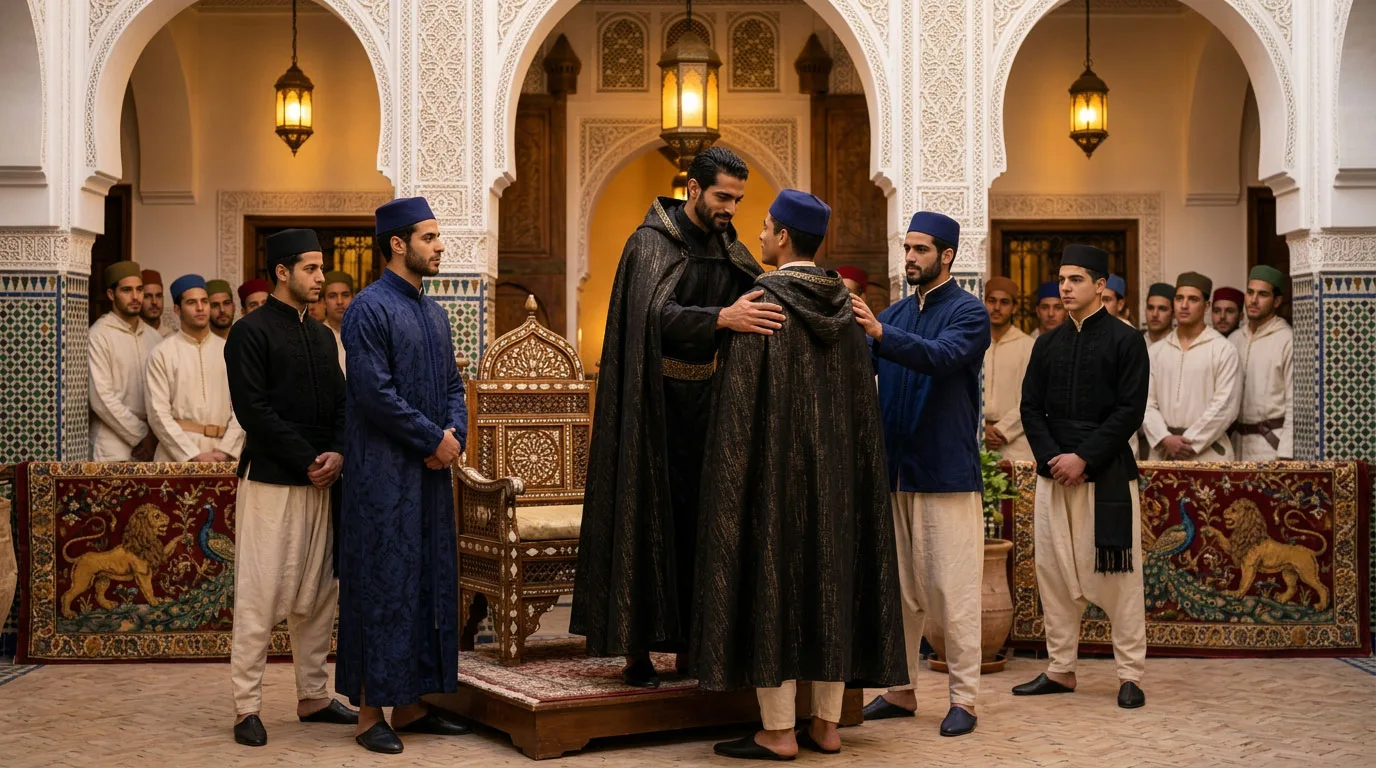
Al-Khirqa — the mantle of investiture
For entry into the path and for the investiture of a master, a distinct mantle is given rather than worn: the master himself puts it on the student, before the whole house. Deep black, gold-thread sqalli brocade — with the standard of the house, the only use of that cloth. It is the one moment when dress openly aims at hiba (هيبة), presence; everywhere else sobriety prevails.
It is sewn once in a lifetime and remains thereafter the dress of every later ceremony, the same for all who are invested, with no distinction of workshop or grade. What the gesture means belongs to the ideal that carries it — see Futuwwa.
The garment as gift
No garment is offered to a guest of standing to be put on there and then: a dignitary’s protocol is his own. An overtunic or a light mantle is, however, offered to him at the end of the visit, after the old usage of the guilds and the Maghrebi courts.
The dress of prayer
A qamīṣ of plain white linen, without embroidery, without a belt, without anything else, covering from shoulders to ankles. In prayer, equality prevails over every sign of workshop, grade or function — and the faqīh himself, who wears white all day, is no longer distinguished there from anyone.
The disciplines of the body
Wrestling, archery, horsemanship and the Persian exercises have their own dress, described where they are practised: Furusiyya and Javanmardi.
ONE NOTE ONLY
Where the tones come from
The colours were not chosen to mean anything. They come from the material each workshop has to hand and from what Fez knows how to dye: the red of its leathers, the verdigris that beaten copper takes, the olive of oiled cedar, the indigo of the dyers’ vats, the blue of Fez in its glazes, the sand of fresh plaster, the ochre of the ramparts, the brown of iron-gall inks, the undyed of raw linen.
They are workshop colours before they are colours of function. If they read well, it is because they were already there.
A note on the words
Najjār, ṣaffār and ʿaṭṭār are attested at Fez as guild names: the medina wrote them on its own squares — Nejjarine, Seffarine, Attarine. Sarrāj, mujallid, nassāj, fakhkhār and jabbāṣ are regular classical forms, kept here for consistency.
The cylindrical cap described above, by contrast, is a form particular to Dar al-Hiraf: qubbaʿat al-ḥirfa describes it, but is not an attested historical term. The catalogue of Moroccan and Arab forms lies elsewhere — see Traditional dress.
The words of this page are in the common glossary; the works cited in the sources; the sister house is Al-Funduq aṣ-Ṣiqillī.