Life at the Riad
An ordered day. Five canonical prayers, the work of the crafts, formation of body and spirit, shared meals, silence.
الرِّياضُ لِأَهْلِهِ، لَا أَهْلُهُ لِلرِّياضِ
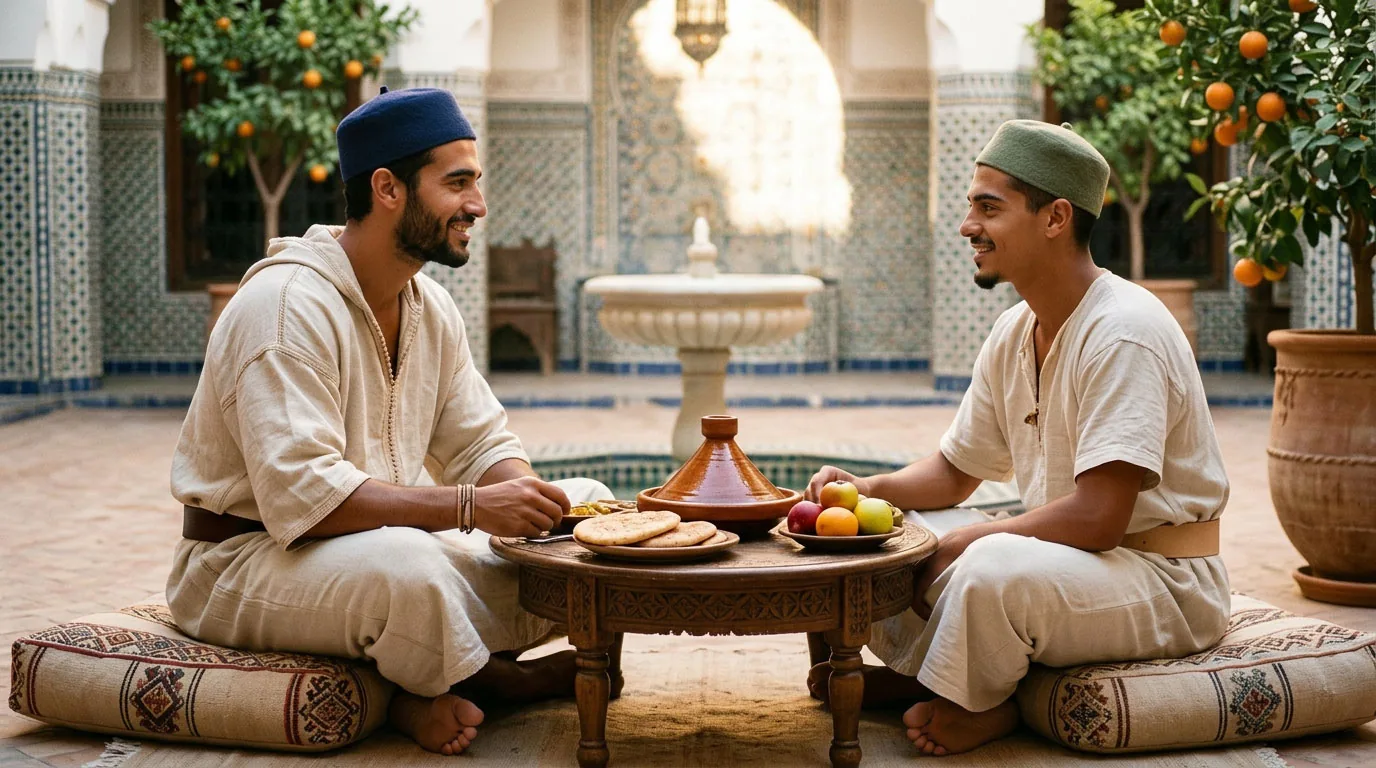
The Riad is a house that lives according to a clear rhythm, and not a hotel: prayer structures time, the gesture forms the hand, study and the body complete the day. Here one does not come to consume an atmosphere: one enters, for a measured time, into a form of life.
The five canonical prayers — Fajr, Dhuhr, ʿAsr, Maghrib, ʿIshāʾ — are not a spiritual décor. They already ordered the day of traditional houses; here, they continue to do so.
Between dawn and night, the work of the crafts, formation, shared meals and silence each find their exact place.
CANONICAL PRAYER — DAWN
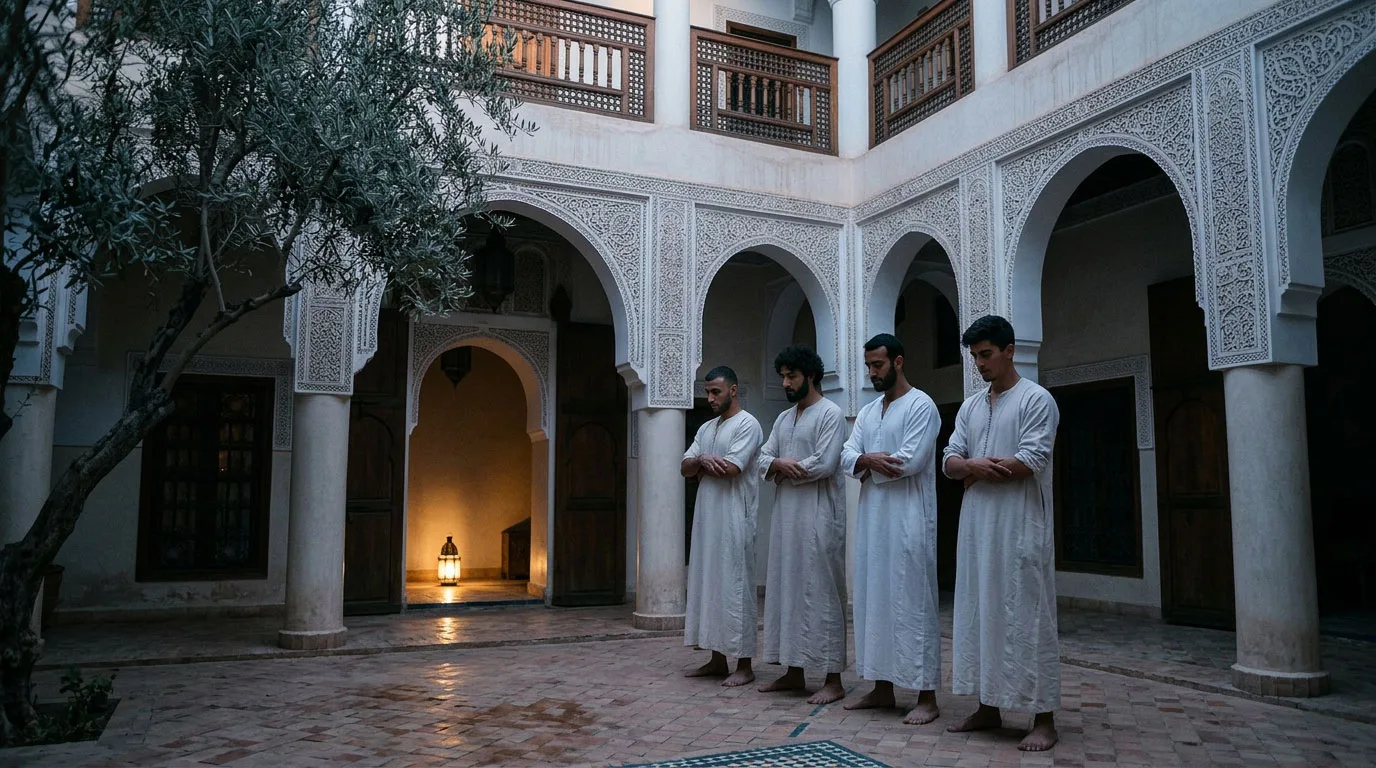
Fajr
Fajr — the threshold of the workshop. Dawn. The house rises in silence. Prayer opens the day before noise and before work. Then the frugal breakfast, and the beginning of study.
CANONICAL PRAYER — NOON
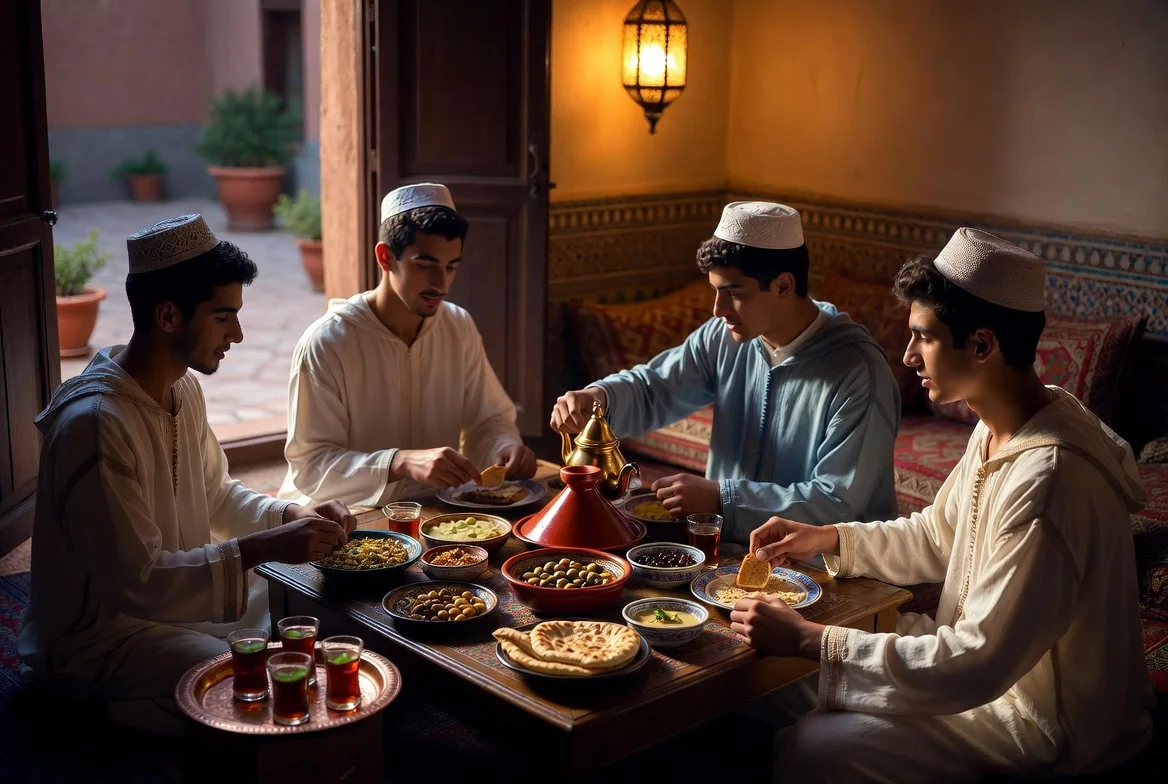
Dhuhr
Dhuhr — the common meal and the midday pause. Zenith. Pause from work. Prayer, then the shared meal. The common table is a place of formation as much as of nourishment.
CANONICAL PRAYER — AFTERNOON
Asr
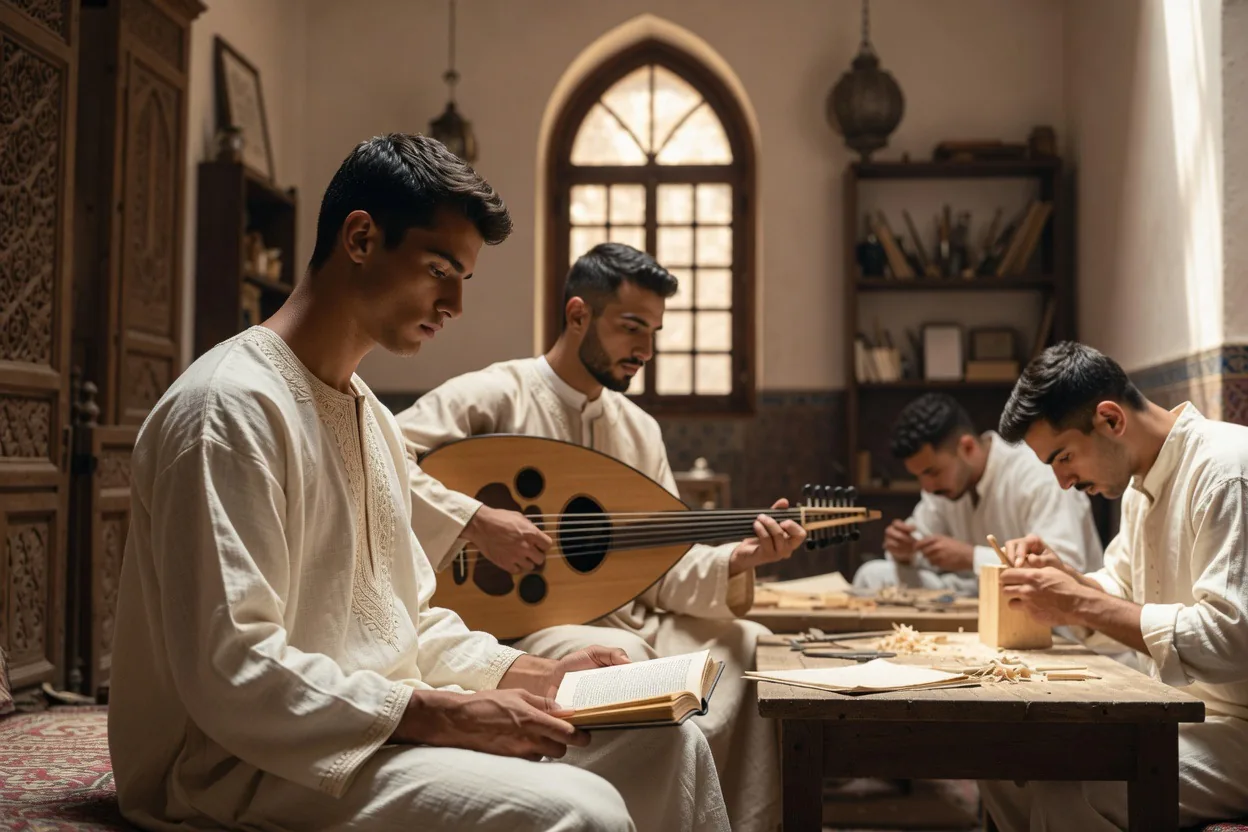
ʿAsr — the gesture taken up again. Afternoon. Return to the workshop or to the body. The light falls; the gesture continues, more concentrated.
CANONICAL PRAYER — SUNSET
Maghrib
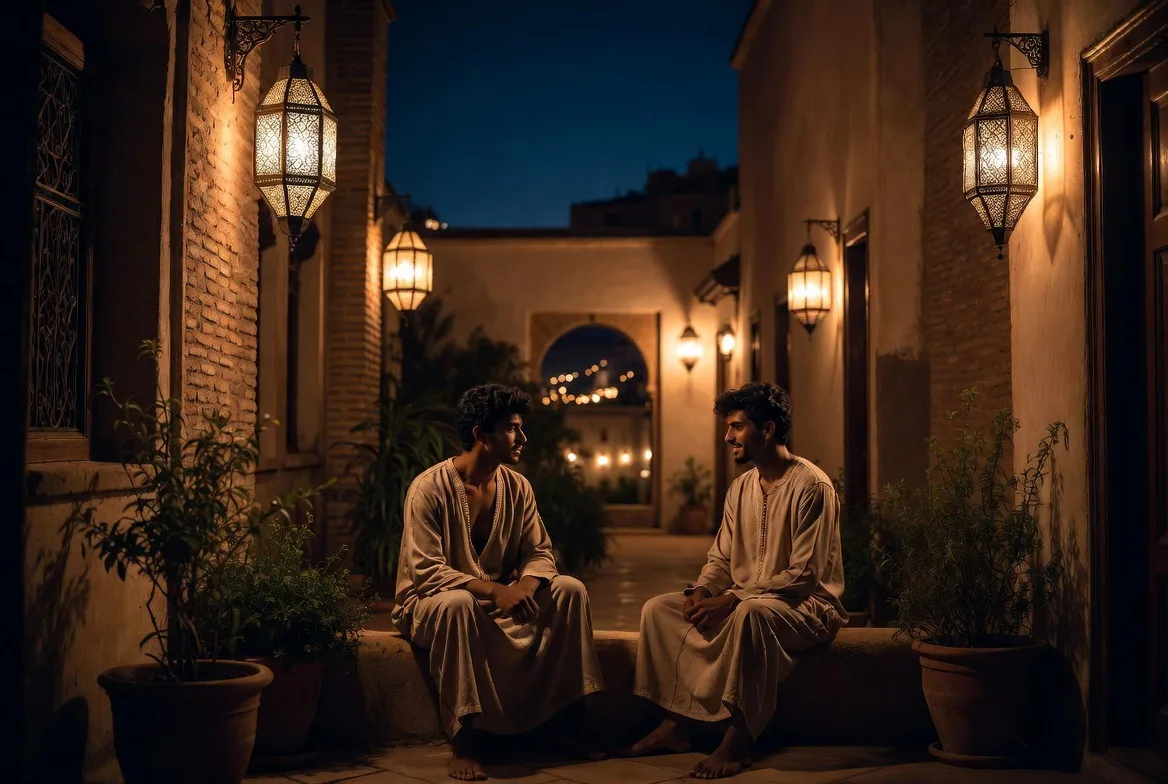
Maghrib — the return to the cloister and to study. Sunset. The day of work is done. Prayer, then dinner. Then comes the part of the day that nothing governs: the tea going round, the kefir, a shisha passed from hand to hand, an oud someone is tuning, and the laughter heard from the gallery.
CANONICAL PRAYER — NIGHT
Isha
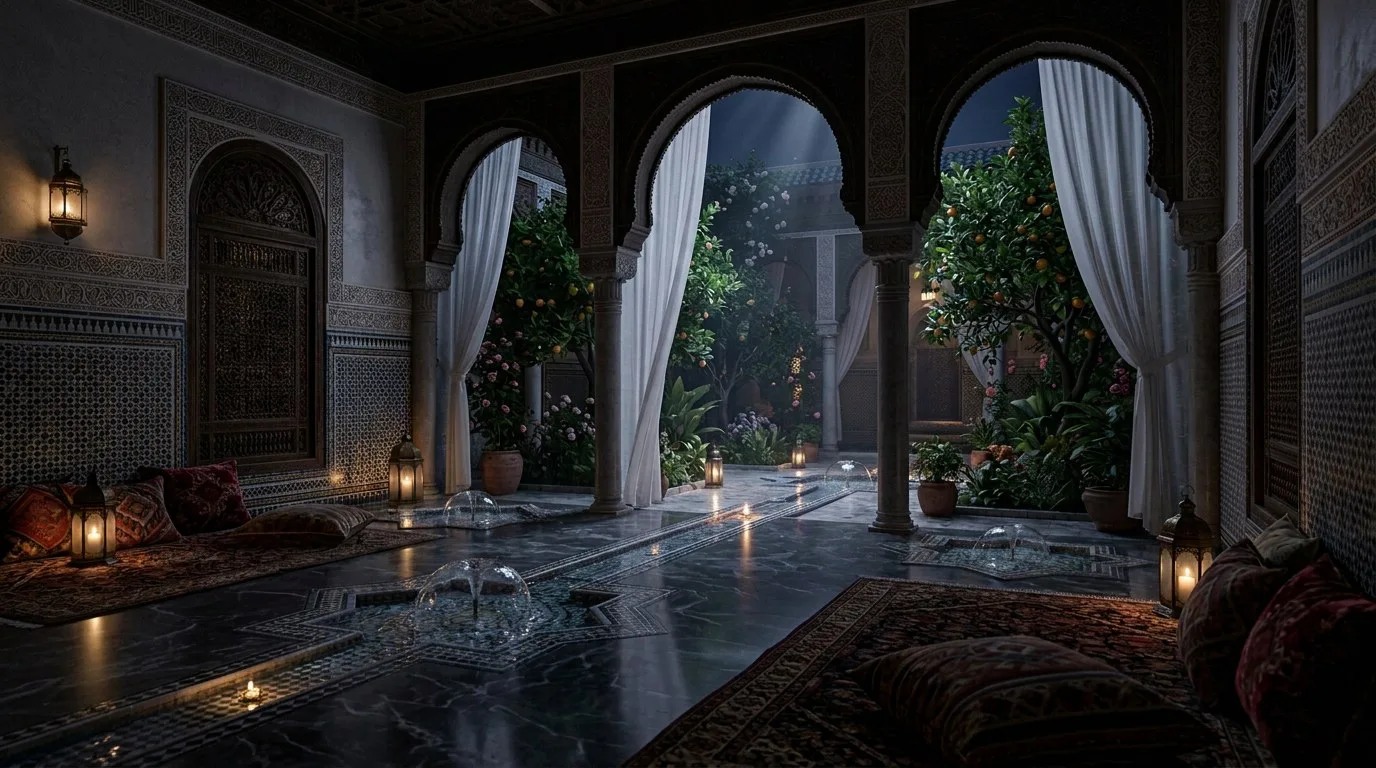
ʿIshāʾ — the silence of the dwelling. Night. Last prayer. Then silence. The house gathers itself. No noise after ʿIshāʾ — except, sometimes, a vigil of samāʿ or a discreet conversation.
WHAT IS FREE
What the house does not govern
An ordered day is not a supervised one. Those who live here are men, not paying guests. The house sets the hours of prayer, of work and of the table; it does not legislate on the rest, and that is not an oversight.
Men smoke here — cigarette or shisha — where they gather: the winter salons, the reading rooms, the patio, the galleries, the gardens. They sing and play an instrument. They dance when the occasion comes. They kick a ball about, in the patio too if the moment allows. They bathe together in the basins, and splash each other as boys do everywhere.
None of this is a concession: all of it is the house. And if no one here watches over anyone, the reason is that there is nothing to watch over, and not any laxity. Men live together because none is trying to hide — none needs to, and none would manage it: his brothers know him, and he knows them. To forbid what is licit would teach one thing only, concealment, to men from whom the kept word is precisely what is expected. Alcohol is not part of the house; the rest is.
The only rule of time belongs to the calendar: during Ramadan, no consumption in public before sunset.
THE QUARTER
They go out, and they are known
What happens inside these walls is ordered; it shuts no one in. The residents go out: they do the errands of the house, carry an order to a workshop, sit at the barber’s, go to the neighbourhood mosque like everyone else. A house that let no one out would not form men — it would make recluses of them, and that is not the same project.
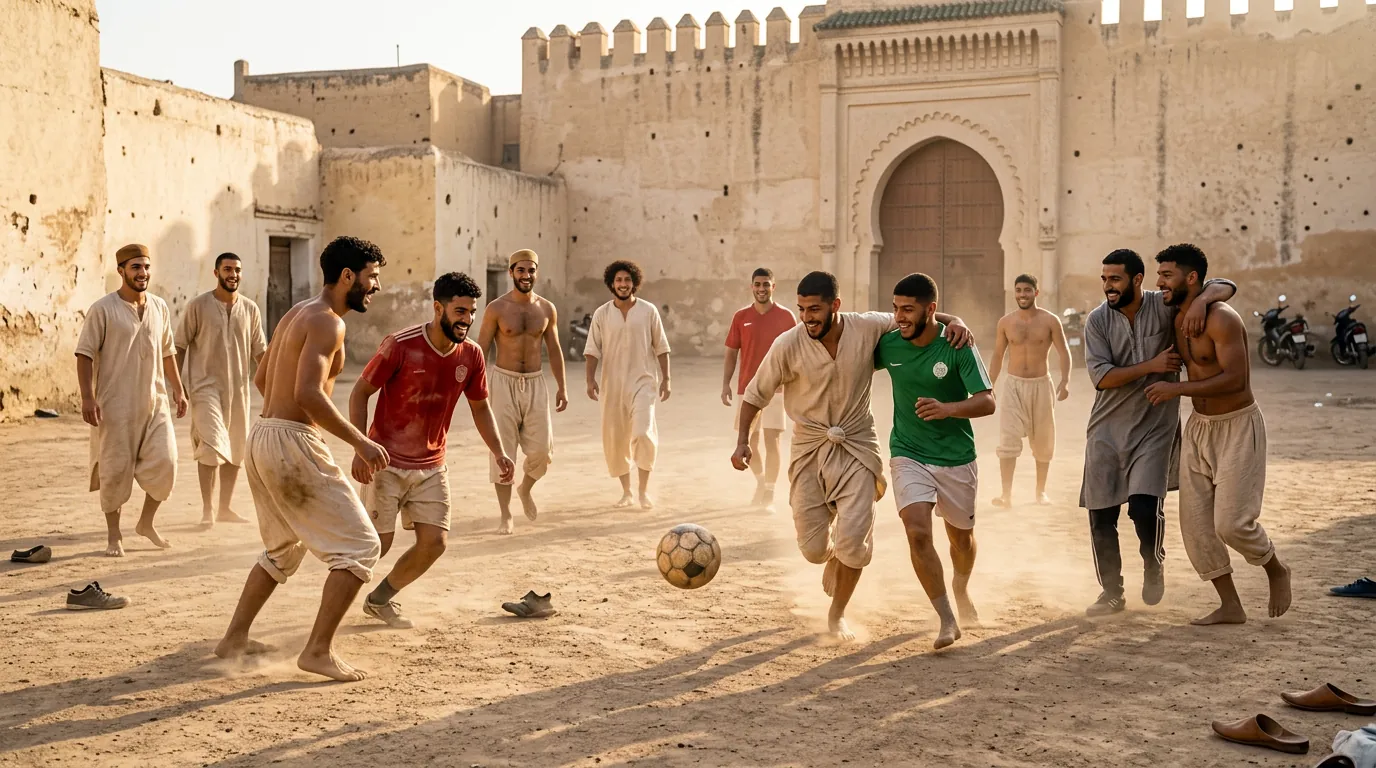
The pitch is where this shows best. Late in the afternoon, on a square or a patch of ground in the medina, the boys of the house play football with those of the quarter: the same teams, the same arguments over an offside, the same walk home at sunset. Some go in ecru, some in a football shirt; a few take off their shirt. Ten minutes in, the dust settles the difference, and there a boy is a boy among boys.
This matters for them first. A craft is learned in a house, but a man is also formed by the company of those who are not like him and owe him nothing. A resident whom the quarter knows by name is a resident no one needs to defend.
And it matters for the house. The first bond is tied on a pitch, or at the door of a workshop, and never on a page or a form. More than one boy of Fez will first look over a companion’s shoulder before asking, one day, what goes on in there — and it is in that way, rather than through a call for applications, that Dar al-Hiraf wishes to become known at home. See Who we are looking for.
Craft, body, study: between the prayers, the day is full. Workshop in the morning, physical formation or choreutic discipline in the afternoon, according to the rhythm of the house and the path of each one.
It is a form of life to which one accords oneself, and not a programme to consume — for a short stay, a craft immersion or the residential path.
نِعْمَتَانِ مَغْبُونٌ فِيهِمَا كَثِيرٌ مِنَ النَّاسِ: الصِّحَّةُ وَالفَرَاغُ
“Two graces of which many men are cheated: health and free time.” — Prophetic tradition, Ṣaḥīḥ al-Bukhārī, no. 6412
The word used, maghbūn, is a term of the market: it names the man who closes a deal at a loss without noticing it. Health and time are capital that drains away rather than goods to be enjoyed — and never so fast as when nothing orders them. An ordered day is what these two graces require in order not to be lost, and not a day filled up.
The words of this page are in the common glossary; the works cited in the sources; the sister house is Al-Funduq aṣ-Ṣiqillī.