The first house
What is being undertaken in Fez will have its full reach only if the manner of undertaking it can be taken up elsewhere in Morocco, in the cities where a craft is dying out for want of anyone to receive it.
What one house can establish
A house of formation saves by itself only the crafts it shelters and the men it receives, and its reach stops at its walls while the tally of lost gestures goes on everywhere else. What it can establish nonetheless far exceeds what it produces, since it verifies that a precise arrangement works: a dwelling acquired and restored by the firms of the city, masters paid to teach as much as to produce, a residence long enough for the hand to become sure, and a patrimony made inalienable so that the whole may outlive those who willed it.
A verification made somewhere ceases to be a conviction and becomes a precedent that others may examine, discuss and take up. The first instance therefore carries a charge not limited to itself, and must be conducted accordingly: choices documented, mistakes recorded, costs established, the register of the works kept from the first day, so that whoever wishes to begin again in Tétouan, in Salé or in Meknès does not set out from the same ignorance.
Why Fez
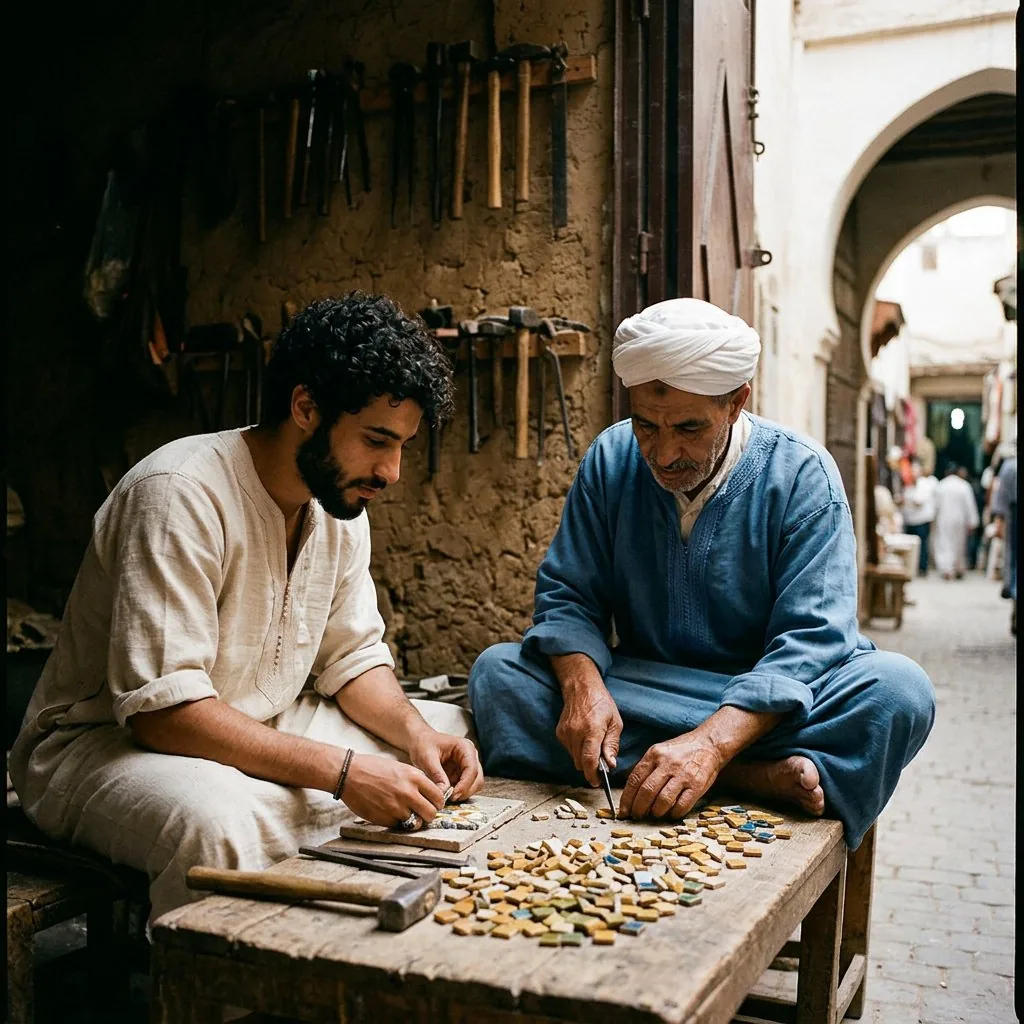
Fez is today the city of the Kingdom where the chain of the crafts most completely keeps its names, its quarters and its institutions. The guilds are set around the Qarawiyyin according to an old order the city has not undone; the technical vocabulary is still spoken in the workshops, and an apprentice finds within walking distance the tanner, the plaster carver (naqqāsh), the mosaicist (zallayji) and the copper founder (saffār).
Such density cannot be manufactured, and it explains why one begins here rather than elsewhere. It explains the urgency as well, since it thins from one generation to the next: rehabilitation programmes restore the walls and open routes for the visitor, without answering the question of who will receive the gesture each day, for years?
The precedents and their measure
The undertaking is not without precedent. In Marrakech, Dar Bellarj has occupied since 1999 a house of the medina that a Swiss couple of bookbinders had acquired and restored, and which a foundation continues to fund more than fifteen years after its founder’s death. In Fez, the Nejjarine complex, with its fondouk, its square and its fountain, was restored between 1990 and 1996 at the expense of a single man, for eighteen million dirhams and six years of works, and has housed since 1998 the museum of wooden arts and crafts. In Afghanistan, in Burma and in Jordan, the Turquoise Mountain foundation has restored more than one hundred and eighty historic buildings and trained several thousand craftsmen, articulating a neighbourhood building site, an institute of crafts and a commercial channel.
None of these examples brings together the three elements on which continuity depends. Dar Bellarj trains and receives without lodging. The Nejjarine was restored and opened to the public without a single apprentice residing there. Turquoise Mountain lodges and trains, but nowhere in Morocco. There is not, in Fez, a house that is at once restored according to the rules of the art, inhabited by those who learn there, and bound as an inalienable good so that its vocation ceases to depend on a particular will.
What can be taken up, and what cannot
A medina cannot be reproduced, and to claim to carry elsewhere what belongs to the thickness of a city would have no effect. What can be taken up is of another order: the legal form that withdraws the patrimony from commerce, the commission that gives the master a building site before giving him a market, the rule that makes residence the condition of apprenticeship, and the accounts of a house of this size, once they have been kept for five years.
The rest belongs to the place. Every city has its own crafts, its families and its authorisations; the weaving of the Middle Atlas, the pottery of Safi, the marquetry of Essaouira and the embossed brass of Fez do not revive in the same manner, and the house that sheltered them would not be the same house.
The dwelling
What the house must do before it is drawn, what it excludes, and to whom the walls belong.
The building site
Who restores the house, who learns, in what order, and why the firms are of Fez.
Openness and collaborations
The schools, the workshops and the institutions with which the house works.
Support
What one funds in supporting this house, and the forms in which it may be done.
Back to the project
The words of this page are in the common glossary; the works cited in the sources; the sister house is Al-Funduq aṣ-Ṣiqillī.