Measured hospitality
To welcome with measure. The stay is an entry into the rhythm of the house, and not a product.
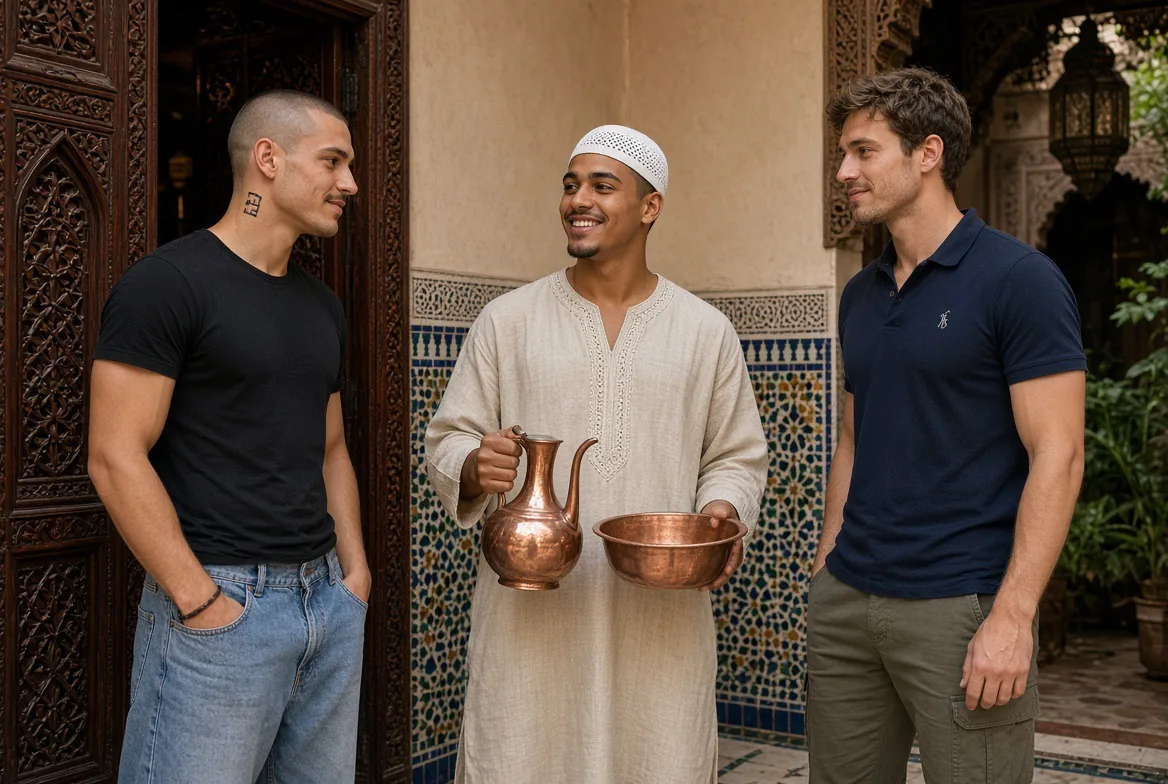
The hospitality of the Riad is measured by nature. It does not seek numbers, but harmony: between the guest and the place, between the time of the stay and the rhythm of formation, of prayer, of the table.
مَنْ كَانَ يُؤْمِنُ بِاللَّهِ وَالْيَوْمِ الآخِرِ فَلْيُكْرِمْ ضَيْفَهُ
“Whoever believes in God and the Last Day, let him honour his guest.”
Prophetic tradition — Ṣaḥīḥ al-Bukhārī, nos. 6018–6019; Ṣaḥīḥ Muslim, nos. 47–48
Already in pre-Islamic Arabia, hospitality was not an option but an honour to be defended: the name of Ḥātim al-Ṭāʾī, the poet become a living proverb of generosity toward the guest, still carries its memory. The Riad invents nothing, but continues a duty older than itself.
Those who come are received as guests, not as clients. Measure protects the company and guarantees the quality of the shared presence.
This hospitality is the natural extension of the life of the house — open, with prudence, to those who know how to respect its time.
The rite of the threshold: water and linen
غسل اليدين
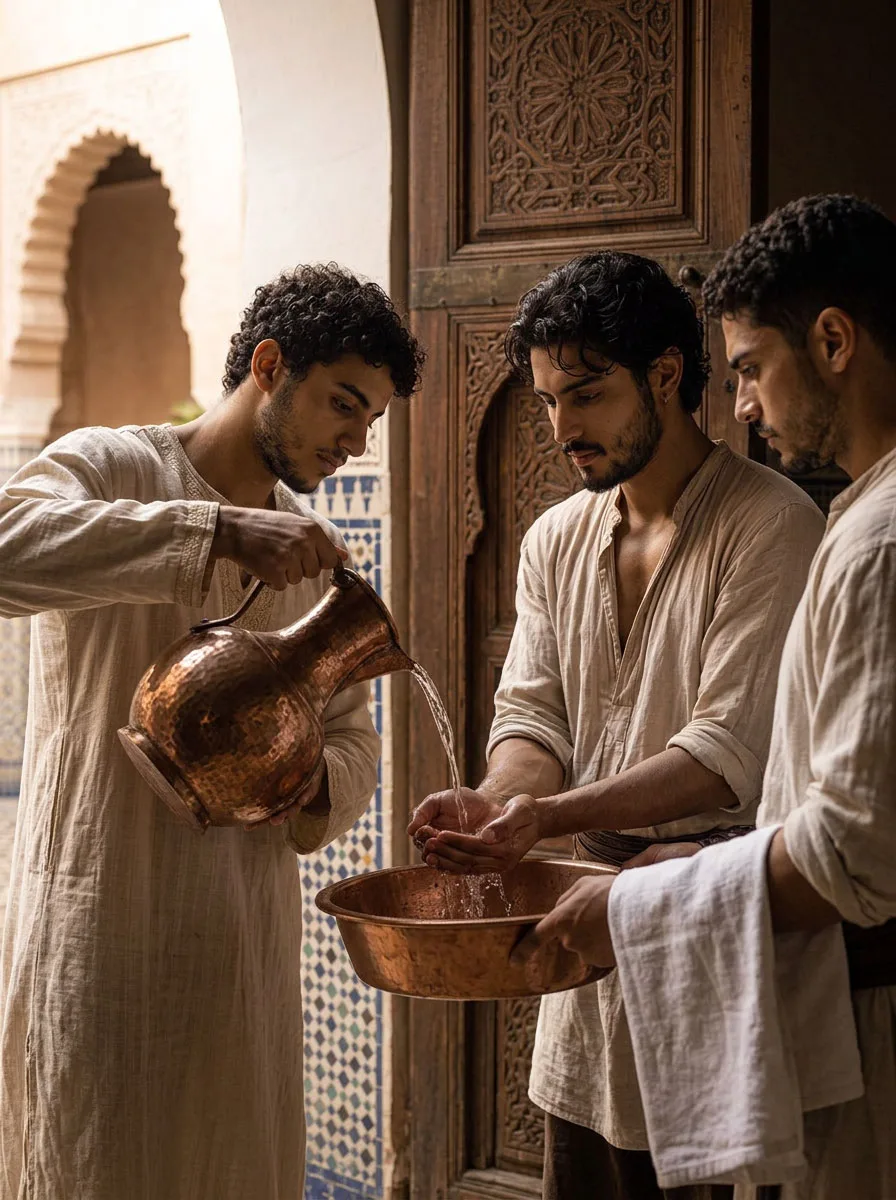
The washing of the hands. Copper ewer and basin, linen. The customary gesture, and the one most faithful to the measure of the house.
A fuller welcome
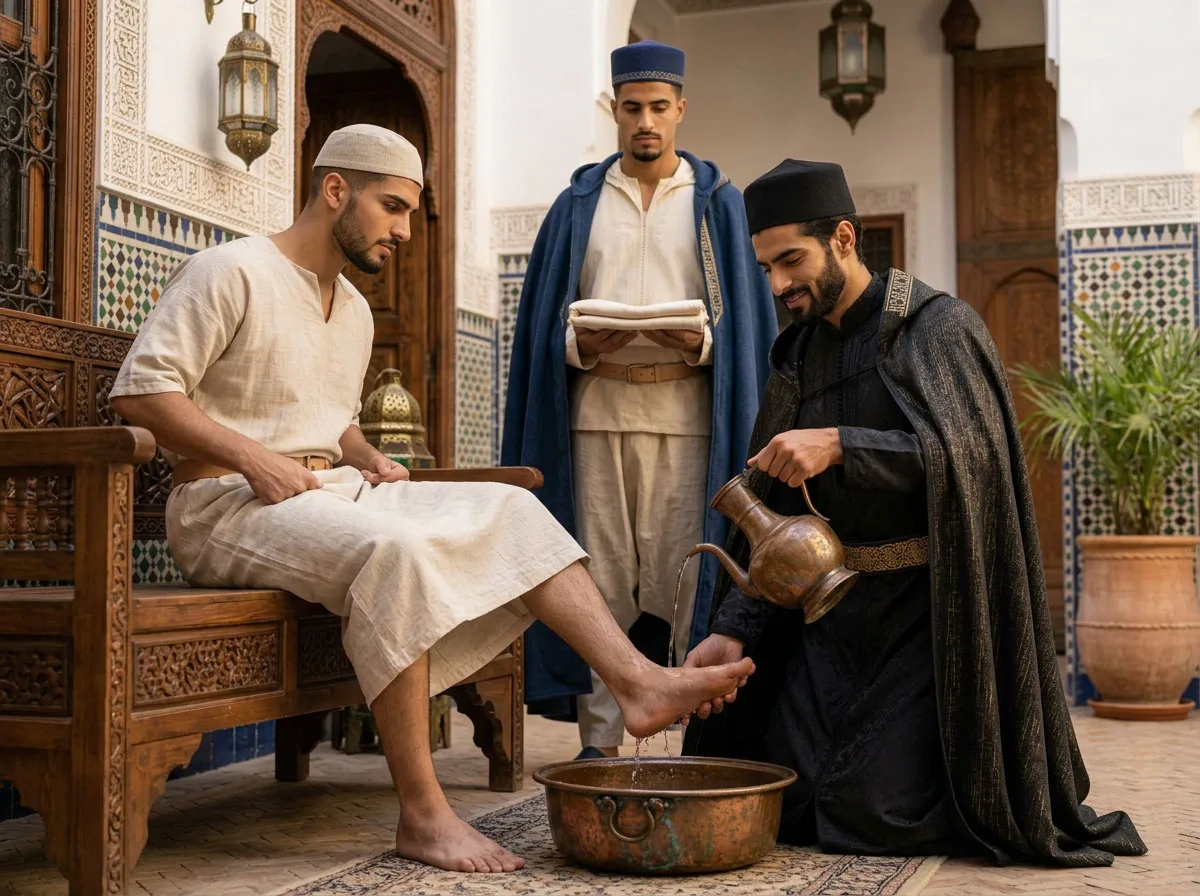
Sometimes, for a traveller or a moment of particular honour, the washing of the feet. The same sobriety, the same intention.
At the more significant passages — the arrival of a guest, the admission of a new resident, the passage from Al-Munya to the Riad — the washing of the hands is offered.
A muqaddam or the shaykh pours the water. The youngest of the house holds the linen. The ewer, the basin and the small tray are the work of the chaser; the linen, of the weaver; the light perfumes, of the artisan perfumer.
This moment has nothing of a formality. It is the one in which the guest is invited to leave outside the dust of the road and what has no place here. He enters an order in which generosity (sakhāʾ), fidelity (wafāʾ), courage (shajāʿa), sincerity (ṣidq), the governance of the nafs and the quality of the fatā hold.
For one who stays several days, the house hands over the simple set (tunic, belt, sarouel, babouches, ṭāqiyah). The clothes of the road are washed, folded and returned in a cover.
The same honour is given to the distinguished guest and to the young man received without means.
When the washing of the feet is given, the one who pours the water bends at the end and kisses the foot he has just washed. At times it is the shaykh himself. The gesture is old, and no guest expects it: the man who lacks nothing and the young man who arrived with nothing receive there the same thing, and neither was prepared for it. What the house says there is not said in words. The one who receives places himself lower than the one who arrives, and the rank one thought one carried stays outside with the dust of the road.
Hands are held out. The name stays outside. The water removes the dust of the road before the house reads anything else.
Once the threshold is crossed, the guest is not a spectator. He takes part, when the house proposes it, in the same offices as the ṣāniʿ — the patio, the garden, the kitchen, the workshop — and sits at the common table. The intimacy of the house rests in that gesture.
Measure
Few guests at a time. A calendar that follows the rhythm of the Riad, not the reverse. Rarity is the condition of presence, and not a commercial device.
Agreement
One does not welcome everyone. One welcomes those for whom the place has meaning — and who accept to enter into its order, without turning it into a décor.
Presence
The guest shares the table, the silence, sometimes a craft gesture. He does not pay a hotel tariff: he gives a contribution in support of the house and of the common chest (As-Sanduq), and finds himself admitted, for a time, into a house already living — sometimes taking part in the Encounters that mark certain evenings.
Selection is made by correspondence and conversation. It concerns the inner disposition of the guest as much as the places available. The Riad reserves the right to refuse without detailed justification — not out of arrogance, but to protect what constitutes it.
For the practical modalities of the stay: Staying. For the order of the doors — stay, craft immersion, residence, and the guest of Al-Munya: How one enters. For the adjoining dwelling: Al-Munya.
The words of this page are in the common glossary; the works cited in the sources; the sister house is Al-Funduq aṣ-Ṣiqillī.