Organisation of the spaces
Here, the order of the rooms
The house is ordered according to precise uses, and not a mere juxtaposition of rooms: formation, body, knowledge, threshold, common life.
Each space has a function and a rule. If it begins to serve the image or the guest more than the resident, it must be corrected or removed.
NUCLEUS
The nucleus and the growth
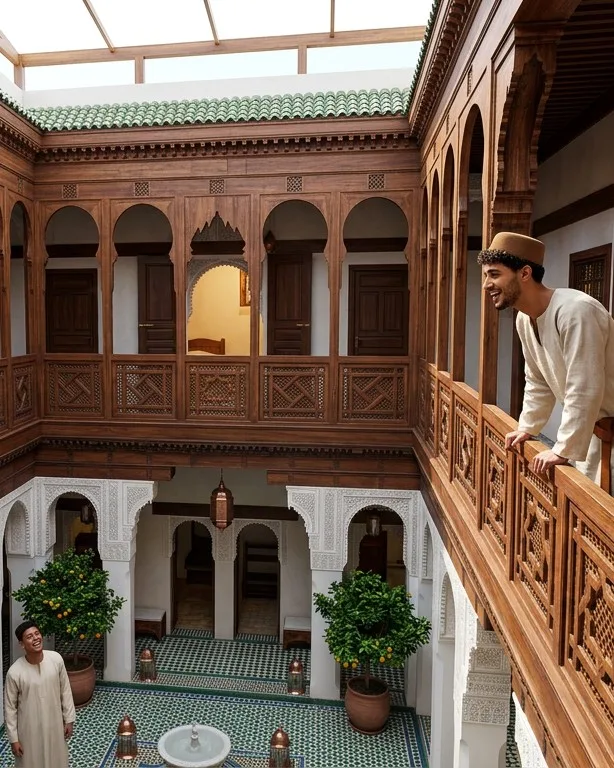
The house opens with a single workshop, saddlery, to the measure of a single ʿudda: see Dar al-Hiraf. The other crafts are added when the masters and the resources are there.
The plan provides for the possibility of growing — by a wing reserved from the start, or by the later acquisition of adjoining volumes on the side opposite the Munya. The door that separates the two houses remains untouchable.
SLEEPING
The rooms on the gallery
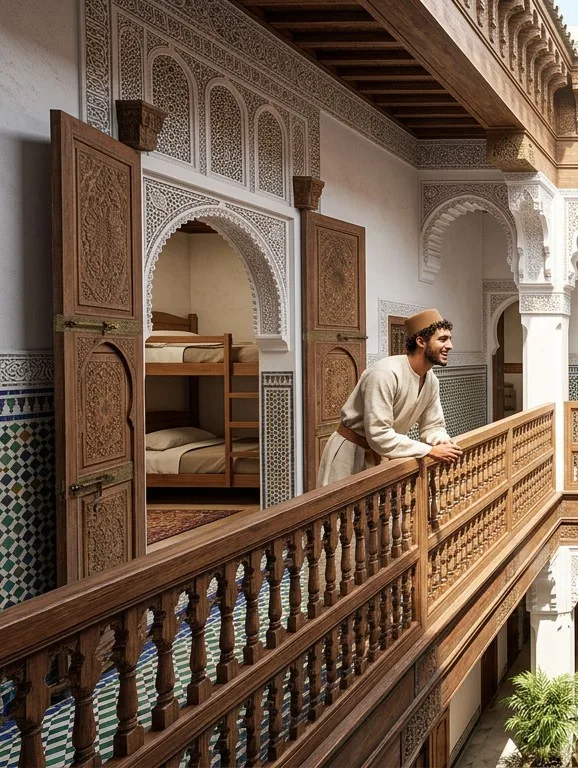
One does not sleep in a corridor of equal rooms. The rooms open onto the gallery that runs around the courtyard on the upper floor, in the arrangement Fez has always given to houses where men work and lodge at once: that of the fondouk. Each room takes the measure the bay leaves it, so that none is identical to its neighbour.
The inequality of the rooms excludes any tariff, instead of amounting to a fault of the building. They are distributed according to what the house judges and never according to what one pays — the work, the seniority, the charge exercised. The ṣāniʿ, the nāʾib and the maʿallem sleep under the same gallery.
The shared rooms have six beds. Most men lodge with the ṣāniʿ of their own workshop, so that the unit of life ordinarily coincides with the unit of work. That is the rule, and it admits exceptions: each changes bed and room when he wishes, because it is the young men who decide, in full freedom. The nāʾib sleeps among his companions. The maʿallem occupies a room of his own, adjoining that of his ṣāniʿ, so that he can be called during the night without sharing their room. It opens on both sides: onto the dormitory gallery, and onto the common spaces, so that he comes and goes without crossing the shared room. The faqīh sleeps in the shared room with the apprentices, in a bed like the others; the house reserves for him only a study cell adjoining the khizāna, without a bed. The house opens with four or five shared rooms — twenty-five to thirty-five places — to reach, at full establishment, eight to ten units. The single and double rooms meant for guests are at the Munya, not here. The upkeep of the shared room falls to those who occupy it.
Young men of more modest means are received in the same rooms. Integration is part of the formation.

BODY
The zone of the body
Hammam, space of discipline (furūsiyya), changing rooms. Nearby: the water basin that crosses a courtyard — traditional form, not a swimming pool — and the secret garden of Damask roses.
On the side opposite the Munya, a sheltered courtyard for archery and combat exercises. It is seen only from a private terrace or a passing mashrabiyya.
KNOWLEDGE
Knowledge
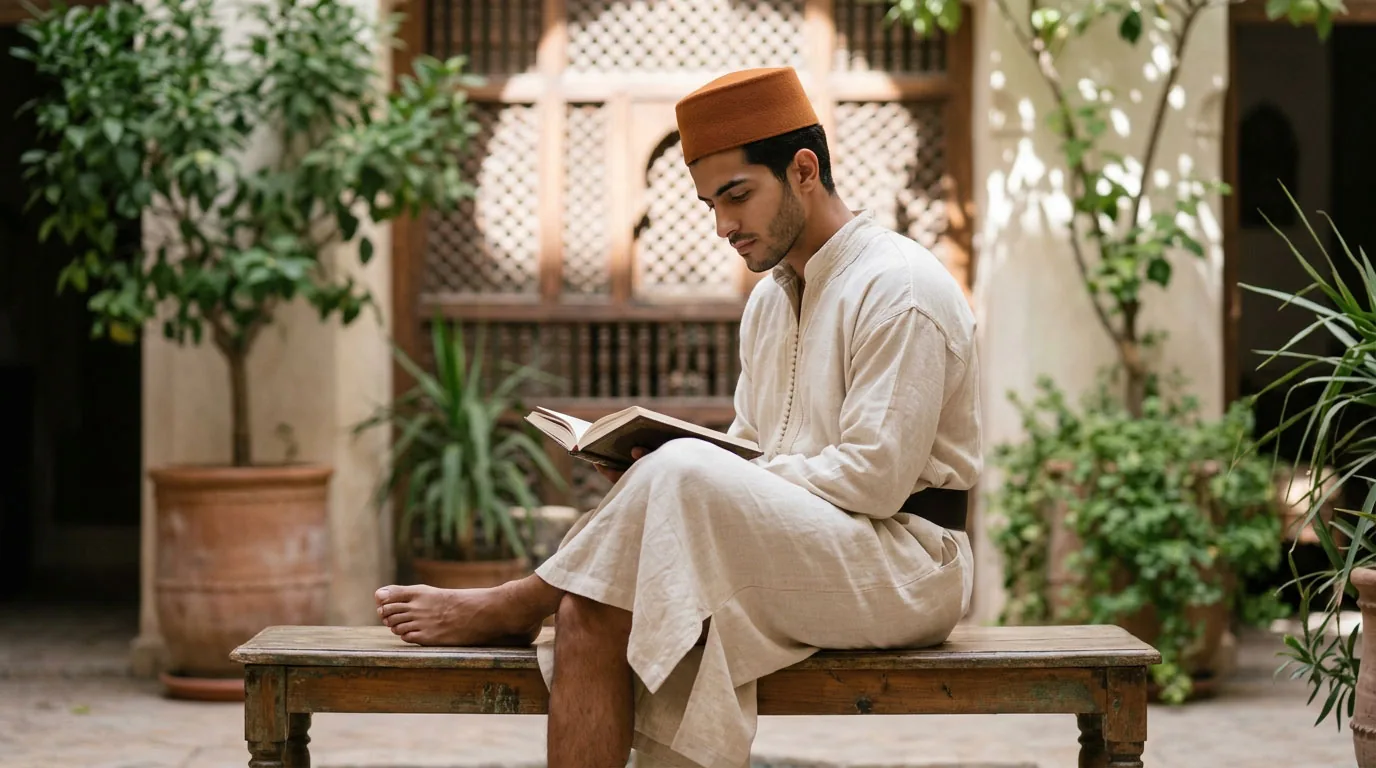
The room of the books and the small reading salon adjoining it. The khizāna — the cabinet of the volumes — remains under lock on the Riad’s side. One asks for a book; the book is brought.
It is also the passage between the Munya, the apartment of honour and the Riad: the only room the three can reach when the door is opened from the inside.
COMMON LIFE
Common life
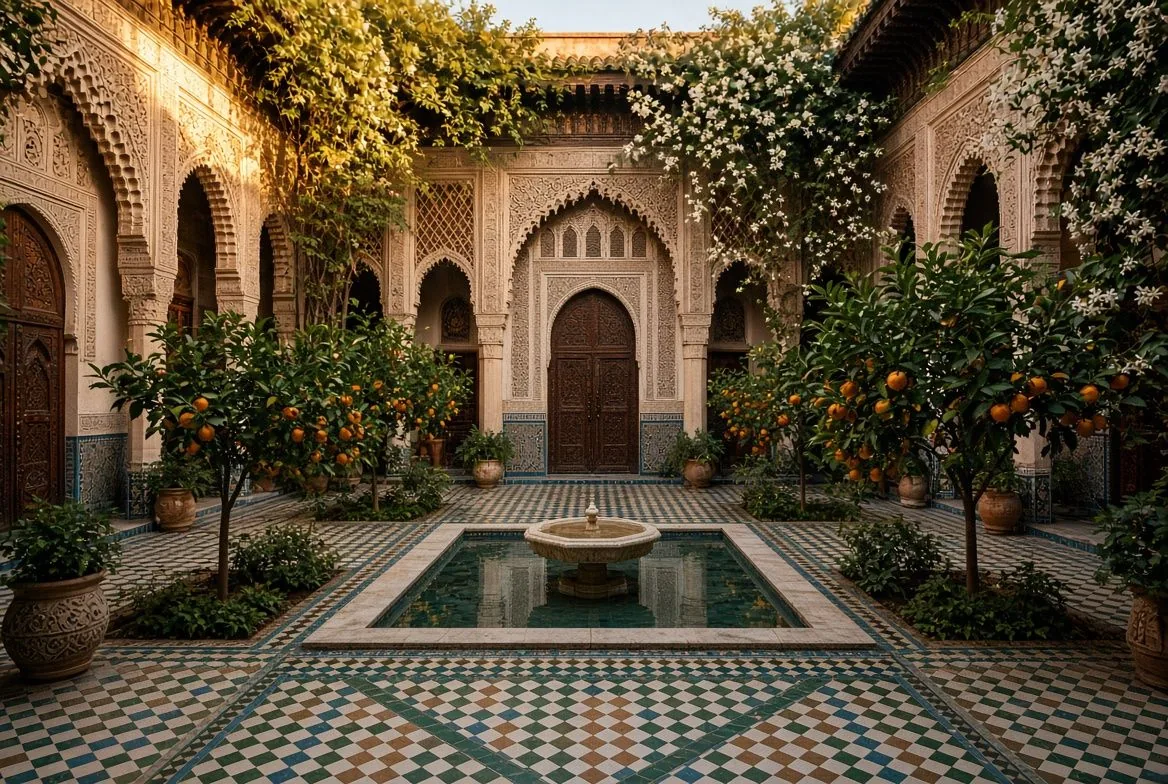
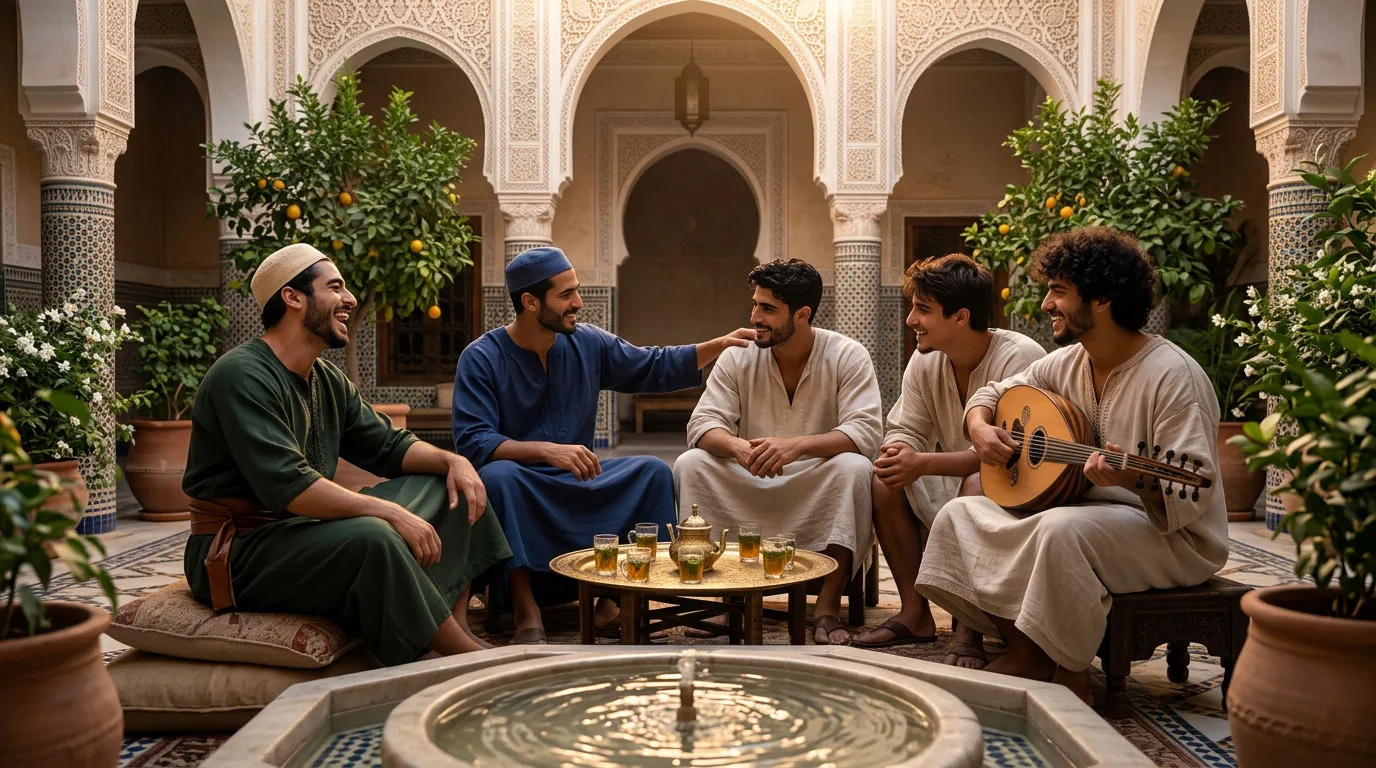
The single table, the oratory, the salons, the parlour. The patio and the garden with their fountains, salsabil and channels. Water is not an ornament, since it structures the space. See also the natural coolness.
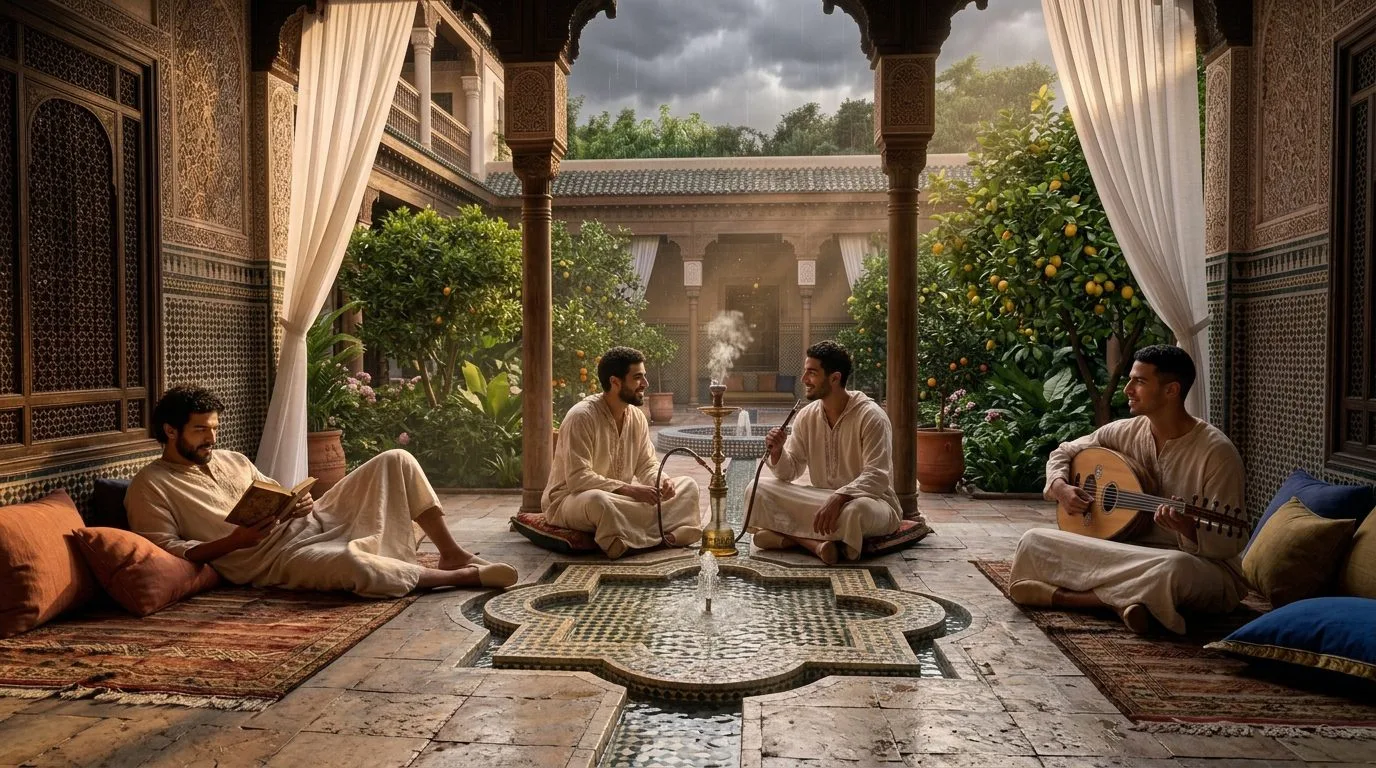
The residents’ room of rest opens onto the courtyard and the garden, where carpets, cushions and hangings are gathered with the same generosity as in a great house of Fez. Those who have spent the day in the workshop, at prayer, in the exercises of furūsiyya and in the apprenticeship of futuwwa meet there to read, to make music, to smoke the narghile and to talk.
THRESHOLD
Government and threshold
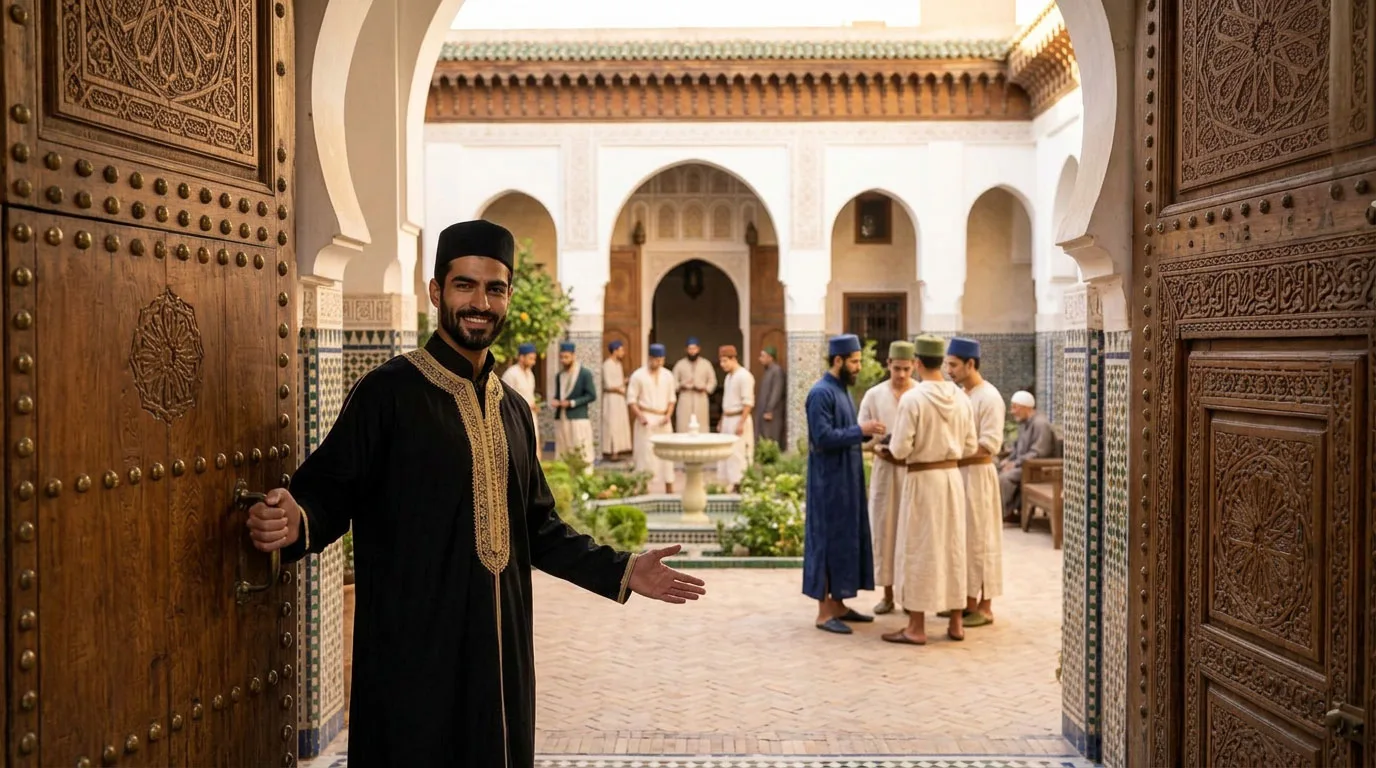
The rooms of the Ash-Shaykh and of the Muqaddam are distinct — by function, not by comfort. The Ash-Shaykh has a room with a small sitting room adjoining it, onto which the two rooms of the Muqaddam open directly, so that the government of the house occupies a single quarter and is always to be found in one place. That quarter communicates with the dormitory zone, but it also has its own access from the common spaces: one may come to it without passing through the rooms, and leave it without crossing them. A single door in the common wall with the Munya, the lock openable only from the Riad’s side. The key is held by the Bawwāb.
An apartment opening onto the courtyard and the garden is set aside for the direction or for an aged master. It belongs not to luxury but to necessity: a man who answers for the house must be able to withdraw from it without leaving it.
Near the porter’s quarters, opening onto the vestibule, a small bare room serves to confine, for a fixed time, a man who has gravely broken the rules of common life without the fault calling for dismissal; the measure belongs to taʿzīr and is pronounced before the arbitration of the house.
THE PATH
How one enters this house
The organisation of the spaces gives the order of a life, and not a plan to visit. One approaches it by the same gesture as for everything else: to read, to write, the exchange — never the inscription.
See also the glossary of the house.
الرِّياضُ لِأَهْلِهِ، لَا أَهْلُهُ لِلرِّياضِ
The words of this page are in the common glossary; the works cited in the sources; the sister house is Al-Funduq aṣ-Ṣiqillī.