Al-Athar
An imprint carved to last.
THE RULE
Written before the house
No one will leave Dar al-Hiraf without having left, in its walls, a work of his own hand.
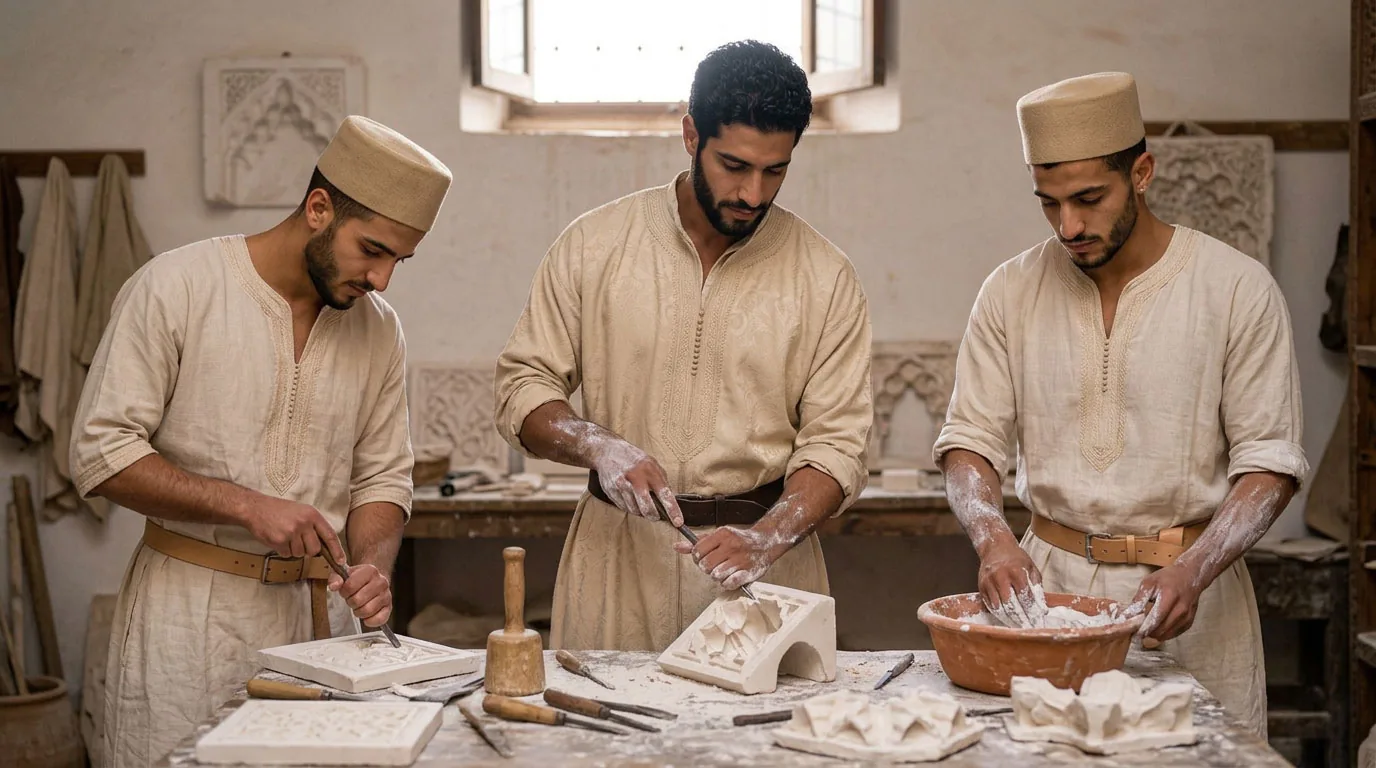
Not an object to carry away: a zellīj panel in a corridor, a door, a basin, a plaster ceiling, an iron grille, an inscription above a threshold. Something that stays, and cannot be taken back.
It is the formation brought to its end, and not a ceremony added to it. A companion is the man whose work has been received by his master and then set in place in the house, and that reception weighs more than skill alone.
The rule is written now, before there is a house, because the house will be made this way.
THE WORK OF RECEPTION
What is received, and what is not
The work is chosen with the master, within the craft learned, and to the measure of what the man can truly do — not of what he would like to display. It must be useful to the house and destined for a precise place: a wall, a threshold, a courtyard, a workshop.
It is then judged. The master may refuse it: then one begins again, and one may not finish. It is this possible refusal that gives the reception its weight; a trial one is certain to pass is not a trial.
Fixed
The work is built into the building. It is not sold, not moved, not returned.
Useful
It serves a purpose: it is walked on, leaned against, drawn from, looked at every day.
Received
It exists as a work only when the master accepts it and the community sees it set in place.
The logic is an old one: that of the masterpiece in the craft brotherhoods, and that of the ijāza in the Islamic tradition of learning, where authorisation to transmit rests on a master’s attestation, and not on the mere fact of having learned.
إِنَّ اللهَ يُحِبُّ إِذَا عَمِلَ أَحَدُكُمْ عَمَلًا أَنْ يُتْقِنَهُ
inna Allāh yuḥibbu idhā ʿamila aḥadukum ʿamalan an yutqinahu
“God loves that, when one of you does a work, he does it with excellence.”
Reported by Abū Yaʿlā and al-Ṭabarānī; held authentic by al-Albānī.
THE FIRST WORK
The first work will not be the monument
The Riad does not exist yet. The house itself, which will be an old and protected building, is restored by established masters under a site director: the ṣāniʿ take no part in it, and train meanwhile in the workshops of the medina.
What the first ones will raise with their own hands comes afterwards, and never stops: the outbuildings, the terraces and the service rooms, then the garden — channels, basins, pergolas, enclosing wall — and, for a long time, the houses of the derb that the house restores one by one. Works modest enough for a mistake to be repaired, and real enough for it to count.
This is also what sets the project apart from an ordinary restoration. A site entrusted to a contractor produces a building; a site led by masters with their ṣāniʿ produces a building and men. See Al-Warsha and The building site.
AS-SIJILL
The register
To every work set in place corresponds a written line: what was made, by which hand, under which master, in which year. The register stays in the house. It is not published, and no resident’s name appears on this site.
After twenty years the building and the register say the same thing in two ways: a chain of men, and what they left behind. A man returning at forty can show his son the door he carved at twenty-two.
THE INSCRIPTION ON THE MANTLE OF ROGER II
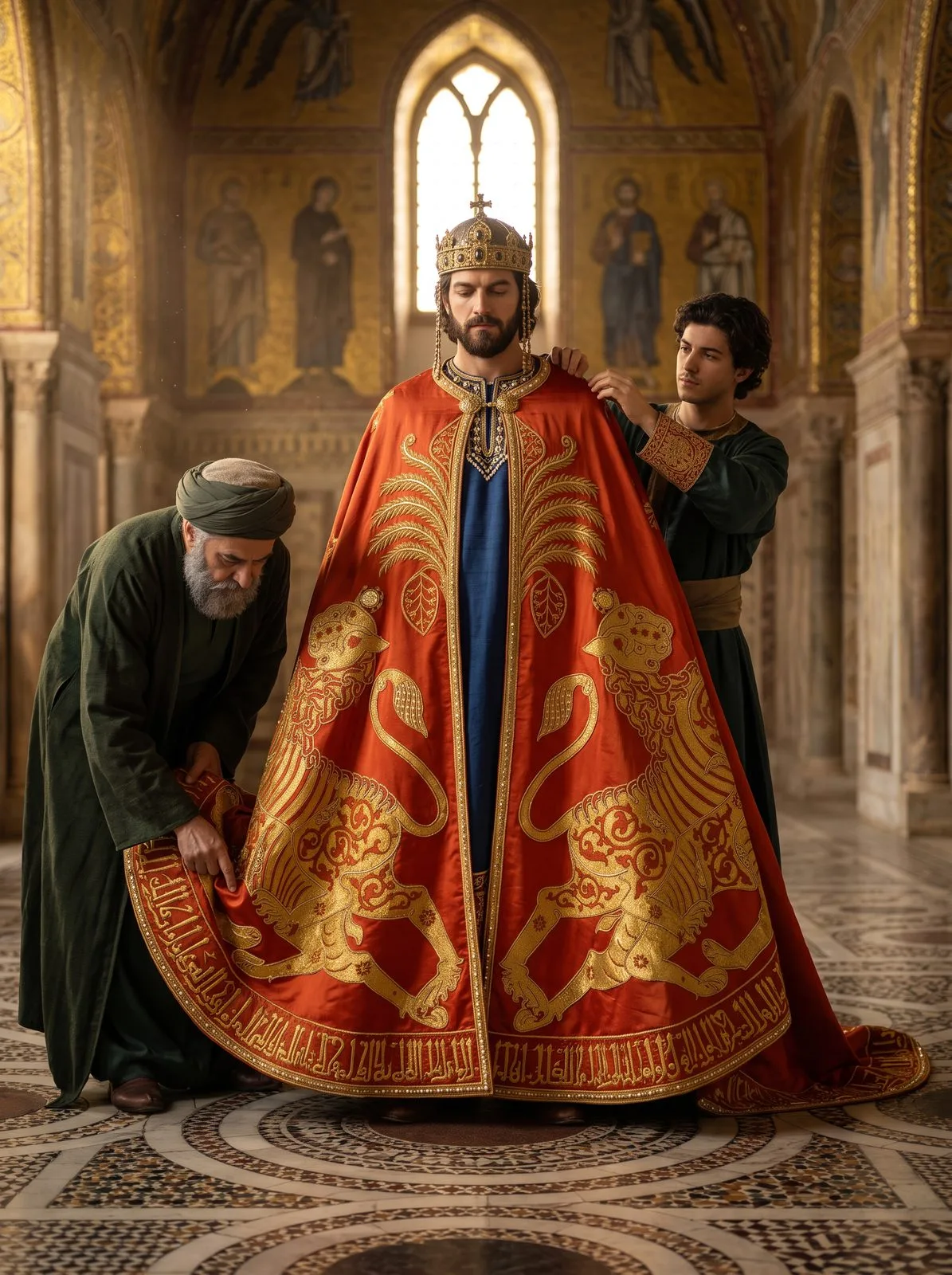
مِمَّا عُمِلَ بِالْحَضْرَةِ الْمَلَكِيَّةِ، مَعَ حَظٍّ وَسَعَادَةٍ، وَامْتِيَازٍ وَكَفَاءَةٍ، وَإِتْقَانٍ وَاقْتِدَارٍ، وَحَظْوَةٍ وَاجْتِدَارٍ، وَرَغْبَةٍ وَإِجْمَالٍ، وَعِزَّةٍ وَإِقْبَالٍ، وَبُلُوغِ أَمَانِيٍّ وَآمَالٍ، وَلَيْلٍ وَنَهَارٍ، بِلَا زَوَالٍ وَلَا انْتِقَالٍ، بِعِزٍّ وَإِكْرَامٍ، وَحِيَاطَةٍ وَسَلَامٍ، وَنَصْرٍ وَتَمْكِينٍ، فِي حَضْرَةِ صِقِلِّيَّةَ، سَنَةَ ثَمَانٍ وَعِشْرِينَ وَخَمْسِمِائَةٍ
“Work executed in the flourishing royal manufactory, with happiness and honour, application and perfection, might and efficiency, favour and good fortune, generosity and sublimity, glory and beauty, the fulfilment of desires and hopes, propitious days and nights, without cease or removal, with honour and care, vigilance and defence, prosperity and integrity, triumph and capability, in the Capital of Sicily, in the year 528 of the Hijra.”
Kufic, embroidered in gold along the hem of the coronation mantle, royal workshop of Palermo, 528 AH / 1133–1134. Now in the Kunsthistorisches Museum, Vienna, in the Imperial Treasury.
THE FORM OF THE ENTRY
مِمَّا عُمِلَ بِدَارِ الحِرَفِ بِرِيَاضِ الأُنْسِ
Among the things made in the house of Al-Uns — filled with patience and constancy, uprightness and valour, generosity and kindness, silence and perseverance —: the work, of the craft of the craft, by the hand of the name, under the guidance of maalem the name, set in the place, received in the year the year of the Hijra.
The formula follows the inscribed bands of the royal ṭirāz, the silk workshops where the place and the year of making were embroidered along the very hem of the cloth. The mantle of Roger II, woven in Palermo in 528 of the Hijra (1133–1134), opens in the same way: “Among the things made in the royal khizāna, filled with fortune and honour, glory and perfection…” — then comes the long rhymed chain of qualities, and last the city and the date. The Riad belongs to this Arab-Mediterranean tradition — from Palermo to Cordoba and to Fez — in which the work carries, embroidered, the memory of the place, the year and the hands that wove it. There the object carries its own memory, as here the work carries its own.
AL-LIWĀʾ
The standard and the man who carries it
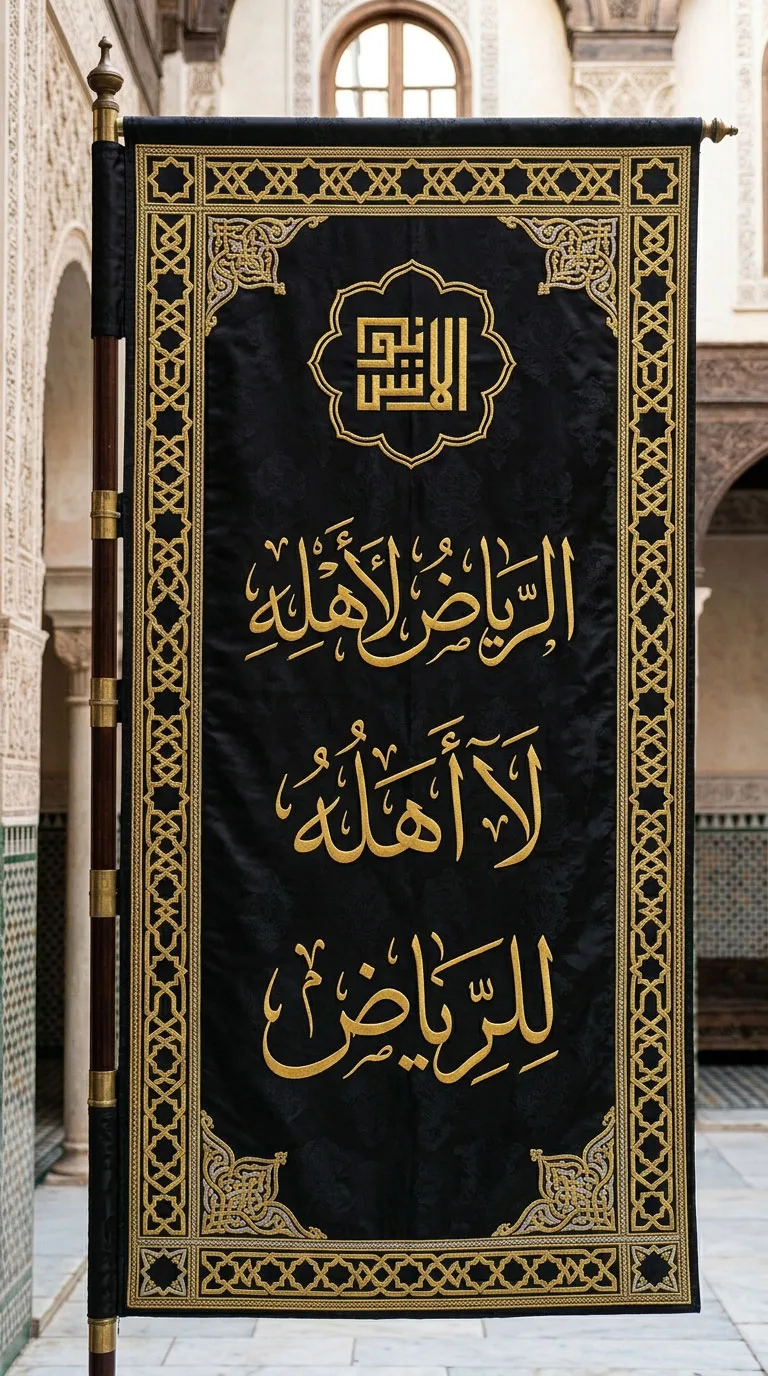
The house has one standard. Black and gold, gold-thread sqalli brocade — the same cloth as the mantle of investiture, and the only two objects in the house that use it.
Nothing is written on it that ranks men: no titles, no grades, no list. A shamsa carrying the name of the house, the motto at the centre in Maghrebi Kufic, and all around a border of interlace without a single letter.
الرِّياضُ لِأَهْلِهِ، لَا أَهْلُهُ لِلرِّياضِ
ar-riyāḍu li-ahlihi, lā ahluhu li-r-riyāḍ
The guilds have their banners, but of plain cloth, in the colour of their workshop, carrying the sign of the craft alone and not one thread of gold: a guild is not the house. See the signs of the workshops.
Who carries it
Not the highest in rank. For one year the standard goes to the last man whose work was received into the walls — the man who writes the last line of the register. The following year another work is received, and he hands it on.
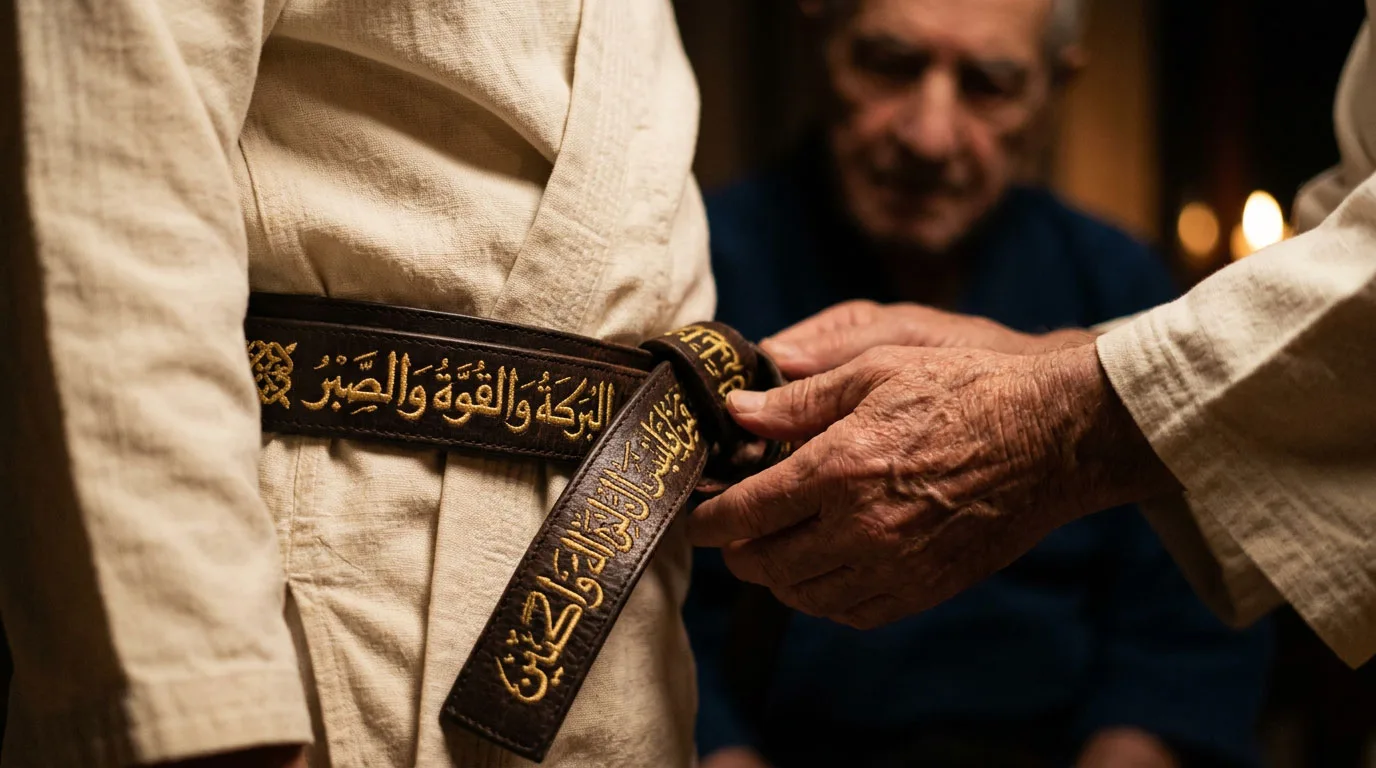
He carries it in his everyday dress: the cap of his workshop, the belt of his grade, his jacket. Nothing is added to the man — it is he who carries the thing, and not the thing that distinguishes him. A maalem may therefore walk behind a ṣāniʿ and no one finds anything to say about it, because it is the work that goes in front, and not the man.
One piece only is added, and it is equipment, not ornament: the leather socket in which the foot of the staff rests, carried on a shoulder strap. A standard of that weight cannot be held at arm’s length for long. It comes from the saddlery, in natural undyed leather, without decoration, and is passed on with the standard.
The standard is never carried with the khirqa: one thing of gold at a time. The mantle of investiture belongs to a man, the standard belongs to the house, and they are not worn together. On the day the bearer is himself invested, the previous one carries it still.
The handing over takes place before the wall. Not in a hall and not at table: the standard is passed on the day the new work is received, in front of the wall where it has just been set, from the hand of the man who carried it to that of the man who has just set his own work in place — the same munāwala as for the objects of the charges. The man who gives it up steps back and returns to the line. No speeches.
It is the one charge in the house that is not given, not elected and not asked for. It falls to whoever has just set his own work in place.
ONE CLEAR LIMIT
What does not leave the house
The workshops also produce for the outside: objects, cloth, essences, commissioned work. That production is necessary — it keeps the house alive and tests the craft against the demands of a real client.
The work of reception never enters that circuit. It has no price because it can have no buyer. It is the one thing the Riad makes and cannot part with.
THE DEBT
No one leaves free of the debt
He who has received a craft owes one. At the end of the residency, the man undertakes to teach in his turn what he has learned — to at least one other, in the years that follow, wherever he goes.
That undertaking is entered in the register alongside the work, and the register also records the day it is discharged. Dar al-Hiraf does not produce graduates, but debtors of a chain.
This is the most concrete meaning of the futuwwa: what has been received freely is never one’s own alone.
TODAY
The waiting wall
In the house to come, one wall will be left bare and declared as such: reserved for the first work received. It will not be painted, nor decorated, nor filled in the meantime.
It is a small thing, and it is the essential one: the house will begin with an emptiness that already has a recipient.
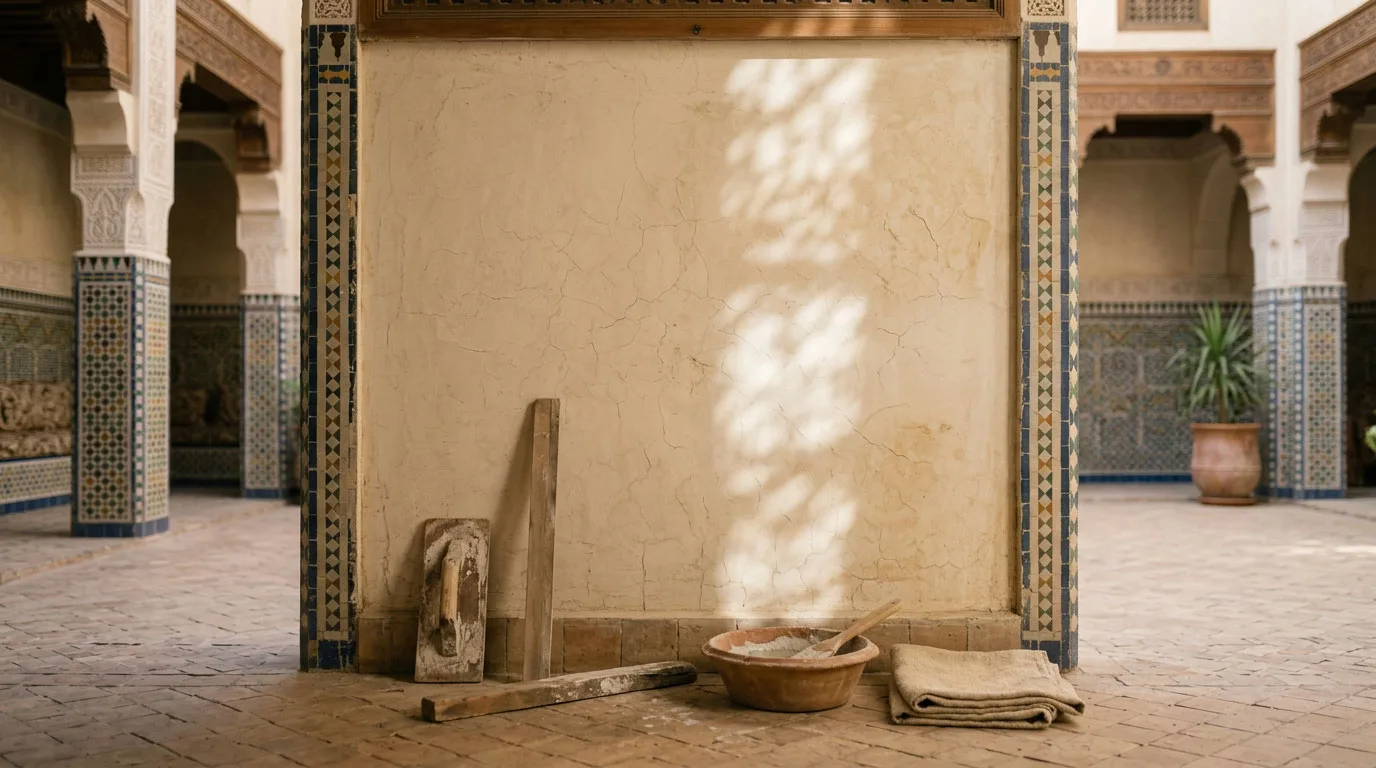
مكان محفوظ
Reserved
This place awaits the work of the first companion received at Dar al-Hiraf.
A note on the word
Athar (أثر) is an attested Arabic word: the trace, the vestige, what remains after a passage — and, in religious vocabulary, the report transmitted from one generation to the next. Both senses are deliberately kept here. Its use as the name of a house rule belongs to this project and refers to no historical institution of that name.
AFTER THE WORK
What remains when one leaves
The work stays in the walls. The man takes a malaka with him — the craft practised, the word, the household to lead. One does not take the Riad away.
The words of this page are in the common glossary; the works cited in the sources; the sister house is Al-Funduq aṣ-Ṣiqillī.