
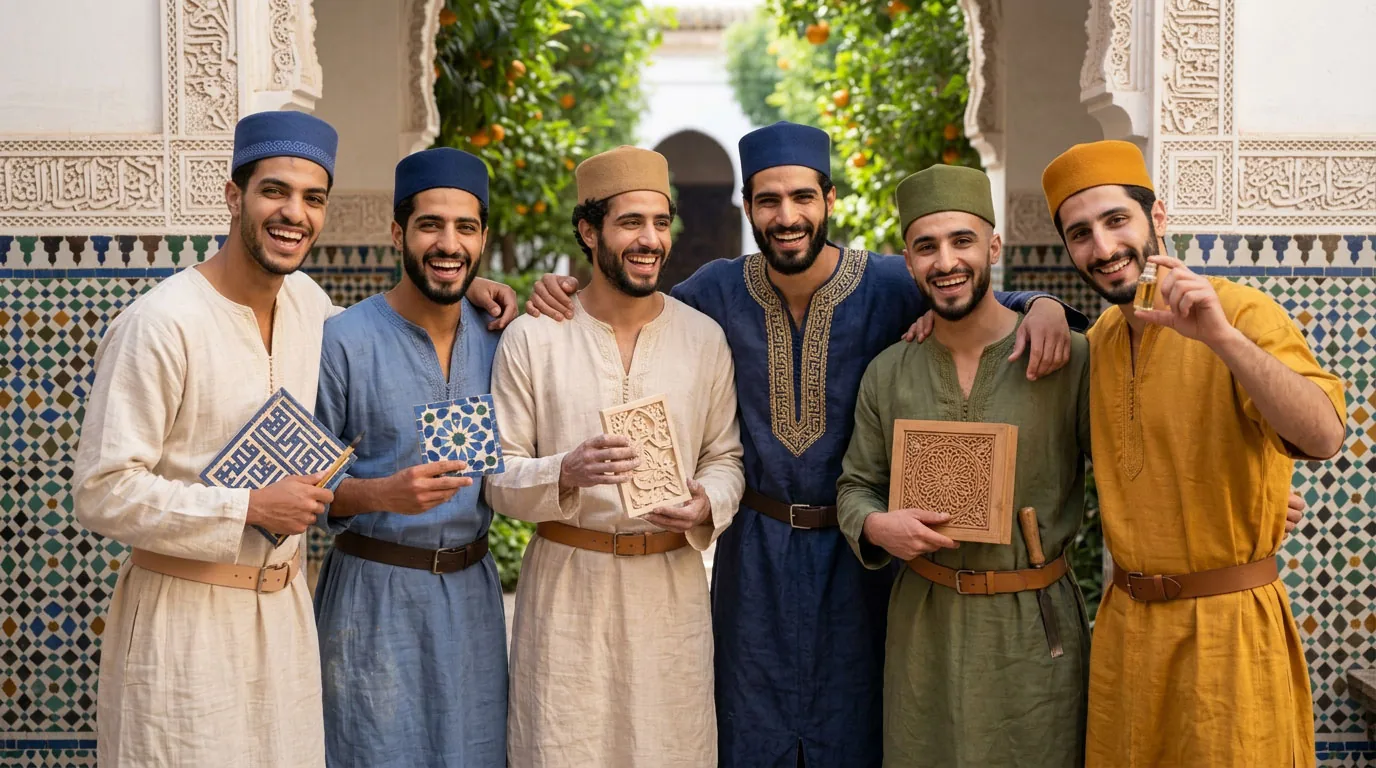
Masters and staff wanted
These positions are for salaried masters and professionals rather than residents: they come to transmit their art or to make the house run, without entering the circle of the residence. For the master craftsmen (maalem), the mission goes beyond technical teaching: to transmit a gesture is to transmit a way of being within the craft — the same demand carried by the futuwwa.
Each master has his own equipped workshop, with motivated ṣāniʿ ready to receive what he has to transmit. When a workshop of the medina closes for want of a successor, Riad Al-Uns can offer its tools — and its knowledge — a second life.
CRAFTS OF THE HAND
Master artisans wanted
Priority given to transmission — one maalem per discipline, committed for the long term.
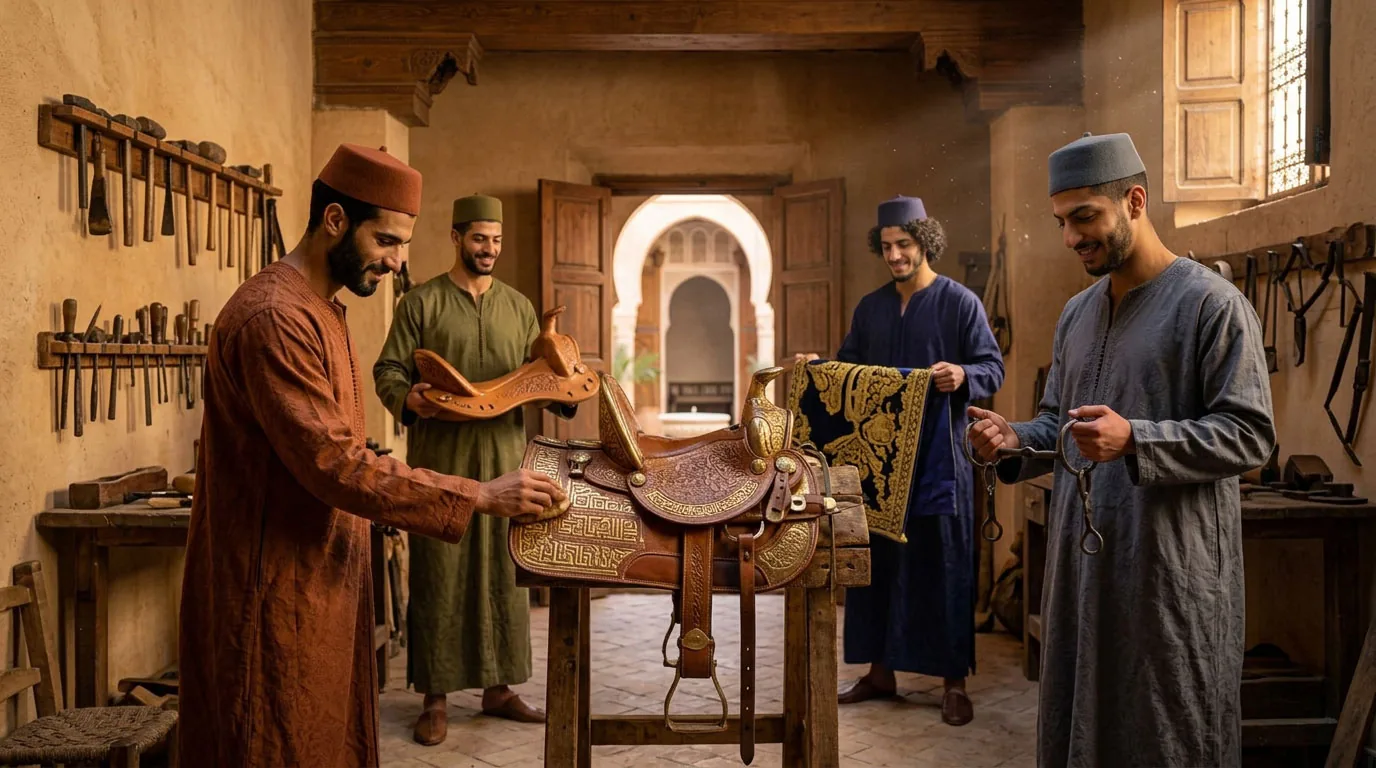
Master saddler (sarrāj) — saddle, harness, leatherwork. Founding nucleus
Master coppersmith-blacksmith (ṣaffār) — copper, brass, wrought iron. Founding nucleus
Master joiner-cabinetmaker (najjār) — cedar, ceilings, turned wood. Founding nucleus
Master bookbinder (mujallid) — binding, restoration, leather gilding, and the calligrapher’s khaṭṭ maghribī.
Master weaver (nassāj) — silk, gold thread, tirāz, embroidery and passementerie.
Master potter and zallāj (fakhkhār) — earth and kiln, cutting and laying of zellige in the Marinid tradition.
Master plasterer (jabbāṣ) — carved plaster (gebs) on fresh wall, muqarnas.
Master perfumer (ʿaṭṭār) — distillation, essences, soaps; and the orchard’s preserves laboratory.
→ The crafts of the hand
BODY, WORD AND SOUND
Masters of discipline wanted
Master of Andalusian music (al-âla) — oud, ney, chant, nouba repertoire.
Master of taḥṭīb — the Egyptian art of the staff.
Shaykh al-malḥūn — the sung word of the guilds.
Maâlem gnawa — guembri, qraqeb, transmission of the brotherhoods.
Master of Muṣāraʿa — traditional wrestling.
Master of archery (rimāya).
Master of horsemanship (furūsiyya).
Master of traditional fencing (sayf wa-l-turs).
Master of zūrkhāne (javānmardi) — mīl, sang, kabbāde.
OTHER ROLES
What keeps the house alive
Beyond the masters, a house of residence needs functions essential to daily life. The ordinary tasks — keeping one’s room, washing dishes, serving at table, looking after certain common spaces — fall to the residents themselves; the rest calls for a regular salaried presence. These posts are outside the residence: the rule fits in one sentence — no one who lives here is paid, no one who is paid lives here. See At-Tadbir.
Head of the common kitchen
Consulting agronomist — the orange trees and the orchard, a few visits a year
Outside accountancy firm — bookkeeping and tax, with no role whatever inside the house
Communications and website manager
Maintenance staff (2 or 3 positions) — kitchen, plumbing, electrical work and heavy maintenance; open preferably to young men in difficulty seeking work
Steward (wakīl) — economy of the house and of the rooms
Farnatchi — the man of the hammam fire
Master tailor (khayyat) — cutting and repair of the house’s clothing, with the cloth workshop and at the steward’s request
Non-resident nurse / first-aid attendant — basic care, health monitoring
Driver — errands and deliveries
Some of these roles may be combined or evolve according to the skills of the person recruited.
THREE CHARGES EXERCISED FROM WITHIN
The faqih, the instructor and the bawwab
These three charges are not exercised at fixed hours, but call for living in the house and sharing its rhythm. The faqīh and the instructor receive, like the residents, full provision — board, lodging, clothing and a providence fund — and not a wage, so that the rule may hold: no one who lives here is paid, no one who is paid lives here.
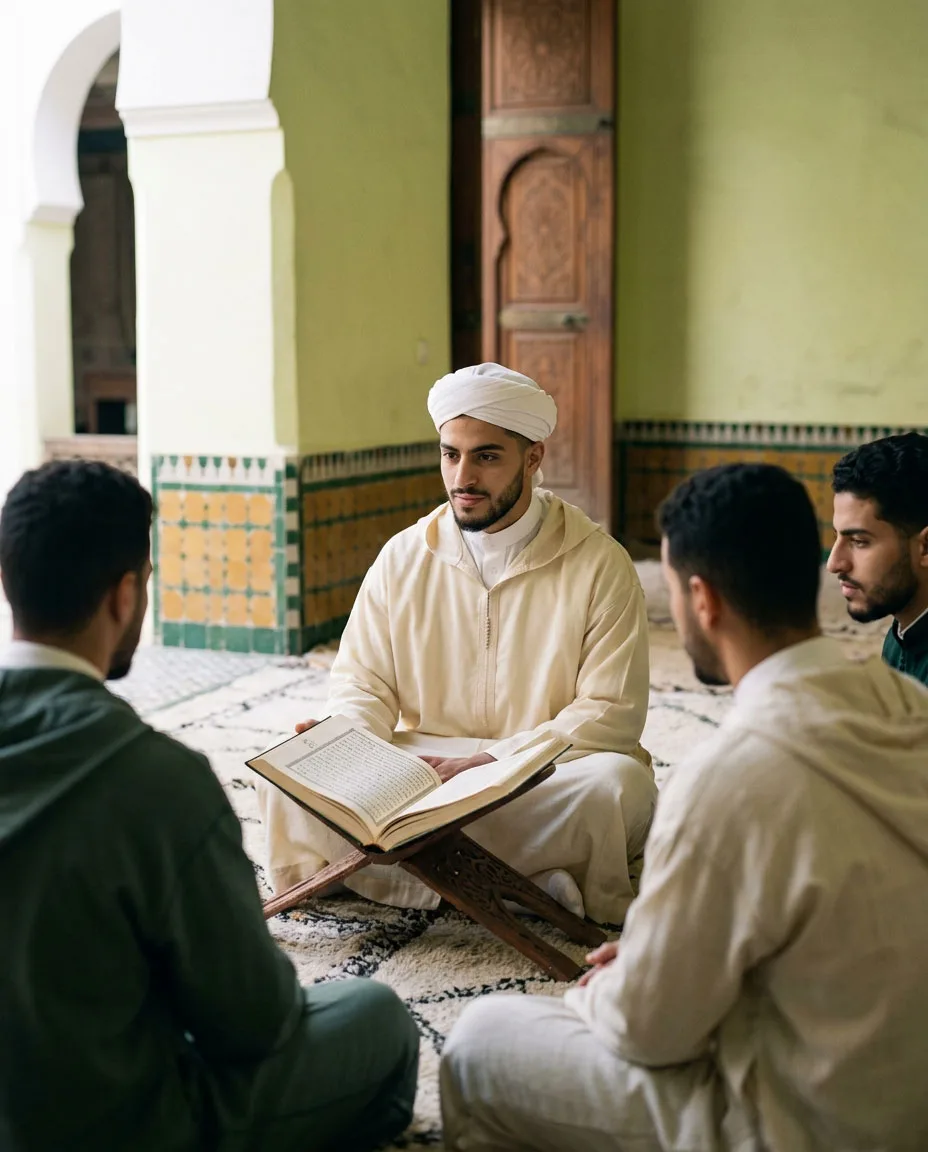
The faqih — the lesson and the hours of prayer
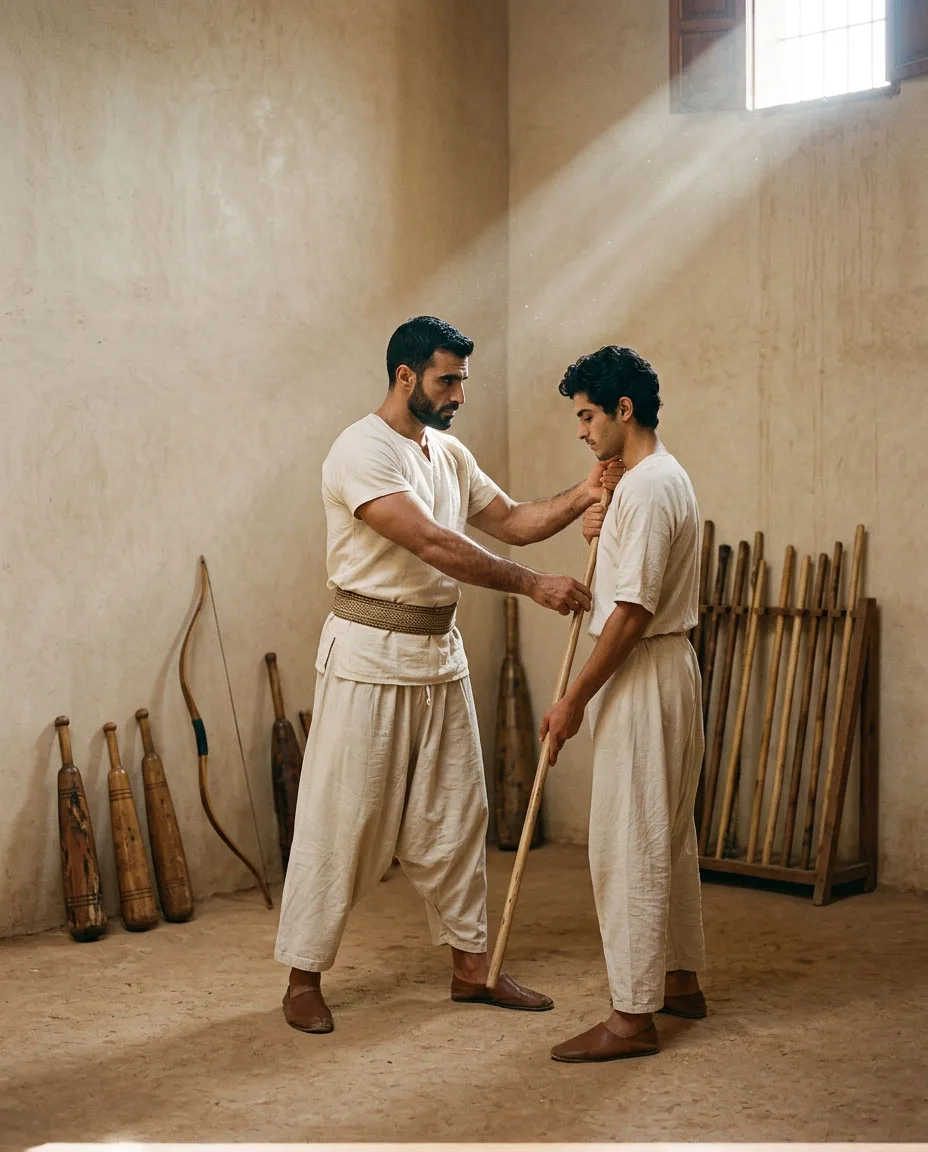
The instructor — a strength that is educated
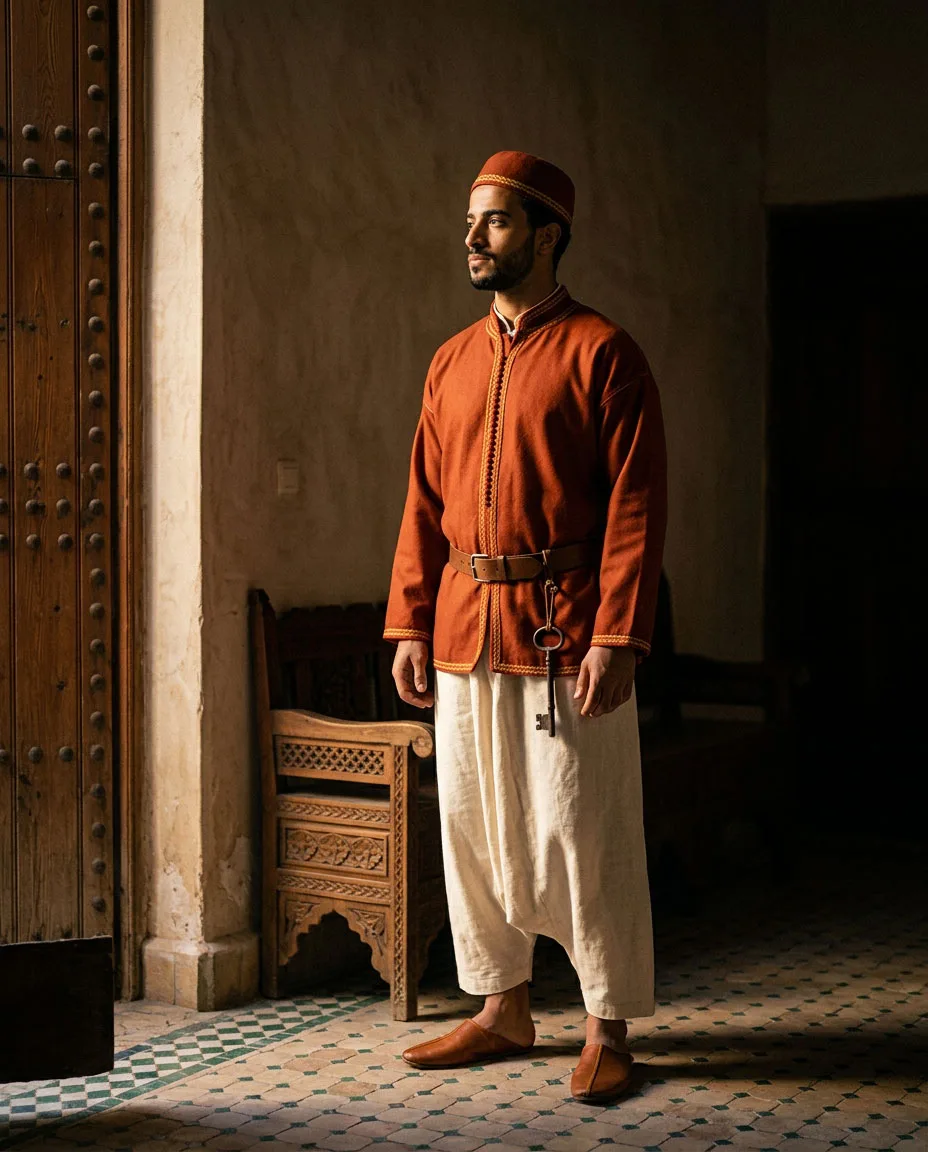
The bawwab — keeping the threshold
Resident faqih
He gives the lessons in doctrine — Qur’an, fiqh, ʿaqīda — and keeps the hours of the five prayers. He lives in the house: what is transmitted passes as much through shared meals and shared silences as through lessons, and a teacher who arrives at the appointed hour forms no one. He sleeps in the dormitory, in a bed like the others, and takes the same turns of service and cleaning as the apprentices; the house reserves for him only a study cell adjoining the khizāna, where he prepares his lessons and receives whoever has a question to put outside the company.
His charge is the timetable and the teaching, not the government of the house: he does not decide admissions, does not arbitrate disputes between residents and holds no power of sanction. His authority comes from what he knows. The house seeks him young — close in age to those he teaches, able to live among them —, trained in Mālikī fiqh and Ashʿarī ʿaqīda, at ease with the Moroccan musical and confraternal tradition, for a renewable mandate of a few years.
He lives the day of the house like the others: he trains with them, rides, uses the common hammam and eats at the common table, since a charge that exempted itself from the disciplines would produce the class of clerics the house does not have. He teaches no discipline of the body, however, the two registers remaining distinct.
Physical training instructor
He leads the daily training of the body and prepares the residents for the disciplines of the house — musāraʿa, archery, zūrkhāne. The word riyāḍa first meant the schooling of a horse before it came to name the exercise of the body: its root is the very one that gives riyāḍ. In it one hears what is expected — a strength that is educated, not displayed.
The point is to make these young men genuinely strong: a back, hands and breath that will last through a day in the workshop and through a whole life. Useful strength, then, and not a figure: the training hall serves the craft and the disciplines, never the mirror. An instructor who demands, who pushes, who picks up the one who gives in — and who knows where the exercise stops.
The charge calls for a physical presence the residents recognise of their own accord: at that age authority passes through the body before it passes through speech, and an instructor no one seeks to match obtains nothing. The tradition has a name for such a man — the pahlavān, the champion of the zūrkhāne, who is held in honour for the uprightness and generosity with which he uses them, and not for his strength nor for his build.
The charge is exercised from within: he trains with them, shares the hall, the hammam and the common spaces, and lives at the rhythm of the house. Like the others, he is close to them in age.
It is exercised for a few years, renewable, like that of the faqīh, since a permanent ascendancy ceases to be a pedagogy. It addresses the whole company and never a single man: the house knows no favourite pupil, and an instructor who needed the young men to stay around him has no place here. Entry is decided on a season lived in the house and never on an interview, at the end of which the table gives its opinion, as for anyone who sits among them.
Bawwab
This charge cannot be applied for: it is exercised by a resident, chosen among those most advanced in the disciplines of the body. Keeping the door is his work and his contribution to the house, as another holds his in the workshop. What he does at the threshold is described in Threshold and rooms.
APPLY
Send your letter
If you are a master of a craft or of a discipline, or if one of the other roles interests you, write to us.
The information sent through this form is handled according to our privacy policy.
The words of this page are in the common glossary; the works cited in the sources; the sister house is Al-Funduq aṣ-Ṣiqillī.