Hammam
Ṭahāra — purification. Before it is a place of rest, the hammam is, in the Muslim house, an annex of prayer: one washes there in order to present oneself pure. At the Riad it has its place beside the workshop and the prayer room, with the same sobriety.
THE FIRE
The farnatchi
A hammam is first of all a furnace, with rooms arranged around it. That furnace — bayt an-nār, the farnatchi — is not inside the bath. It backs onto the wall of the innermost room, from outside, and opens onto the alley. The word names at once the place and the man who keeps the fire there, day and night.
This fire works twice over. It heats the water first — in the copper vessel set over the hearth, and in the masonry basin built against it, the borma, the one from which water is drawn — and then the flue gases, with what heat remains in them, run into the chebka: the network of ducts hollowed out beneath the paving of the innermost and the middle rooms, before reaching the flue. The heat radiates from no visible source; it rises from the floor, slowly, and the floor gives it back long after the fire has died down.
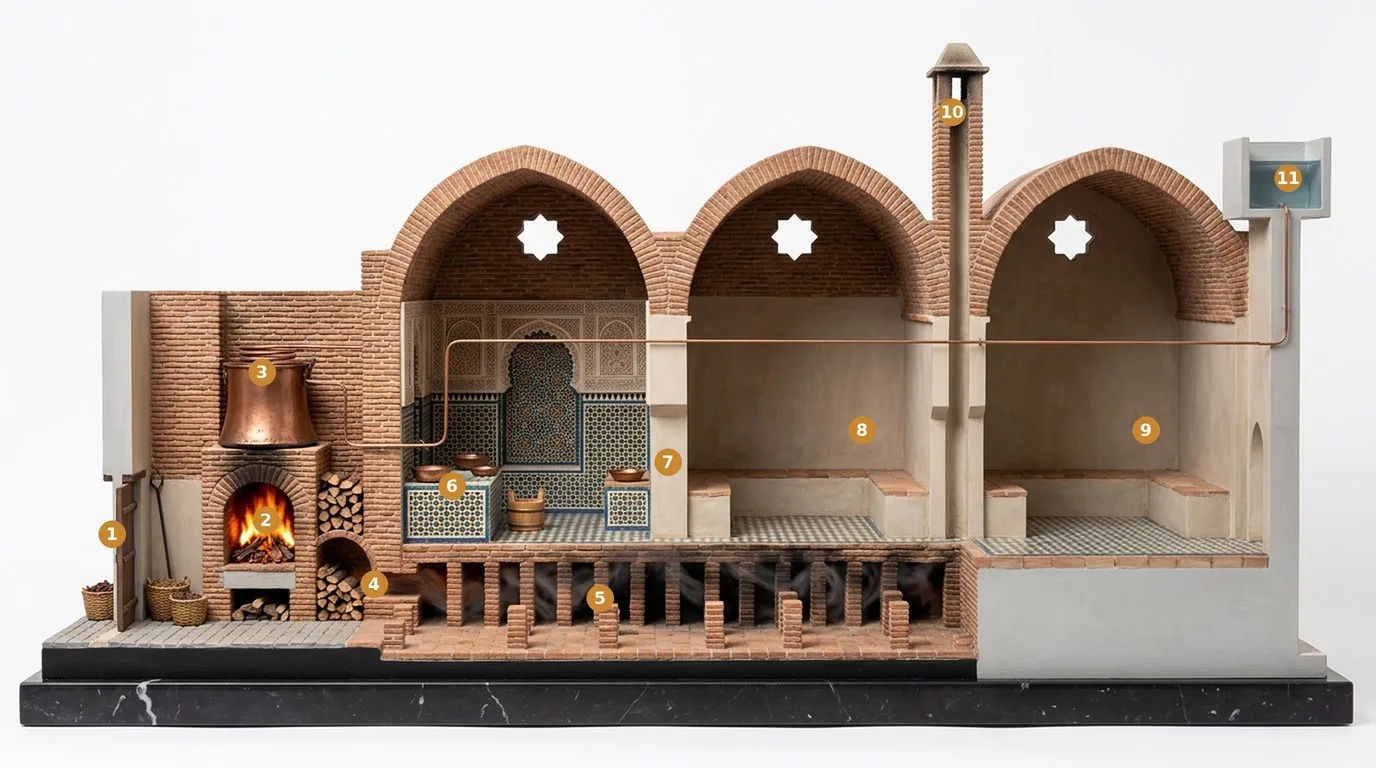
1The alley and the service door — the fuel comes in this way, the ash goes out this way.
2The farnatchi — the furnace, outside the bath, and the wood.
3The copper vessel set over the hearth: this is where the water is heated.
4The mouth — the arched opening, level with the ground, through which the flame passes beneath the paving.
5The chebka — the brick piers; the ducts are the voids between them.
6The borma — the basin against the furnace wall, the one from which water is drawn, and the copper bowls.
7Ad-dākhilī — the innermost room, the hottest because the nearest to the fire, and the most ornamented.
8Al-wasṭī — the middle room.
9Al-barrānī — the first room; its floor is no longer heated.
10The chimney, at the end of the course.
11The cold-water tank.
Model after a medina hammam. An illustration, not a plan: the house does not yet exist.
What the house will burn there
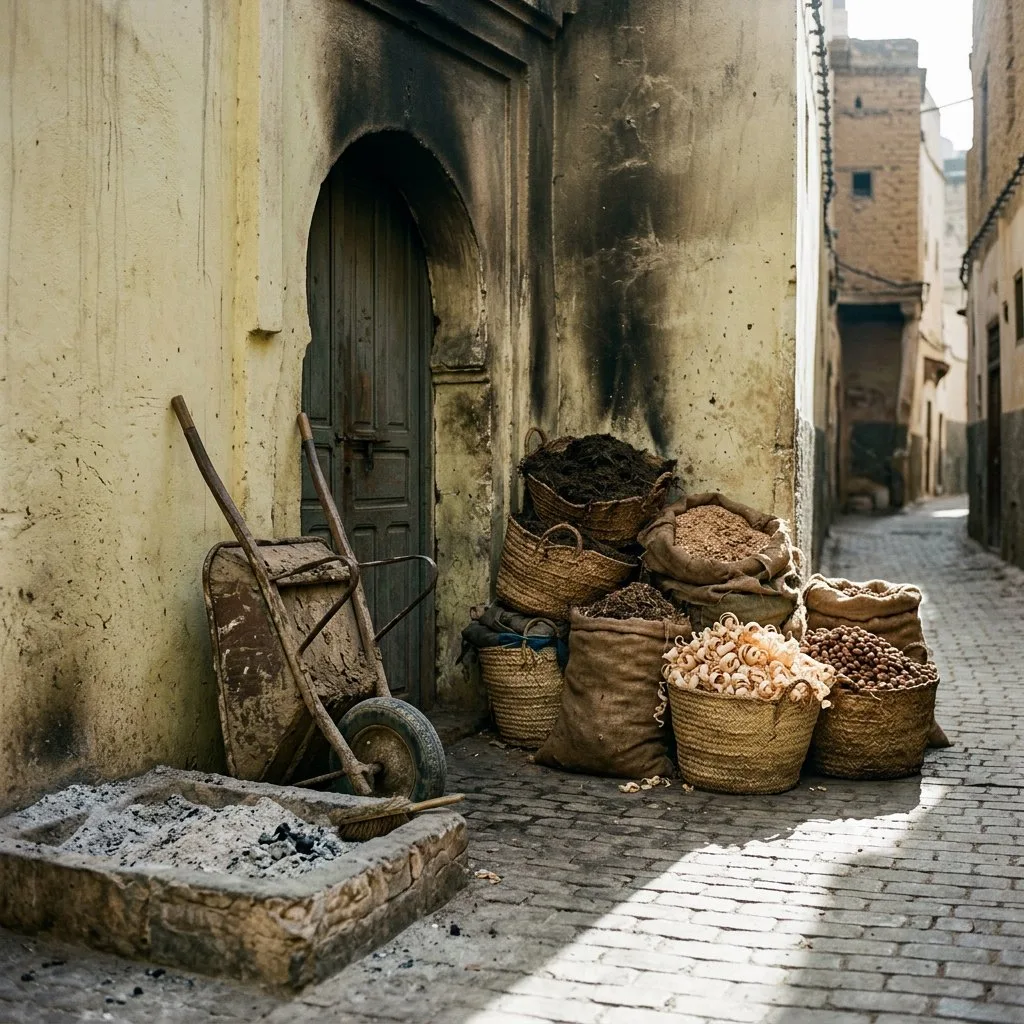
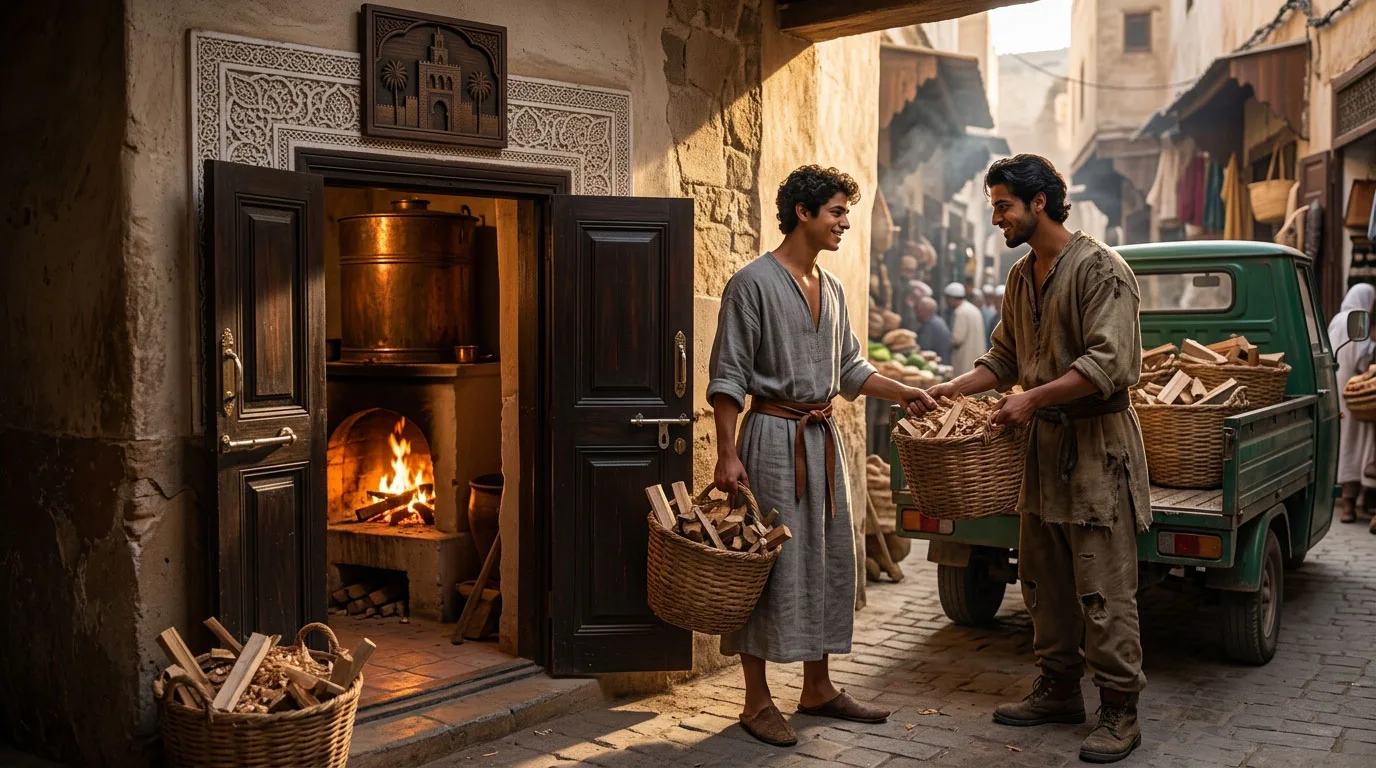
A medina hammam consumes wood, and it consumes a great deal of it: hammams are among the foremost consumers of wood in the country. That is the most serious question such a building raises today, and our decision is settled: the furnace will not be fed with purchased wood, but with the offcuts of the workshops.
The joiners of the medina discard sawdust, shavings, cedar cuttings and ends of beam every day; our own workshops — wood, saddlery, forge — will produce their share in turn. To these are added the pomace and olive stones left by the presses. The hammam thus takes the last place in a chain: it finishes what the other trades have left behind, and gives back in exchange the hot water of the house.
The arrangement is not merely a matter of economy. It binds the house to the workshops of the medina by a reciprocal service: the joiner is relieved of a nuisance, the hammam receives its fuel. It is a dependence we seek, not one we submit to.
The heat that remains
TECHNICAL FEASIBILITY STUDY
On leaving the chebka, the gases still keep a share of their heat. We are studying the possibility of leading them, before the flue, into the thickness of the wall that carries the upper gallery, where the men sleep: the same furnace would then warm the dormitories. The principle is nothing new — it is that of the hammam itself, a mass of masonry slowly charged and long in giving back.
The matter is not settled. It presupposes sufficient draught, a calculated duct section, and the certainty that no smoke reaches the place where men sleep; it therefore calls for the judgement of a man of the art before any other decision. We mention it here because it would commit part of the plan, and a choice of that kind is made at the beginning or is not made at all.
This machinery settles the plan before anything else. The fuel comes in from the alley and never crosses the house; the ash goes out by the same door; the chimney requires its height and its draught; the innermost room must back onto the furnace, and the chebka demands beneath it a void that cannot be moved once the floor is laid. Where the chimney passes, where the fuel comes in, where the ash goes out, who keeps the fire, and with what: these are the five questions a hammam puts to the man who builds it, and they are put before the zellige.
A course, not a single room
The traditional hammam is a sequence of rooms of rising, then falling, temperature, and never one room. In Fez these rooms are named after their position and not after their heat.
These are the names the bathers of Fez use, and they are the ones the house uses. The sequence of the three rooms — barrani, wasti, dakhli — reads from outside inwards rather than from cold to hot: temperature is spoken of as distance, and the hottest room is simply the innermost, the one that touches the furnace.
The descent from the Roman baths is real and is not hidden, since the heating method comes from the praefurnium and the hypocaustum, and the baths of al-Andalus and then of the Maghreb kept it unaltered. But the inheritance is read in the construction, not in the names: on the spot, no one has ever called a room a frigidarium.
The bath never left the Arab city
The hammam was not born in the Islamic world, which only inherited it. Its roots lie in the Roman and Byzantine baths, which the nascent Muslim world adopted and transformed from the eighth century onward. But it at once took on a necessity it had not had before: the law requires the believer to perform the major ablution, and a city that wants men to pray must first make it possible for them to wash. The bath then ceased to be an amenity and became a public service, on the same footing as the fountain.
From Baghdad to Cordoba it accompanies the mosque everywhere. The geographers count their number as one counts the wealth of a city; the physicians debate their effects; the jurists regulate their use. It has crossed the centuries and the dynasties without changing its principle, and it is still, in the medina of Fez today, a place one goes to every week.
Its social place is as firm as its religious one. One goes before Friday, before a wedding, after a birth; one takes the children; one learns there, without its being taught, restraint before the body of another. In the old city there is no other place where a man remains so long doing nothing useful.
مُتَفَرِّجُ الأَبْوابِ عَن صَحْنٍ ثَوى فيهِ الصَّباحُ وَشَرَّدَ الأَظلامُ
“Its doors open wide upon a court where the morning has settled and from which the shadows have been put to flight.”
— Ibn Darrāj al-Qasṭallī, Andalusi poet (10th–11th c.), Waṣf al-ḥammām
A place the law surrounds
The public bath does not enter Muslim life unquestioned, but it enters it hedged about. The jurists set its conditions very early — the ʿawra covered, the sexes strictly separated, the custody of the gaze — and al-Ghazālī devotes to the ādāb al-ḥammām, the proprieties of the bath, a passage of his Iḥyāʾ ʿulūm al-dīn. In al-Andalus, the ḥisba treatise of Ibn ʿAbdūn, written at Seville in the twelfth century, goes so far as to rule who may work there, and under what conditions of decency.
The hammam is thus one of the few places in the city whose use has been written down from the beginning. It is that tradition, and not a house rulebook of today, that the house applies.
What Morocco, and Fez, made of it
A quarter of Fez is traditionally defined by five institutions: the mosque, the fountain, the bread oven, the hammam and the Qurʾanic school. A derb that has them all is sufficient to itself; one need not leave it to live out a week. The hammam is therefore not an added amenity, since it is part of what defines a quarter, and its absence would be noticed as the absence of the oven would be.
It shares the oven’s logic besides. The bread oven and the bath are the two permanent fires of the medina, often neighbours, fed by the same discards; one bakes, the other heats, and both live on what the city sets aside.
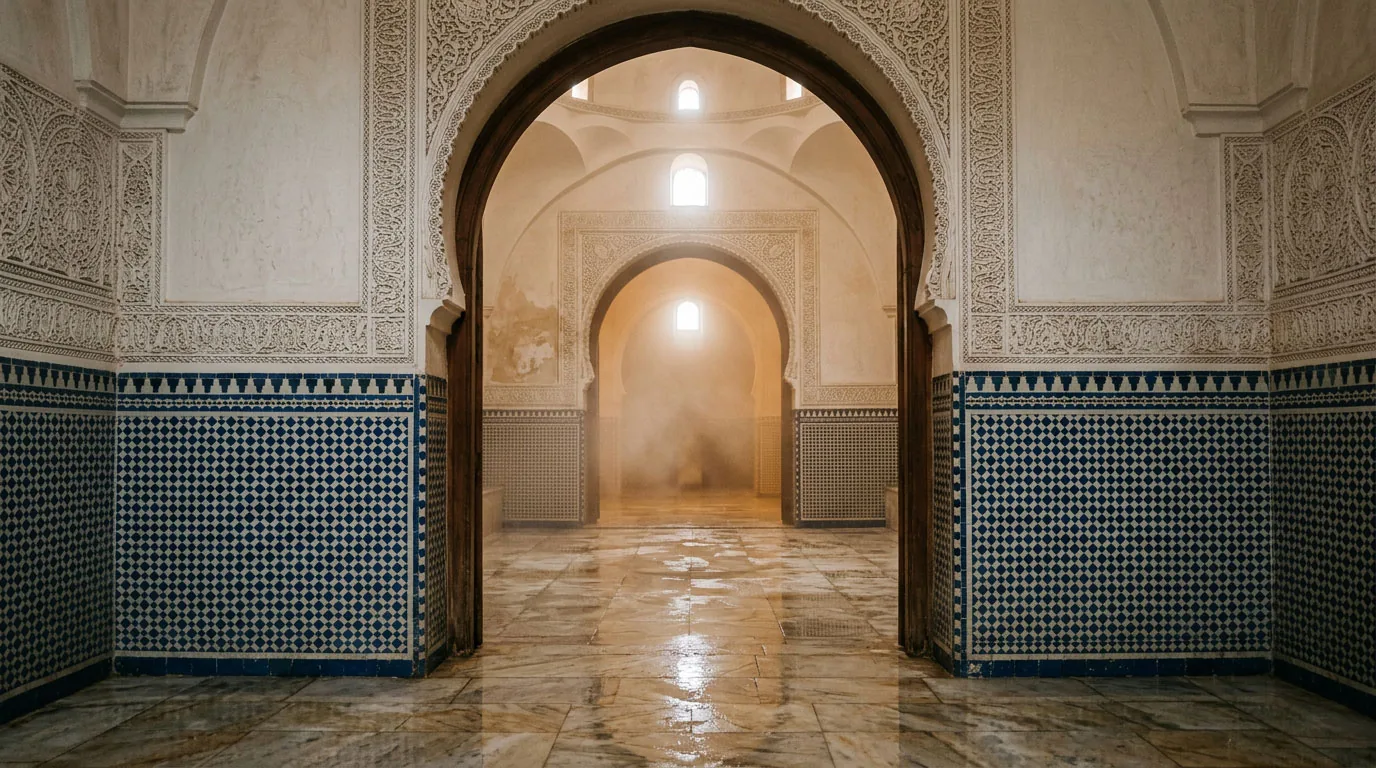
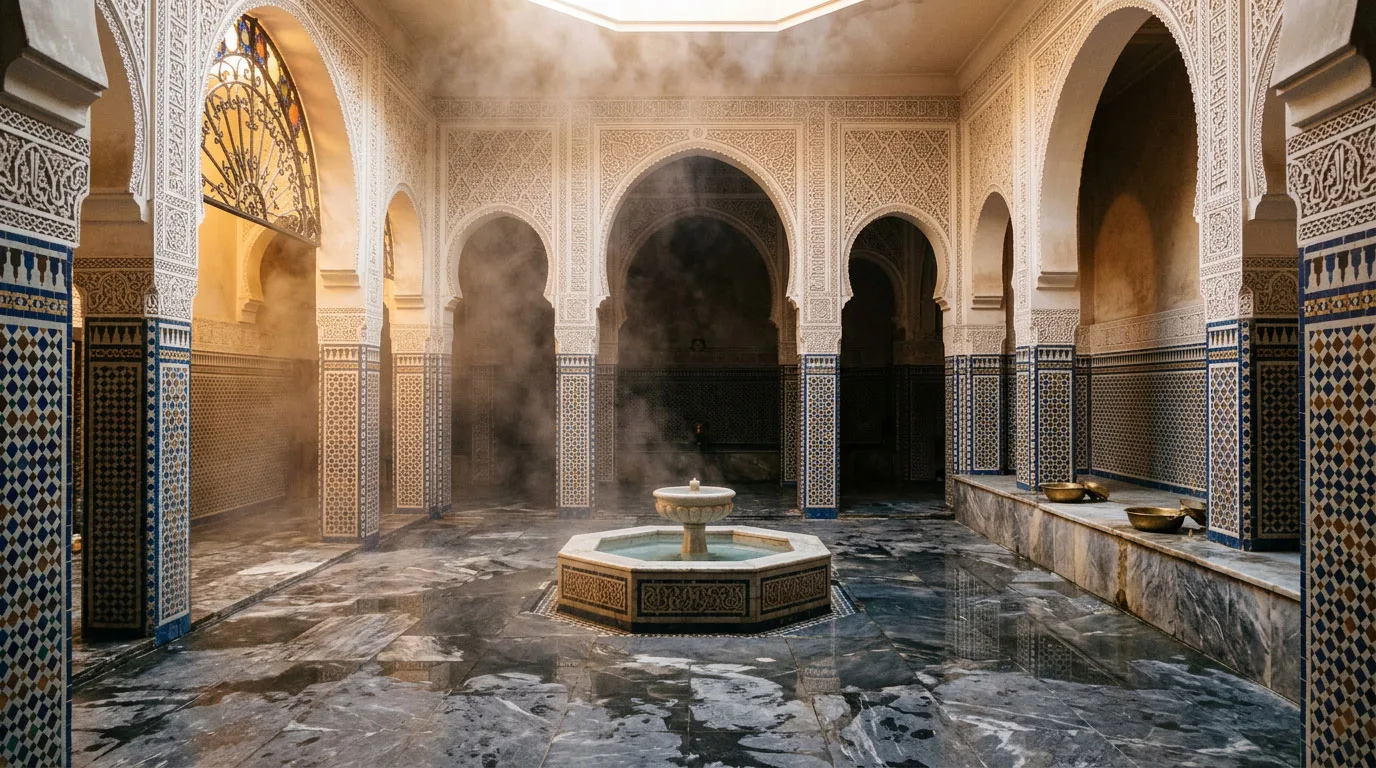
Water settles the rest. Fez distributes the water of its oued through a network of covered channels serving the fountains, the mosques and the baths: the site of a hammam is determined as much by the water supply as by the alley of the fuel. Many of these baths belong to the ḥubus of a mosque, which withdraws them from trade and keeps them through time — such is the case of the Hammam al-Mokhfiya, dated to the middle of the fourteenth century, under the reign of the Marinid sultan Abū ʿInān, ornamented with carved stucco and zellige, and attached to the ḥubus of the Qarawiyyīn mosque, a few steps from what will one day be the Riad.
There remains what distinguishes the Moroccan bath from its Ottoman cousin, and it lies in two absences. There is no pool in which to immerse oneself, and there is no heated stone at the centre of the hot room. One washes seated, in contact with the marble or zellige floor, drawing water with a bowl from the common basin. The body is not plunged; it is washed.
Why the Riad has one
Because the five prayers order the day, and purification precedes them. A house that prays five times must first make washing possible, and the hammam is the answer this city has given to that obligation for a thousand years.
Because men work here with their hands. Plaster, leather, forge and clay leave on the body what a shower does not take away; slow heat and the glove answer better. In a house of trades, the bath is the ordinary end of a day in the workshop, and not an added comfort.
Because a bearing is learned there. It is the one place in the house where the rule concerning the body — the ʿawra covered, the gaze withheld — stops being an article of the regulations and becomes a habit. It is not taught; it is acquired by seeing others keep it.
And because it binds the house to the medina. The fuel comes from the workshops of the quarter; the fire requires a man to keep it — and two men are not too many.
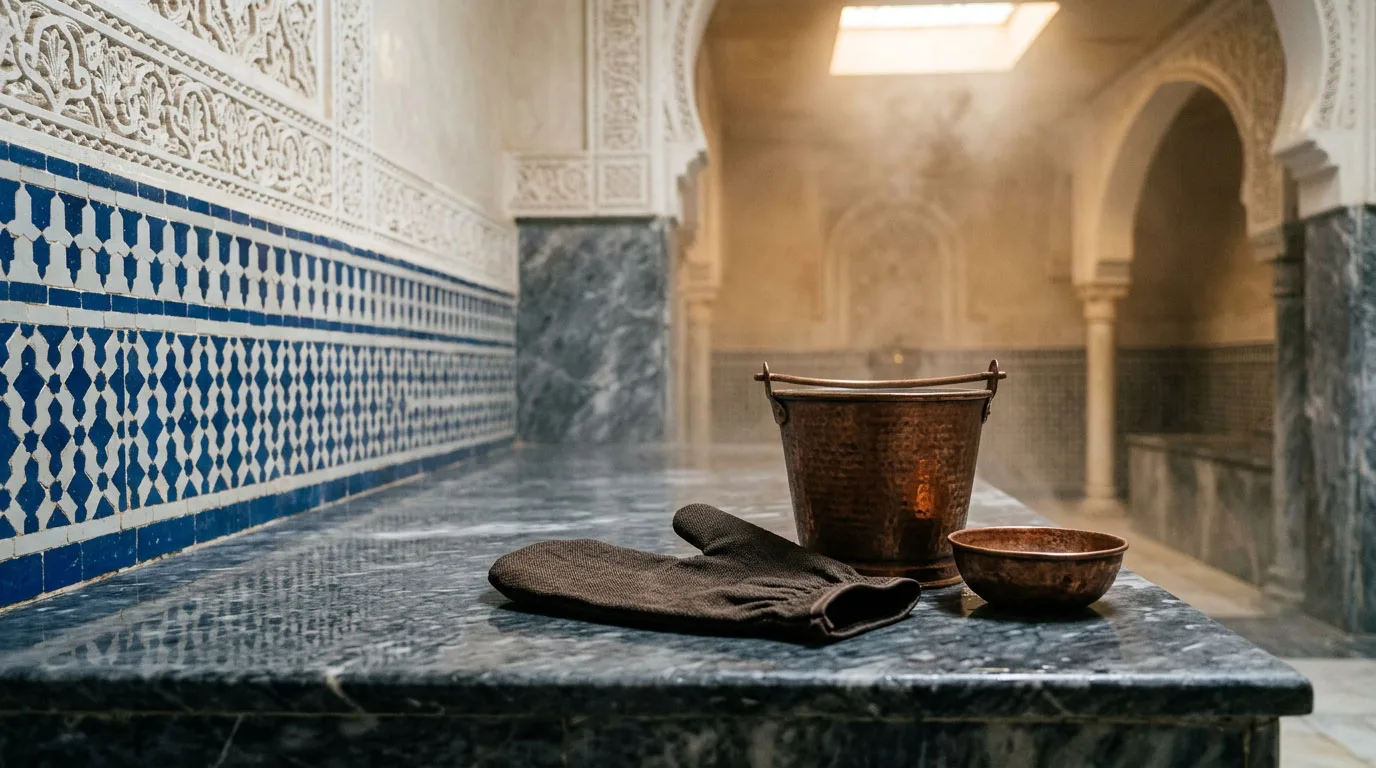
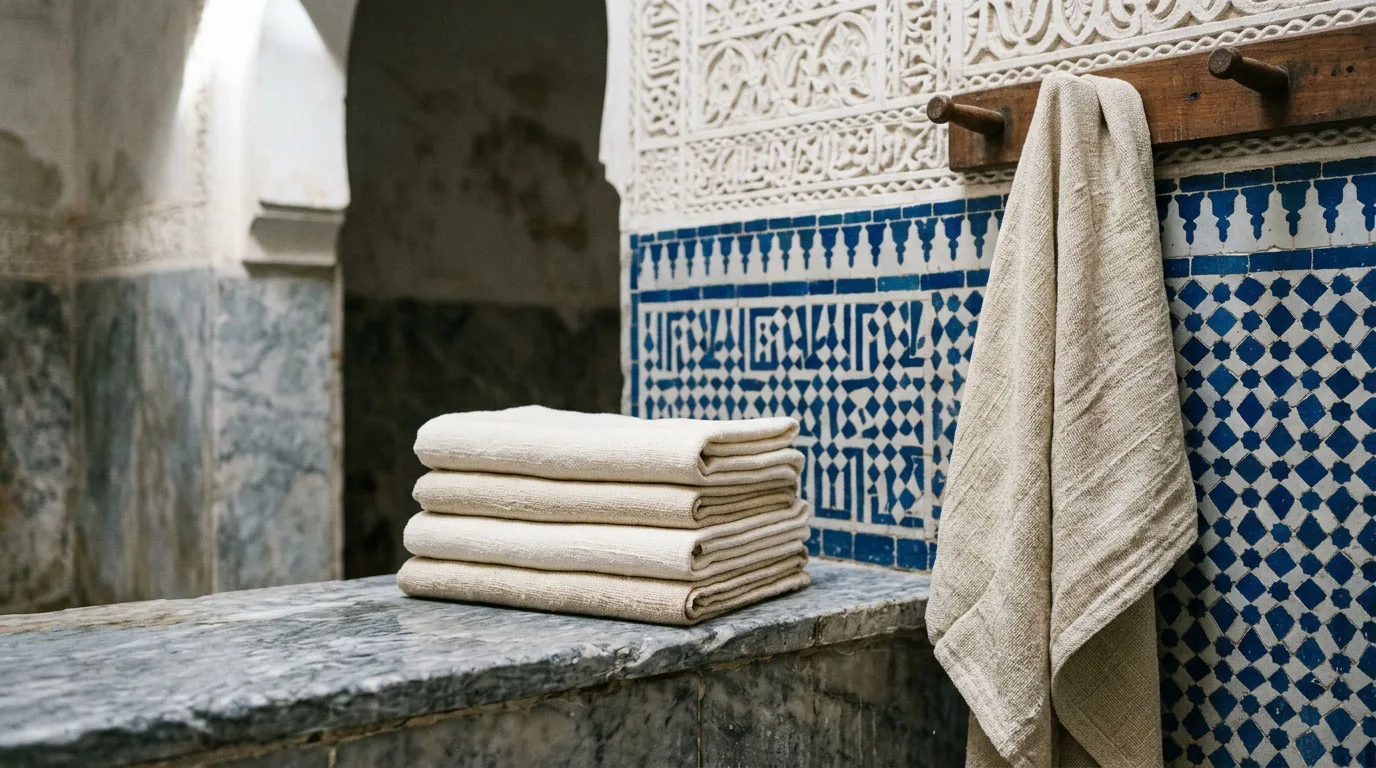
The first is of the house. He is called al-qayyim al-ḥammām — قيّم الحمّام — and his charge is one of the six that keep the Riad running: he answers for the hot water, the heat, the linen and the hours of the bath. Like every charge it is worn — its colour is ash, its object the copper bucket — and, like every charge, it is not paid, a resident not being an employee. In the bath he wears the fūṭa only, like everyone.
THE BATH
Two gestures, and nothing more
Black soap — sabun beldi. A dark olive-oil paste, spread on warm damp skin and left to rest. It does not lather and does not, properly speaking, clean, but softens in depth what the glove will afterwards take away.
The kessa glove. Woven, deliberately rough, it removes with firm measured strokes what the soap has loosened. It is a gesture of patience and not one of violence against the skin, the same as the potter’s or the tanner’s, applied to the body rather than to matter.
Then water, and nothing else. No oils, no scented vapours, no treatments: these two gestures do not aim at pleasure, they aim at ritual cleanliness. The body recovers the ritual purity required for prayer, and that is the whole of the matter.
SERVICE
The tayeb
The man who, in the Maghrebi hammam, helps with the washing by the glove is called the tayeb. It is a knowledge handed on inside the bath itself, by repetition, and not a spa trade learned in a school.
In this house there is no tayeb — there are companions. One scrubs the back of the man who has scrubbed one’s own; one loosens the shoulders of a man who has spent the day bent over his bench. The gesture is learned once, and it is passed on to the next. If a few become more adept at it than the others, the house does not make a function of it for all that, and is content to benefit.
No one is paid for this and no one exercises a charge for it. It happens that the service is rendered to a guest, but rarely, and only to one the house has chosen. A hand one pays is a hand one uses; a hand one does not pay is a hand one thanks. That is the whole distance between a bath-house and a house where men live together.
Of the whole house, the hammam is the work that must function before it is beautiful. We shall know it has succeeded on the day no one speaks of it any more: when the fire is kept without anyone thinking about it, the hot water in its place, and the floor still warm at the hour the men come back from the workshop.
The words of this page are in the common glossary; the works cited in the sources; the sister house is Al-Funduq aṣ-Ṣiqillī.