Al-Warsha
الورشة
The school always has a real piece of work in hand, and it is on that work that it teaches.
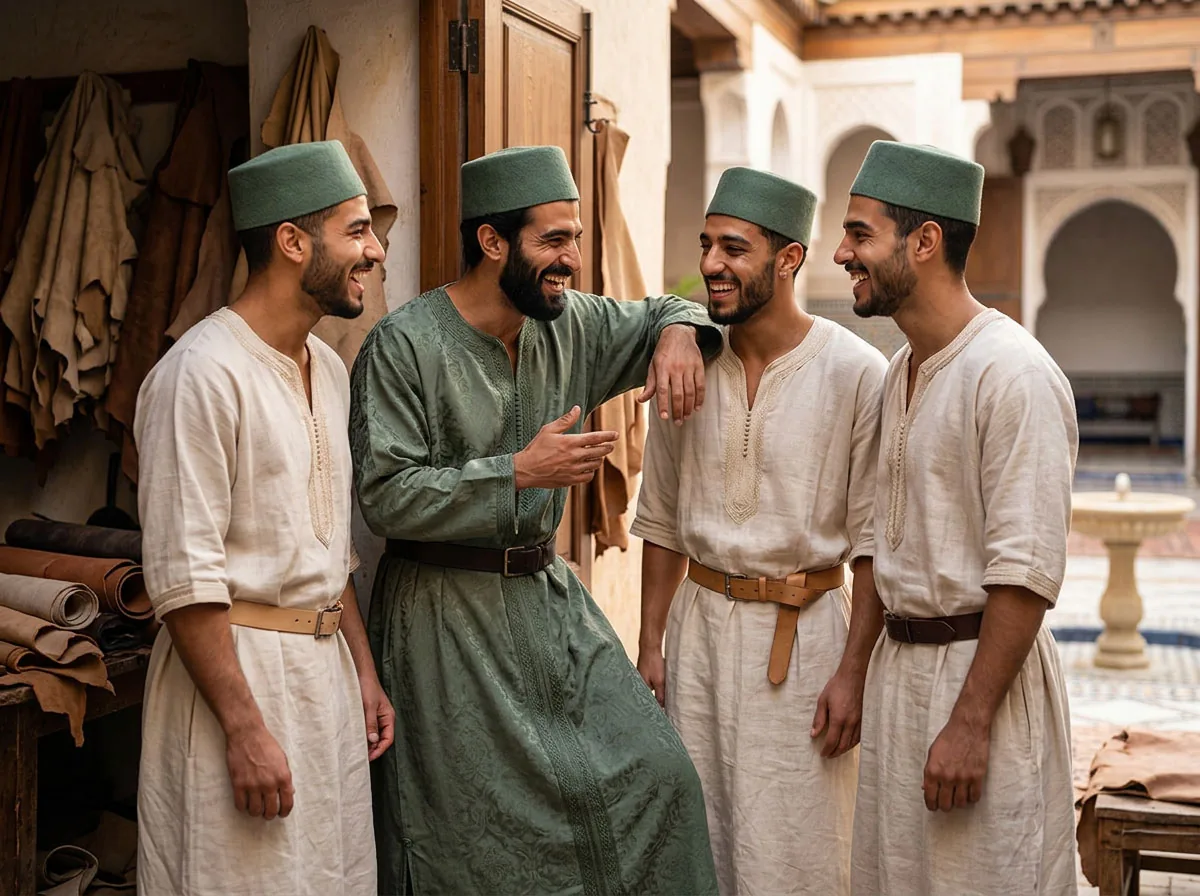
Moroccan Arabic has a single word, warsha, for the workshop where things are shaped and the building site where things are built, as if the language had kept together what the modern organisation of labour ended up separating: for a craftsman, the two places are one.
Dar al-Hiraf was therefore not conceived on the model of the school, where lessons would come before exercises, but on that of the house that always has a real piece of work in hand, and trains its ṣāniʿ by carrying it out.
From exercise to work
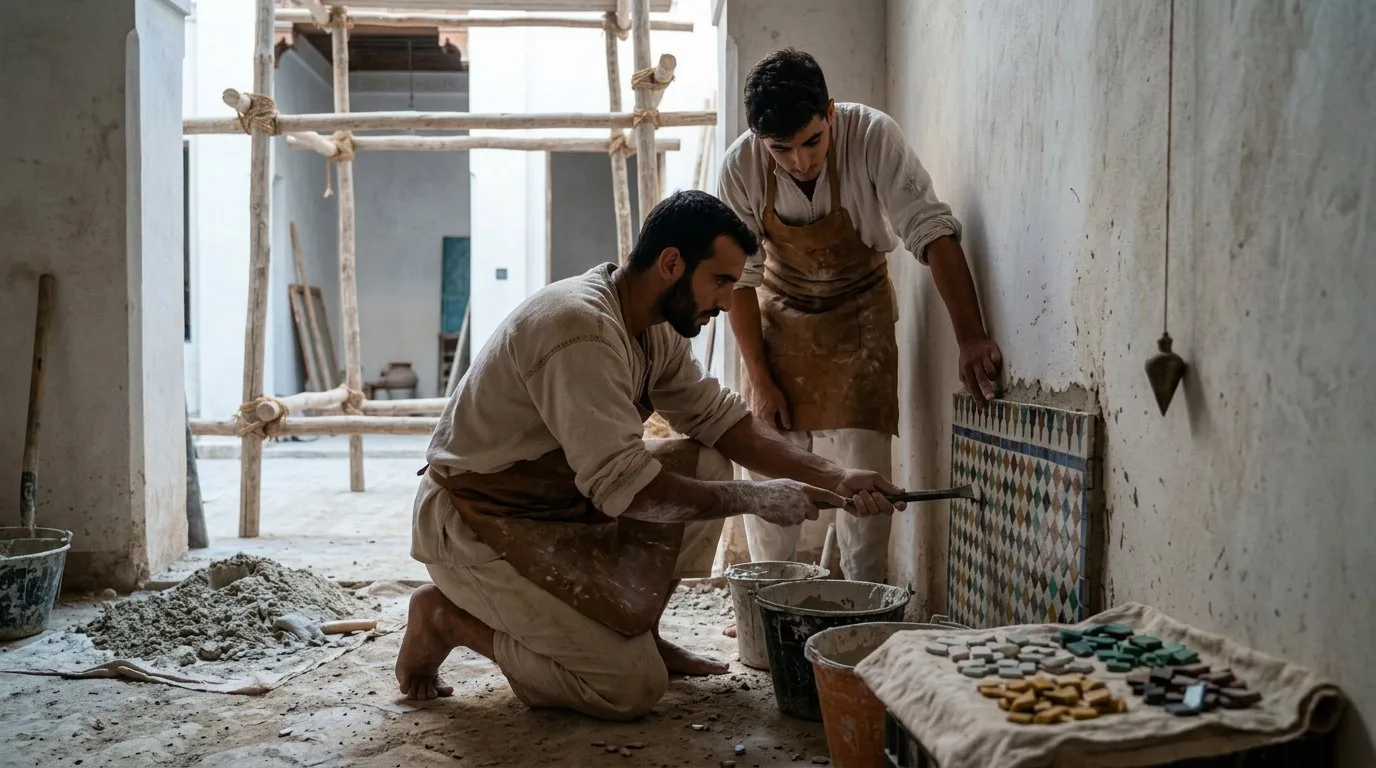
A technique can be learned on a test piece; a craft cannot be learned that way. The latter presupposes a piece of work with a client, a deadline and a measure to respect, whose faults are redone at the expense of whoever made them — conditions that the school exercise, by its very nature, never brings together.
This is where the workshop differs from the school, and it is why the house works on buildings meant to be lived in, and not on models meant to be graded.
The house and its masters
The fondouk that shelters the house is restored by established masters, under a site director and according to the procedures a listed building requires; the ṣāniʿ take no part in it. Care for the heritage would be reason enough, but a simpler one is added: the ṣāniʿ are also the residents, and as long as the house is a building site there is nowhere to lodge them.
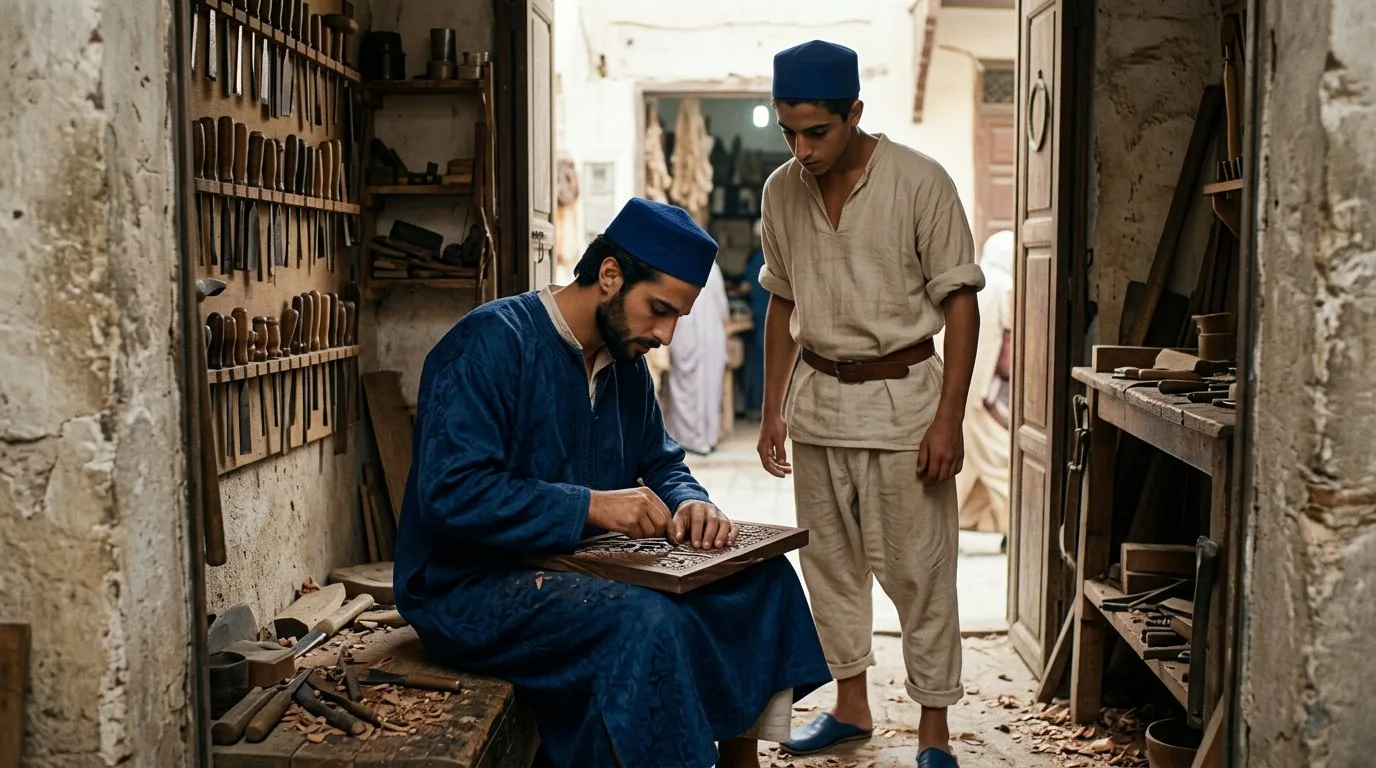
That period is not lost for them. The first cohort trains during the works in the masters’ workshops of the medina, as apprenticeship has always been arranged in this city, each one sleeping at home; it enters the house when the house is finished, and enters it already half trained.
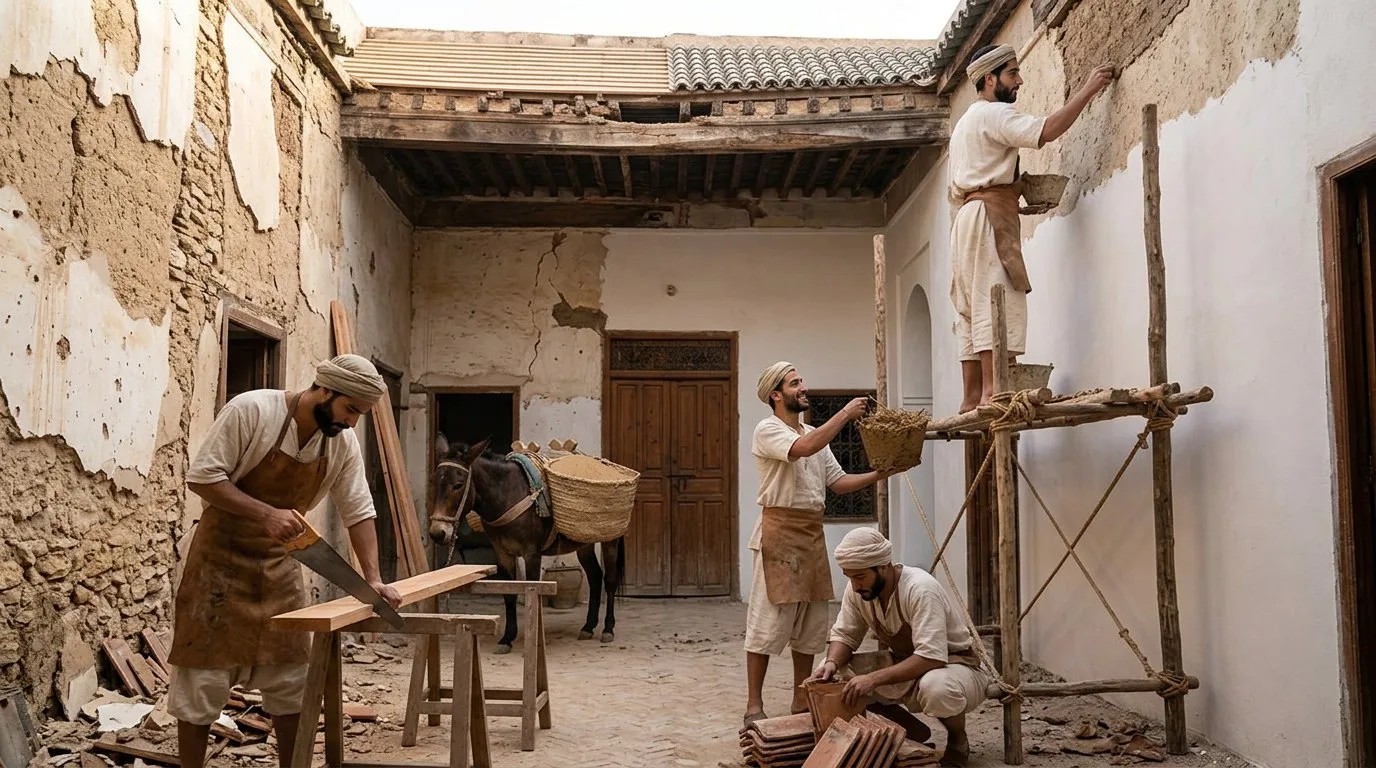
What the site works on
Once the house is open, the school’s site opens in turn and never closes again. It advances in the order in which the ṣāniʿ become able to measure themselves against it, and covers three groups of work that nothing obliges the house to carry out at the same time.
First come the outbuildings of the house, stores, terraces, service rooms and laundry, then the garden with its channels, basins, pergolas and enclosing wall: work modest enough for a mistake to be repaired, and real enough for it to matter.
Then come certain parts of Al-Munya, the adjoining house, whose successive campaigns may be financed by those who wish to support an identifiable work rather than a general budget; each campaign remains in the hands of the school’s workshops under a master’s direction, and is signed like all the others.
Last, and for a long time, comes the set of houses in the derb that the house raises again one by one in order to settle craftsmen there: those it has trained, and those who, trained elsewhere, ask to be affiliated to it and agree to keep its rule. It is the slowest part of the programme and the largest, since it aims less at restoring walls than at bringing back to the quarter the families of the crafts who left it for the new town.
The circle closes on this last point, since these restored houses are precisely the ones where those who leave here with a craft will settle, as the page After the residency describes.
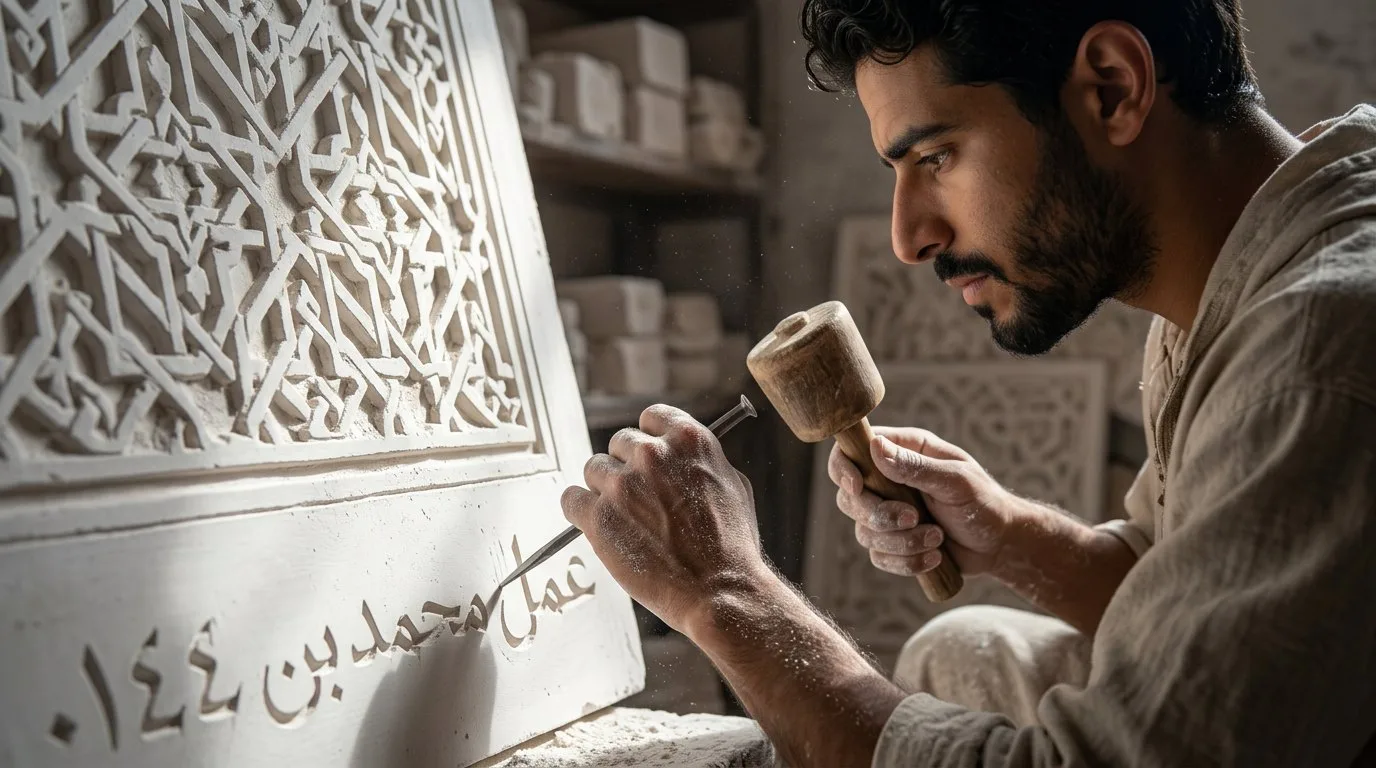
Signing the work
In the Maghreb, work is signed. On a zellige panel, a cedar ceiling or a plaster tympanum, the formula ʿamal (عمل), “work of”, precedes a name and a date; it is thanks to these inscriptions that we know, seven centuries later, which hand carved what in the Marinid madrasas of this city.
The house takes up this custom without exception. Every finished work bears, discreetly and outside the field of the composition, the name of the man whose hands made it and the year; when a ṣāniʿ has worked under a master’s direction, both names appear, the one who showed and the one who did.
It is not a gesture of vanity. The signature binds the man who bears it, so that if, thirty years later, a joint gives way, it will be known which workshop to call to account. The guilds held to this deferred responsibility, and it is for its sake, not for honour, that the craftsman has always agreed to sign.
Over the decades the walls of the house thus become a register of the hands that made it: first the six masters who restored it, then their pupils, then the pupils of those. This genealogy is kept in no book; it is read on the spot, by looking up.
Work is paid
A school that restored its own buildings with unpaid apprentices, and called it teaching, would have stopped being what it claims. The rule is written with the rest: as soon as a ṣāniʿ’s work has a value, he is paid what it is worth.
At the first degree of the belt, the ḥizām al-itqān, hours on site are hours of training, and in exchange the house gives roof, table, dress, tools and teaching. At the second degree the nāʾib produces, and his hours on site are paid at half the going rate. From the third degree the work is saleable according to the belt, and the hours are paid at the full rate. Practice on the school’s own tools remains training. The masters engaged on the site are paid in full from the first day.
To this the house adds, at its own expense, a craft share fixed in advance for each site, divided among those who worked on it in proportion to hours and degree.
The craft account
A real piece of work has a value, and as soon as a ṣāniʿ’s work possesses one — that is, from the second degree of the belt, the ḥizām al-itqān — that work is paid to him at the rate of the craft, and not handed over as an allowance.
Each man has for this purpose a craft account with the house, on which accumulate the wages of his hours on site as well as a share, fixed in advance, of the value produced when a restored house is sold or let, that share being divided in proportion to the hours worked and the degree reached.
The account is in no way a share in a company and gives no voice in the government of the house; it records what has been earned, and nothing more.
What one takes away
On leaving, each man disposes of his balance as he wishes: he may take it in money, or convert it at its value into the first share of the house-workshop he will buy from the house, without interest, year after year — often one of those the school itself will have raised in the derb.
A man who has spent those years restoring the houses of the quarter thus owns a share of the one where he will settle, and he has paid for it with his own work. To whoever completes the whole path and opens a workshop in the medina, the house doubles the balance earned.
When he settles he has another support besides the account: the tools of his first workshop are advanced to him without interest by As-Sanduq, the chest of the Futuwwa, to which he remains affiliated after leaving for what concerns illness, marriage and burial.
The three rules of the account
The account gives no voice: neither right of government, nor assembly, nor share in a company, since this house is not constituted as a company.
The account is never touched for a fault. A man who is sent away leaves with his balance, because what has been earned stays earned; an account that could be confiscated would become a means of pressure, and a man who fears losing it stops telling the truth about his own conduct.
On death the balance goes to the heirs, without any condition.
In return, the house provides throughout those years roof, table, dress, tools and teaching, and charges nothing for them. These are not entered in any account; it matters only that they be stated.
What has existed before
None of this was invented here. Precedents say where a solution comes from; they do not guarantee that it will succeed, and two of them are warnings.
The cathedral workshops. In Strasbourg the Œuvre Notre-Dame appears in the records around 1224–1228 under the name Opus Sancte Marie. Since then a permanent workshop of stonemasons, sculptors, masons, smiths, carpenters and glaziers has maintained the cathedral, and it lives on its own property: gifts and bequests, land, sandstone quarries, rents. On 17 December 2020 UNESCO inscribed the practices of these workshops, eighteen of them in five countries, on its Register of Good Safeguarding Practices. The apprentice learns on the building itself, and an endowment pays for a site that never ends: eight centuries earlier, this is the form of Al-Warsha.
The Val di Noto after 1693. Four months after the earthquake of January 1693 the towns of south-eastern Sicily were building sites. There the capomastri and the maestranze often held both the direction of the works and the design, and the craft passed from father to son in families that formed true dynasties. The baroque towns born of that site have been World Heritage since 2002. It is the Sicilian precedent of a school of masters that never had any classroom but the site.
Ragusa Ibla, 1981. To halt the abandonment of the baroque town, the Sicilian Region passed law no. 61 of 11 April 1981, which finances the restoration of houses through subsidised loans to private owners, provides for the acquisition of ruined buildings and encourages the settlement of art-craft workshops in the historic centre. Ibla was repopulated by raising its ruins. In the very province of the second house, it is the precedent of what the house in Fez intends to do in its derb.
Cairo, al-Darb al-Ahmar. Since 1996 the Aga Khan Trust for Culture has restored the monuments of the quarter with a training component on every site: direct apprenticeships on the restoration sites, agreements with the quarter’s existing workshops, and local hiring as wide as possible. Alongside this, a revolving fund financed the repair of the neighbouring houses, some two hundred and seventy small loans repaid to the fund to serve the next. Site, apprenticeship and revolving fund were brought together before us.
Caltagirone, 1918. Luigi Sturzo, then deputy mayor of the town, wanted a ceramics school there so that the town’s craft would be handed on in the town; from 1923 it worked as the Regia Scuola di Tirocinio per l’Arte della Ceramica, in the convent of San Gregorio. A school born of a local craft, within the walls of the place that practised it.
Two warnings. Charles Robert Ashbee’s Guild of Handicraft, founded in London in 1888, moved in 1902 to the old silk mill at Chipping Campden with its craftsmen and their families; the market for art furniture and silverwork was saturated by 1905, and the guild was wound up in 1907. A few craftsmen stayed. A colony of crafts without a lasting commission dies within five years; the house’s own site is its commission. And in Fez itself the Nejjarine fondouk, restored from 1990 to 1996 and reopened in 1998 as a museum of wood, shows that a well-restored building can become a destination and stop being a place of work. The sources for these precedents are gathered on the sources page.
The words of this page are in the common glossary; the works cited in the sources; the sister house is Al-Funduq aṣ-Ṣiqillī.