

At-Tadbir
التدبير
The governance of the Riad — who trains, who decides, who answers.
At-tadbīr (التدبير) is not a term chosen at random. It is not the modern calque of “governance” — al-ḥawkama, imported from the vocabulary of business — but the classical word that Islamic political thought reserved for the government of the household: the tadbīr al-manzil that Ibn Sīnā set, at the scale of the home, as the counterpart to the siyāsa that governs the city. The Riad thinks of itself as a house, not as an institution, and that was the word it needed.
This page says who decides what, how the chain is ordered from the ṣāniʿ to the shaykh, which charges keep the house standing, and what it lives on. What each man wears is described in Al-Kiswa.
THE DECISIONS
Who decides, and before whom
A house is judged less by its chart than by the question of who settles a matter, after hearing whom, and who answers for it afterwards.
THE TRIANGLE OF DECISION
Admission
The maalem of the workshop proposes, the two muqaddam prepare the case, the Ash-Shaykh admits. A man therefore never enters on the liking of one master alone, nor on the decision of one head alone.
Sending away
Arbitration comes first; the muqaddam are heard. Then the Ash-Shaykh alone decides, and he does not delegate that decision. What costs the house is not laid on another man’s shoulders.
The grade
The maalem, and nothing else: neither seniority nor the asking of the man concerned. The grade is given when the hand has acquired the gesture. See Hizam al-Itqan.
The work received
The eye of the maalem, before the whole house. That is where it is said whether a man has left something behind him. See Al-Athar.
Tensions of honour
Between peers first, then, if it must be, the trial under rule. It does not travel up the chain, and forms a register of its own. See At-Tahkim.
The accounts
Within, the wakīl holds the stores, the table and the ordinary accounts. Outside, a firm keeps the books and answers only to the Ash-Shaykh and the wakīl. Each man’s savings are deposited outside, in his own name.
Doctrine
The faqīh teaches and holds the hours of prayer. He does not admit, does not arbitrate, does not sanction. His authority is that of knowledge, not that of the house.
The two muqaddam and the Ash-Shaykh are elected among their peers. A charge of the house is never proclaimed: it is passed from hand to hand, on the day of taking office and on the day of handing it over — the munāwala.
THE CHAIN
From the sani to the Ash-Shaykh
THE CHAIN
الشيخ Ash-Shaykh Decides and answers. Elected.
The degrees of the craft are given when the hand has acquired the gesture. The muqaddam and the Ash-Shaykh are elected among their peers.

الصانع
The sani
Every man enters here as a ṣāniʿ, whatever his age, his schooling or what he owned outside. He receives a craft, a discipline and a place at the table — the same one as the others.
He advances through the three leathers of the Hizam al-Itqan, and through them alone: nothing there is gained by seniority. The first degree of the chain is not a lesser being, it is a man at the beginning of his work.

النائب
The naib
In each workshop, one of the most advanced ṣāniʿ assists the others when the maalem is busy or away. He does not take the place of his authority, since he directs the workshop for the length of an absence without governing it.
Since his function is exercised inside his own guild, he is the one man in the house for whom the colour of the charge and the colour of the workshop are the same. He remains a ṣāniʿ among ṣāniʿ, marked by a responsibility and not by a rank.
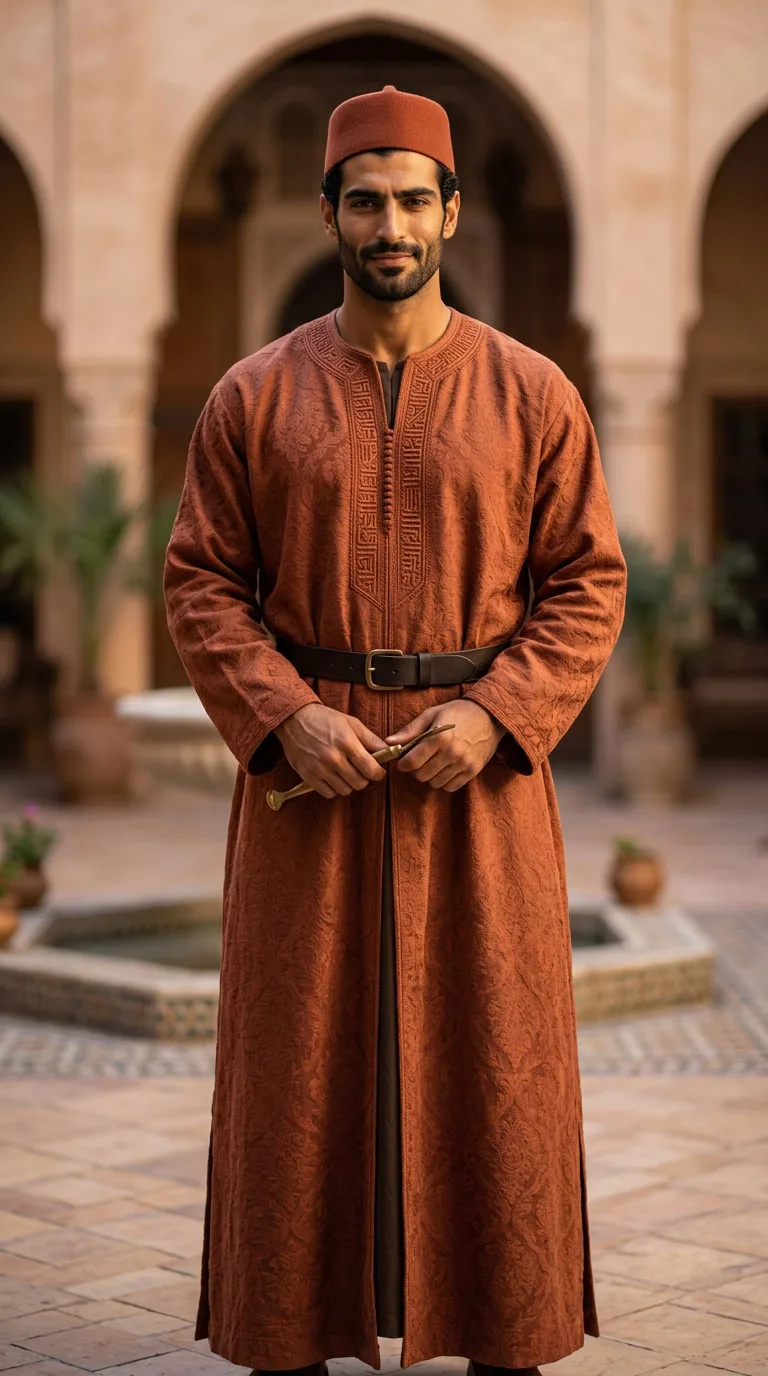
المعلّم
The maalem
One master to a craft. It is he who receives a man into his workshop — the day the cap is dyed, once in a lifetime —, he who judges whether a gesture is acquired, he who proposes an admission and he who gives the next leather.
He no longer shows a belt: the ḥulla, woven tone on tone in the colour of his workshop, has taken over on its own what the belt used to say. A workshop that forms new masters keeps them: they remain of their guild. See Masters wanted.
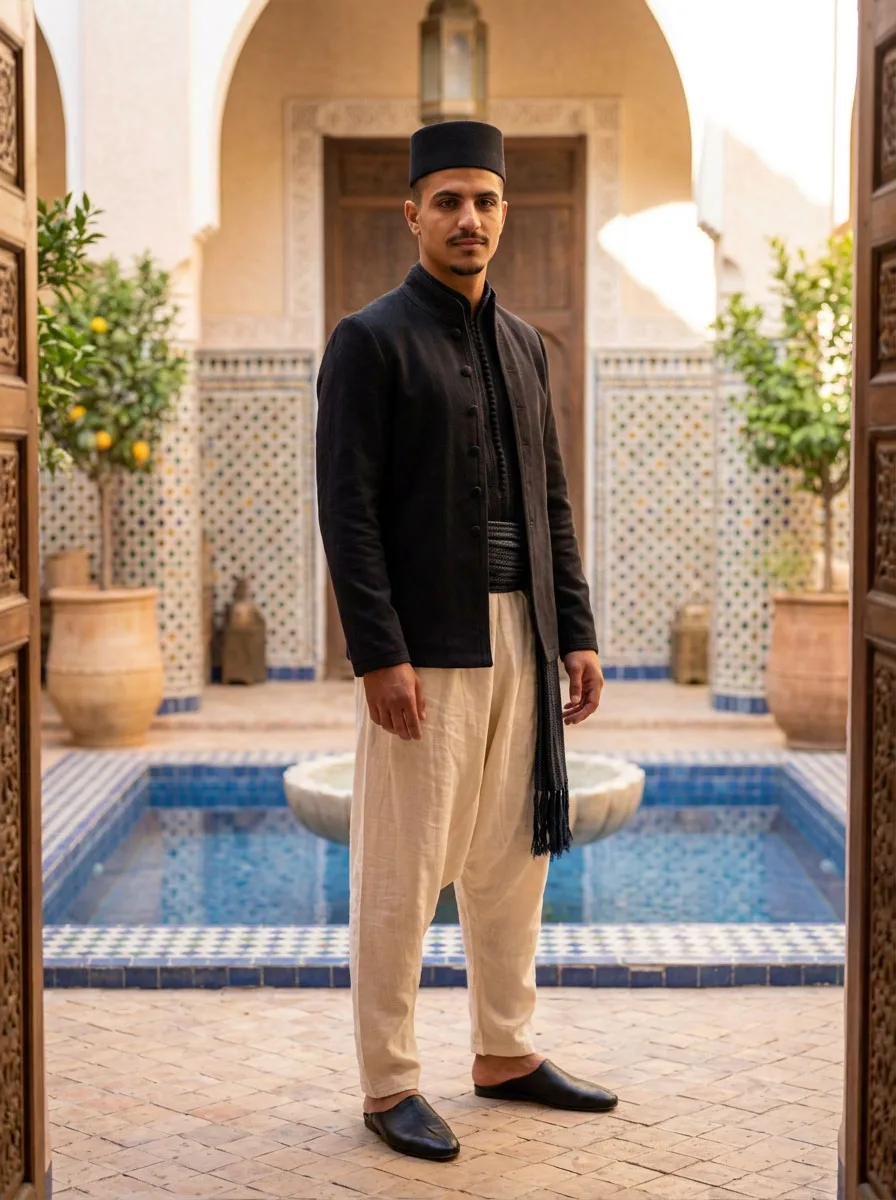
المقدّمون
The two muqaddam
Two advisors assist the Ash-Shaykh in permanent residence: one for the inner life of the house, the other for what comes from outside. They prepare requests for admission, are heard before any sending away, and live beside him.
They are elected among their peers. Their dress follows the cut worn by the ṣāniʿ, in black, with the plaited cord of the function.

الشيخ
The Ash-Shaykh
He has the colour of no workshop, belonging to no guild and standing for them all. He admits, he sends away, he answers for what no one else answers for — and it is by that, rather than by any power, that his charge is measured.
His overtunic is black to the ankle, and his belt carries the Kufic gold-thread embroidery at all times, not for ceremonies alone: his authority does not need a scale in order to be stated. He is elected among his peers.
THE CHARGES
Neither craft nor rank

Six offices of residents keep the house standing, and they are whole days’ work: none of them is added to a day in a workshop. They are held for two years — the time to learn the work properly and to form the man who will take it on.
Each is taken up with a colour and with an object. The colour is worn on the jacket, the coat and the cord; the cap keeps the workshop and the belt keeps the grade. The object is put into the hand on the day of taking office, and given back into the hand on the day it is handed over.
Al-Bawwab البوّاب
The man who guards the door. Rampart ochre, the iron key of the gate. See Threshold and rooms.
Al-Jannan الجنّان
The man who cultivates the gardens and the kitchen plot. Deep green, the pruning hook. See Garden and kitchen plot.
Al-Farrash الفرّاش
The man who has charge of the rooms, the linen and the wardrobe of the whole house. Flax grey, the room keys.
Al-Khazin الخازن
The man who keeps the books. Ink brown, the key of the khizāna and a bound volume. See Al-Khizana.
Al-Wakil الوكيل
The man who administers the economy — provisions, stores, table, ordinary accounts. Oil brown, the ledger.
Al-Qayyim al-hammam قيّم الحمّام
The man who answers for the hammam and for the fire that never goes out. Ash, the copper pail. See The hammam.
Two other offices carry a colour without belonging to those six: the muezzin, whose charge follows the hours and not the day — he keeps his workshop and takes the cord alone — and the standard-bearer, the one charge of the house that falls to a man instead of being given, for a single year. The dress is set out in detail in Al-Kiswa.
ASSISTANCE
Each man answers for someone
Since the difference in age is deliberately kept small, between the charges as between the degrees of apprenticeship, obedience cannot rest upon seniority of birth, and a man commands only for as long as his companions recognise in him the capacity to exercise that authority in the name of those for whom he answers. A hierarchy established in this way obliges authority to justify itself by competence and by service, and it leaves standing among these men a fraternal equality which is the very condition of their common spirit.
The house draws a practical consequence from this: no one remains here long without having someone for whom he answers, and without answering himself before another.
The sani of the third degree
The ṣāniʿ who has reached the third degree of the belt receives a ṣāniʿ of his own, whom he starts on the roughing-out of the material and on the preparatory work of the workshop before the maʿallem takes his formation in hand, and this first responsibility teaches him, at a time when he has as yet nothing to command, what it means to answer for another man’s work. By the ordinary rule of succession the elder becomes maʿallem when his master passes the charge on, and the younger rises behind him. The nāʾib, who stands in for the maʿallem at the bench when the latter is occupied elsewhere, belongs to the same order of things. See Hizam al-Itqan.
The assistant to each charge
Each of the six residents’ charges forms its assistant, the muʿāwin, in the same manner: the hammam boy learns the fire beside the qayyim, the gardener his helper, the librarian his own, and so with the door, the linen and the provisions. Since a charge is exercised for two years, the assistant has time to learn the work before being called to it, so that the house knows no vacancy and nothing essential rests upon the memory of a single man.
The same usage governs the disciplines of the body, where the younger assists his elder before practising in his turn: he sees to the horse, the girth and the cooling-down after work; he gathers, counts and checks the arrows, strings and unstrings the bow, waxes the cord; he keeps the second weapon ready, oils the blades and sets the posts; he marks out the wrestling ground and keeps the time. At the zurkhāne he brings out and puts back the clubs, the stone shields, the iron bow and the board, wipes them down after the exercise and gives the cadence while his elder works. The service does not stop at the equipment: coming out of a wrestling bout he brushes the sand from his elder’s body, brings him the resting qamīs after a ride, and beats the dust from his clothes. He also greases the tonban and works it supple before his elder puts it on for the zurkhāne, since the leather hardens as soon as it is neglected. See Javanmardi·The harness.
The pairs so formed, the librarian and his assistant, the man of the hammam and his, the gardener and his, become over the months a model of friendship and brotherhood which the common life consolidates, and the movement continues of itself when the younger, raised in grade, receives in his turn an assistant whom it falls to him to instruct.
Serving before commanding
The tasks entrusted to the young ṣāniʿ are modest, and he performs them with humility, discovering as he goes how indispensable they are to the working of an organism as complex as this house, where nothing touching the fire, the linen, the garden or the animals is left to an invisible hand. They do not make a servant of him, nor do they prejudge in any way his capacity to carry considerable charges later on, of which they are on the contrary the natural introduction. He sees, moreover, that these same tasks, gathering the dead leaves in the garden or sweeping his own dormitory, are performed by the nāʾib, by the maʿallem and by the two muqaddam as much as by the ṣāniʿ, which teaches him in practice that none of them lowers the man who carries it out.
The effect of this is surer than that of an order. A maʿallem who himself cleans and puts the workshop in order, work that ordinarily falls to the latest arrivals, establishes his authority better than by directing the ṣāniʿ to see to it alone; and the young man who finds his master capable of humility recognises that authority with more conviction, since he reads nothing in it that lowers him, but one reason more to grow and to form his character. The maʿallem does not lend himself to it in order to be seen, but because nothing in that work is dishonourable and the workshop would cease to function if no one saw to it. His pride, indeed, lies in showing himself true before them, since he esteems them enough to know that they understand the sense of what he does and the spirit in which he does it. The proof is immediate and comes from no rule, for young men of that age perceive at once when a master is not sincere, and that alone is enough to cost him, before them, an authority and a prestige that no office would give back to him. And what is lost with them is the desire to follow him, to obey him and to learn from him, for a young man does not attach himself to a model he has caught dissembling, loyalty being precisely what he comes to look for in an elder. The ṣāniʿ draws a resolution from it: to perform these tasks in the spirit in which his maʿallem performs them, since he will still be performing them on the day he is maʿallem himself.
This reciprocity holds within the house. Before a client the maʿallem deals and the ṣāniʿ does what falls to him, the workshop presenting itself outside as a single body, with an internal order that the man who comes to commission a piece has no need to know.
No one learns to command without having learned to obey, and no one takes responsibility, physical and moral, for his companions without having first learned to entrust himself to his maʿallem and to follow him as a pupil follows his master. Only the man who has lived his subordination serenely is afterwards in a condition to exercise a command or a coordination.
The expected objection
It will be objected that a young man of twenty-one or twenty-two has not the capacity to guide an assistant of eighteen or nineteen. The pedagogy of the house consists precisely in that: these young men are made responsible from their entry into the community and accustomed to exercising a limited authority, so that they may learn from their own experience that commanding presupposes, before anything else, the capacity to obey.
What this arrangement produces
The intention is not, in the first place, to lighten the task of the man who exercises the charge, but to bring each member of the house gradually into a community whose responsibility he shares, since a man entrusted with a real part of the work knows himself to be useful, and his daily commitment takes its reason from that.
This knowledge is handed down in the ordinary day and at the rhythm of the house, and never from a chair, by accompanying the man who knows how to do the work and by taking a share of it little by little, so that the succession is accomplished without a break on the day the charge passes from one hand to another.
WHAT IS NEEDED
What the house lives on
No one here is paid for what he does. A resident is not an employee, and he receives lodging, the table and everything he needs, with nothing withheld from him and nothing counted against him. Clothing, tools, care and books come from the house.
The necessary being covered, each man has a personal allowance for what is not — and more of it if he asks. Alongside that, a savings account accumulates in his name throughout his years of residence. This is provision and not deferred wages, so that a man leaves here with something in front of him rather than empty-handed.
Who answers for what
Bookkeeping and tax are entrusted to an outside firm, which has no role in the house, does not live in it and does not teach in it: it keeps the books, nothing else, and answers only to the Ash-Shaykh and the wakīl.
Within, the wakīl holds the stores, the table and the ordinary accounts; the Ash-Shaykh answers for the rest. The savings are deposited outside and in each man’s own name: they are in nobody’s hands here, and no one has to ask permission for them.
What it earns, what it receives
The house earns its living first. By the work of its workshops, whose production is sold; and by the fixed annual sum paid by Al-Munya.
It receives next: study bursaries, the support of its patrons — gifts and bequests —, institutional funds, and the contribution of those families able to give one.
No one of these sources is enough on its own, and that is deliberate: a house that hangs on a single source hangs on whoever holds it.
Those who have nothing
A young man without means is received free of charge, and nothing in the house sets him apart: not the room, not the place at table, not the clothing, which is handed to him complete on arrival as it is to everyone.
What makes this possible has nothing of alms taken out of the rest. It is Al-Munya: Dār al-Diyāfa, where the nudamāʾ and their guests stay at their own expense, pays the House a fixed annual sum, and Dār al-Aṣl lodges free of charge those whom the House invites. The house has not set charity beside its economy — it has made its economy the instrument of its charity.
Those who come from outside
Salaried masters, professionals and tradesmen called in for what the house cannot do itself are paid for their work and go home when it is done. The rule fits in one sentence: no one who lives here is paid, no one who is paid lives here. The residents form a formative community on a full scholarship; a bound provision fund is held for each man outside, in his own name.
THE CRITERION
How authority states itself
The house holds together two things usually thought to be opposed: a real hierarchy, and an equality of substance. An office, a competence, means of one’s own do not make the man who holds them more important — they oblige him further.
Authority does not state itself by exempting itself from humble tasks. It states itself by accepting them without fear. The nāʾib, the maalem, the muqaddam and the shaykh discharge, when the house requires it, the same offices as the ṣāniʿ. A man whose rank is secure only on condition that he never performs a lowly task does not yet have authority, and wears no more than the badge of it.
This holds only if both men know it. If the younger took the master’s service as a victory over him, the gesture would already be lost.
Nearness of age
The maalem and the faqīh are chosen older than the ṣāniʿ, without the gap becoming a barrier of generations. Authority is earned by the maturity a man has reached through effort and discipline, and the man who commands never acts in his own name: he exercises a charge in the name of those for whom he answers. He who cannot command himself cannot command others.
What the house seeks to form belongs to no particular condition, being the same capacity that keeps a craftsman at his bench, a man of business before his commitments and a minister before his charge — knowing how to command oneself. It is for that reason that it receives, without distinction, the son of a well-off house and the man who has nothing: they come to win the same thing.
The passions are held in bridle rather than extinguished. Furūsiyya gives that the experience of the body — mastering an animal not yet broken, so as to understand in the gesture itself what it is to command oneself.
The same exercise
This principle is also the model for the presence of the guests of Al-Munya within the community. Their stay does not rest on what they own. It rests on this exercise: commanding oneself, setting aside rank, name, fortune, office and the prestige the world attaches to such things — in order to be, here, only oneself.
That amounts to stepping down from a pedestal in order to rise more truly, and higher.
TRANSMISSION
The maalem and the sani
A man is received into a workshop before he enters a craft. On the day a maalem takes him into his own, his cap and his babouches are dyed — once in a lifetime — and he becomes a ṣāniʿ of that workshop. The pair is formed because a master has judged that he can receive this man and answer for him.
What is transmitted afterwards does not pass first through words. The maalem shows, then has him do, then corrects by setting his hand on the other’s: the body learns the pressure, the angle and the speed before the head has understood anything. The chant that accompanies the work — the malḥūn, which the house learns as well — is not an ornament, for it sets the cadence of the work, as it always has in the workshops of Fez. When the body knows before the head, that is the sign that the gesture has been understood.
Why the ages are close
The maalem are chosen older than the ṣāniʿ, but only by a little — enough to have gone a real way into the craft, not enough to belong to another generation. This is a decision and not a convenience, and it aims at one precise thing.
A wide gap in age installs a relation of domination all by itself, and transmission suffers from it: a man obeys because he is younger, not because he recognises something. Between men of neighbouring ages, authority has to be recognised in order to exist — and that is exactly what a ṣāniʿ must learn. In his maalem he sees not another order of man, but what he himself may be in a few years, if he perseveres.
Authority so understood is recognised before it is imposed. It is the same principle that has the nāʾib, the maalem, the muqaddam and the shaykh discharge, when the house requires it, the same offices as the ṣāniʿ.
What he may do, and what he may not
The maalem judges the gesture and gives the next leather: progression in the craft belongs to him and to no one else. He proposes a man’s admission into the house, but does not admit him; he does not arbitrate disputes, which belong to At-Tahkim; he holds no power of sanction, since sending a man away belongs to the Ash-Shaykh alone.
This limit proceeds from no suspicion, and it is what makes obedience bearable over time. A ṣāniʿ obeys his maalem because that man’s hand knows something his own does not yet know, and because the rule of the house provides for it — not because he feels attachment to him. Esteem makes the work happy; it does not found the authority. A man who one day no longer shared his master’s feelings must still be able to learn from him without being at fault.
Nothing done apart
All of this takes place in the middle of the workshop, in sight of everyone. No conversation between a man who holds a responsibility and the man who depends on it is held one-on-one in an isolated place: training, advice and correction take place in common, visible spaces — workshop, study room, courtyard. The personal relationship between master and student, essential to the transmission of the craft, is lived fully within this shared setting, never in isolation.
The same transparency that protects a young man is what makes possible the transmission of the art from master to pupil.
What remains
At the end of the years, what a man takes away depends less on his maalem’s approval than on the malaka — the stable quality Ibn Khaldūn spoke of, the one born of repetition, which no longer depends on anyone. The master has placed it in a hand that from now on has no further need of his. That is how one measures whether he taught well.
Two registers, not one
The house distinguishes what touches persons from what touches the work.
At-Tahkim — the arbitration of tensions of honour between peers and, if need be, the trial under rule. It closes a dispute between men. It does not judge a panel of zellige, nor a grade.
The work and the grade — Athar, the ijāza, the eye of the maalem: this is where it is said whether a gesture is acquired and whether a man rises. The trade council, provided for by the rule, belongs to this second register. It is not a commercial label.
→ At-Tahkim — Arbitration · → Al-Athar
WHAT THE HIERARCHY DOES NOT DO
A chain of responsibility, not of distance
The spaces of educators and masters remain physically distinct from those of the residents. Hierarchy does not become remoteness: responsibility is exercised at close range, and the distinction of rooms serves protection, not withdrawal.
Lessons in doctrine (Qur’an, fiqh, ʿaqīda) remain separate: they are given by a resident faqīh, who shares the rhythm of the house without belonging to the chain of the crafts. His charge is the hours of prayer and the teaching — he does not decide admissions, does not arbitrate disputes and holds no power of sanction. His lessons are held, like everything else, in common and visible spaces.
THE ENTRANCE
How one approaches the house
Governance assumes men who have crossed the threshold in order: reading, writing, the exchange, the training or the stay, then the residency. It is not an enrolment.
The detail is set out in the rule given to each resident.
← Dar al-Hiraf · Glossary
The words of this page are in the common glossary; the works cited in the sources; the sister house is Al-Funduq aṣ-Ṣiqillī.