Patio
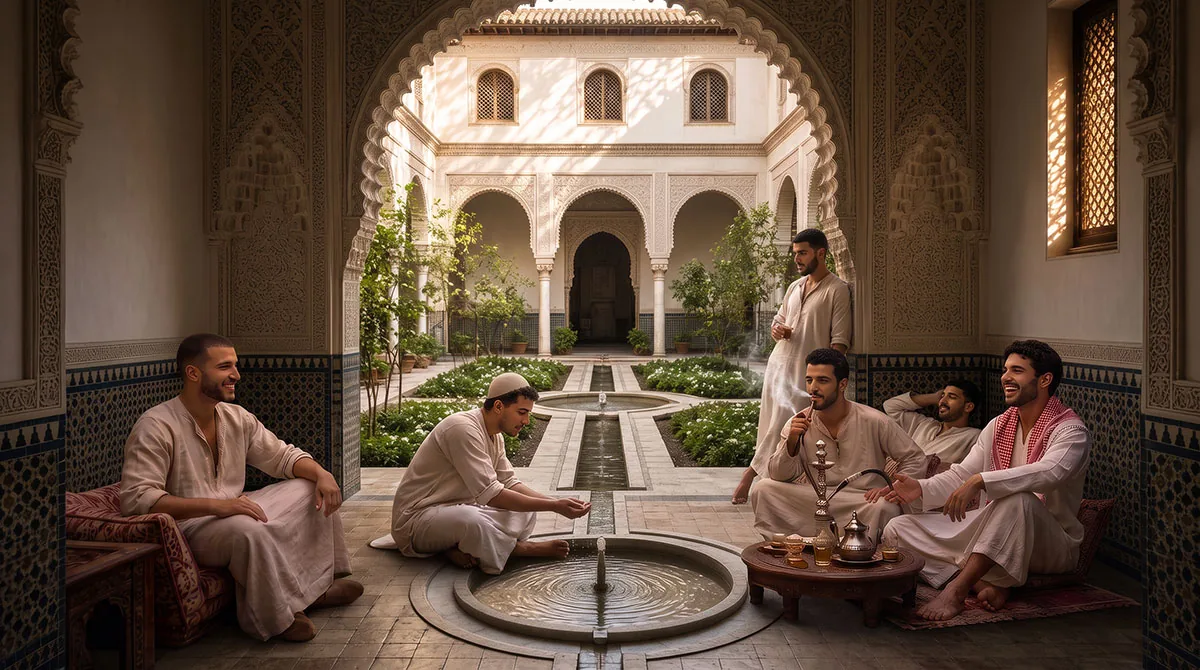
Inner courtyard, fountain, reflection of the sky — the silent heart of the house.
“From the garden one entered the small inner courtyard through a very low door, and a passage barely wide enough for one person to pass. All round the courtyard rose twelve white pillars, joined by as many horseshoe arches, which carried at first-floor level an arcaded gallery fitted with a wooden balustrade. In the middle of the courtyard there was a fountain […].”
Edmondo De Amicis, Marocco, Treves, Milan 1876, chapter “Fez” (translated from the Italian).
Inner courtyard closed to the outside, open to the sky — the patio is the silent centre around which the whole house is organised. Rooms, workshops and common spaces open onto it, never onto the street.
It is a device — climatic, social, spiritual — and not a purely ornamental garden. It tempers the air, gathers without exposing, and its open sky recalls, to whoever lifts the eyes, a presence above the house.
An architecture older than Islam
The principle is older even than the courtyard. From the fourth millennium BCE, in the Mediterranean deserts, the wāḥa (واحة) is born of a group’s decision to stay in one place and make its scarce water bear fruit — underground channels, trees planted in layers to form a microclimate. Greece drew the same conclusion at the scale of the house: at Olynthos the dwellings already open onto a court, the aulé, oriented to take the low winter sun and to shade itself in summer. None of this is a luxury; it is a climatic intelligence within everyone’s reach, and it still governs the least courtyard of the Riad: water organised, shade calculated, nothing wasted.
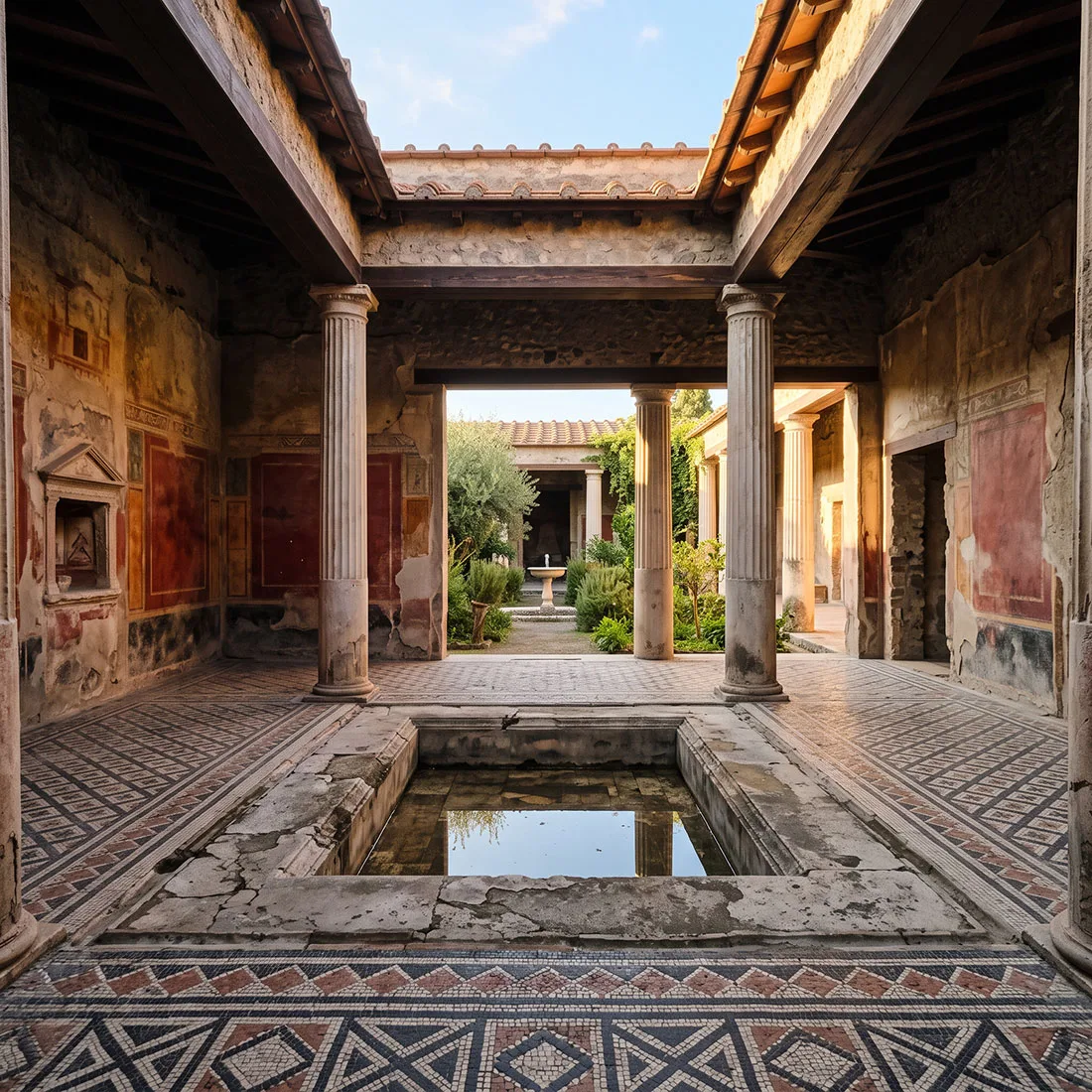
The house organised around a closed courtyard is not an Arab invention, since it goes back to the ancient Near East, where it already constitutes, millennia before Islam, the domestic form of reference. Rome inherits it in its own way — the Roman domus, with its atrium, open-air courtyard that collects rainwater under the gaze of the sky: it is this same device that, by direct transmission, will become the Andalusian patio, then the Moroccan patio that the Riad perpetuates today. The Arabo-Andalusian world composes its own synthesis for the riad: the Mediterranean courtyard joined to the enclosed Islamic garden.
The same logic, as far as Sicily
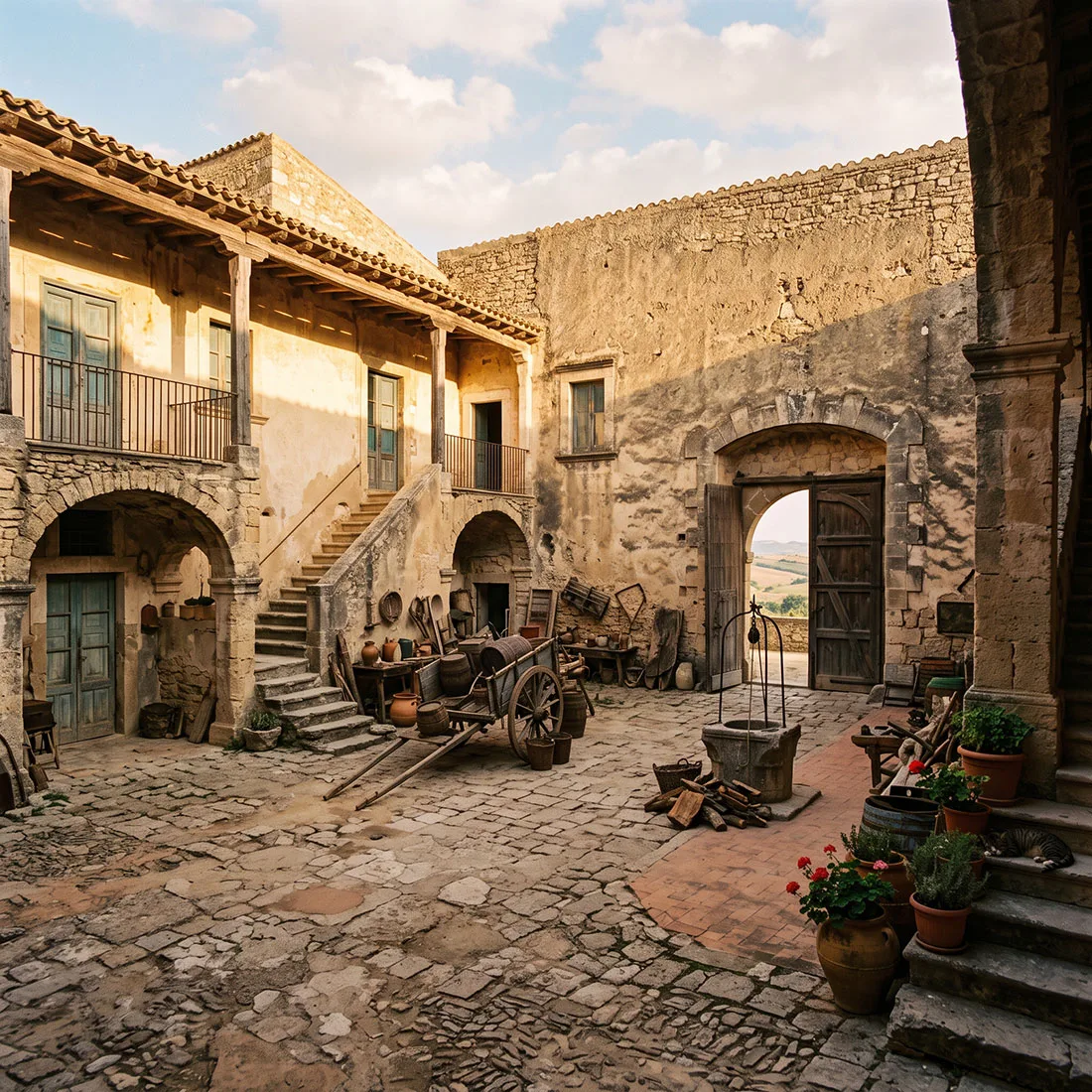
This same geometry — closed courtyard, blind façades toward the outside, life turned inward — reappears as far as Sicily in the baglio, the fortified masseria that still organises the rural landscape of the island today. Its name most likely comes from the Norman-French ballium (the fortified bailey of a castle, attested from 1194), even if a minority hypothesis sees in it a loan from the Arabic bāḥa (بَاحَة, “courtyard”). What can be affirmed with certainty is that the architectural logic of the baglio — the same as that of the rustic Roman courtyard — joins, by distinct paths rather than by direct borrowing, that of the Andalusian and Maghrebi patio: a courtyard that one closes to the world the better to inhabit it.

What a courtyard in Fez is
The courtyard of a Fassi house — wast ed-dar, “the middle of the house” — is the one room through which all the others take their light and their air. One does not step into it from the street but through a bent corridor, the driba, which forbids the gaze to enter along with the body. The rooms open onto it and onto nothing else; towards the alley the walls stay blind.
Around it run the galleries, on one level or two, carried on columns. They keep the doors and windows out of the sun and give a covered path from one end of the house to the other. The floor is marble or zellige, laid to a slight fall towards a central drain, because a Moroccan courtyard is washed with water thrown by the bucket. On its axis opens the bhou, the vaulted alcove without a door: neither inside nor out, the room one sits in when the weather is kind.
One goes up, and one comes down
A courtyard house is not lived in the same way all year, since one moves through it with the season. In summer life descends — the ground floor, the galleries, the shade of the courtyard at the hard hours. In winter it climbs in search of the sun: the upper gallery, then the menzeh, the room on the top level open to the view, and the terrace, the stiha, the highest point of the house, where the linen dries and where the medina is seen as far as the hills.
This slow migration is why such a house has no need to double its rooms, each level being good for one season. It also explains why a courtyard is not furnished like a drawing room. What is put there must be able to leave.
The only piece of sky
A medina house is closed on every side: the courtyard is, for those who live within, the only piece of sky. The hour is read there without a clock, by the travel of the shadow across the walls, and the five prayers find their natural bounds in it — the light changing in the well of the courtyard tells the moment better than a dial.
A fountain, a verse engraved in stone
Nowhere has this encounter between water and stone been sung with more precision than at the Alhambra of Granada, where the poet-vizier Ibn Zamrak had his own verses engraved on the rim of the fountain of the Patio de los Leones:
تَشَابَهَ جَارٍ لِلْعُيُونِ بِجَامِدٍ فَلَمْ نَدْرِ أَيًّا مِنْهُمَا كَانَ جَارِيَا
“What flows and what is solid became confused to the gaze: we no longer knew which of the two was flowing.”
— Ibn Zamrak, poet-vizier of Granada (1333–1393)
What the verse describes — water so calm that it seems stone, stone so polished that it seems to flow — is the very experience of one who sits facing the patio fountain: an instant when the gaze no longer knows how to distinguish what flows from what is solid.
The patio and its fountain return in the page Water, which says how the house counts the water it shows.
What Ibn Zamrak’s verse describes in the proportions of a fountain, the Riad lives in the proportions of a life. The patio becomes the beating heart of formation: the young men who grow there do not learn only a craft or a gesture, but to recognise, in the order of the place, the order of the Creator Himself — force tempered by measure, passion disciplined by rhythm, the sky recognised even in the reflection of a basin. The patio is, at human height, its inhabited microcosm, more than an image of the cosmos.
The words of this page are in the common glossary; the works cited in the sources; the sister house is Al-Funduq aṣ-Ṣiqillī.