The young masters who choose to remain:
a brotherhood under the same rule, a pillar of the house.
Not all the young masters choose to open a workshop at the end of their apprenticeship. Some decide not to scatter: they remain in Riad Al-Uns, together, under the same rule that formed them. Ar-Riwaq is the name of this stable community, which forms the link between the past of the masters who came before them and the future that opens to the apprentices.
In the Arab Mediterranean and in the craft guilds, this figure exists and it is precisely the futuwwa: the brotherhood or spiritual chivalry of unmarried young men, the fityan. They were young craftsmen who chose to live together under a rigorous rule made of loyalty, disinterested hospitality, discipline of the craft and service to the community, before or instead of marriage. It is not a monastic order in the strict sense, but a communal dedication to the craft and to common life.
In the traditional Arab and Islamic world, ar-riwaq (الرواق) has two closely linked meanings, one architectural and the other communal.
I
The architectural meaning
It is the portico, the covered gallery of arcades or columns that runs along the sides of an inner courtyard (of a mosque, a madrasa, a caravanserai or a great house). It is the space of mediation par excellence: sheltered from sun and rain, open to the air and light of the patio.
II
The institutional and residential meaning
In the great historical community and university institutions (such as the Qarawiyyin of Fez or Al-Azhar in Cairo), the riwaq became the communal lodging: each riwaq was a true residential wing reserved for a community of unmarried students and young men, often united by a common origin or a brotherhood (for instance the Riwaq al-Maghariba for the Maghrebis, the Riwaq ash-Shwam for the Syrians).
It was not a modern dormitory: it was a space of autonomous common life where the young men slept, kept their books, ate and prayed together, guided by a responsible elder (shaykh ar-riwaq), sharing a rule of discipline, study and mutual respect.
III
The synthesis of our Riad
The wing of the House set aside for the permanent residence of the unmarried young men who choose the common life is called Ar-Riwaq, preserving an authentic historical institution of the Mediterranean and giving a precise architectural and symbolic form to this stable community.
Remaining to keep
The brotherhood gives continuity to the house. Its members are young masters: they know the work of the workshops, accompany those who arrive and keep the thresholds of common life. Their daily presence ensures that the gesture learned is not interrupted when one apprenticeship ends and another begins.
Being a pillar of the house does not mean owning it or withdrawing from its rule. Those who remain continue to answer for it together with the others, in the work, at the table and in the care of the place. The workshop is not separate from the dwelling: the craft received from the master becomes a responsibility towards those who learn after him.
The riwaq is the portico,
and by extension the wing that opens onto it.
The portico and the palm
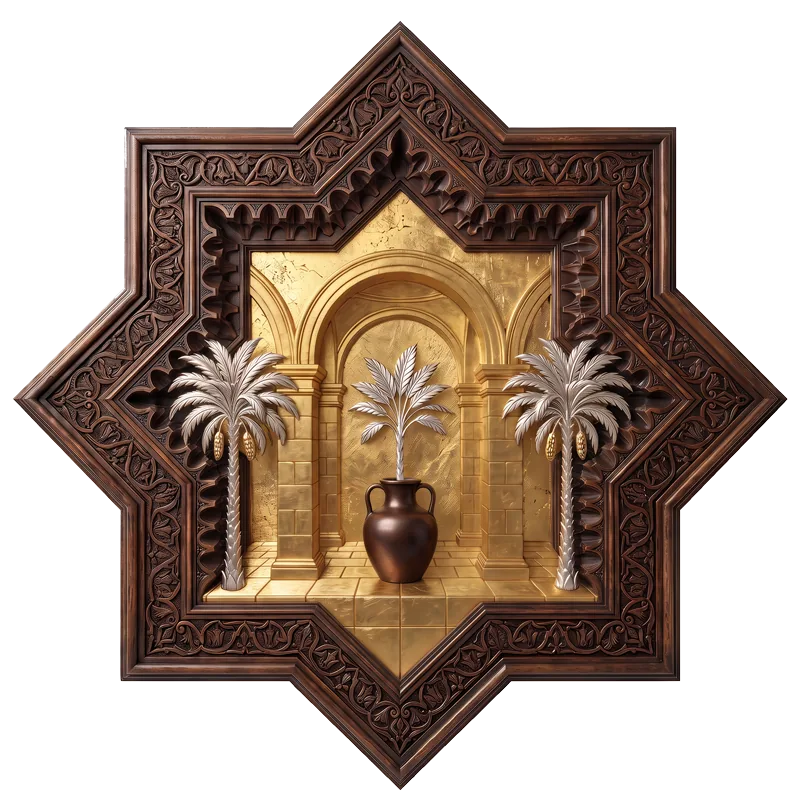
Riwaq means portico. The emblem shows three arches and, on the threshold, a young palm in a pot, among the grown palms of the Riad. The plant still growing refers to the formation of the young apprentice; the earthenware pot points to the fragility of the pupil’s first stage; the portico, to the shared dwelling that can endure thanks to those who choose to live in it and keep it. The two grown palms recall the protection of those who have grown and have firm roots sunk in the ground.