Water
Rule and coolness — how a city of water taught a house to measure it, and how the house gives it back to the air.
“And We made from water every living thing.”
Qur’an, al-Anbiyāʾ, 21:30
A city of water
Fez was founded on a river and made it its reason. The chronicler of the Marinids, Ibn Abī Zarʿ, opens his description of the city with three gifts that hold together — the sweetness of the water, the temperance of the air, the goodness of the soil — and continues with the image every visitor has repeated after him:
“Its river splits it in two halves and, within it, branches into channels, streams and conduits, which run through its houses, its gardens, its streets, its markets and its baths; and by it its mills grind.”
Ibn Abī Zarʿ, al-Anīs al-muṭrib bi-rawḍ al-qirṭās, description of Fez. Our translation.
Behind the image stands a system, and the studies that have reconstructed it — Tariq Madani’s thesis on water in medieval Fez, the classic Le Tourneau, the recent inventories of the medina’s hydraulic heritage — describe a network that carried water by gravity to fountains, houses, baths, mills and gardens through distributors that fixed the shares, and passed it down from one use to the next in the order of the quality required, so that water which had already served one function served another further downstream before leaving the city.1 It is a cascade before it is a network, and the house, which still receives a branch of it today, repeats the principle in small.
The cascade of uses: one water, five services
Ibn Khaldūn, who lived and taught in Fez, made of it a general rule in his chapter on the founding of cities: that the city should stand on a river or have before it sweet and abundant springs, “because the nearness of water eases for the inhabitant a need that is necessary, and it is for all a great and common benefit”.2 The adjective that counts is the last: common.
Today’s measure
The reason this page cannot be merely a page of history lies in three figures. In 1960 every Moroccan had 2 560 cubic metres of renewable water a year; in 2020, about 620; by 2030 availability will fall below 500, which is the threshold of absolute scarcity.3 Average inflows to the basins have fallen from twenty-two to fifteen billion cubic metres between the second half of the twentieth century and recent decades, and 2024 was the seventh consecutive year of drought. In such a country, laying water flush with the ground in a courtyard to cool it is no neutral gesture, and the house cannot do so without saying how, how much and by what rule.
Water as rule
The communities of al-Andalus knew this, and wrote it down. Carmen Trillo, who has studied Nasrid water for thirty years, sums up the doctrine in a few principles: the right to water rests on its quantity and on the labour spent to capture it; the great rivers belong to all, and on small streams whoever is upstream and whoever settled first has precedence; water won by digging — a well, a gallery — may be owned, but remains subject to everyone’s right to drink and to water their animals; it is divided by turns of time, marked on the calendar and on the hours of prayer, or by shares of volume; and its management belongs to the whole community, which decides how it is apportioned.4 It is a rule before it is a hydraulics, and the source from which it descends is a saying of the Prophet that the jurists placed at the foundation of water law:
“Muslims are partners in three things: pasture, water and fire.”
Abū Dāwūd, Sunan, Kitāb al-ijāra, no. 3477 (ṣaḥīḥ according to al-Albānī).
To this is added a second saying, of weak chain but great fortune, in which the Prophet reproaches Saʿd for wastefulness in ablution, “even if you were at a flowing river”.5 That the tradition preserved it despite its weakness says how much measure was felt as a duty even where water abounded.
On this model the house writes its own rule. Water has an order of uses, which is the order of the cleanliness required — drinking and cooking, ablutions and the fountain, the bath and washing, the garden basins, the kitchen garden — and nothing descends to a use that demands more cleanliness than the one it comes from; the rain from the roofs, which in Fez falls almost entirely between October and April, goes to the cistern for the months without rain; the fountain and the water sheet are recirculated and only what the air has taken is replaced; consumption is measured, and the measurement is published. Who decides on use, in case of scarcity, is the assembly of the house, with a written rota: it is target 6.b of the 2030 Agenda — the participation of local communities in water management — said in the language of a fourteenth-century alquería.6
Water as coolness
Every kilogram of water that passes into vapour takes about 2.44 megajoules from the air, and it is this quantity, the latent heat, that makes a basin an instrument of climate.7 In a semi-arid summer the evaporation from a free surface is of the order of six to eight millimetres a day — an order of magnitude, not a measurement of Fez, which does not exist — so that a basin of six square metres gives back to the air of the courtyard some tens of megajoules a day, an average power of about two hundred watts per square metre. The calculation says how much energy leaves with the vapour; it does not say by how many degrees the courtyard falls, which depends on the volume of air, on wind and on shade, and it reminds us that coolness by evaporation is paid for in water. Hence the small basin, the shade above it, the sheet that increases the exchange surface without increasing the stored water.
How much coolness a metre of water yields
The measurements available come from the Alhambra. In the Court of Comares, with its 252-square-metre pool, the patio proved about three degrees cooler than outside at peak hours, the Hall of the Boat up to eight, the Hall of the Ambassadors up to six, with indoor peaks delayed by at least four hours; in the Hall of the Two Sisters, where water runs in a channel and widens the evaporating surface, the maximum gaps reached eight to eleven degrees.8 Those who measured warn that mass, ventilation and evaporation act together and cannot be separated; Luis José García-Pulido, who has studied the palace’s hydraulics and the bioclimatic analysis of the Alijares, shows how these means — walls of earth and brick, orientation, shade, air distributed from the courtyard, water — formed a system and not a sum.9
Fisqiya and salsabil
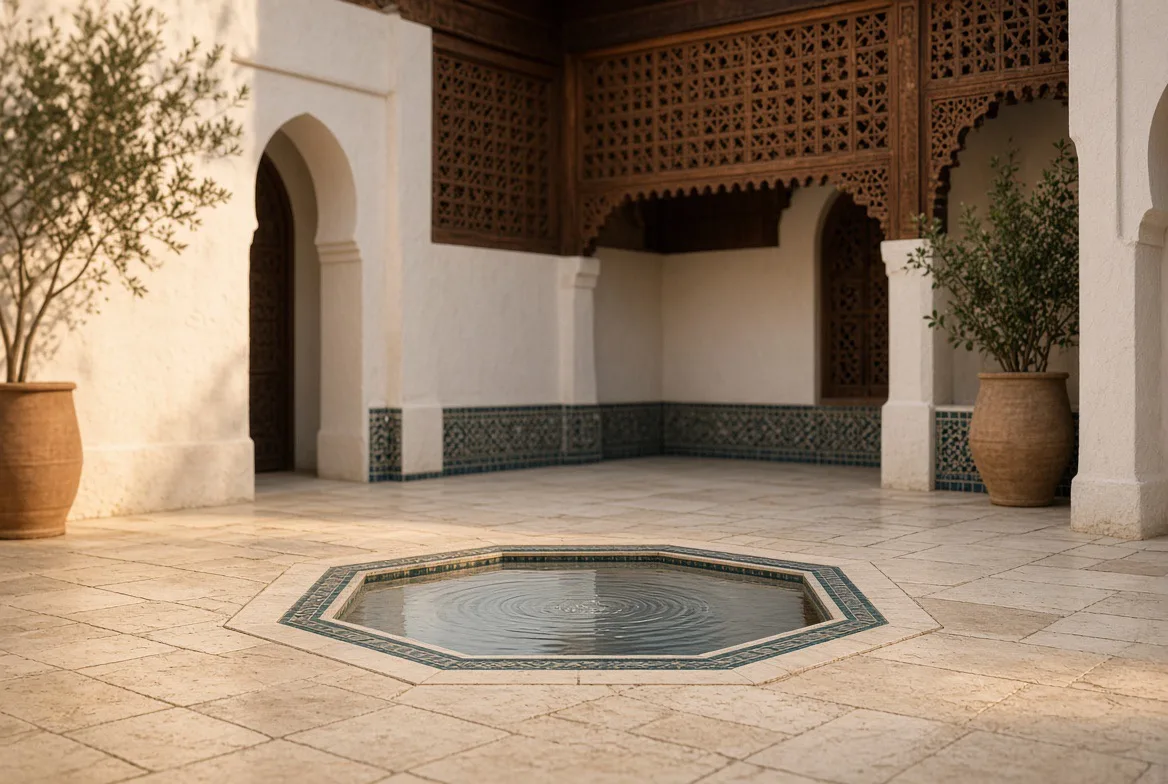
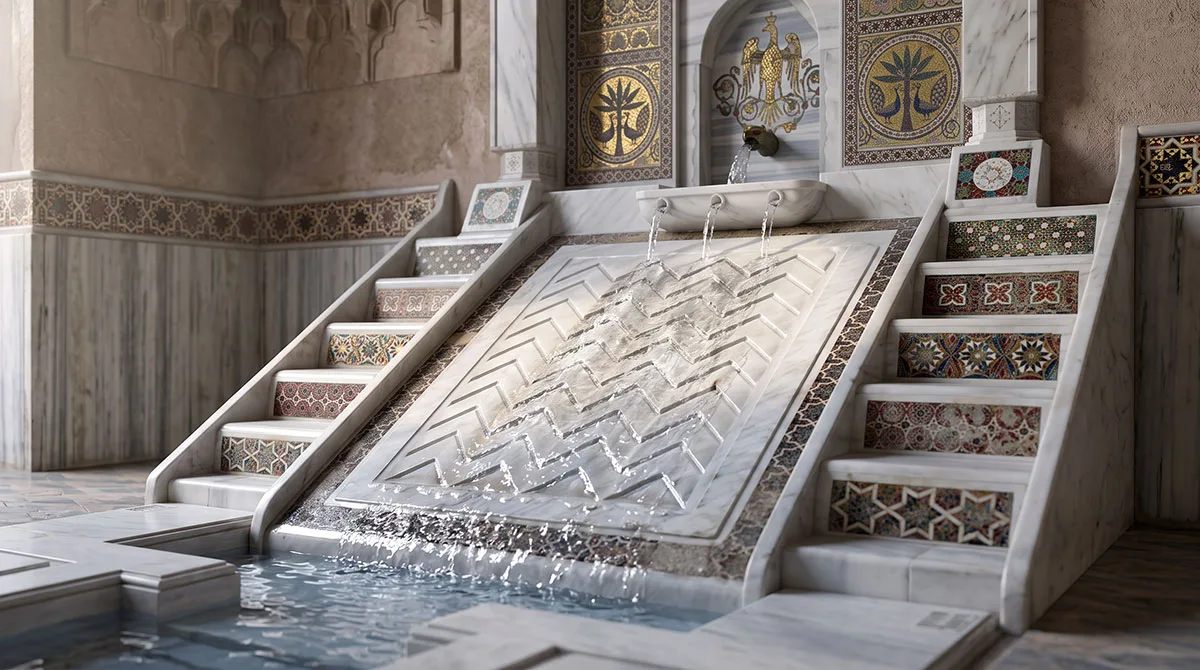
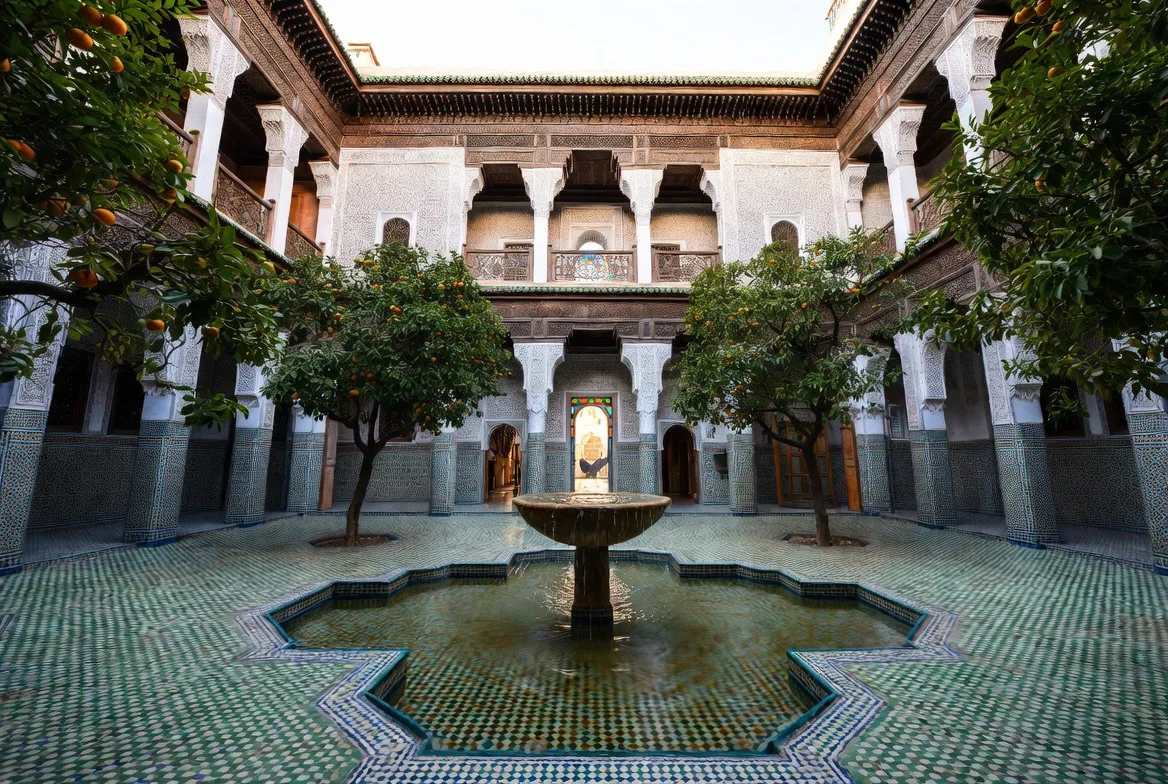
At the centre of the courtyard lies a basin flush with the floor, heir to the fisqiya of the Arab-Andalusian houses: not an inclined sheet but a surface level with the paving, which offers the air the widest expanse of water and gives the sky back to whoever looks at it. The salsabīl — a sheet of water over inclined stone, whose name is that of the spring of paradise — stands instead against the garden wall and not at the centre of the courtyard, which keeps its basin.10 An expression of rare purity survives at the Zisa palace in Palermo, where the sheet still slides down the inclined stone of the fountain hall and continues in a channel across the floor: and it is on that model, Sicilian and Arab-Norman, that the two houses of this project draw their own.
“In the silence of the night one could hear distinctly the sound of the River of Pearls, the gurgling of the fountains.”
Edmondo De Amicis, Marocco, Treves, Milan 1876, chapter “Fez” (translated from the Italian).
The River of Pearls is the Fez river, which runs through the medina.
The devices at the Riad
The fountain flush with the ground, recirculated, in shade, with a meter on the top-up. The channels and the salsabīl of the garden, active in the daytime hours when the courtyard is closed and the air still. The garden basins, reserve and presence, which feed the citrus and the aromatic plants and close the cascade. The cistern, which gathers the winter rains from roofs and terraces. And the washbasin at the entrance, where the first gesture of the house is performed. All on two separate circuits — the water one drinks and the water that works — and with a register, kept by the house, in which everyone’s consumption is written and read.
The gesture and the verse
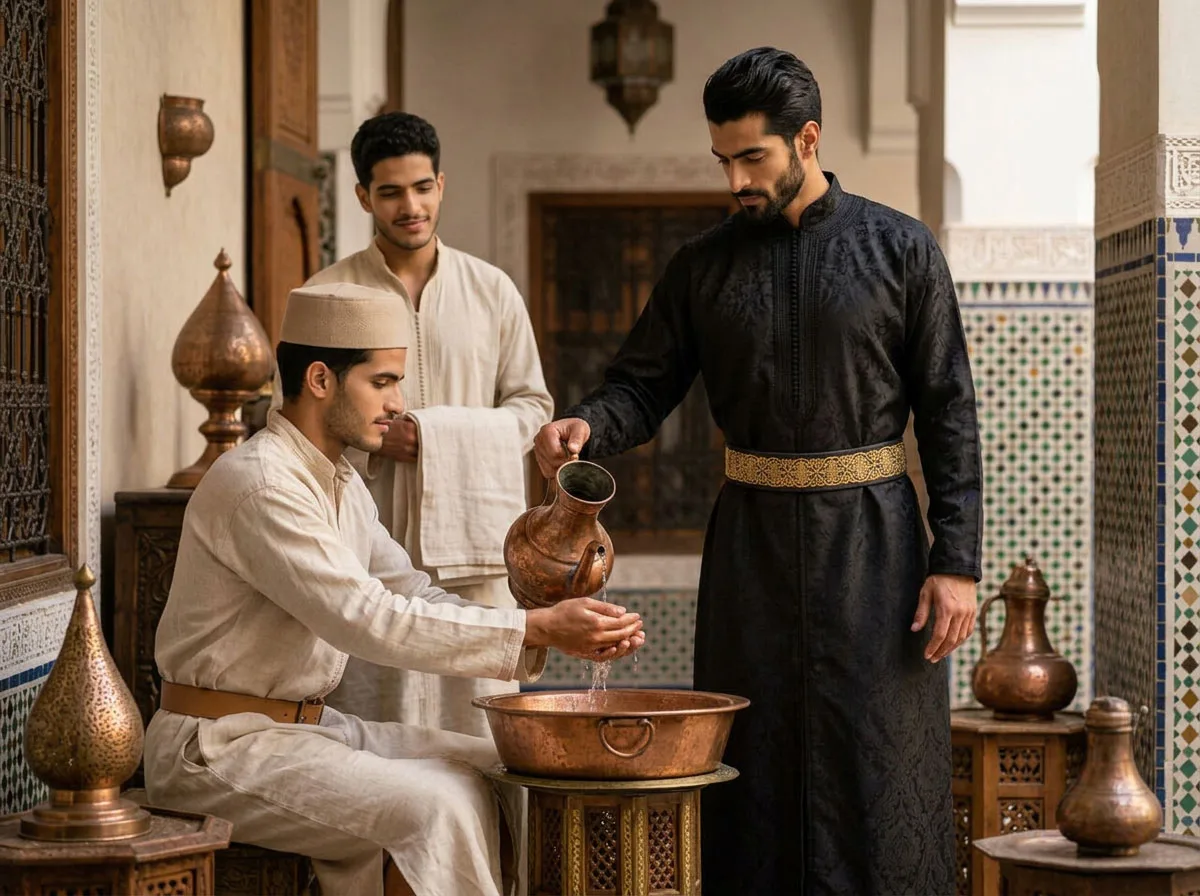
To every guest who crosses the threshold the house offers the same gesture: hands washed in rose water, poured from an ibrīq into a ṭisht, before the first word. It is a purification as much as a welcome, and not a formality: an old usage of Arab hospitality, in which scented water always preceded the meal and the conversation. Before the shade of the courtyard, before the tea, water comes first.
And it comes first in the verses too. On the rim of the Fountain of the Lions, Ibn Zamrak had a eulogy carved in which water and marble exchange their roles:
“Alike to the eye are the flowing and the solid, so that we know not which of the two is running.”
Ibn Zamrak, inscription on the Fountain of the Lions, Alhambra. Our translation; reference editions: García Gómez 1985 and Puerta Vílchez.
In Andalusian poetry water is not a technical element but a motif in its own right, worthy of song as much as the face of a beloved: the river that winds, the basin that reflects, the coolness that edges the gardens.
What those poets saw in their rivers — the curve, the reflection, the coolness — is the same thing the architect of the riad seeks to enclose in a basin of a few square metres: not water as resource, but water as presence. Only, today, to keep it one must also count it; and the house does both things together.
What is not promised
No drop in temperature in degrees is promised, because no published measurement separates the effect of water from that of mass and shade, and the house is not yet built. No consumption is promised, because the top-up depends on wind and on the hours of the water sheet, and will be known only from the meter. It is not promised that the reuse of bath water in the garden is permitted in the form described here, because that depends on local rules and on treatment. What is promised is the register, the measurement campaign from the first year, and the reading of the data by the Scientific Committee the house is now forming, with the freedom to say that something does not work.
T. Madani, L’eau dans le monde musulman médiéval : l’exemple de Fès (Maroc) et de sa région, thesis, Université Lumière Lyon 2, 2003; R. Le Tourneau, Fès avant le Protectorat, Casablanca 1949; M. Ayacine, M. El Bouchikhi, K. Obda, “Le patrimoine hydraulique de la médina de Fès et le développement durable”, Espaces 6–7 (2019); M. El Faïz, Les maîtres de l’eau. Histoire de l’hydraulique arabe, Actes Sud 2005. The counts of fountains and baths of the Almohad period, which circulate in discordant forms, are not cited until checked against al-Jaznāʾī, Janā zahrat al-ās, ed. Ibn Manṣūr, Rabat 1991. ↑
Ibn Khaldūn, *al-Muqaddima*, I, IV, 5 (ed. Shaḥāda, Beirut 1988, I, p. 434): «وأمّا جلب المنافع والمرافق للبلد فيراعى فيه أمور منها الماء بأن يكون البلد على نهر أو بإزائها عيون عذبة ثرّة…». ↑
World Bank, CCDR Maroc – Note technique: Pénurie d’eau et sécheresses, March 2023; DGM, 2024 report. ↑
C. Trillo San José, Agua, tierra y hombres en al-Andalus. La dimensión agrícola del mundo nazarí, Granada 2004; ead., “El agua en al-Andalus: teoría y aplicación según la cultura islámica”, Tecnología del Agua 271 (2006); ead., Agua y paisaje en Granada. Una herencia de al-Andalus, Diputación de Granada 2003. ↑
Ibn Mājah, Sunan, Kitāb al-ṭahāra, no. 425: “مَا هَذَا السَّرَفُ … نَعَمْ وَإِنْ كُنْتَ عَلَى نَهَرٍ جَارٍ”. Weak chain (Ibn Lahīʿa); cited as such. ↑
Targets 6.4 and 6.b of the 2030 Agenda (sdgs.un.org). ↑
Latent heat of vaporisation at 25 °C: 2 441.7 kJ/kg; FAO, Irrigation and Drainage Paper 56, table 2: ET₀ 6–9 mm/day for hot semi-arid climates. ↑
B. Jiménez Alcalá, “Natural cooling in Hispano-Moslem residential architecture: the case-study of the Court of the Lions and the Court of Comares in the Alhambra (Granada)”, PLEA’99, Brisbane 1999, pp. 399–406. ↑
L. J. García-Pulido, “The Alijares Palace (Qaṣr al-Dishār) at the Alhambra: a bioclimatic analysis”, Journal of Medieval Iberian Studies 10/1 (2016), pp. 46–71; id., “The mastery in hydraulic techniques for water supply at the Alhambra”, Journal of Islamic Studies 27/3 (2016), pp. 355–382. ↑
Corano 76:18: «عَيْنًا فِيهَا تُسَمَّىٰ سَلْسَبِيلًا». ↑
The Scientific Committee
The statements on these pages — on climate, on water, on materials — will be read, corrected and, where necessary, refuted by the independent scientific review the two houses are building from the first measurements: a single Committee for Fez and for Ragusa, whose competences are described on al-mithaq.org. It will bring together scholars of the microclimate of courtyard houses, of hydraulics and water law in al-Andalus, and of the vernacular architecture of Morocco. The Committee does not sponsor the project: it sets its measurement programme, reads the data when they exist, and is free to say publicly that something does not work. Names will be published with each member’s consent, once the Committee is formed; anyone wishing to contribute, or to report an error on these pages, can write to us.
What the house already did, said in today’s language
The targets that follow are not applied to the house from outside: they are the description, in today’s language, of a measure the city of water already knew. The tension between coolness by evaporation (goal 7) and water scarcity (goal 6) is real, and the house declares it rather than hiding it.
Lever of the house — target of the 2030 Agenda:
Recirculated fisqiya, salsabīl, rain cistern, cascade of uses — 6.4 — increase water-use efficiency across all sectors · 12.2 — efficient use of natural resources
A written rule of use, decided by the house: turns, priorities, measurement — 6.b — participation of local communities in water management
Water exposed to the air instead of the machine — 7.3 — energy efficiency · 13.1 — adaptation to climate-related hazards
The historic network of Fez and its distributors as heritage — 11.4 — safeguard cultural heritage
The words of this page are in the common glossary; the works cited in the sources; the sister house is Al-Funduq aṣ-Ṣiqillī.