Crafts of the Riad
What the house produces with its own hands and from its own garden — for the table, for the body, for hospitality.
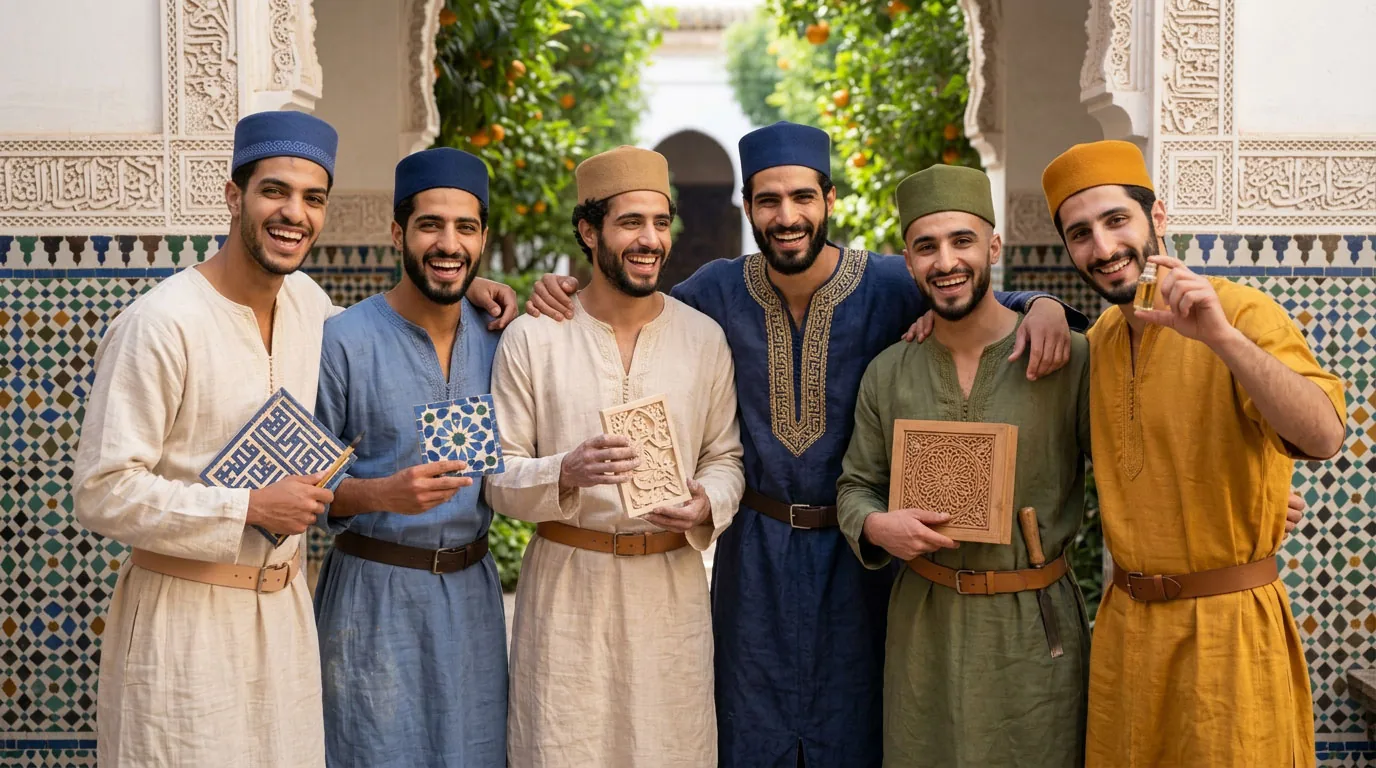
Dar al-Hiraf does not only form ṣāniʿ: products are born from it as well. Damascus rose perfume, olive oil soaps, orange blossom water distilled from the orange trees of the riad and pierced plaster pieces — each bears the mark of the house and, through its sale, sustains the life of the community.
Part of the proceeds funds the upkeep of the house; another part goes back to the craftsmen from the very first pieces sold. This craftsmanship keeps the Riad alive in part, and nothing in it belongs to the showcase.
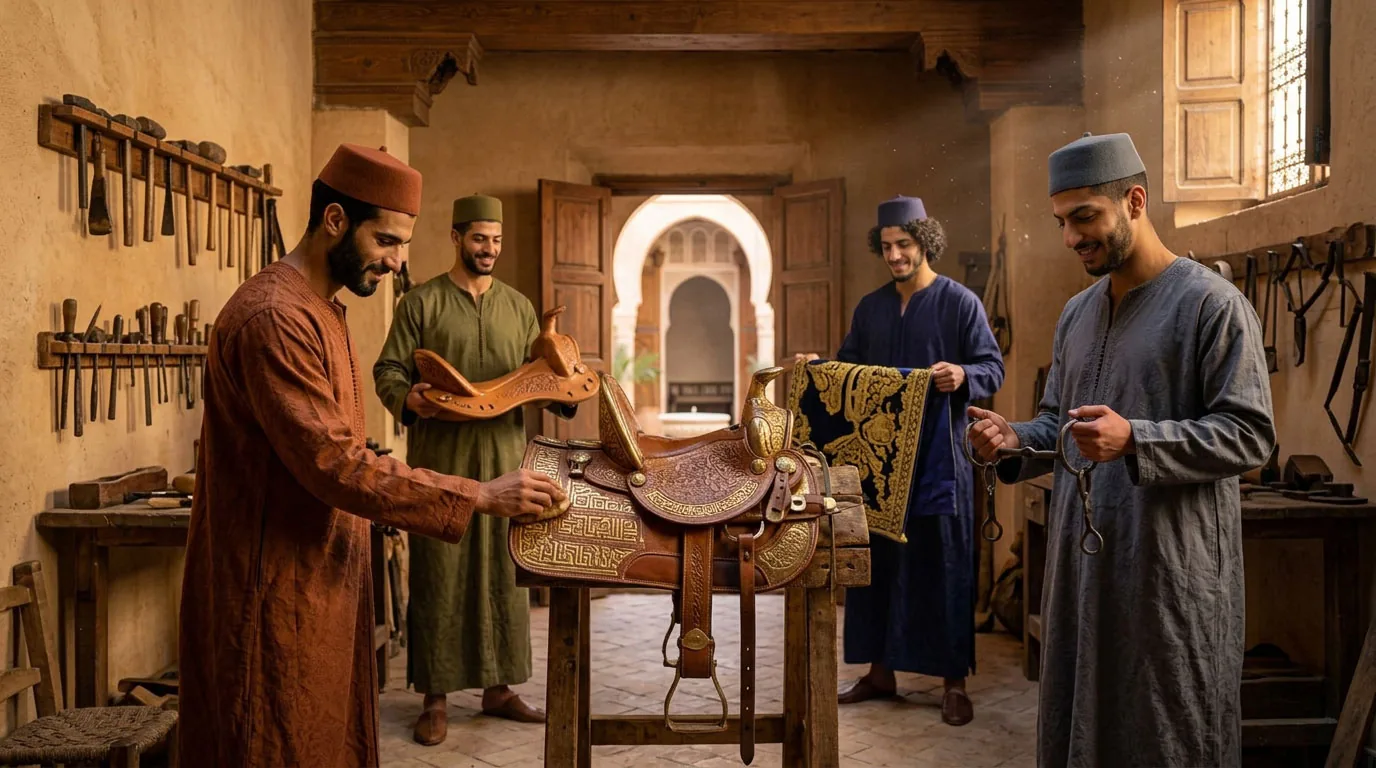
In the same measure, high saddlery and the finishing of the ʿudda — leather, metal, wood, cloth — gather several gestures on a single commission. Workshop work, not a tourist shop. → Al-ʿudda — The harness
THE CORE
The saddle and the house
One ʿudda. Leather, iron, wood, cloth — the core of Dar al-Hiraf. Workshop work, not shop work.
THE CRAFT OF SCENT
Perfumes and essences
The Moroccan art of scent is first of all a discipline of formation, on the same footing as zellige or calligraphy — the nose that distinguishes, the hand that distils, the memory that retains. What follows here are the products that come of it; the discipline itself is treated in Perfumes and essences.
إِذَا قَامَتَا تَضَوَّعَ الْمِسْكُ مِنْهُمَا نَسِيمَ الصَّبَا جَاءَتْ بِرَيَّا الْقَرَنْفُلِ
“When they rose, musk breathed from them — like the east wind laden with the scent of cloves.”
Imruʾ al-Qays, Muʿallaqa
Perfumes and body care
ESSENCE
Damascus rose perfume and rosewater
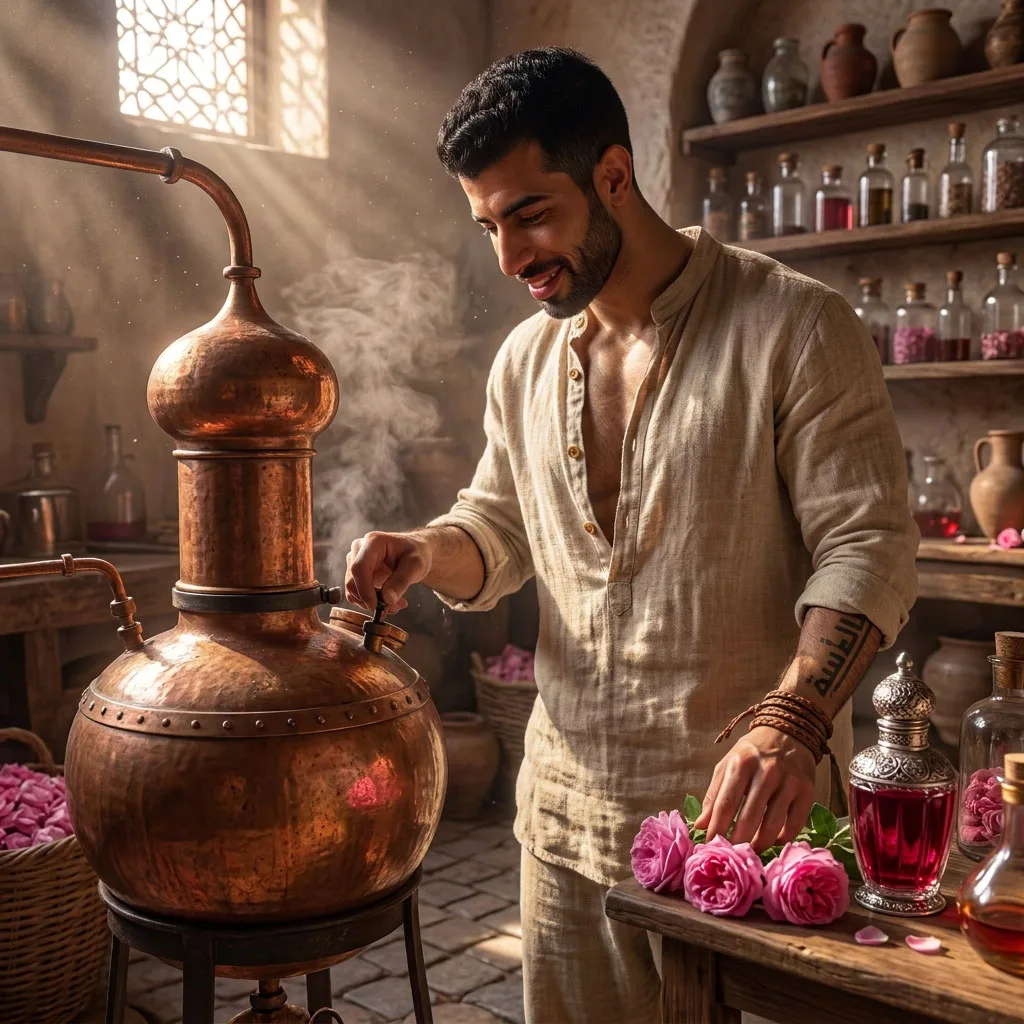
The Damascus rose (Rosa damascena), heir to the tradition of Kelaât M’Gouna and the valley of the Dadès, is distilled according to the ancient gesture. Pure rosewater for the face, the table and ritual; concentrated attar for the skin and linen.
The nose, the hand, the slow fire: what the ṣāniʿ learn in the perfume workshop becomes here a product of the house, sold under the seal of the Riad.
BODY
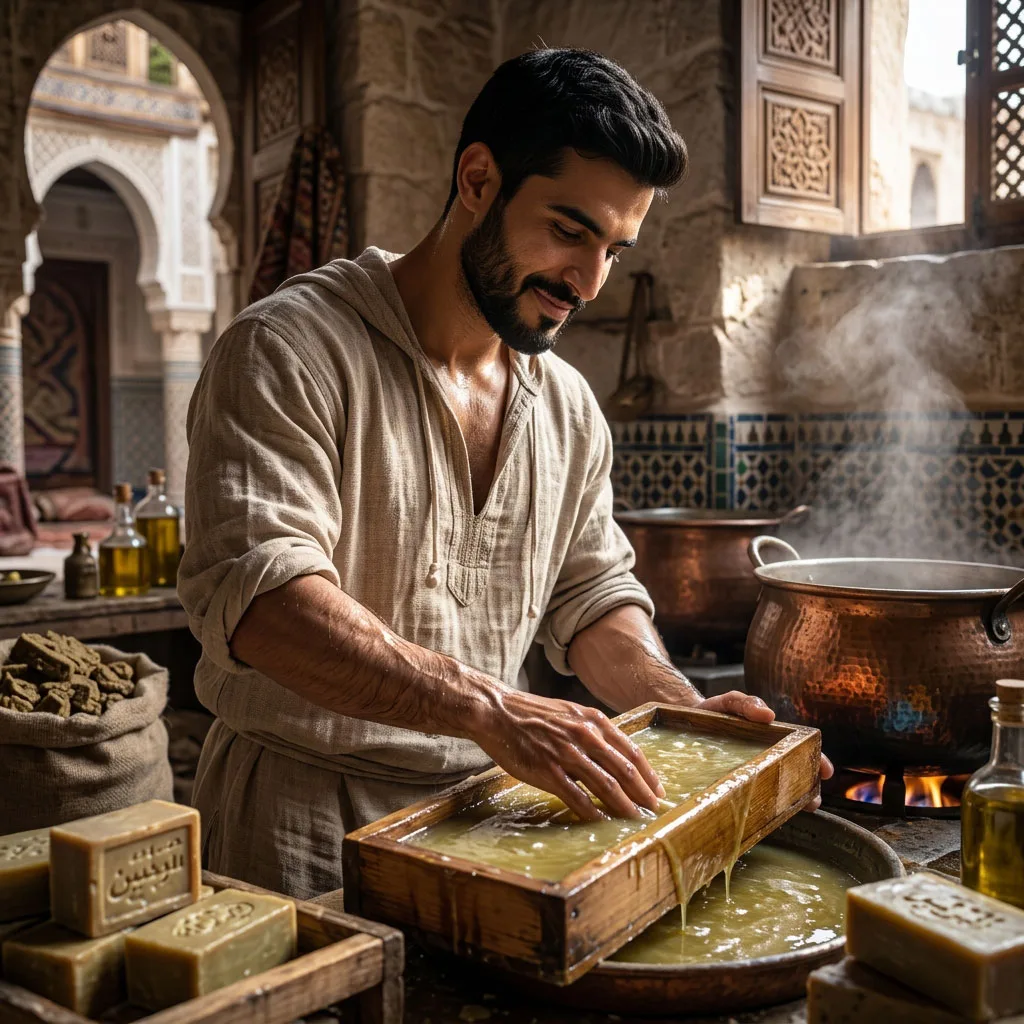
Olive oil soaps
Hard soaps and hammam soaps, made from pressed olive oil, sometimes scented with rose, jasmine or orange blossom. Simple gesture, pure matter — for the bath, the face, the hands of daily work.
They extend the logic of the formed body and of the hammam: purity, softness, nothing industrial.
GARDEN
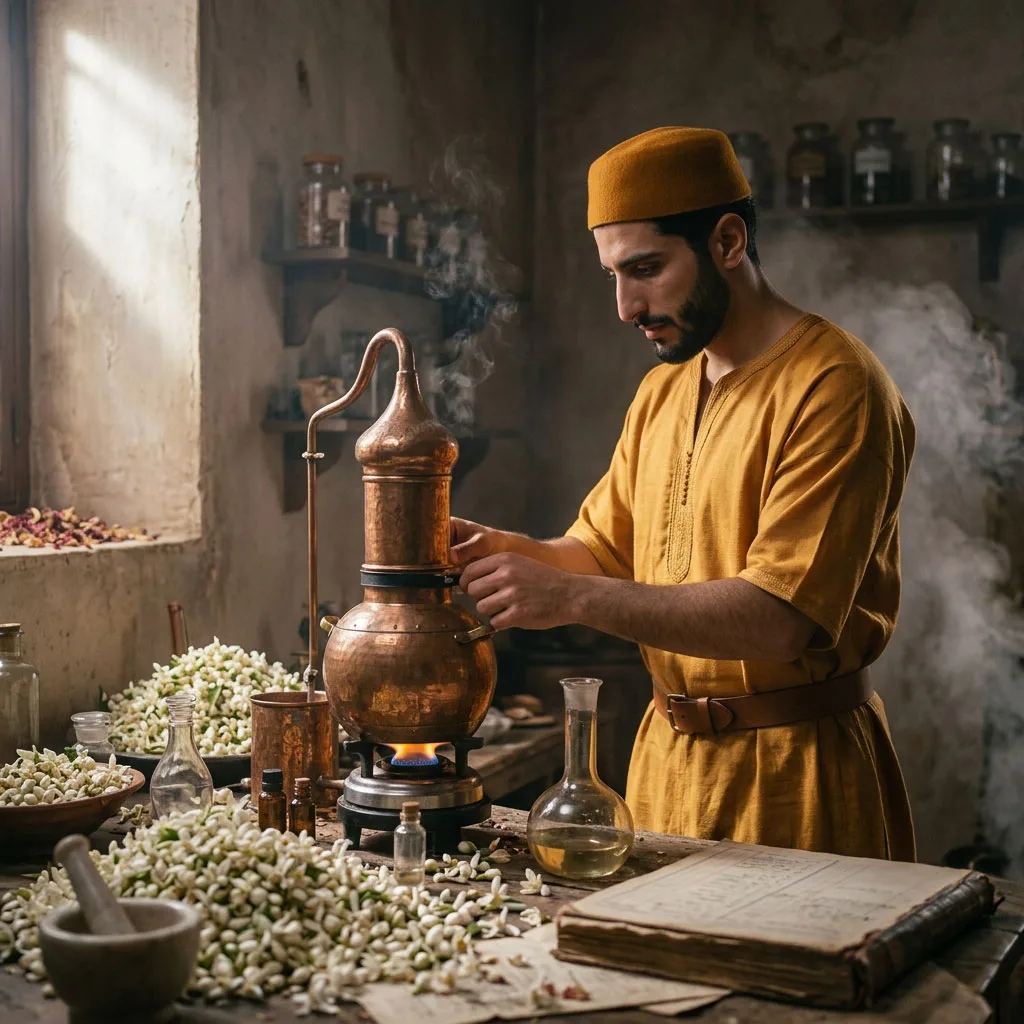
Orange blossom distillate
The orange trees of the patio and the garden give, in spring, the orange blossom. Distilled on site, it becomes orange blossom water — for pastry, tea, linen, the evening ritual.
From garden to still: the same cycle as the rose, rooted in the Riad itself.
Garden kitchen
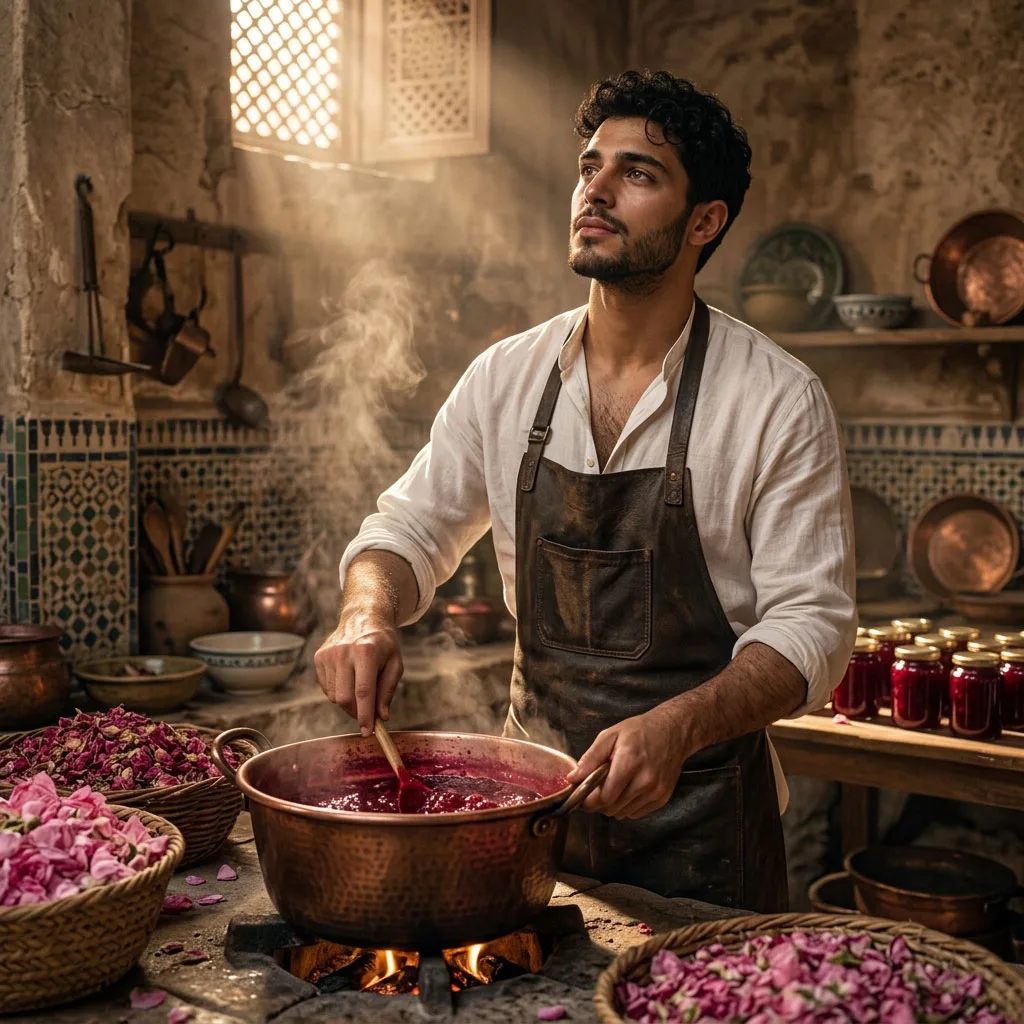
Rose jam, honey and garden herbs
Heir to Kelaât M’Gouna: Damascus rose petals, sugar, slow cooking — the same rose that gives the perfume and the rosewater becomes jam here, another face of the same matter. Alongside it, local honey and bunches of herbs from the kitchen garden — mint, verbena, thyme — dried or fresh, for the table and tea.
What the garden produces, the house puts on the table: nothing imported, nothing industrial.
Matter and hands
Carved plaster, weaving: ancient materials and gestures, for work of today, answered for by a master. The Faro Convention makes this an undertaking of its Parties:
“[The Parties undertake to] promote the use of materials, techniques and skills based on tradition, and explore their potential for contemporary applications; […] promote high-quality work through systems of professional qualifications and accreditation for individuals, businesses and institutions”
Morocco is not a Party to the Convention; we quote it as a reference of method (see The house).
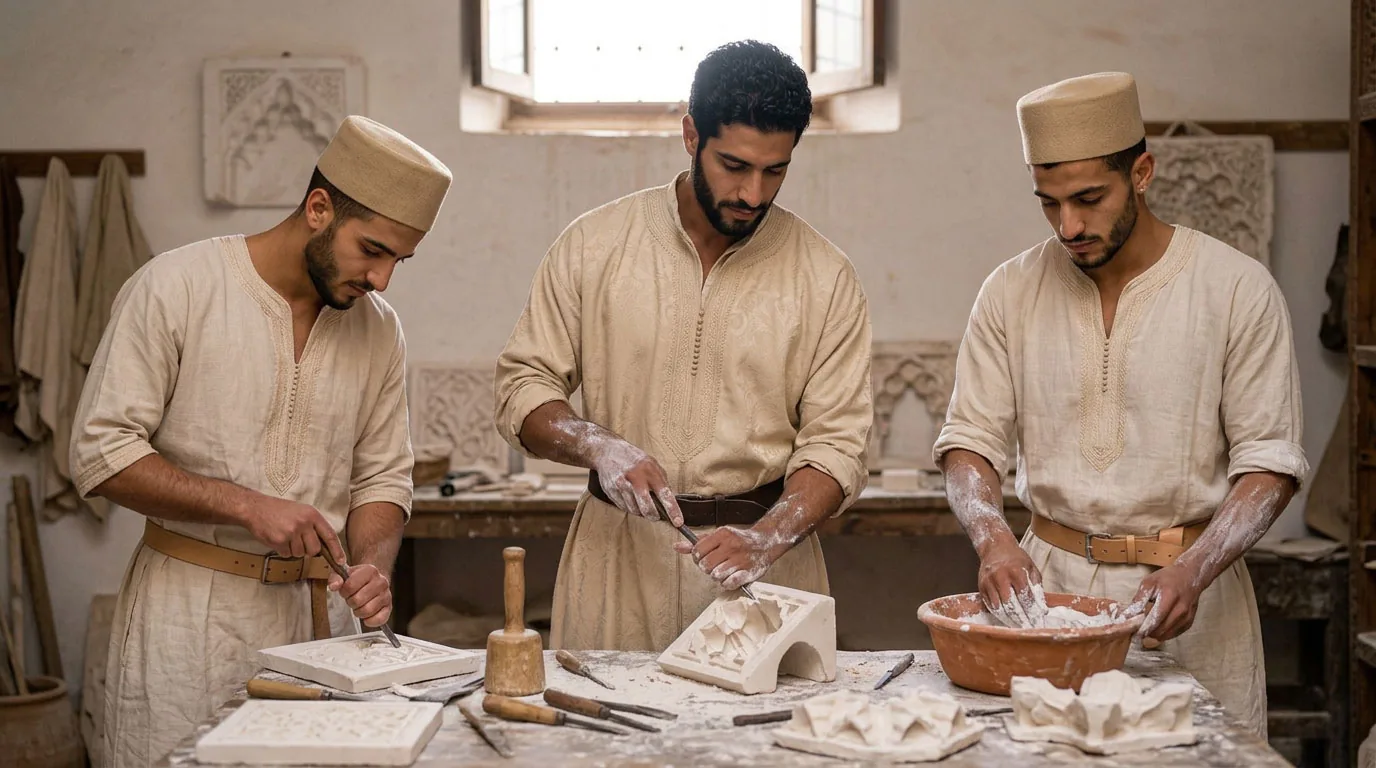
Worked plaster
Gebs — carved plaster, from Samarra to Fez
Carved Islamic stucco was born in Samarra, the Abbasid capital in Iraq in the 9th century, where excavations have uncovered three successive styles of decoration: the first two still close to the vine and plant motifs inherited from Byzantine and Syro-Palestinian art, the third — known as the “bevelled style” (the chisel’s edge cutting the material obliquely rather than at a right angle) — entirely abstract, made of rhythmic curves ending in spirals. This third style, without any earlier equivalent, marks a decisive step towards the fully developed arabesque: a motif with neither beginning nor end, endlessly repeatable, which would go on to irrigate all later Islamic art.
From Samarra, the technique spread rapidly — as far as Afghanistan (the Nine-Domed Mosque of Balkh), to Tulunid Egypt (the Ibn Tulun mosque takes up its vocabulary even in carved wood), then, from the early 9th century, as far as the Maghreb: excavations of the Aghlabid palaces near Kairouan, in Tunisia, already bear its trace.
Stucco reaches its full maturity later and farther away, in al-Andalus and then in the Marinid Maghreb. It is there that the muqarnas (مقرنص) is born — the honeycomb or stalactite cells that cover domes, portals and capitals — carried to its height in the madrasas of Fez (Bou Inania, al-ʿAttarin) where carved plaster, zellige and cedar wood are stacked on a single wall in one composition.
The Riad’s gebs (جبس) workshop takes up this gesture on a reduced scale: finely pierced plaster pieces, set with small coloured glass — the same technique that, in large format, filters the light in the rooms of the Riad, taken up here in the dimensions of a lamp or a wall panel. Each piece is unique: no pattern is ever repeated identically.
The gebs workshop, unlike the other crafts, does not form passing guests — the gesture is learned over years, within the house. But what it produces can, itself, travel.
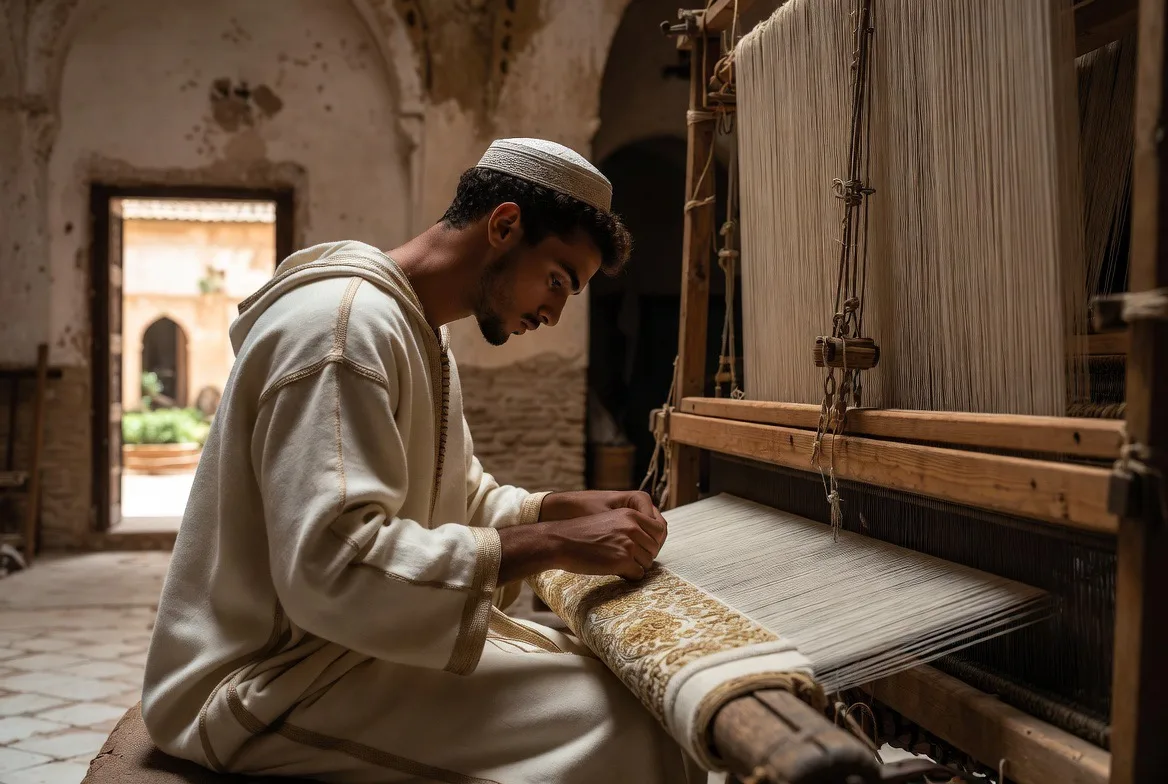
WEAVING
Woven calligraphy bands — tiraz of the Riad
On small card-weaving or tablet-weaving looms — the scale suited to a band, not a whole piece — the workshop reproduces what the state manufactories of the medieval Arab world called the tirāz (طراز): a woven inscription, in gold or silver thread on a ground of silk or linen, running along a garment or a household textile.
Three centres, three eras, one and the same institution:
The angular, sober Kufic script of the Fatimid workshops of Egypt (10th–12th c.), woven on unbleached linen.
The golden cursive script, more sumptuous, of the Nasrid tirāz of Granada — the same Alhambra already celebrated by Ibn Zamrak on the patio fountain.
And, further still, that of the mantle of Roger II of Sicily, woven in Palermo in 1133–34 by Arab craftsmen in the service of a Norman king — a lion overpowering a camel on either side of a stylised palm tree, heir to a very ancient Sassanid motif (the tree of life flanked by confronted animals), with, along the hem, a genuine tirāz inscription in golden Kufic.
Damask and lampas follow the same Mediterranean route. Damask takes its name from Damascus itself, a great crossroads of the Silk Road where merchants and crusaders discovered it in the 11th century — the technique itself no doubt goes back to China, centuries earlier. But after the 9th century, when it became scarce almost everywhere else, it was in al-Andalus that it continued to be woven without interruption, before being rediscovered in Italy and then in France from the 13th century onward.
The weavers of the Riad produce brocades and damasks, lampas and textile articles that take up ancient models and traditional motifs of the Arab tradition, unique and irreplaceable (also made to order).
الخيطُ يكتبُ ما لا يمحوه الزمانُ
“The thread writes what time does not erase.” — Weaver’s saying
Here too, no passing guest trains in it, but a slow knowledge, close to calligraphy itself, is passed on to those who stay.
Mark of the house
Every product bears the name of the Riad. Selling extends the formation, instead of constituting a parallel activity. The ṣāniʿ who has distilled, saponified, turned or sewn sees his own piece put into circulation — and a share of the return is his from the very first sales.
In this way the craftsmanship of the Riad unites three things: the gesture learned at Dar al-Hiraf, the garden that supplies the matter, and the house that lives from what it produces.
ONE CLEAR LIMIT
What does not leave the house
Everything above leaves the Riad: the essences, the soaps, the preserves, the cloth, the commissioned pieces. One thing never does — the work each resident leaves in the walls at the end of his formation, built into the building and received by his master.
It has no price because it can have no buyer. It is the one thing the house makes and does not part with.
The words of this page are in the common glossary; the works cited in the sources; the sister house is Al-Funduq aṣ-Ṣiqillī.