The formed body
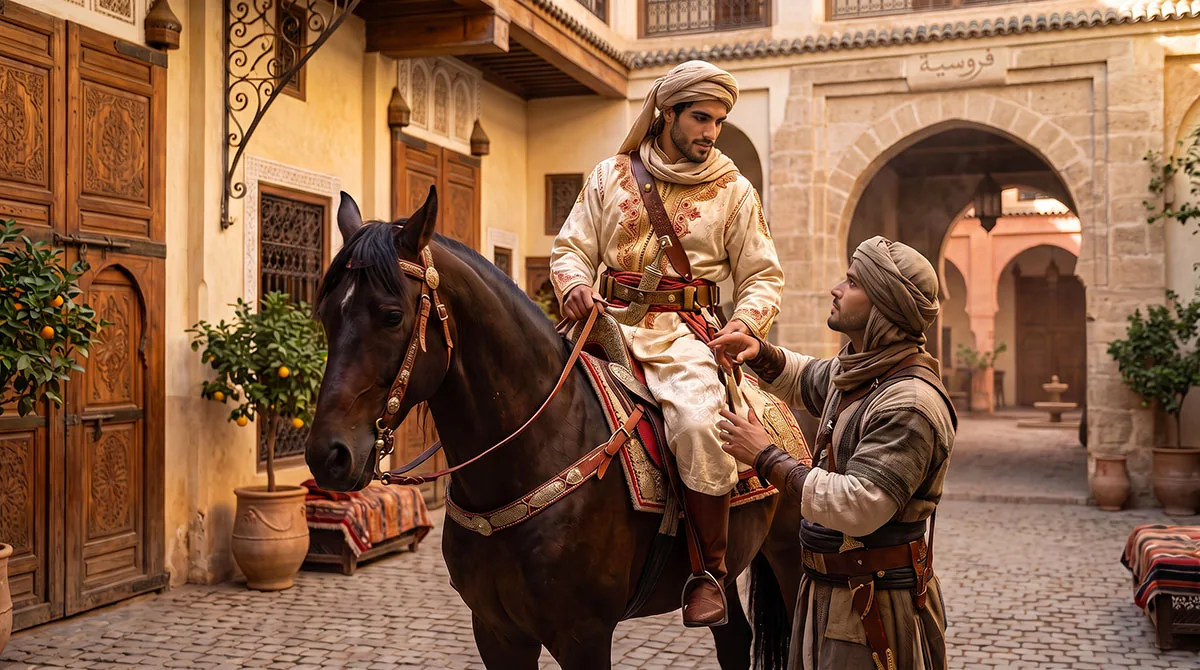
Strength, endurance, wrestling, archery, fencing — the body, far from being an accessory of the craft, is an instrument of presence and discipline.
These disciplines belong to furūsiyya, the Arab-Islamic chivalric tradition that united body, bow, wrestling and sword under a single system of formation. Before specialising, the body first had to be made capable: suppleness, endurance, resistance.
Ibn al-Qayyim, in his treatise al-Furūsiyya al-Muḥammadiyya (الفروسية المحمدية), made of it a spiritual discipline as much as a physical one. Dar al-Hiraf follows the same order: the body is formed before it specialises.
The word that names this training already says the essential. Riyāḍa (رياضة) comes from rāḍa, to school a mount without breaking it; from the same root come rawḍa, the garden, and its plural riyāḍ, which names this house. A body is formed as a horse is schooled and as a garden is kept: by a patient constraint that breaks nothing. This is why the house speaks of riyāḍat al-badan, the training of the body, and not of sport. Furūsiyya remains here a martial art and the spiritual discipline of the mount.
إِنَّ لِجَسَدِكَ عَلَيْكَ حَقًّا
“Your body has a right over you.” — Prophetic tradition, Ṣaḥīḥ al-Bukhārī, no. 1975
The words were addressed to a man who fasted every day and kept vigil every night. They belong to a series — “your body has a right over you, your eyes have a right over you, your wife has a right over you” — and make the formation of the body a matter of justice before it is a matter of strength. The body here is a due, and neither an obstacle to mortify nor an instrument to flatter.
اللهمَّ كما حسَّنتَ خَلْقي فحسِّنْ خُلُقي
“O God, as you have made my body beautiful, make my character beautiful.” — Ibn Masʿūd, Musnad of Ahmad

BODY
Physical discipline
Harmonious training, controlled strength, endurance.
وَإِذا كانَتِ النُّفوسُ كِبارًا تَعِبَتْ في مُرادِها الأَجسامُ
“When souls are great, bodies labour to the measure of their desire.” — al-Mutanabbī
The body is schooled because a soul that aims high needs a body capable of carrying it, and never for its own sake. Endurance prepares the young man to meet, over time, the demands of the craft, of prayer and of the family to come.
This demand joins furūsiyya, the Arab-Islamic chivalric tradition that reached its height under the Mamluks, in Egypt, in the fourteenth century. Before specialising — bow, sword, wrestling — the body first had to be made capable. Ibn al-Qayyim, in his treatise al-Furūsiyya al-Muḥammadiyya (الفروسية المحمدية), made of it a spiritual discipline as much as a physical one. Dar al-Hiraf follows the same order: the body is formed before it specialises.
EQUITATION
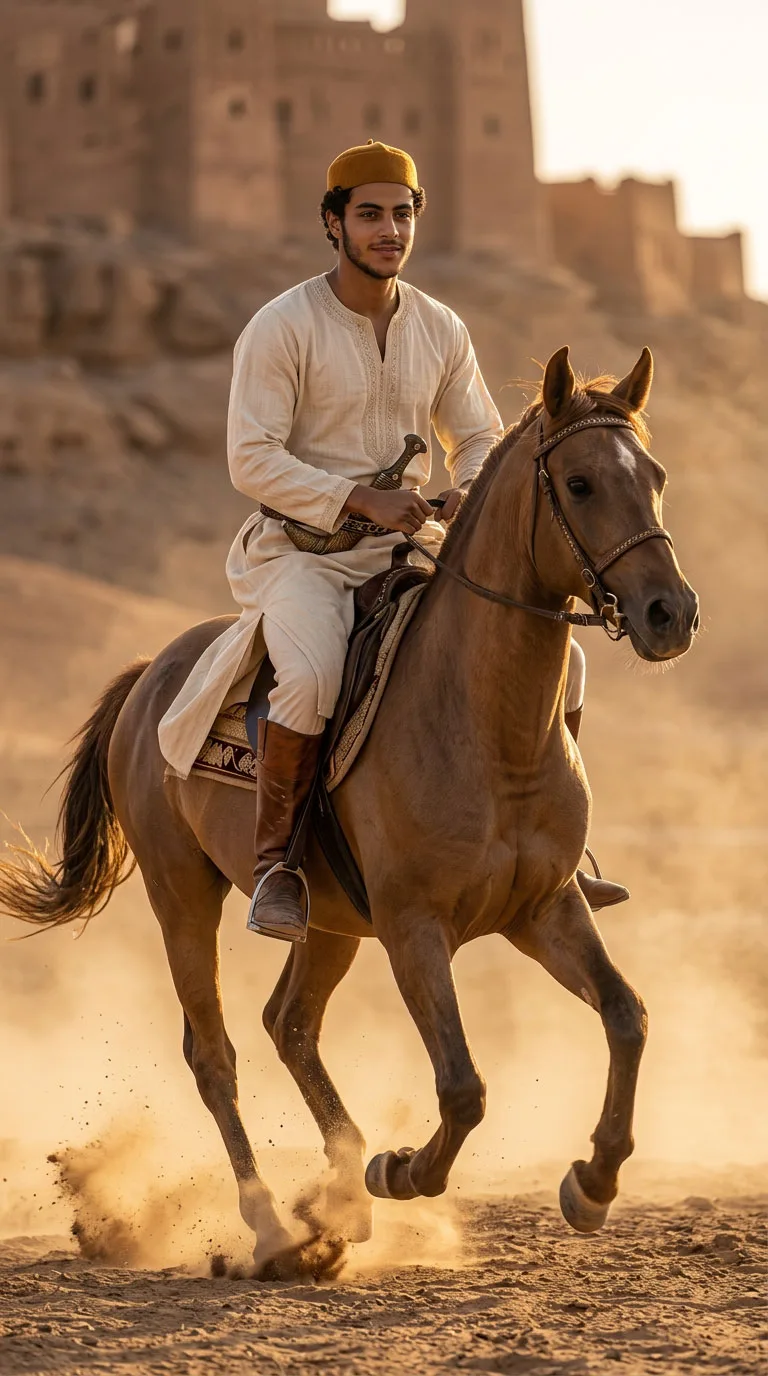
Furusiyya — the art of the horse
The word furūsiyya (فروسية) comes from faras (فرس), the horse: in the strictest sense of the term, even before wrestling, the bow or the sword, furūsiyya designates horsemanship itself. It is the first and oldest of the Arab-Islamic chivalric disciplines — the one that gives its name to all the others.
الخَيْلُ مَعْقُودٌ فِي نَوَاصِيهَا الْخَيْرُ إِلَى يَوْمِ الْقِيَامَةِ
“Good remains tied to the forelock of horses until the Day of Resurrection.” — Prophetic tradition, Ṣaḥīḥ al-Bukhārī, no. 2850
The classical treatises of furūsiyya, systematised especially under the Mamluks, taught seat, handling and care of the horse even before mounted combat — the same progression Dar al-Hiraf applies today: the body, then the horse, then the weapon.
What is placed on the horse figures what the house places around the man. The ʿudda — bit, saddle, leather, metal, parade cloth — is the point where several crafts meet, and nothing of an accessory. A single piece of high saddlery calls for the maalem of leather, the maalem of iron and chasing, the maalem of textile. Work to commission, with no tourist window: a piece commissioned because it lasts, and shown because it honours the one who made it.
For the patron, the return lies far from any logo. It is first the worksite of the complex: hands from Fez — or, failing that, from the Kingdom — employed in the restoration, not sent elsewhere. It is then young men who learn crafts still alive but close to breaking, and who build their future upon them. It is finally, for the other craftsmen of the city, the spur of Dar al-Hiraf: a house that works to the measure of the craft obliges those around it to raise their quality, not to lower their price. And it is the choice of another way: neither the luxury resort already seen, nor the riad for indifferent tourists, nor the restaurant that could stand anywhere. Lustre can still be given to Fez and to the Kingdom — on condition of supporting what forms men and perpetuates a craft, not what copies an imported model. To support here is to commission work and open a way — not to buy a shop window.
The detail of each piece, and its figure for character, are set out on the page of the tack.
→ Al-ʿudda — The tack
WRESTLING
Wrestling and strength
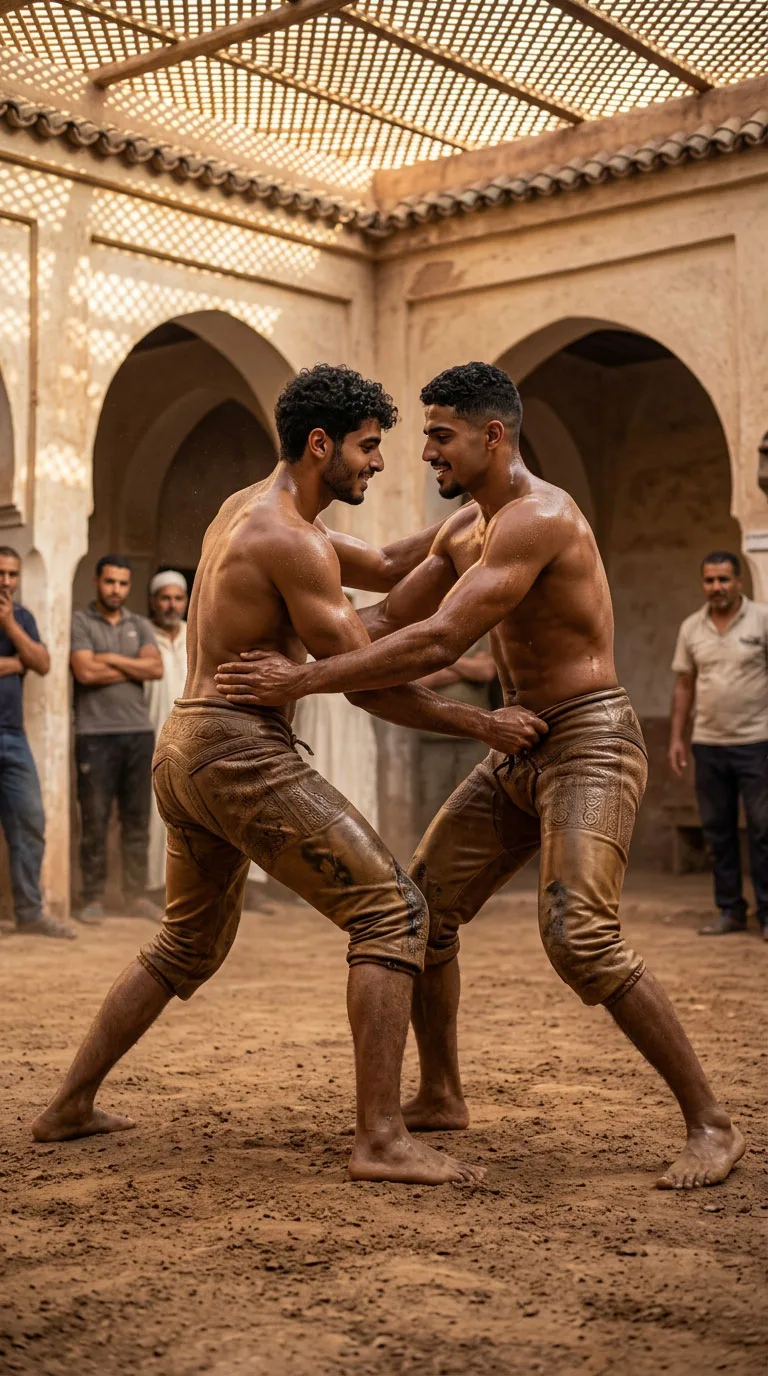
Body to body, respect, measure. A tradition of formative combat.
وَلَقَدْ شَفى نَفسي وَأَبرَأَ سُقمَها قَولُ الفَوارِسِ وَيْكَ عَنتَرَ أَقدِمِ
“My soul was healed, its ailment cured, by the horsemen’s cry: ‘Courage, Antar, advance!’” — ʿAntarah ibn Shaddād
Wrestling does not teach violence, but its opposite: respect for the exact measure, mastery of the gesture that could wound and does not. Body to body with a brother — a school of restraint as much as of strength.
This practice belongs to a tradition far older than the Riad: muṣāraʿat al-nūba, Nubian wrestling, practised since ancient Egypt — traces of it are already found in pharaonic tombs — and still alive today in Sudan, where it remains, after football, the second public discipline of the body. On a sand floor, without submission or pinning to the ground: only the controlled fall of the opponent counts.
To this standing wrestling, Dar al-Hiraf adds a second form, of a distinct lineage: ground wrestling, in worked leather trousers inspired by the kispet of Ottoman wrestling (yağlı güreş) — an agonistic tradition also documented for centuries, but foreign to the muṣāraʿat al-nūba described above. The two traditions are not confused: the first is practised standing, on sand, without ground work; the second is devoted precisely to it. Dar al-Hiraf keeps them side by side rather than merging them into one — two schools, two gestures, the same demand for measure. The ground form remains reserved for the internal context of training, never for occasions of public display.
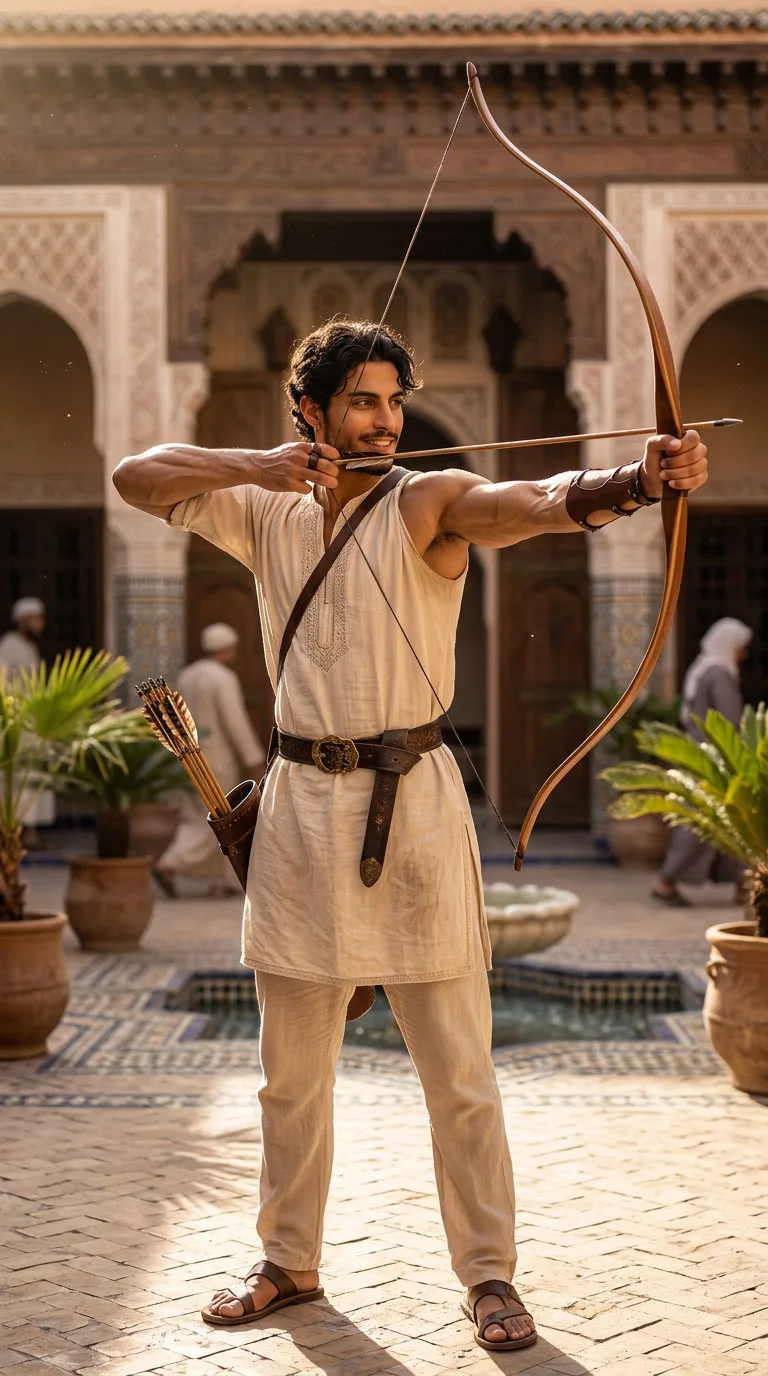
RIMĀYA
Archery
Rimāya. Breath, aim, stillness before the gesture. A discipline of measure as much as of strength.
وَالسَّهْمُ لَولا فِراقُ القَوسِ لَم يُصِب
“The arrow, without leaving the bow, would not reach its target.” — al-Shāfiʿī
Archery forms the mind more than the arm: inner stillness before any outer movement, total attention given to a single instant. A discipline of concentration and restraint.
Rimāya was one of the oldest arts of furūsiyya, practised from the dawn of Islam and systematised by generations of masters, especially under the Mamluks. One taught there less how to hit the target than how to master body and breath in the instant before the shot: the same inner discipline Dar al-Hiraf seeks today.
COMBAT ARTS
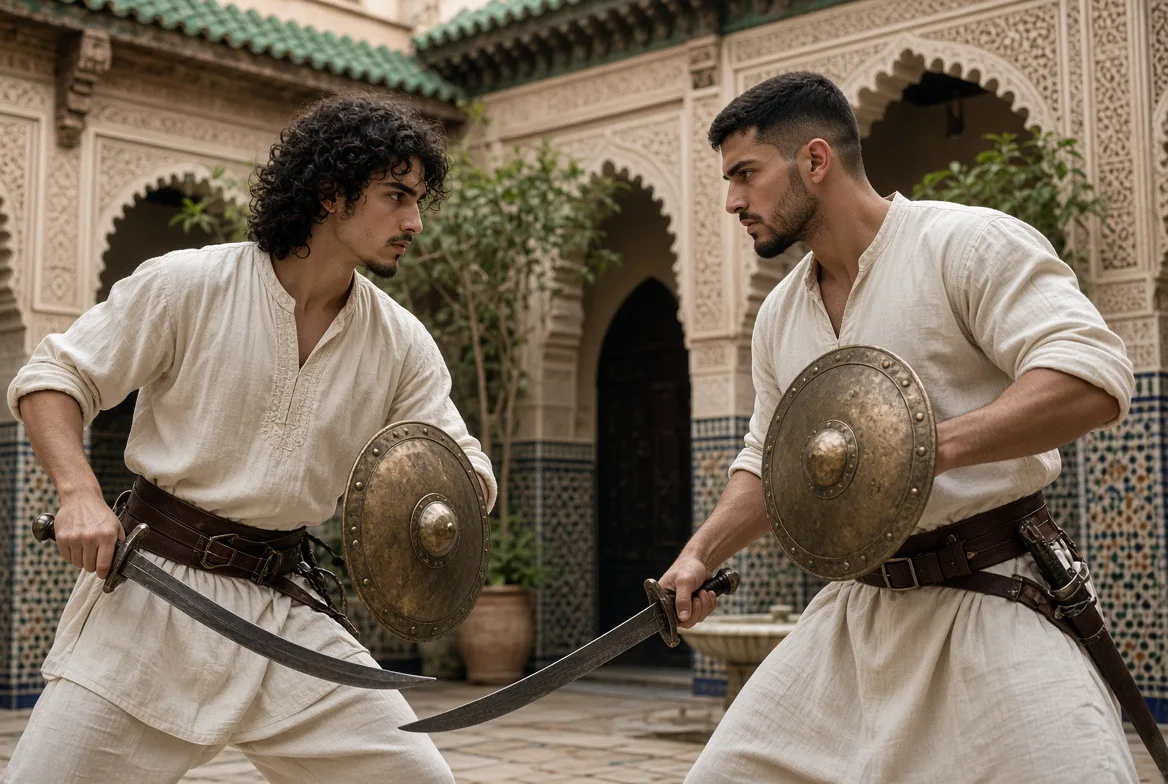
Sayf wa-l-turs — the sword and the shield
Traditional fencing with the curved sword and the small round shield, attested among the medieval Arabs alongside the lance and wrestling. Two men, two blunted blades, the guard that protects as much as it threatens — the same spirit of measure as taḥṭīb, but carried by iron rather than wood. It belongs, like the bow and wrestling, to the lineage of furūsiyya — formation of the body before any specialisation.
الخيلُ والليلُ والبيداءُ تعرفني والسيفُ والرمحُ والقرطاسُ والقلمُ
“Horses, night and the desert know me — the sword, the lance, the paper and the pen.” — Abū al-Ṭayyib al-Mutanabbī, tenth century
This verse, one of the most famous in all Arabic literature, says everything: mastery of the sword is never separate from mastery of the pen. The formed body and the cultivated mind are one and the same discipline.
No dedicated garment is cut for this discipline: the same basic gandora suffices, sleeves rolled and fastened above the elbow to free the gesture, and a reinforced belt with a double loop to hold the scabbard. Only the turs (تُرس, the shield) has its own construction — leather stretched over a wooden core, adorned with an eight-pointed star, held by a forearm strap and a central grip.
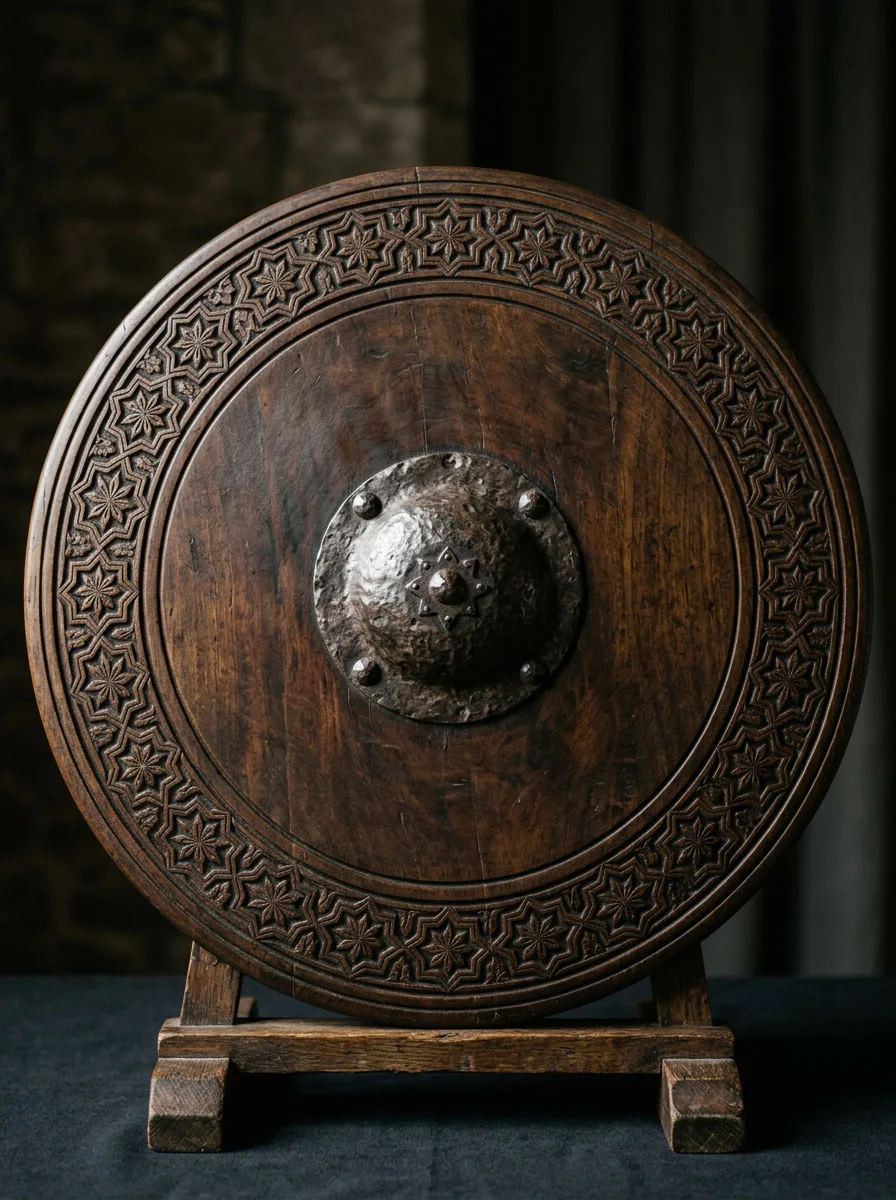
Turs — front face, eight-pointed star
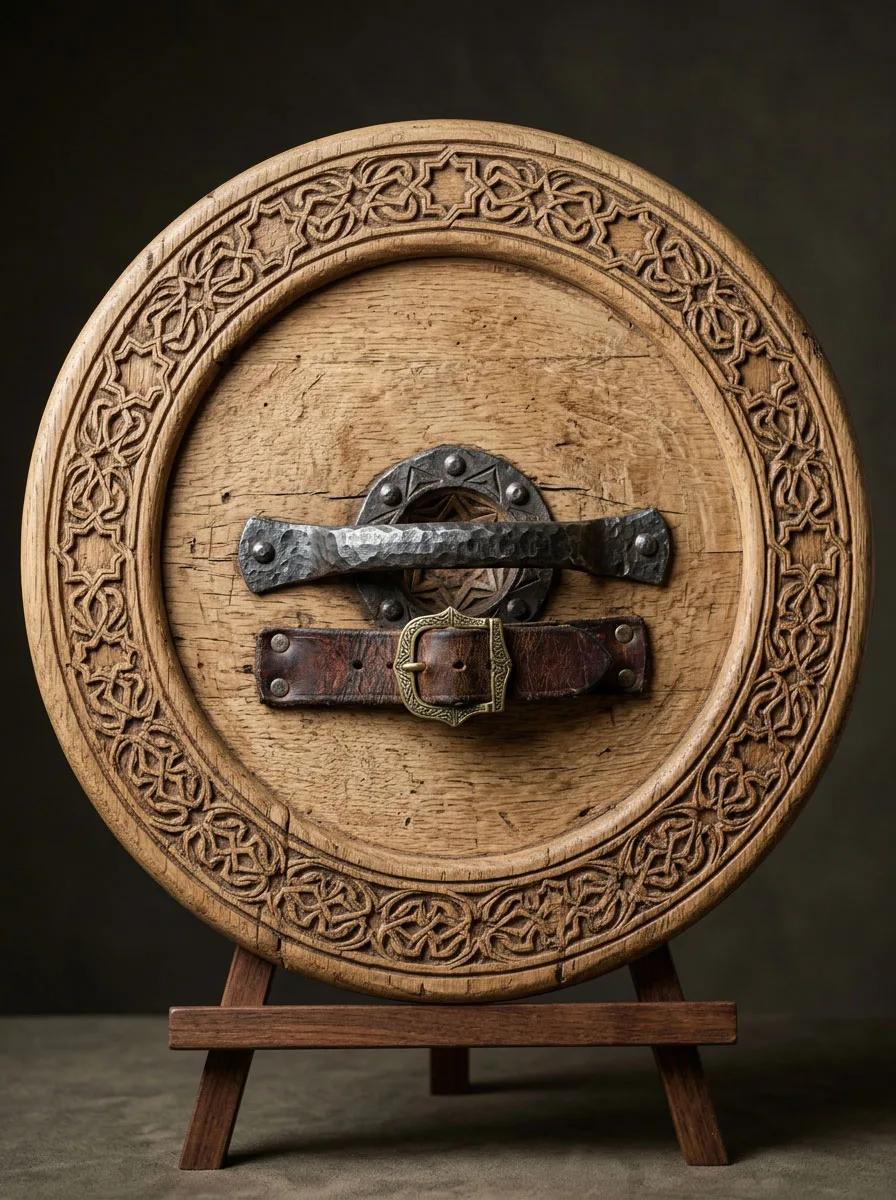
Turs — back, grip and strap
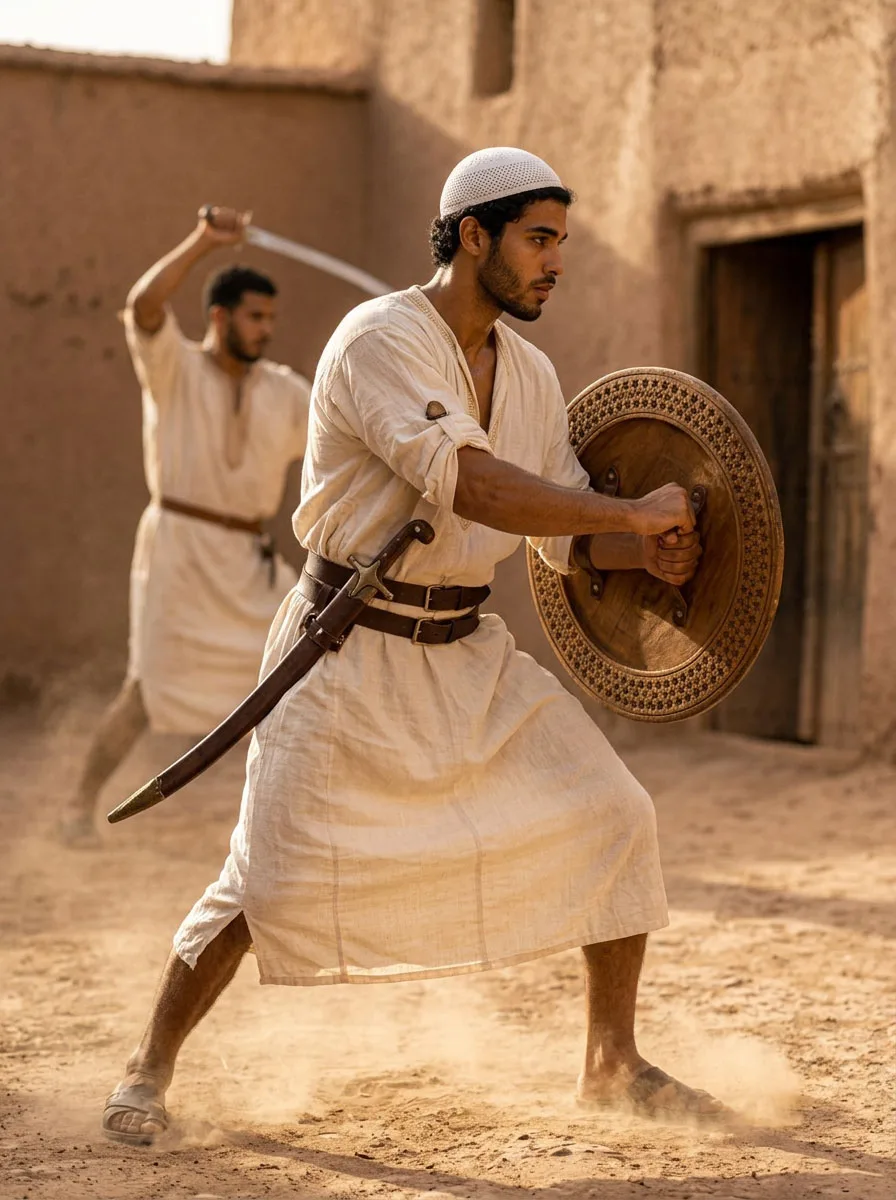
Sayf wa-l-turs — training with sword and shield
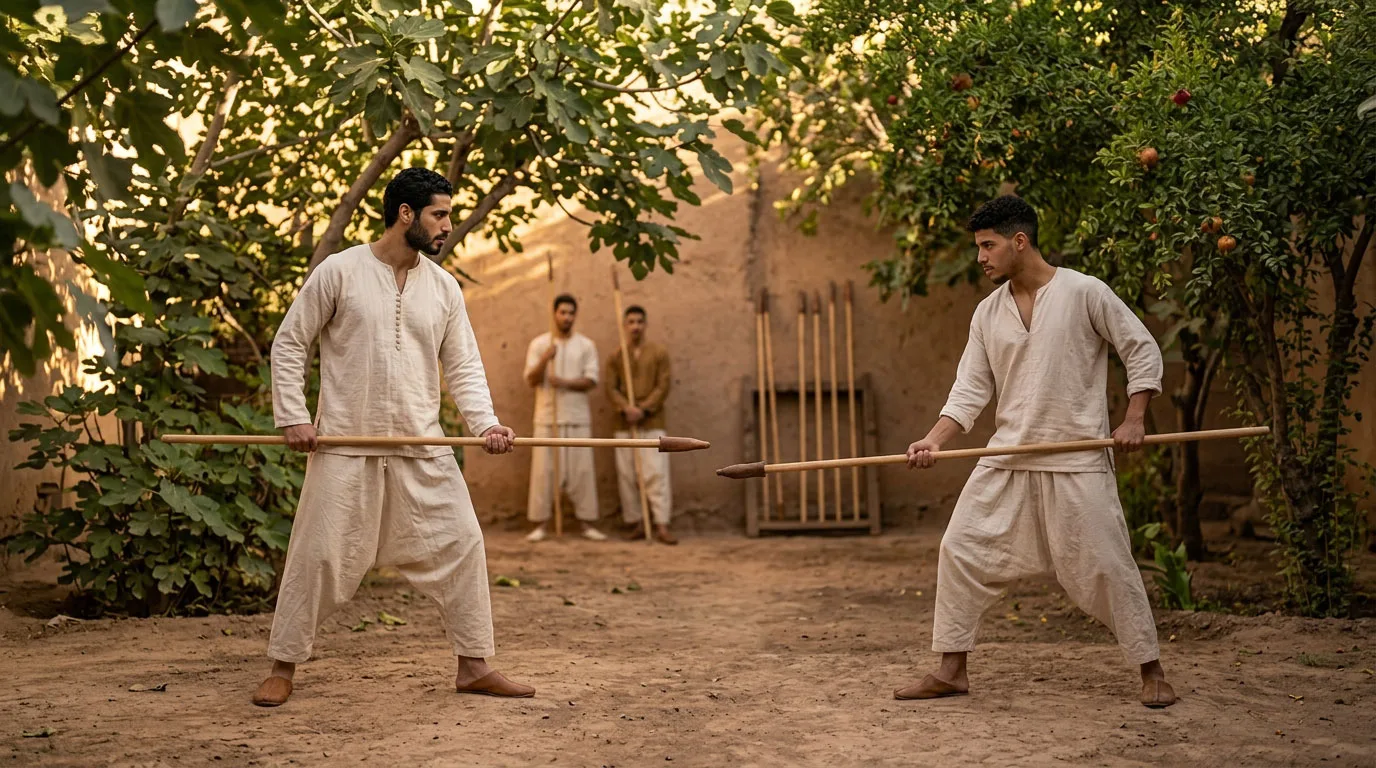
THE MEASURE AT THREE PACES
Ar-Rumh — the lance
The fourth art of the canon of furūsiyya was still missing from the house. Ibn Akhī Hizām placed the play of the lance at the summit of the rider’s science, and the Mamluk manuals, the Nihāyat as-sūl as well as the seventy-two bunūd of Najm ad-Dīn al-Aḥdab ar-Rammāḥ, devote more exercises to it than to any other weapon. What the lance teaches and the three other disciplines do not can be stated as a distance: the bow trains the instant that precedes the gesture, wrestling the body against the body, the sword the measure at arm’s length, and the lance the measure at three paces.
A man learns there to occupy the three metres in front of him without throwing himself into them, to read the man opposite before the bodies meet, and to carry his eye where the shaft will go rather than where it stands. It is a discipline of the eye as much as of the arm, and it is practised slowly enough to be useless as a display.
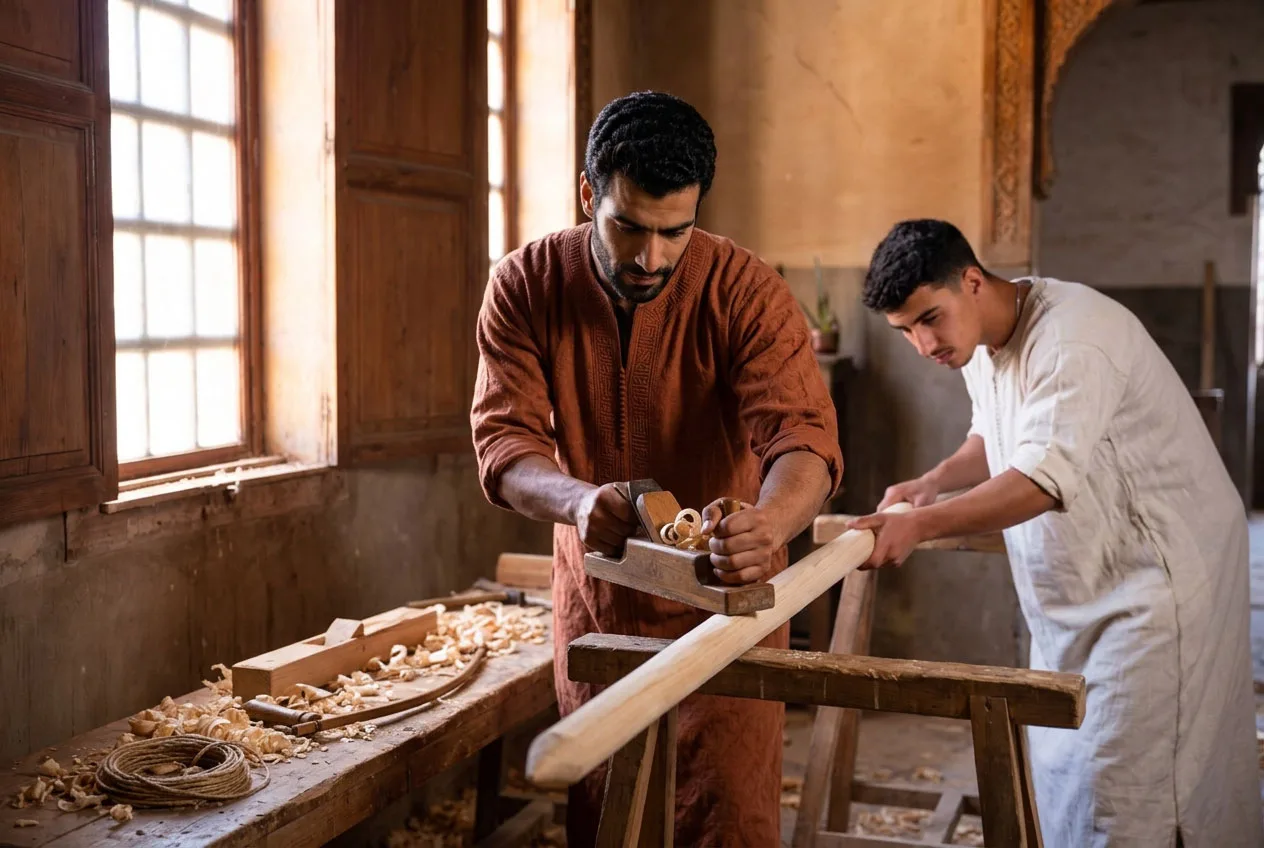
The shafts come out of the wood workshop, planed straight and checked along their whole length.
The ash is turned, planed true and then checked by the very man who will use it, and this arrangement is in no way a saving: the workshop of the house makes the instruments of the disciplines the house teaches, in the same way as the saddlery supplies the horse’s ʿudda. A shaft made here and broken at the first exercise is made again here.
الثِّقافُ ما تُسوَّى بِهِ الرِّماحُ، وَتَثقيفُها تَسوِيَتُها
“The thiqāf is that by which lances are straightened, and to straighten them is called tathqīf.” — Lisān al-ʿArab
The root th-q-f denotes first of all this work of the bench, the warped wood passed and passed again through a pierced block until it runs true, and it is on that root that contemporary Arabic formed thaqāfa, the word that now means culture. The filiation asks to be stated with care, since the modern sense is recent and follows a calque, but the lesson of the classical dictionaries admits of no dispute and the gesture they describe is exactly the joiner’s.
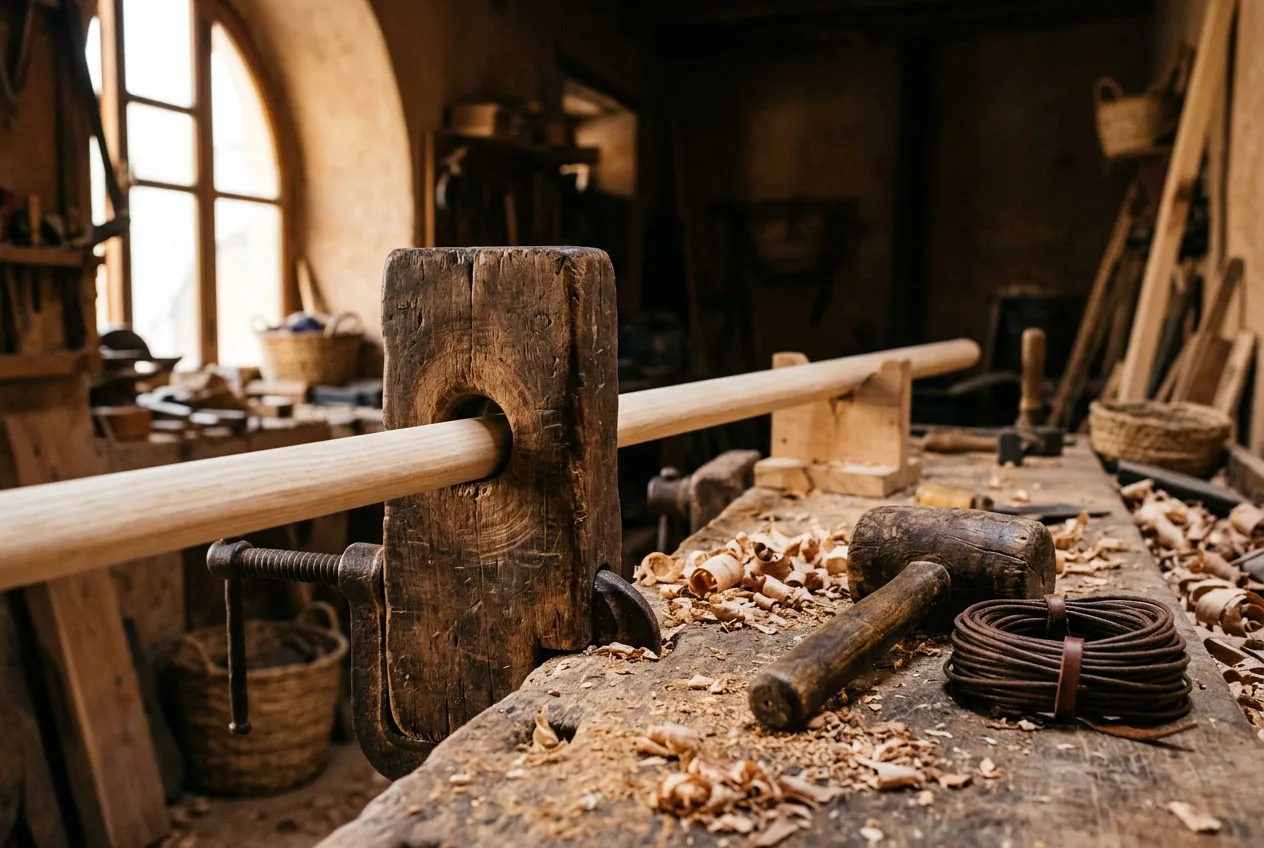
The thiqāf, a pierced block clamped to the bench, in which the shaft is straightened.
The first year is done on foot, in the shaded part of the garden and on beaten earth, at two sessions a week at the close of riyāḍa, never on the day of ground wrestling. The shafts measure between two metres twenty and two metres eighty, carry a rounded butt or a stitched leather cap, and never receive iron. Mounted work, with the rings and the birjās, will come later and outside the medina, on the riding ground, once the seat is secure: the horse must first accept the shaft around its head and flanks, and that is obtained in the stable, over several months.
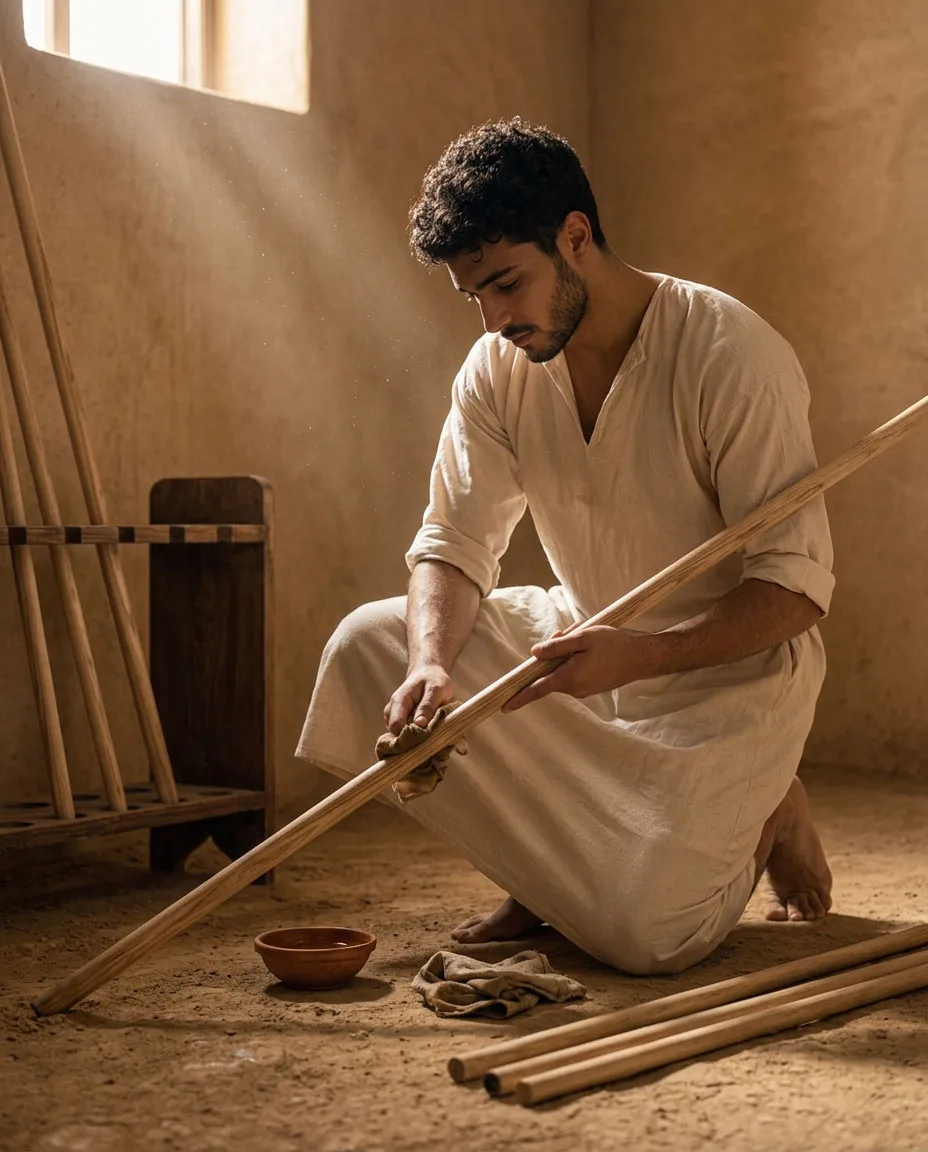
The muʿāwin oils the wood and looks for cracks before the session.
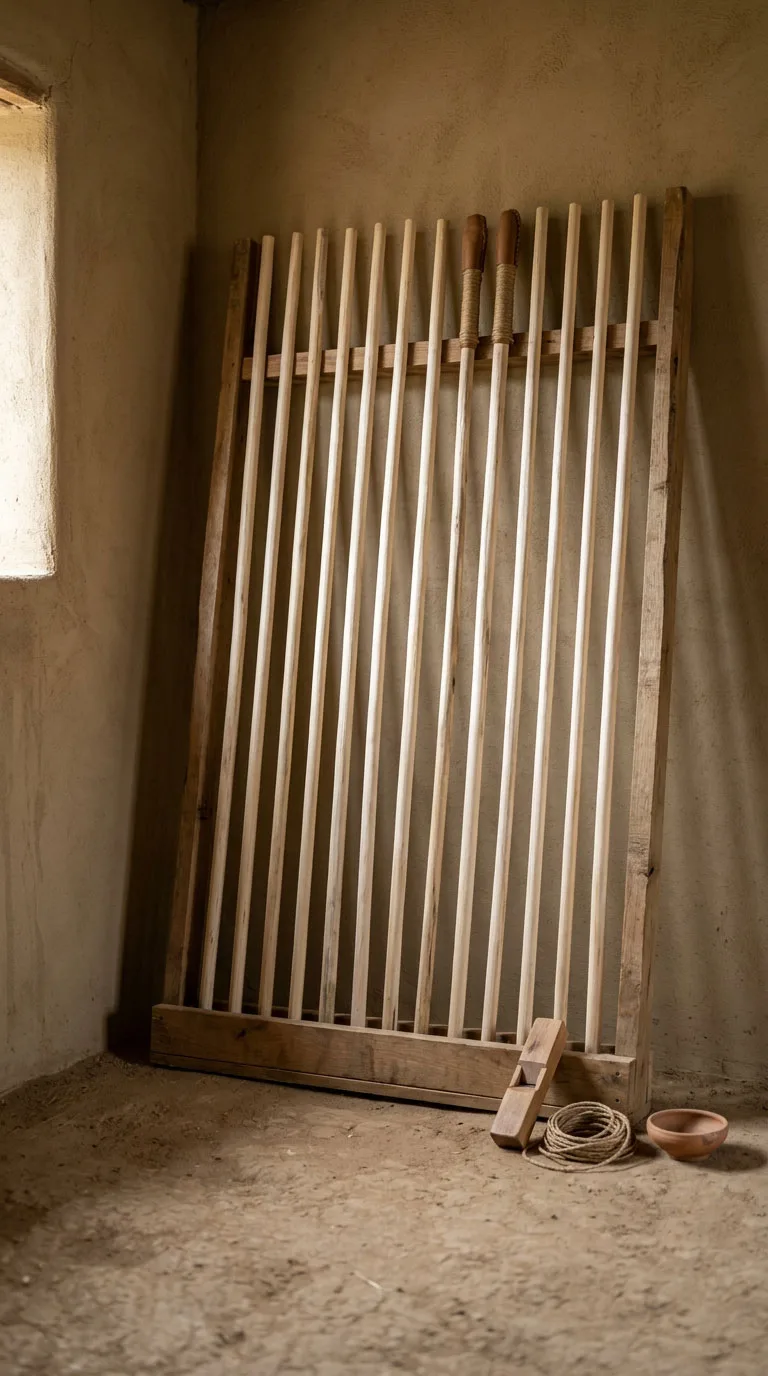
The rack, made by the wood workshop, where the shafts stand upright and dry.
The saddlery
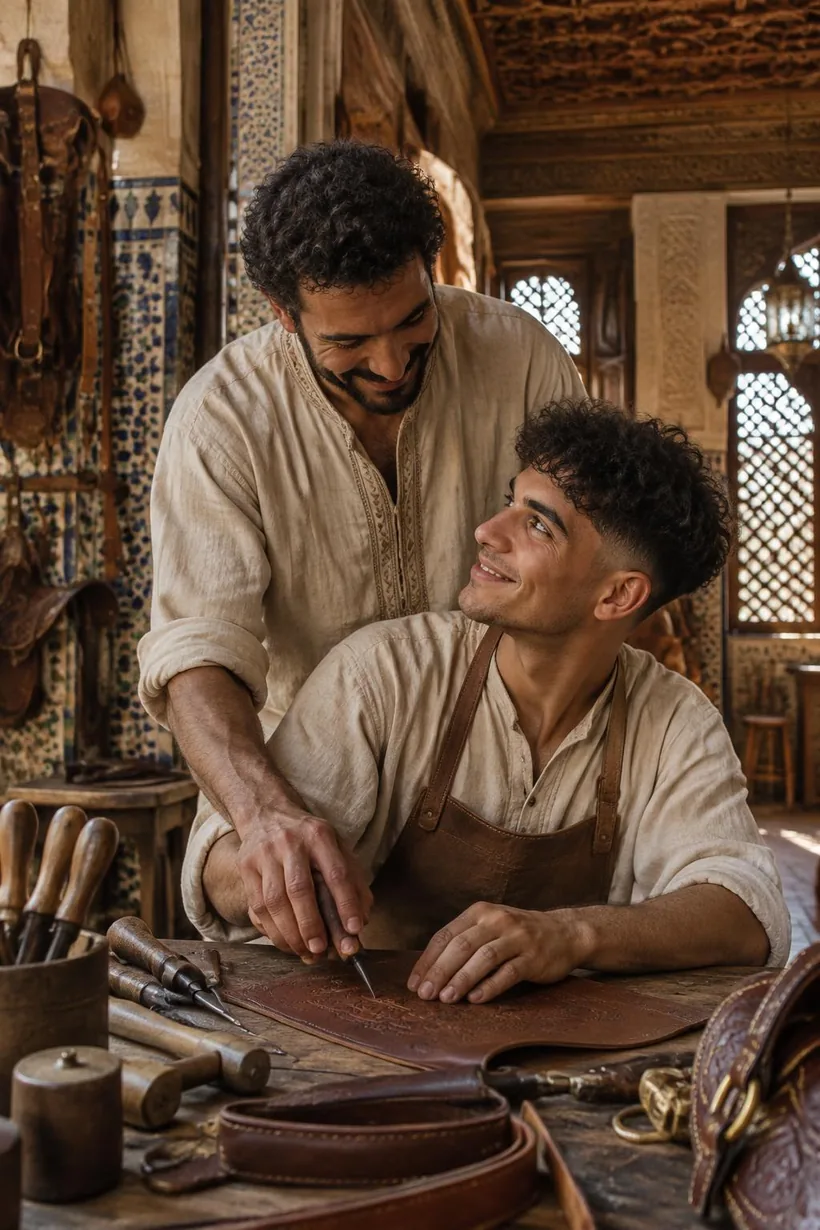
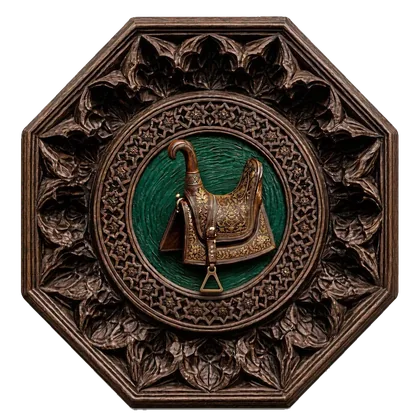
The ʿudda does not make itself: it comes from a workshop. It is the first the house opens — the saddlery, which gathers leather, wood and metal, and around which ten other trades work. A parade saddle is made of thirty-eight pieces and takes between six and twelve months.
The words of this page are in the common glossary; the works cited in the sources; the sister house is Al-Funduq aṣ-Ṣiqillī.