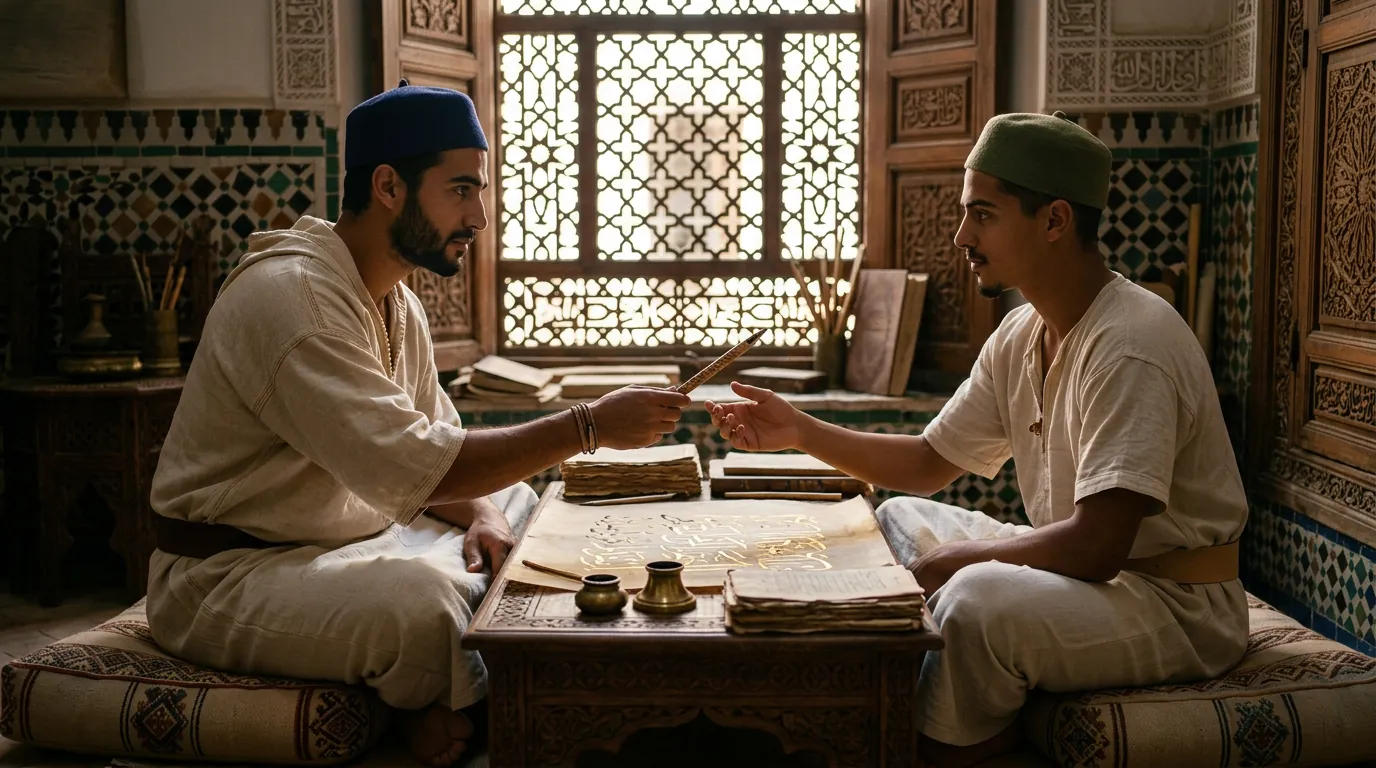

The chain of masters
A craft is known by those who taught it. Every master of the two houses leaves in writing from whom he learned, and from whom his master had learned: this is the chain that carries a gesture down to the present.
01Who did you learn from
Among craftsmen it is often the first question. The answer is a name, a workshop, a city, and it says more than a diploma, because it binds the hand that works to the hand that guided it. Written knowledge can be read in a book; the malaka, the disposition the hand acquires over years, passes only from one person to another, and carries with it the memory of its path.
02The model of the isnad
Arabic tradition knows this form well. Every saying of the Prophet comes with its isnād, the series of names of those who handed it on, one after another, back to the source; the brotherhoods keep their silsila, the succession of masters. In both cases the chain is the warrant: what is known is received together with those who delivered it. The two houses apply the same measure to the gesture of the craft.
03How it is gathered
Each master deposits his chain in the khizāna, the library of the house: from whom he learned, and from whom his master had learned, as far back as memory and documents go, with the places, the workshops and the years. When a journeyman becomes a master, the chain grows by one link.
What the master recounts is recorded as declared, with the date and the name of the person who gathered it. What a document confirms is recorded as attested: a workshop contract, a letter, a dated photograph, the word of another master. The two are always kept apart, as in the science of traditions, where a chain is worth what can be verified of it.
04What it is for
To know where what the house teaches comes from, and to say so to whoever asks. For the recognition of grades between the houses: the journeyman who moves from Fez to Ragusa takes his grade with him, and the chain that explains it. And for time: a written chain is completed when a new document confirms or corrects it, and it remains legible for those who come after.
05Names and faces
The chains are published with the names and faces of the masters. Whoever taught a craft deserves to be recognised, and whoever learned it bears that name with pride. Each master reviews his own entry, with his photograph, before it appears on this page; the original, with the documents, stays in the khizāna.
The first chain will be that of the first master of the saddlery, followed by those of the masters who will work with him and with the apprentices. They will be the first document of the khizāna.