Forming those who will lead
From two weeks to six months and more, the sons of ruling families live in the House as the young men of the community do: to forge character, not to become masters of the craft.
Who comes, and for how long
The House is meant first of all for those who want to make a trade of it. But on both shores the generations called to responsibilities of government, enterprise and patronage need a school they rarely find at home, and the House, which forms men through work, can offer it. Whoever asks may spend a stay of variable length, from two weeks to six months and sometimes longer.
It is a single formation of character, lived in two houses. The young men of the Arab ruling class undertake it at Riad Al-Uns, in Fez; the young men of the Western ruling class, in the fondachi, beginning with Al-Funduq as-Siqilli, in Sicily. The threshold and the language of the day change, not the rule nor the way of forming.
One enters as everyone else does: by name, on one’s own application, if one is of the age of the House and only if the House accepts, for it may refuse. No title, no expected office and no gift from the family gives a right to admission, to the length of the stay or to the outcome of the application. The name of those who support the House goes on the works, not on the persons.

What one does
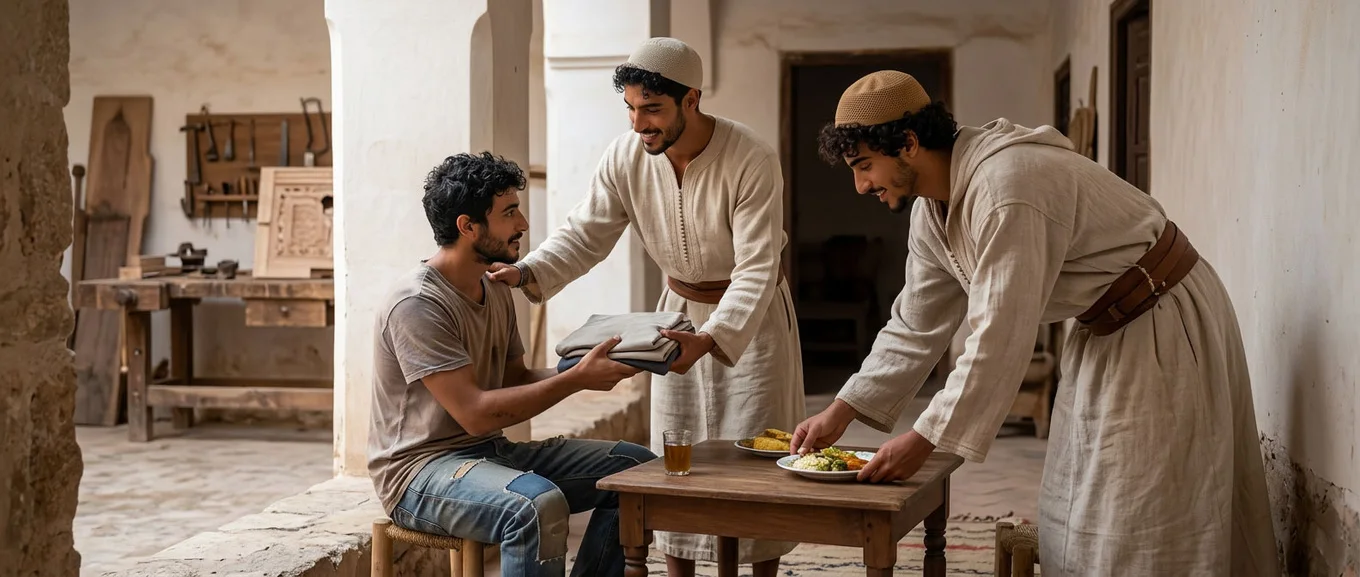
The trainee lives exactly as the young men of the community do, without being set on the path of the craft. He works at a bench beside a master, takes part in the House’s sport and in its choreographic and musical activities, sits at the common table and keeps the regular day of a resident. He is not a guest: he sleeps in the House’s dormitories, and not in Al-Munya, where the guest always remains a guest.
The aim is not mastery but character: what a man becomes when for months no one recognises a rank in him and the bench, which cannot be talked round, judges his work alone. In Fez the day includes prayer, and no companion sets himself up as judge of another’s faith; in Sicily the threshold is secular, and the rule stops at work, at the table and at common life.
Learning to obey in order to learn to command
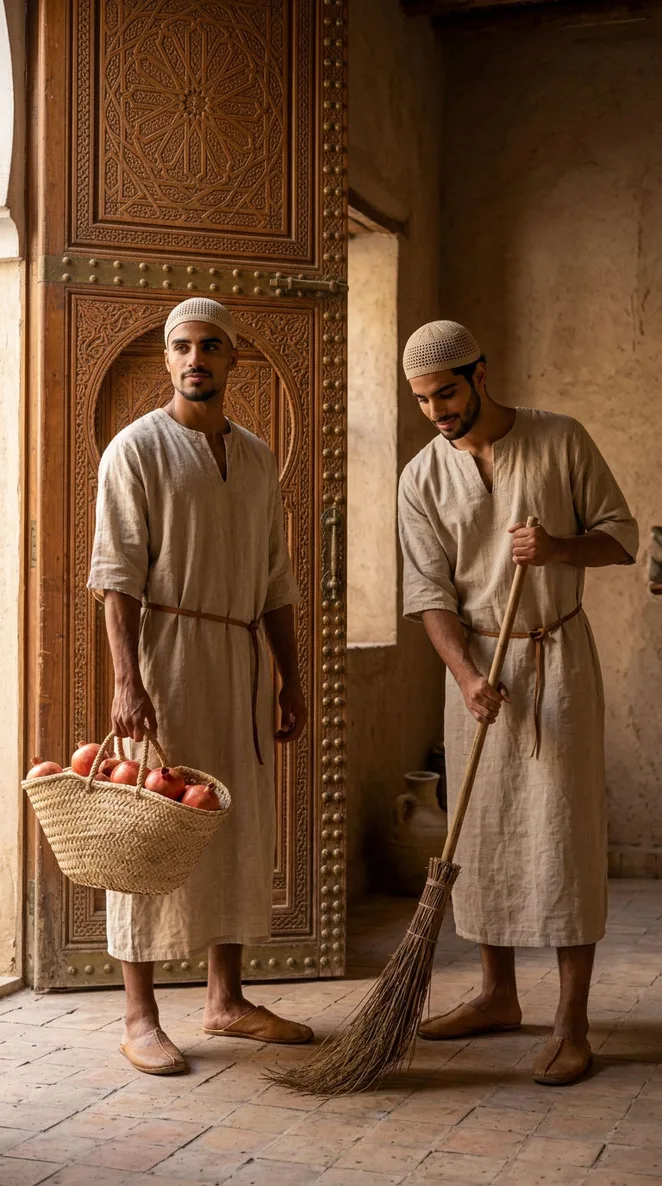
Whoever will be called to decide on the work of others learns more from the effort of doing a simple gesture well than from any discourse on work. This is why the trainee begins from below: he obeys, as all the companions obey, the master of the workshop. To learn to obey is to recognise the competence and the discipline of the work, not to give up one’s judgment: to accept the master’s guidance, to do the humble tasks as well, and to answer for one’s own work.
“It is well said that no one knows how to command who has not himself been under the command of another.”
Aristotle, Politics, III, 4, 1277b (our rendering)
The obedience of the House is neither that of age nor that of rank. The age gap between masters and apprentices is deliberately small: the masters are only a few years ahead of the apprentices, and the apprentice sees in his master what he may be in a few years, if he perseveres. Between men of neighbouring ages, authority has to be recognised in order to exist. One obeys a hand that knows what one’s own has yet to learn, and not a date of birth. That is what makes obedience bearable over time, and lets it be learned.
It has precise limits. At the bench the master commands the work, the tools, the timing and the quality; outside the workshop he is a companion further along in the craft, and has no authority over anyone’s faith, friendships or private life. The master is master of a craft, not of a life.
Command, moreover, turns. He who holds an office today obeys tomorrow the companion at his side, and the masters themselves perform, when the house requires it, the offices of the newest arrival. Each is entrusted with a real part of the work, so that he may find for himself that commanding presupposes, before all else, the capacity to obey: only he who has lived his subordination serenely is afterwards in a state to exercise command.
كُلُّكُمْ رَاعٍ وَكُلُّكُمْ مَسْؤُولٌ عَنْ رَعِيَّتِهِ، وَالرَّجُلُ رَاعٍ عَلَى أَهْلِ بَيْتِهِ وَهُوَ مَسْؤُولٌ عَنْهُمْ
“Each of you is a shepherd, and each of you is answerable for his flock; the man is the shepherd of his household, and is answerable for it.”
Prophetic tradition, al-Bukhārī, Ṣaḥīḥ, no. 893; Muslim, Ṣaḥīḥ, no. 1829
What he receives, and what he does not
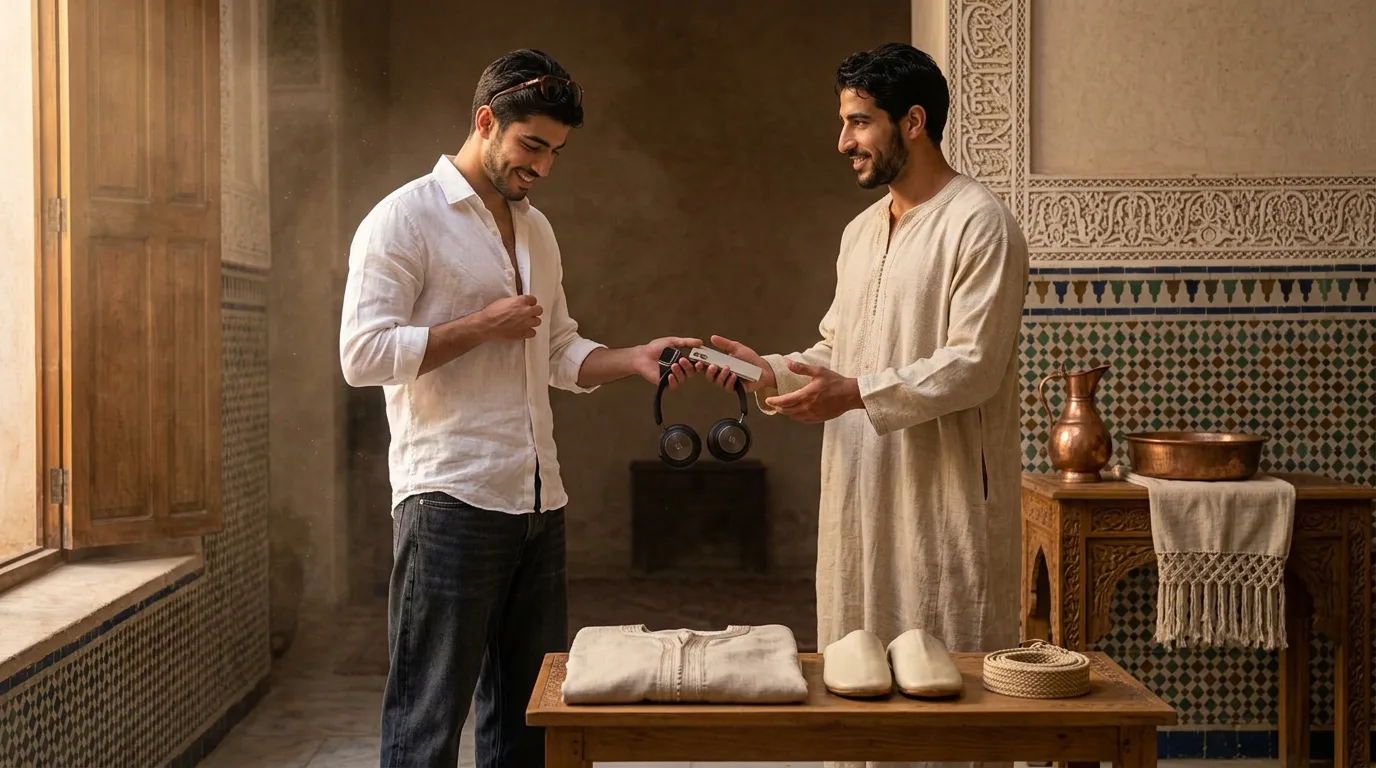
The trainee pays no fee: he is received as a poor man. The House gives him clothing, linen, a bed, his meals and even a wage, and the reason concerns money. The son of a well-off family often knows money only as what a credit card makes available everywhere, without the expense carrying any weight; whoever lives by his work knows that every purchase costs hours at the bench. With an apprentice’s wage the trainee measures what a man earns who works with his hands, and learns to manage what he has, to set a part of it aside and to square his wishes with his earnings, not with his family’s wealth: what almost all men learn from necessity, and what would otherwise have been missing in him.
When the young man leaves, he may decide to leave the money he has saved to the community or to a workshop. It is always an anonymous gift: no name goes with it, and the House recalls it neither to the giver nor to others.
A parent’s gift to the House gives a right to nothing: it neither shortens nor lengthens nor changes what the young man lives. Whoever supports the House sits at its table, when he comes, as a guest of Al-Munya, and lives apart from the life of the apprentices.
The stay in brief
- Length
- From two weeks to six months and more
- Who
- Young men of the age of the House, admitted by name
- Where
- The House’s dormitories, in Fez and in Sicily
- Fee
- None: clothing, bed, meals and a wage
- Aim
- Character, not the craft