The craftsman before the craft
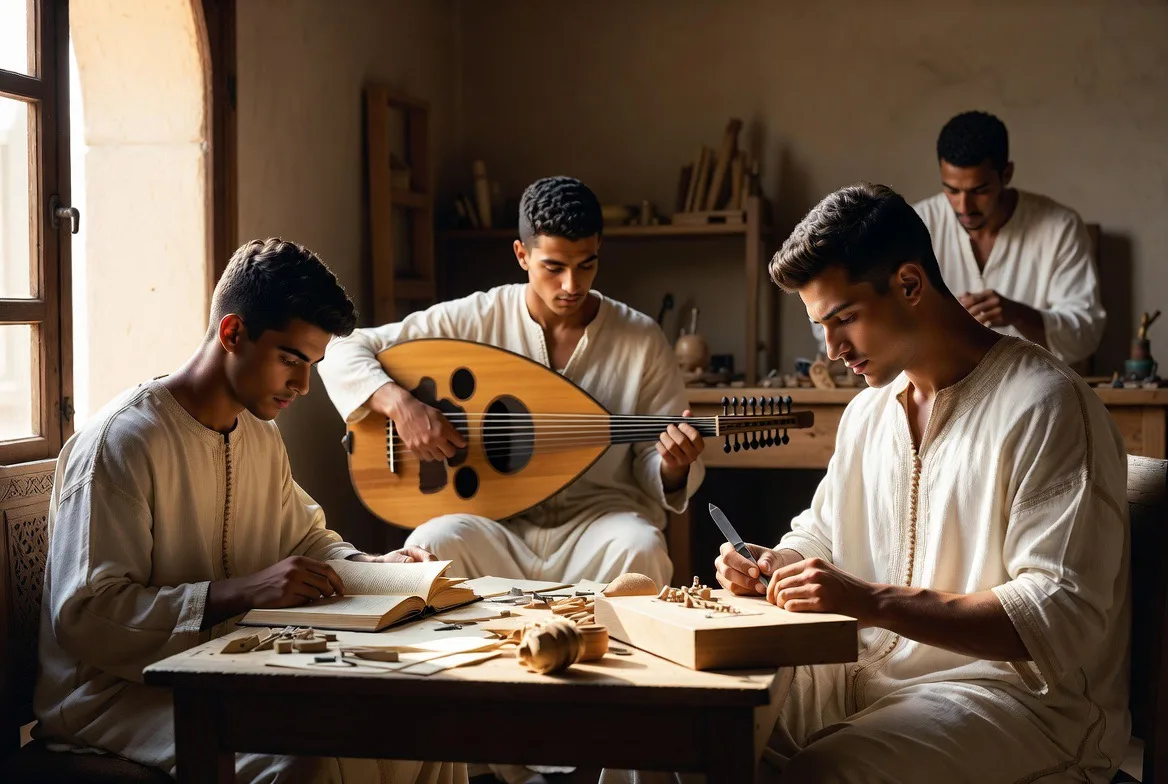
A craftsman’s life extends well beyond the technical and material side of his work. The master of a workshop dwells within an order of days, places and relationships that allows him to hand on what he knows to an apprentice, so that the apprentice may hand it on in turn; his time is measured by that handing on, and very little by the hours of someone who enters an office at eight and leaves it at four. On such a rhythm of life, more than on any syllabus, the continuity of knowledge has rested for centuries, along a line that runs from the past into the future.
The initiatives devoted so far to safeguarding the crafts have for the most part overlooked this dimension. They have funded courses and placements that closed as they had opened, leaving behind neither a living workshop nor a community able to renew itself. Al-Mithaq proposes a social experiment of another nature: a network of intentional communities, each with a character of its own, held together by a few shared principles.
The principles of the houses
Authority as service. It belongs to those who know the art and can hand it on, whatever their age. This is the old sense of auctoritas, from augere, to increase: authority belongs to whoever makes others grow, and he exercises it in a spirit of service.
A short distance between generations. Pupils are between eighteen and twenty-four, masters between twenty-three and twenty-eight. The master walked the same road a few years earlier, and the apprentice recognises in him a goal near at hand.

A community that governs itself. The residents elect, for a fixed term, those who lead the house; the weightiest decisions go to the vote of the whole community.

Only two conditions in the craft. One enters as an apprentice and becomes a master through a piece judged by those who know the craft.
The arts of the body and the voice. Beside the arts of the hand, qualified masters hand down sporting, dance and musical disciplines, themselves threatened with disappearance, so that training reaches the whole man.
Common life. Table, work and service are shared; each answers for his duties to the community and keeps faith with his word.
The forming of character. For periods of two weeks to six months and more, the houses will also receive young men from ruling families, Arab ones in Fez and Western ones in the fondouks. They will live as the young men of the community do, with no fee and no privilege, to form their character and not to become masters.

Continuity beyond the house. A revolving fund lends without interest to the new master who opens a workshop, and every master undertakes to teach in his turn.
Solidarity among artisans. The houses will be able to receive masters from countries struck by war, so that they may carry on their craft and hand it on to local young men; a glass workshop will be born for this purpose too.
A register and a network. The Dīwān al-Ṣanāʾiʿ documents the regional variants of each craft; the network brings craftsmen new commissions and recognises them as masters as well as producers.
The climate of the house. The houses will adopt the natural cooling and heating systems of traditional dwellings (the courtyard and shade, water, the mass of the walls, ventilation) and will measure their performance, to curb energy use in line with research on traditional and bioclimatic architecture.
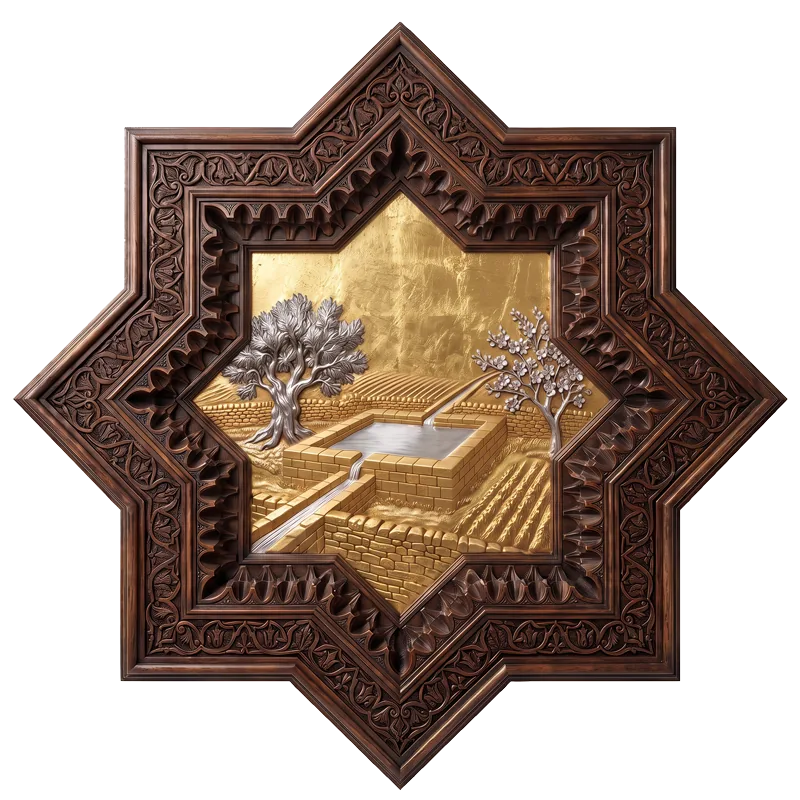
The land. In the garden of the medina as in the fields of the fondouks, permaculture will be tried out, inspired by the Arab and Moroccan agronomic tradition or taking up some of its elements to show their relevance today, together with the keeping of poultry and, where the land allows, other livestock.
The house in its neighbourhood. In each house, beginning with the Riad in the medina of Fez, the craftsmen of the restoration will be chosen together with the local community, and the outward-facing spaces will open to events, concerts and gatherings, so that neighbours and residents come to know and esteem one another.
These principles do not seek to reproduce the past. We take them up in the light of accumulated experience and in the awareness of a profoundly changed world, keeping their spirit rather than their letter. The project seeks to restore life to the dwellings and institutions that allowed communities of craftsmen, yesterday as today, to rediscover the meaning of common life, of shared responsibility, of an authority lived by the one who commands as much as by the one who obeys, of respect for the given word. None of this implies renouncing technology and progress, nor keeping watch over the ruins of the past.
The arts of the Mediterranean share a common root, inflected in different forms from one shore to the other, and some of these variants are disappearing. To secure their continuity, the bond between master and apprentice must be restored within a complete ecosystem, one that protects the craftsman and his way of life even before what he makes.
This wholeness will take different forms in different places. In Fez it will include the religious dimension; in the fondouks, a secular framework that makes living together possible, after the example of the medieval fondouks of the West, where dialogue rested on respect and mutual knowledge. The dialogue the houses aspire to proceeds from the deepening of differences, which lets each person know his own and those of others better, rather than from their erasure.
Whoever supports the project, patron or institution, will take part in an experience that touches the very form of patronage. An arrangement of this kind has never been tried as a whole: it gathers, bringing it up to date, a legacy of vernacular experience, in common life as in the institutions that made it possible, and submits it to the test of real conditions.
Such an ecosystem requires a legal and financial arrangement able to ensure that it lasts: an independent custody of the property and other non-profit bodies, each with a defined task. Only in this way can Fez, and the cities of the fondouks, be given back a sound economic model, faithful to its roots and turned towards the future. The sections that follow set out its design: the model, the bodies and their form, the thresholds of the start, the studies that will accompany it.