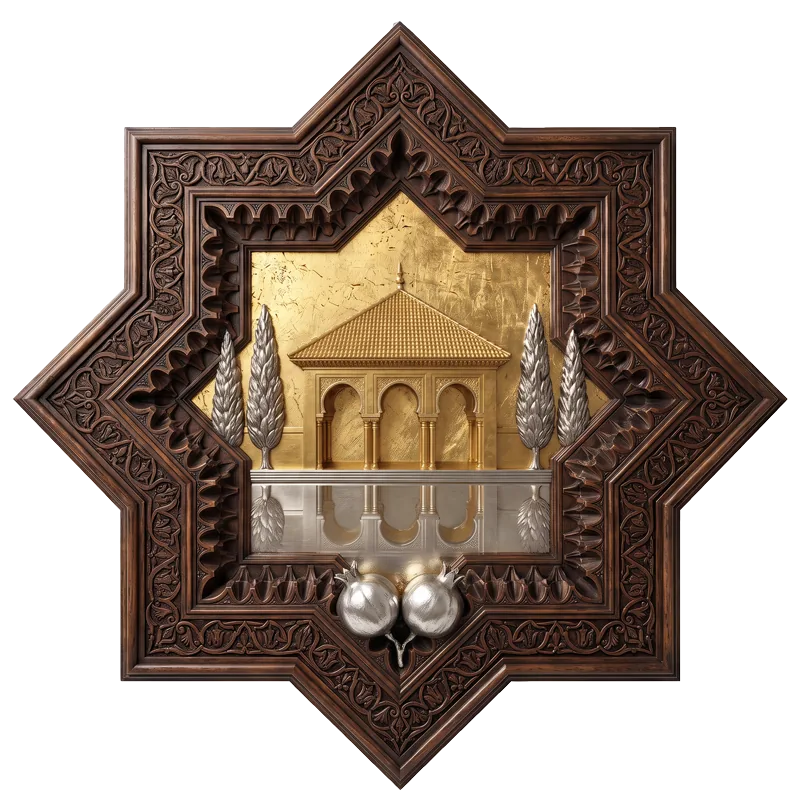
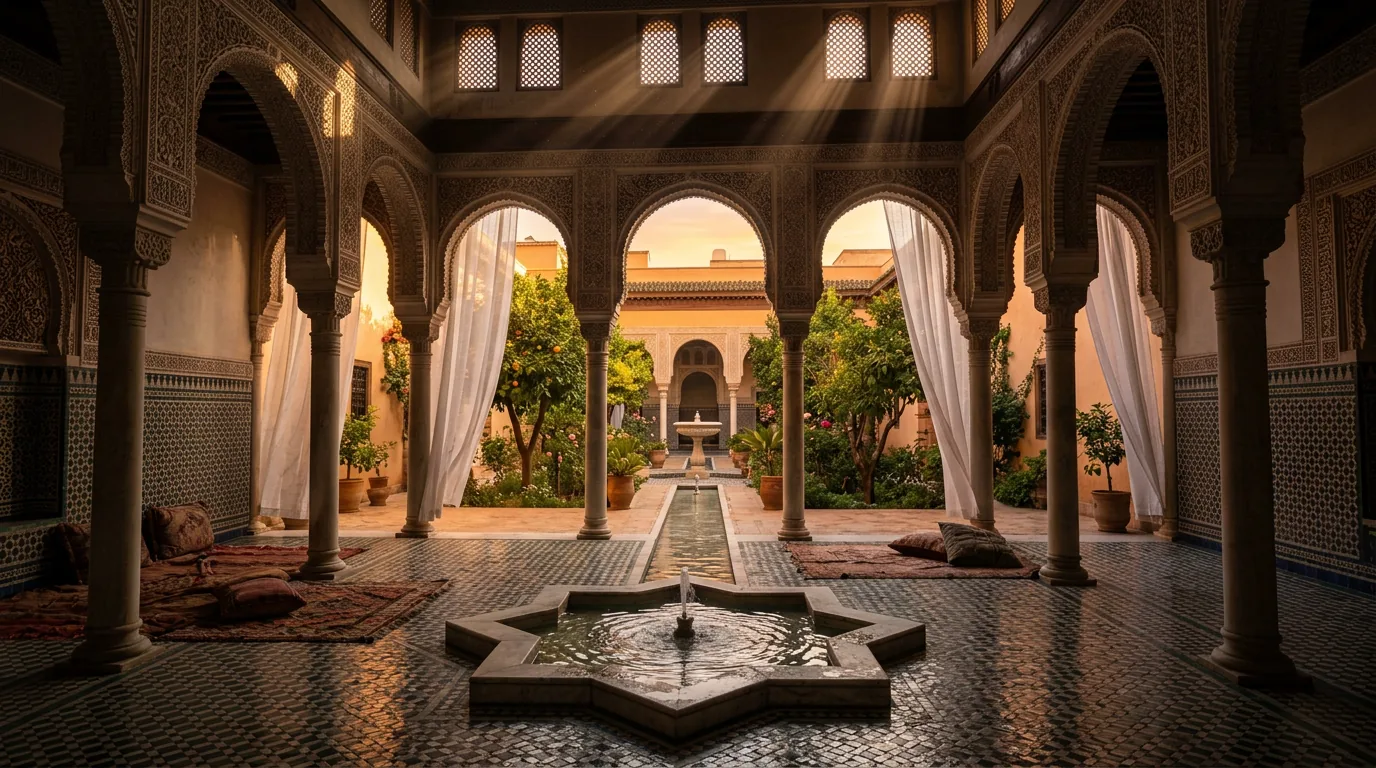
Al-Munya in Fez — Riad Al-Uns
Al-Munya is the body in Fez, beside the Riad Al-Uns. Dar al-Asl lodges without charge the guests of the House (costs on the company); Dar al-Diyafa lodges the nudamāʾ and their guests (proceeds to the company). An-Nudama gathers the ninety-nine founders.
Fez · Riad Al-Uns
المُنية
The name is not an ornament. In al-Andalus and in the Maghreb the munya was a villa of retreat: garden, water, shade, chosen company. A house away from the noise, and yet wholly a house.
Al-Munya will be a private house, wall to wall with the Riad Al-Uns. It will be a separate building, with its own entrance, its own patrimony and its own responsibility, but with the same crest and the same vision.
It is not an extension of the house of formation. It is not a hotel. It is not a club. It is not an open place.
An-Nudama, its founders, form a closed company, entered by co-optation alone.
The two houses will have entirely separate entrances, kitchens, staff and circulations. A single door in the common wall, which opens only from the side of the Riad.
Living in beauty, when it is not staged, already educates the eye and the body. The quality of the light, the weight of a cloth, the proportion of a patio, an old object that was not produced for you and that cannot be taken away: all this precedes discourse.
The spaces
The house
Few spaces, generous, ordered. Each answers to a precise use. Nothing is thought for accumulation or for display.
One does not enter a munya as one enters a hall. One is received, by degrees.
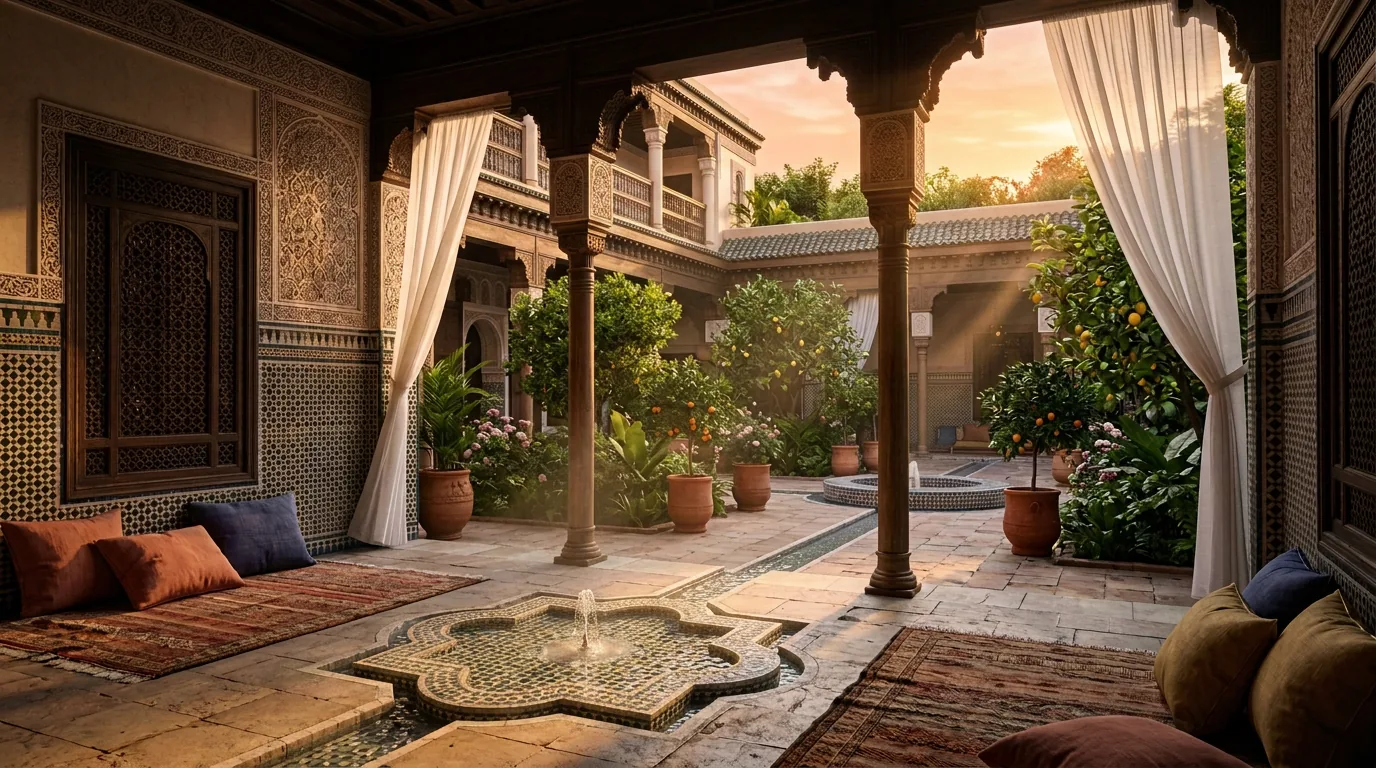
Threshold
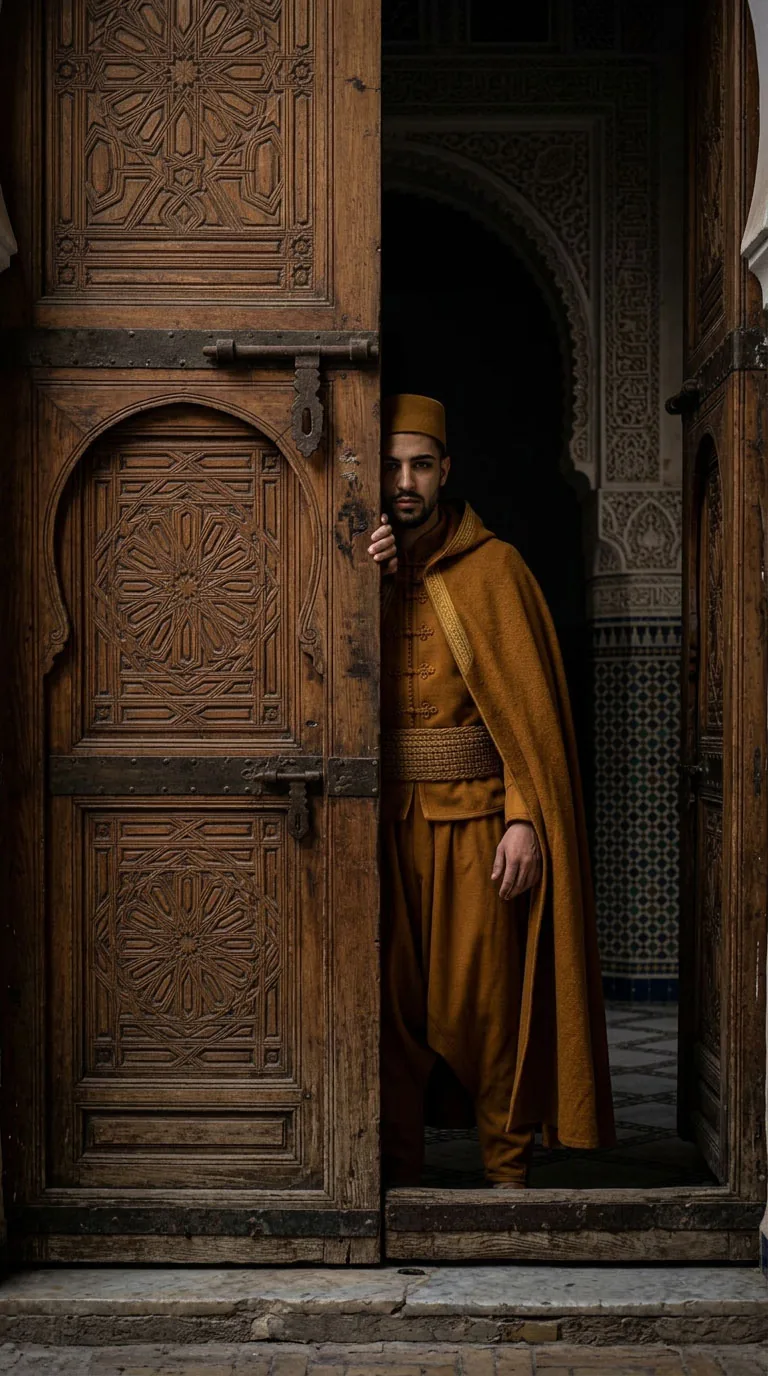
Sqifa Entrance vestibule. He who crosses the door does not yet see. The intimacy of the house is guarded before it is offered.
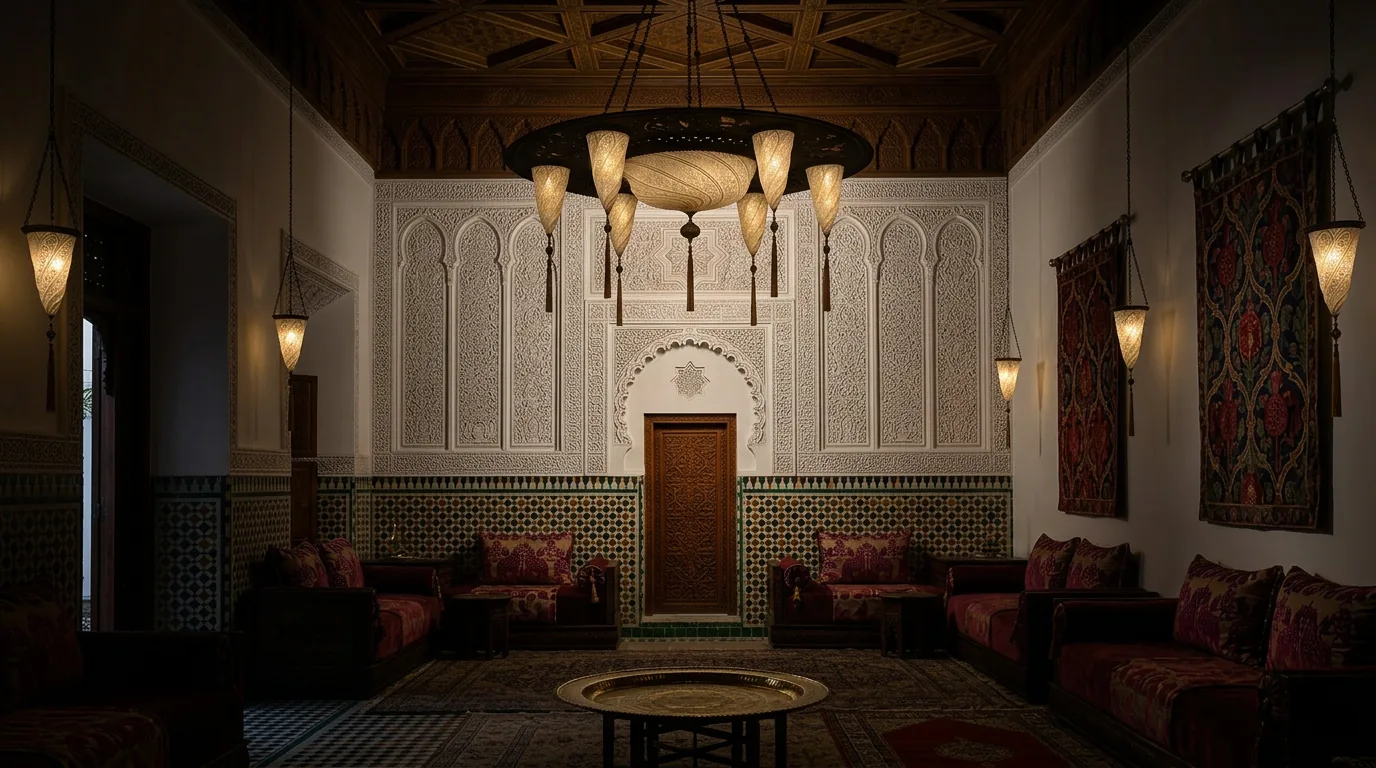
Parlour First reception, distinct from any space of the Riad. Here one sits before being admitted further.
Heart
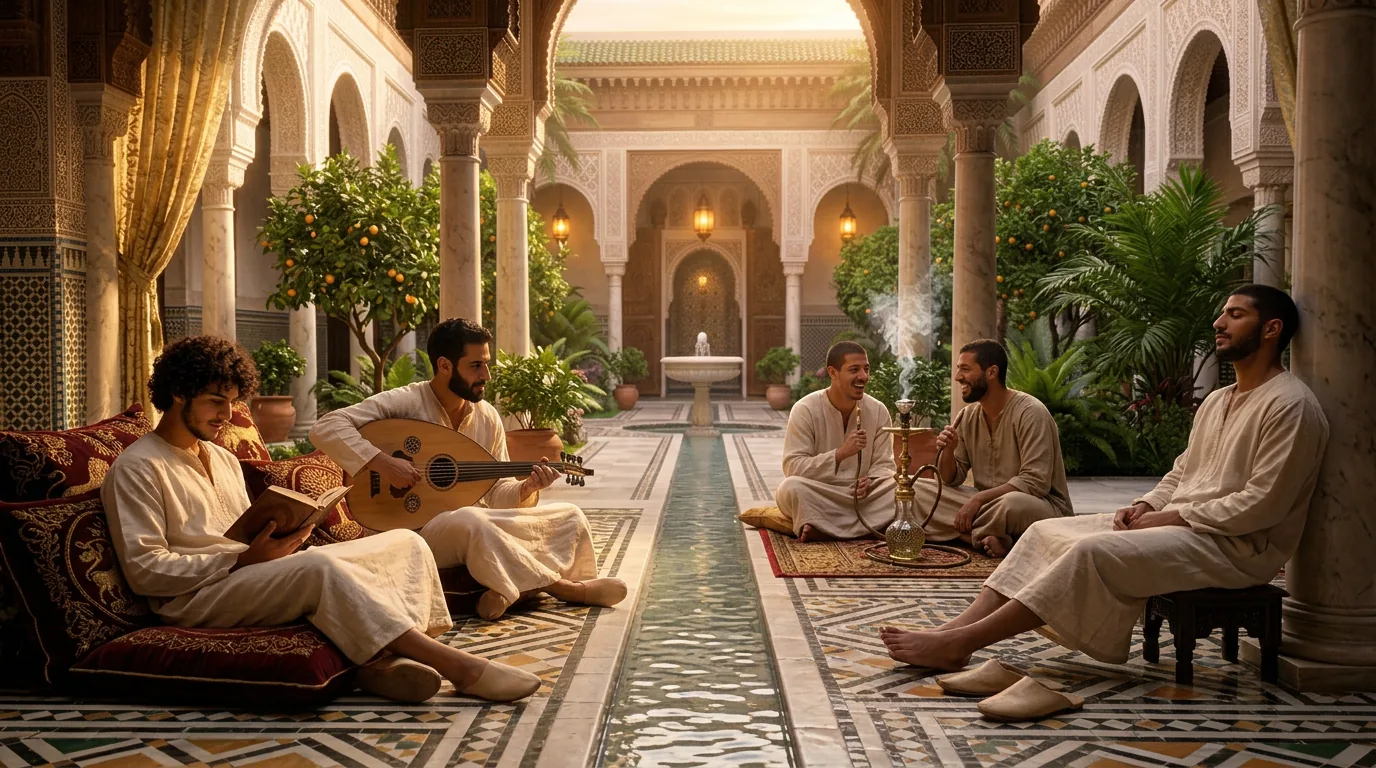
Patio with porticoes and hall The centre, and the motif of the name. Porticoed patio and great hall that opens directly onto it. A place of presence and of shared silence.
Garden Water, shade, scents. Not a décor: the continuity of the patio toward the sky.
Oratory Oriented space of prayer, looking onto the patio and the garden.
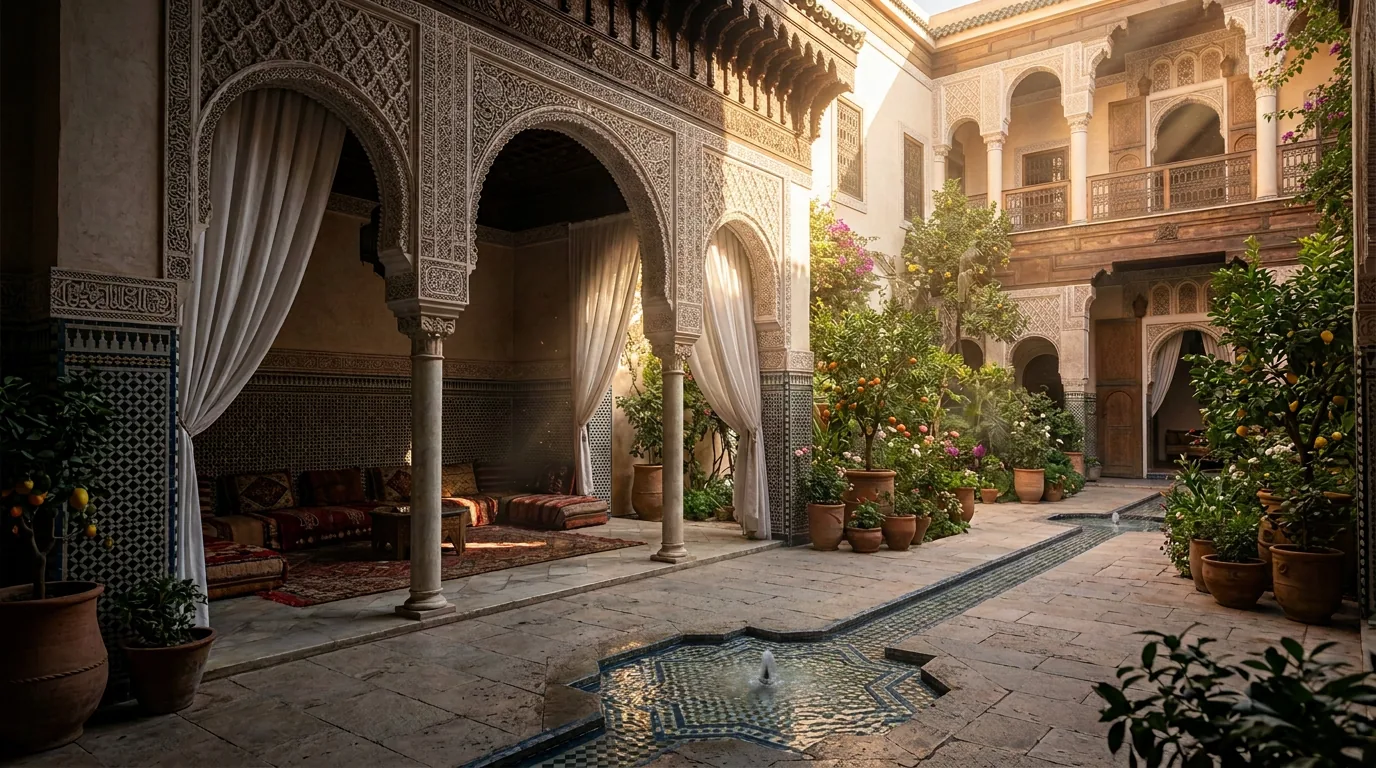
Permanence
Guest apartments Private rooms with their own bathroom. Contained number.
Apartment of honour Unit of higher rank and of greater generosity of space — the rank of the room, not of who occupies it.
Salon A closed room for conversation, onto the patio.
Service
Dining room With a complete autonomous kitchen, entirely separate from that of the Riad.
Service quarters Accessible only to the staff of the Munya.
Discreet store For valuable textiles, pieces in deposit and objects that must not remain on display.
Threshold
The rule
The number is closed. Access is by co-optation alone. What is said here remains here.
The rule precedes the guest. It is not negotiated upon arrival. One does not relax it to accommodate.
The guest is received. He acquires no right over the life of the neighbouring house. Crossing the common door, if it happens, remains a gesture of those who live there — never a prerogative of the guest.
Beside, in the Riad, it is the men of the house who look. The ṣāniʿ, the nāʾib, the maʿallem, the muqaddam, the shaykh: each, at his degree, holds the measure. They do not judge according to wealth. They judge the man.
At their table, during an archery trial, on a ride in the desert, no one wears his origin on his face. One does not know whether the one sitting beside him is a young man received by hospitality or the son of a house that could buy the medina. The rule is the same. The gaze is the same.
One does not enter by what one has. One is looked at for what one is.
Work
The furnishings
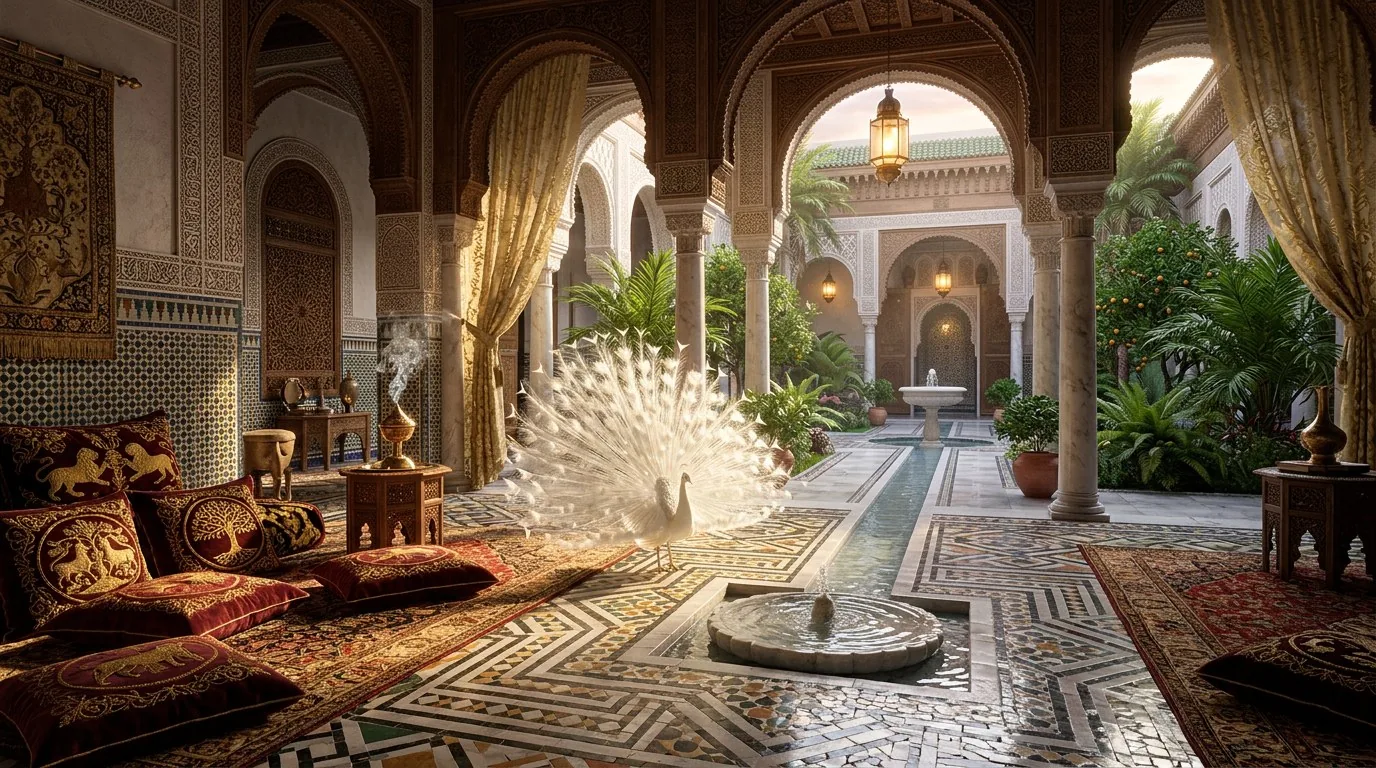
The Munya is not furnished once and for all by a decorator. It is clothed, over time, by the work of the neighbouring house.
The motifs that will return on the walls and the textiles have nothing of an importation. They belong to a repertoire that has already made the journey — from the Islamic Mediterranean toward Venice — and that returns. Few pieces. Few colours. Matte surfaces. Nothing that has not already accomplished the going.
To support this house is to commission a gesture. In the same city, by the same hand. A hanging, a light, a piece of woodwork.
The workshops of Dar al-Hiraf and the corporations of Fez will progressively supply textiles, stuccoes, ceramics, wood, metal and light. The craft thus has a commissioner before it has a market.
Before the eyes remain also, if any are found, a few old objects that were not produced for the guest and that he cannot acquire. They are neither collection nor museum. They are a model — and a warning.
The door does not open by itself. When it opens, it is a man who enters, under the same measure as the others, his rank left outside. The work of the workshops, by contrast, passes every day: it clothes the house.
Correspondence
Every request is examined with discretion. No answer is due.
The two houses within the Munya
Al-Munya is the body, here in Fez as in Sicily: its own entrance, the same crest, a distinct subject. Inside, Dar al-Asl lodges without charge the guests of the House; Dar al-Diyafa lodges the nudamāʾ and their guests.
The settings change, not the names nor the functions. A stay at Dar al-Diyafa confers no title over the common life of the House. Apprentices on trial sleep in the dormitories of the House, never in Al-Munya.
The Sicilian house is Al-Funduq aṣ-Ṣiqillī, here in the portal.
The words of this page are in the common glossary; the works cited in the sources; the houses of the charter are Riyāḍ al-Uns and Al-Funduq aṣ-Ṣiqillī.