Al-Munya
The house beside the Riad: a distinct body, with its own entrance and the same crest. Inside, two houses and two rules.
Beside the Riad stands Al-Munya: a distinct body, with its own entrance and its own patrimony. It bears the same crest in Fez and in Sicily, and does not change its name with the place.
It is the house where those the House receives are lodged, and not a wing of the Riad: inside there are two houses, Dar al-Asl and Dar al-Diyafa.
A single shared wall, and a door that opens only from the Riad’s side.
The two houses, inside
Inside Al-Munya there are two houses, and two rules.
Dar al-Asl دار الأصل
“The house of the origin”. It lodges the guests of the House without charge: the costs stay with the company that holds the body.
No tariff, no price list, no right acquired by a subscription.
Whoever is received here is received because the house decides it, never because he has paid.
Dar al-Diyafa دار الضيافة
“The house of hospitality”. The nudamāʾ and their guests lodge here and pay their share; the proceeds go to the company.
Entry is by request, and a request may be refused.
The price of a stay is high, and it is not the criterion of access.
An-Nudama, the company of the founders
An-Nudama (الندماء) designates the ninety-nine founders and the independent fund destined to finance the Riad. It is not a house and has no lodging of its own: when a nadīm stays, he stays at Dar al-Diyafa and pays his share like anyone else.
An-Nudama is the company of the founders; its members, when they stay, are paying guests of Dār al-Diyāfa. It confers no right of admission to the House and no voice in its deliberations: those belong to the majlis al-umanāʾ of the house of formation, which is another thing.
The separation is deliberate, and not an accounting nicety: it prevents a hospitality from becoming a privilege of members.
What binds the two houses
Al-Munya pays the House a fixed annual sum, never a percentage of takings. The House does not depend on the fortunes of the house next door, and the house next door acquires, by paying, no title over the House.
The Riad is to be constituted as ḥubus, or in the nearest form the law of the Kingdom allows: the property cannot be sold or inherited, and its fruits remain assigned to formation.
Restoration protects the walls; the ḥubus protects the vocation: the house cannot become a hospitality establishment.
What does not change for the House
Apprentices never lodge in Al-Munya: during the probation period the young men lodge in the dormitories where everyone else sleeps. Dar al-Asl is not a wing of formation and does not double the dormitories of the house next door.
The guest of Al-Munya takes his meals at Al-Munya, unless invited, by exception, to the table of the House.
The futuwwa
What binds the two houses is a rule of character, far more than comfort.
The futuwwa — companionship, honour, service — forms the man first. It does not raise a man according to his means. It lowers what the world takes for a measure.
The young man received without means is raised: he is given a craft, a discipline, a place at the table. The man of means is received at the same table, in the same dress, in the same gesture. What is taken from him is the right to pay in order to be looked at.
One learns to deserve what he is given. The other learns to serve. Neither enters by what he has.
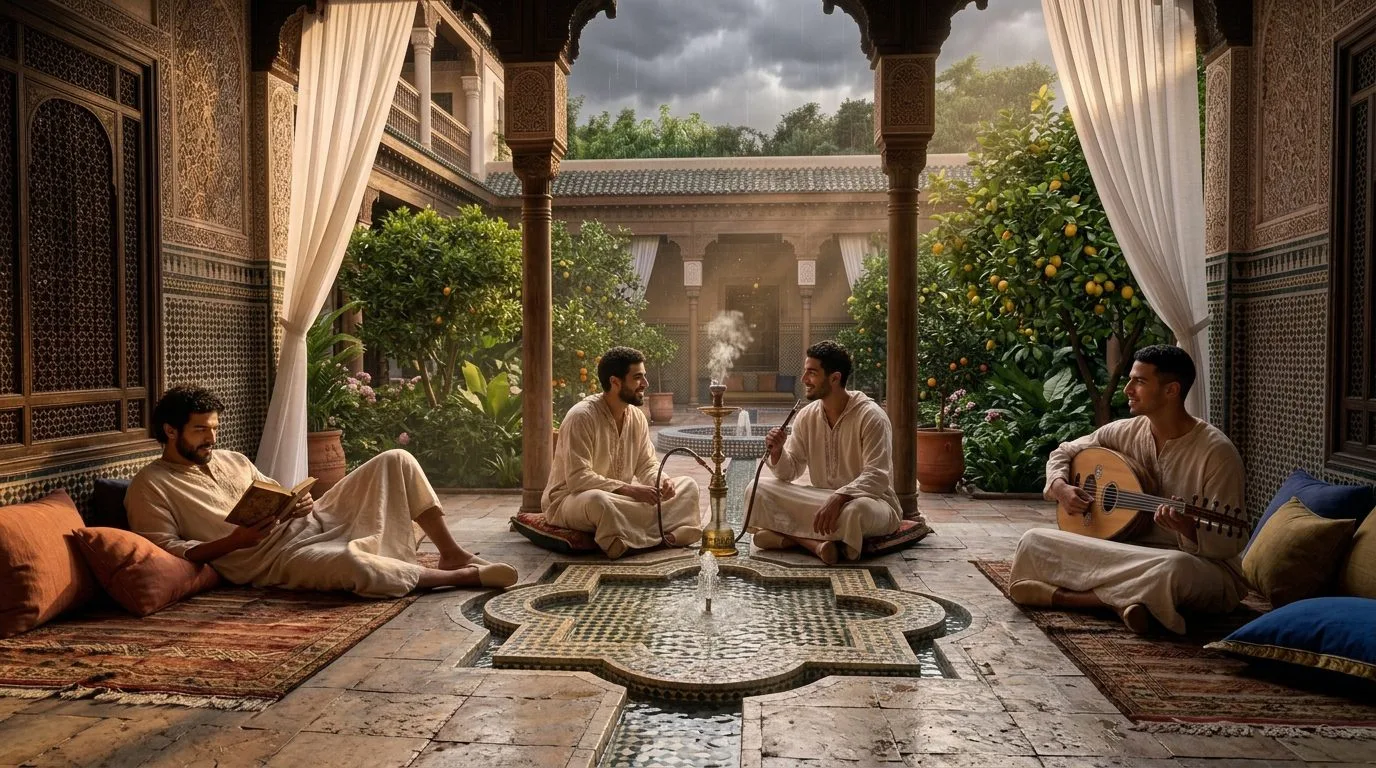
They wear the same qamīṣ of unbleached linen, eat at the same table, work in the same atelier, pray at the same hour and sleep in the same dormitory. The first finds there the means to redeem a past of humiliations; the second learns humility, and to obey before he commands, in a house where his fortune buys him nothing.
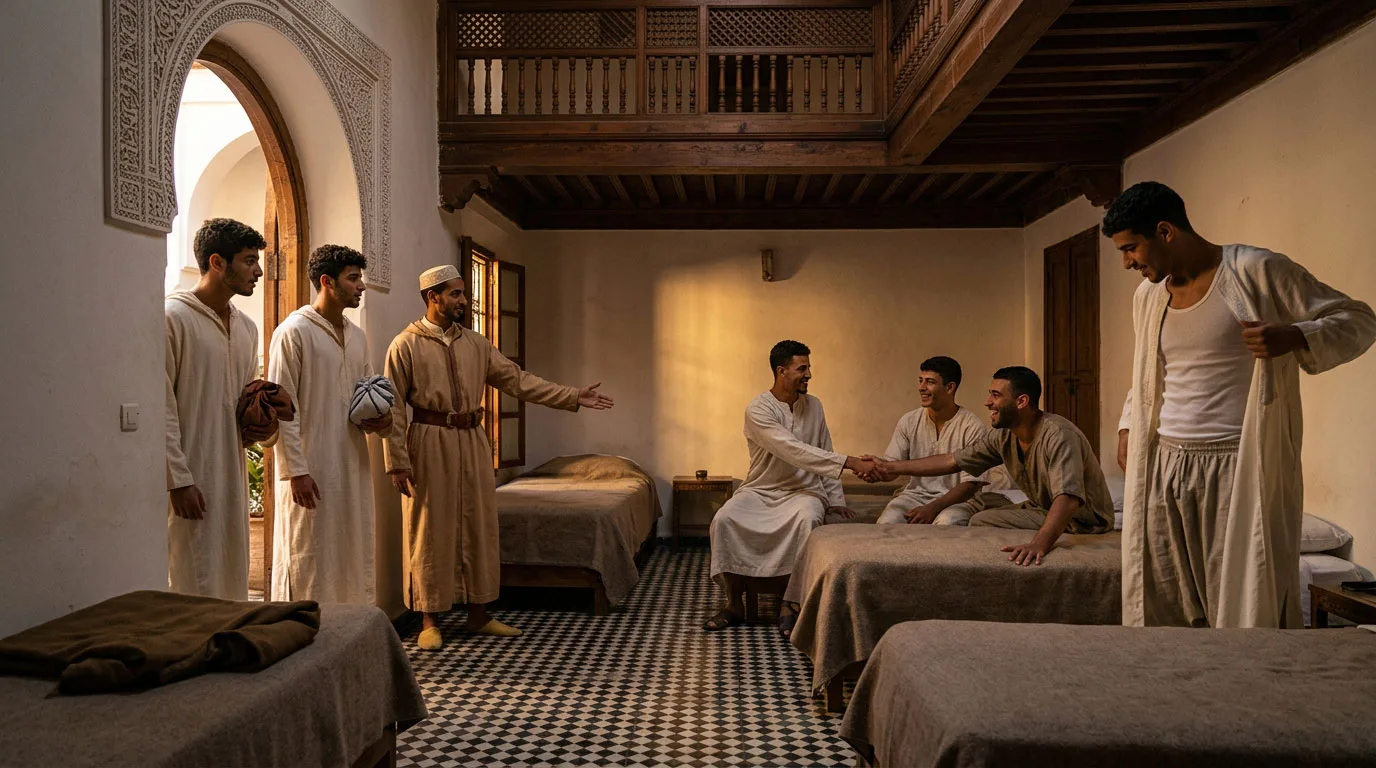
At their table, at a trial of archery, in the garden or in the kitchen, no one wears his origin on his face. The regard is the same.
The guest of the Munya acquires no right over the life of the Riad. A possible passage remains a gesture of those who live there — never a prerogative of money.
→ The futuwwa
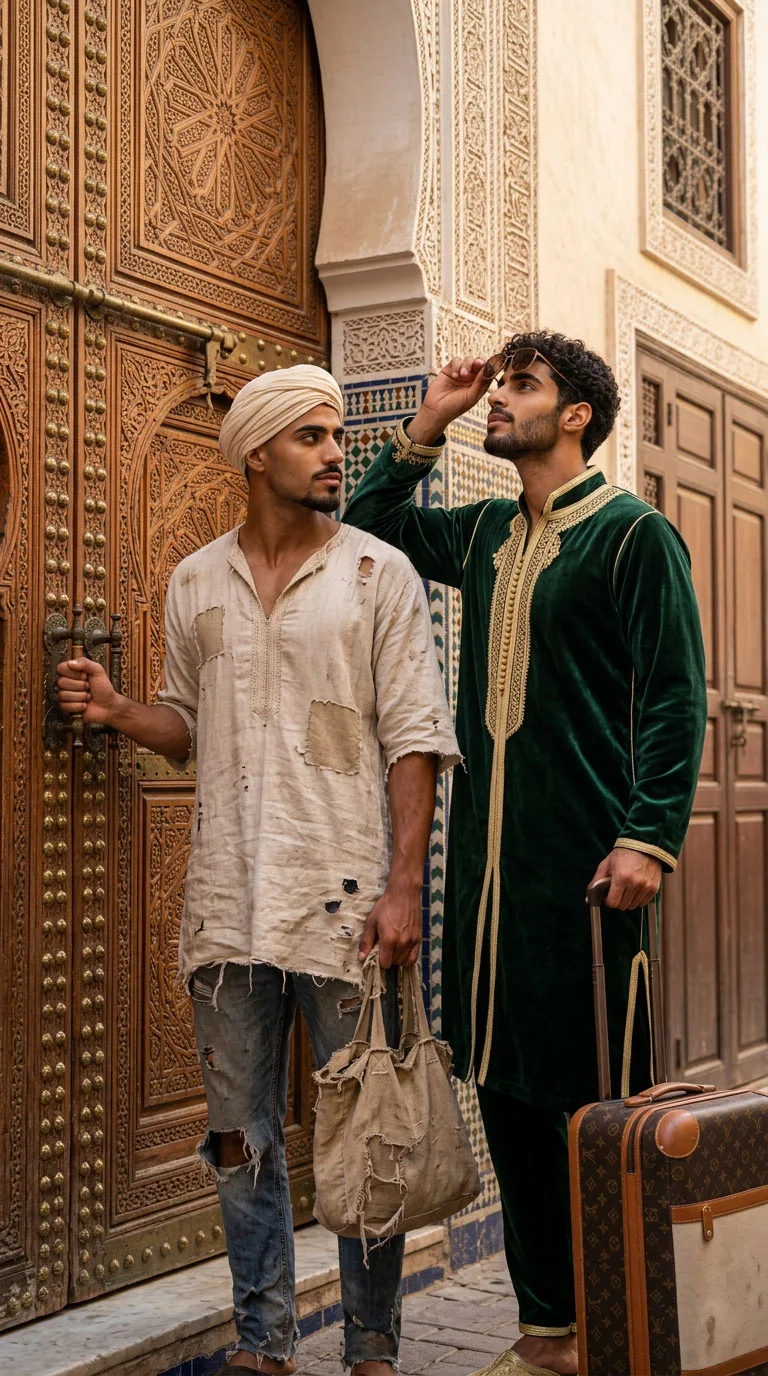
At the door
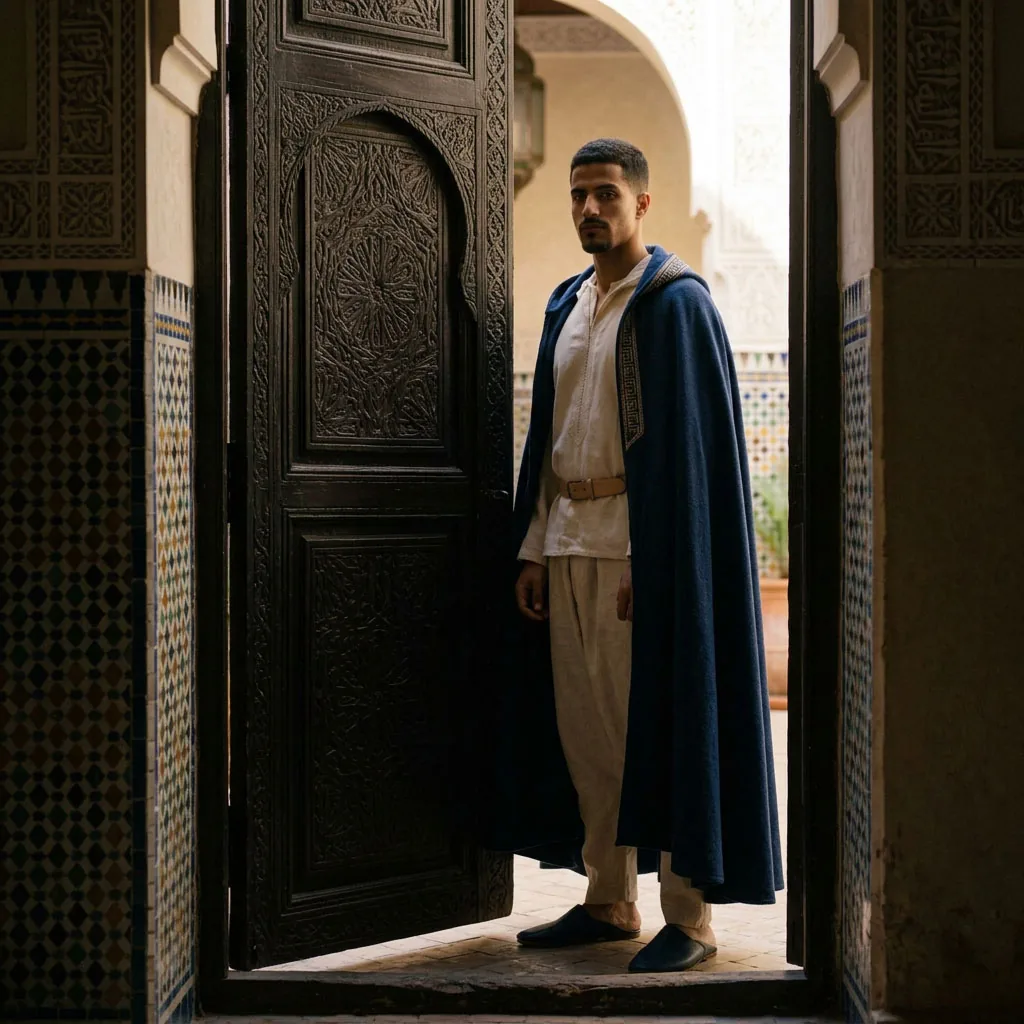
Outside, the world still reads the signs. The clothing, the luggage, the bearing.
One has nothing to show. The other arrives laden with signs.
The door receives them one after the other, in the same silence.
Outside, the world still reads the signs. The door does not read them.
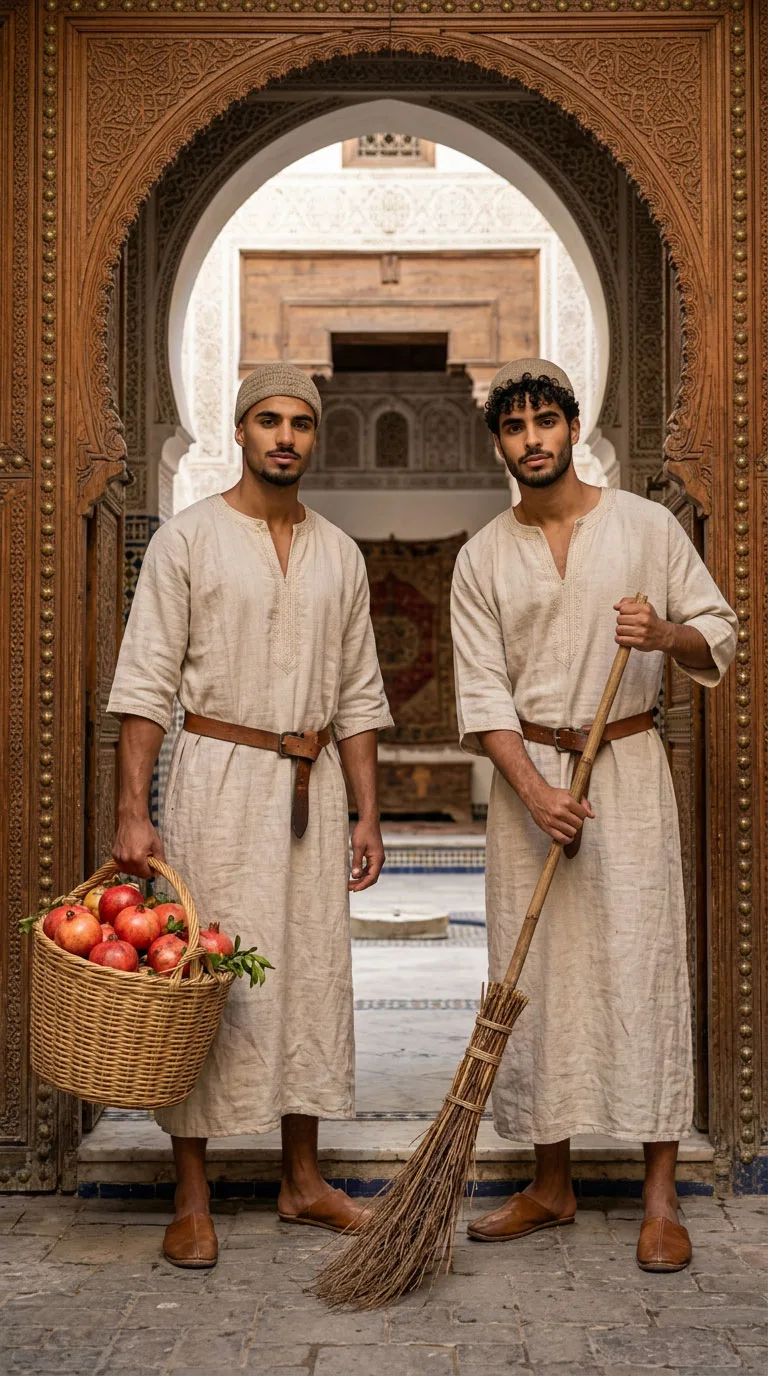
In the house
Once admitted, the difference disappears.
One may be invited to a trial of archery or to a night dance. If there is work to be done in the kitchen or the garden, the guests are the first to learn.
The man who paid outside learns to carry water. The man who had nothing learns that he is looked at like the others.
Once the threshold is crossed, there is no longer the rich man and the poor man. There are only men under the same regard.
FEZ
The chain of the medina
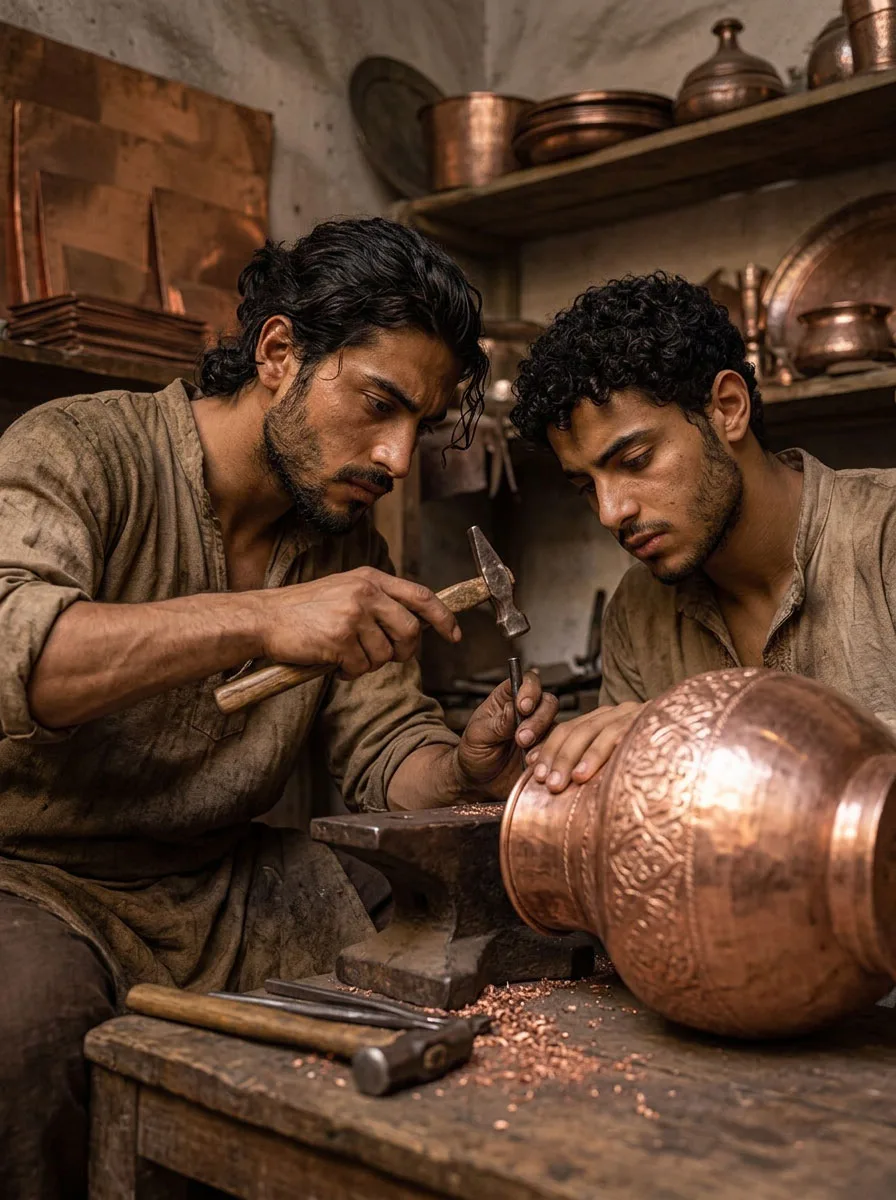
Fez gives the two houses their city: the one where the chain of the crafts still has a name, a quarter, an amīn — and where that chain breaks faster than it is rebuilt.
Dar al-Hiraf occupies one link of that chain: long enough for a malaka to be born. The Munya speaks the same material language. Its plasterwork, its wood, its cloth will come, in time, from the same workshops.
To support the complex is to commission a gesture in Fez. The craft has a commissioner before it has a market. This holds for the plaster and the wood — and, in due time, for the saddle leather and the metal of the fittings, where the furūsiyya reaches the workshop.
THE THRESHOLD OF THE RIAD
Another path
The guest of the Munya does not enter the Riad by the same gesture. The path of the Riad — reading, writing, the exchange, the short stay, the craft immersion or the residential path — remains distinct from the invitation to the house next door.
الرِّياضُ لِأَهْلِهِ، لَا أَهْلُهُ لِلرِّياضِ
The project·Futuwwa
The words of this page are in the common glossary; the works cited in the sources; the sister house is Al-Funduq aṣ-Ṣiqillī.